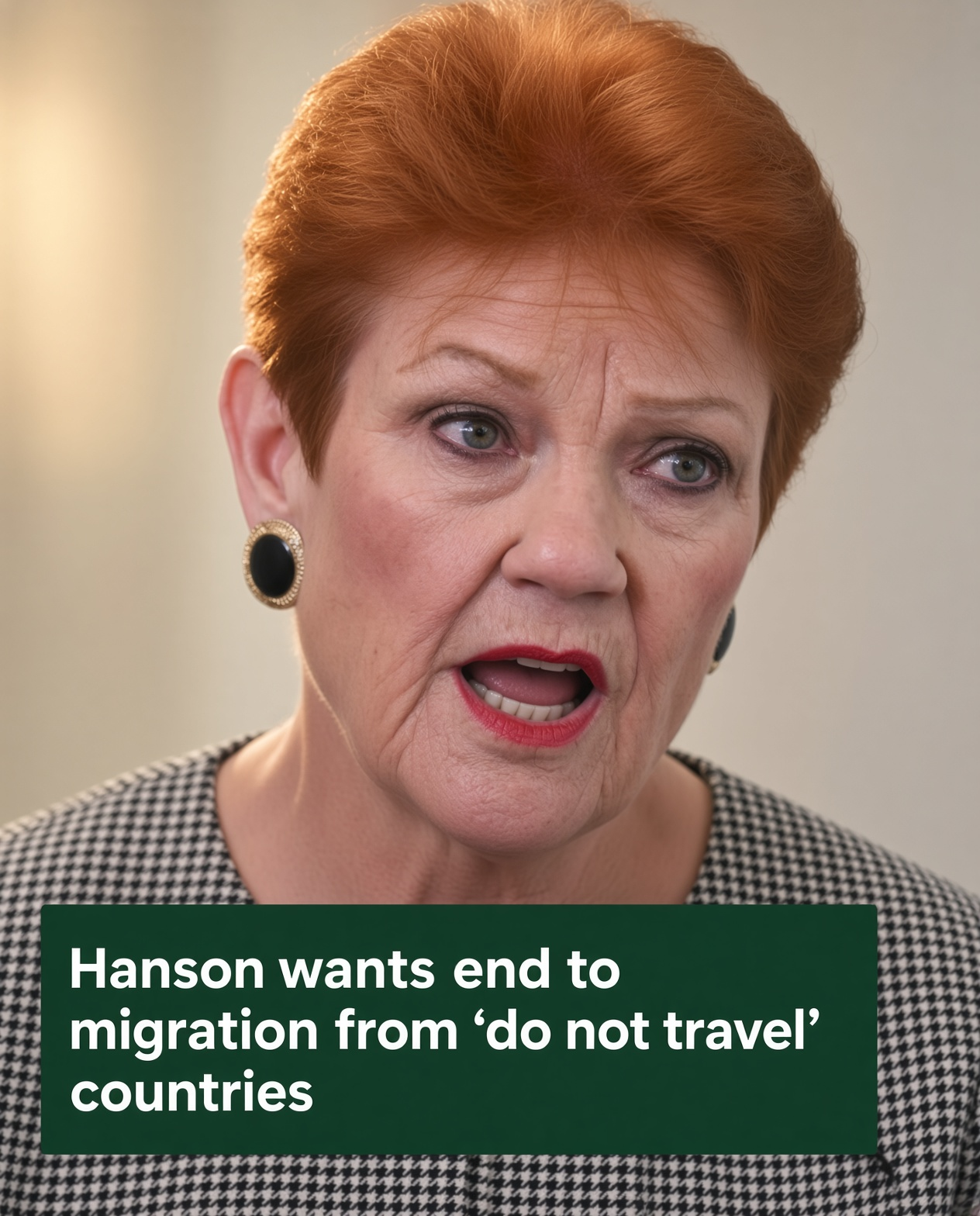
Pauline Hanson is calling for Australia to stop ordinary migration from countries considered too dangerous for Australians to visit, opening a new front in the rapidly escalating national battle over immigration and security.
The One Nation leader wants the federal government to use Australia’s own overseas security assessments when deciding whether migrants from high-risk countries should continue to receive visas.
Her argument is deliberately simple: if the Department of Foreign Affairs and Trade warns Australians that travelling to a country exposes them to an unacceptable risk of terrorism, armed conflict or serious violence, why should ordinary migration from that country continue without additional restrictions?
“If the government warns Australians not to go to a country because of extreme security and terrorism risks, the federal government should not continue accepting ordinary migration from that country on a business-as-usual basis,” Hanson said.
Hanson wants Australia’s travel warnings linked to migration
Australia’s Smartraveller system provides official government advice for Australians travelling overseas.
DFAT assigns destinations one of four overall advice levels, ranging from “Exercise normal safety precautions” through to the most serious warning: “Do not travel”.
Countries can receive the highest warning for different reasons.
They can include terrorism, war, armed conflict, kidnapping, arbitrary detention, violent crime or the Australian government’s limited capacity to provide consular assistance.
Hanson wants those assessments to have consequences beyond Australians travelling overseas.
She argues they should also influence who Australia accepts through its migration system.
Several countries are already on the ‘Do not travel’ list
Current Smartraveller advice places a range of destinations at the highest warning level.
They include Afghanistan, Iran, Iraq, Lebanon, Syria, Yemen, Somalia, Russia, Belarus, Haiti, South Sudan and the Palestinian Territories, among others.
The circumstances vary significantly from country to country.
Some are experiencing war.
Others face severe terrorism, kidnapping or security risks.
That variation is important because a DFAT travel warning is an assessment of danger to Australian travellers — it is not itself an assessment that every citizen of the country represents a security risk.
That distinction is likely to sit at the centre of debate over Hanson’s proposal.
The proposal goes beyond the Level 4 list
One of the most important details emerging from fresh reporting is that One Nation’s proposal is broader than simply banning migration from every country carrying a “Do not travel” warning.
Hanson has also called for an immediate halt to visa entries from five larger migration-source countries: Pakistan, Nigeria, Ethiopia, Cameroon and Algeria.
Not all five currently carry Australia’s highest nationwide “Do not travel” rating.
Pakistan, Nigeria and Ethiopia, for example, have recently carried lower overall warning levels, although serious risks exist in particular areas.
Algeria’s overall Smartraveller advice has been “Exercise a high degree of caution”, again with more severe warnings applying to certain regions.
That makes the proposed policy considerably more complicated than a mechanical application of the Level 4 list.
One Nation says security should come first
Hanson is presenting the proposal primarily as a national-security measure.
She argues Australia’s migration system should respond more aggressively to deteriorating security conditions overseas.
The senator has also pointed to Australia’s national terrorism threat level.
Australia’s terrorism threat level remains “probable”, meaning security authorities assess there is a greater than 50 per cent chance of an onshore attack or attack planning occurring within the next 12 months.
For Hanson, that security environment justifies applying a more precautionary approach to migration.
But country of origin is not the same as individual risk
That is where the policy will face one of its most important challenges.
Australia’s existing visa system assesses individual applicants against security, identity, health and character requirements.
Hanson’s proposal would introduce a much broader country-based restriction.
A person can come from a country experiencing terrorism without being a terrorist, just as someone fleeing violent conflict may themselves be a victim of the very security conditions that produced Australia’s travel warning.
Critics are therefore likely to argue that individual security vetting is a more appropriate tool than nationality-based restrictions.
One Nation’s counterargument is that the existing system does not take sufficient account of broader country risk.
Australian citizens would still be allowed home
The proposal would not prevent Australian citizens from returning to Australia simply because they had travelled to or lived in a country affected by the policy.
Citizenship carries a fundamentally different legal status from holding a temporary visa or applying to migrate.
One Nation’s plan would preserve the right of Australian citizens to return.
That is an important distinction given Hanson’s separate push for tougher laws dealing with Australians suspected of involvement with foreign terrorist organisations.
Permanent residents would not automatically lose their rights
The policy also would not automatically strip existing Australian permanent residents of their status merely because their country of origin was subsequently added to a restricted list.
Nor would the proposal automatically cancel every visa already issued to nationals of an affected country.
There would be no automatic deportation solely because someone’s homeland became subject to a tougher Australian travel warning.
Those safeguards significantly narrow what might otherwise sound like a blanket nationality-based removal policy.
Humanitarian exceptions would remain possible
Another significant qualification involves humanitarian cases.
Countries that are dangerous for Australian travellers are frequently dangerous precisely because their own populations are facing war, persecution or political instability.
That creates an obvious dilemma.
The worse conditions become in a country, the stronger both the security argument for restrictions and the humanitarian argument for accepting people fleeing those conditions can become.
Reporting on One Nation’s proposal indicates temporary humanitarian exemptions would remain possible.
How those exemptions would operate would be critical if the policy were ever translated into legislation or formal government rules.
Hanson is also targeting migration numbers
Although national security is the central justification being offered, the policy sits squarely inside One Nation’s broader campaign to reduce immigration.
Hanson has repeatedly argued that Australia’s migration intake is placing excessive pressure on housing, infrastructure and essential services.
She has called for substantially lower migration than either Labor or the Coalition currently supports.
One Nation estimates that stopping visa entries from Pakistan, Nigeria, Ethiopia, Cameroon and Algeria could reduce net overseas migration by as much as 3.84 per cent.
That figure is the party’s estimate and should not be treated as an independently verified forecast of the policy’s eventual effect.
Migration has become one of Australia’s biggest political battles
The announcement comes as immigration policy rapidly moves towards the centre of federal political competition.
Labor has faced sustained pressure over the sharp rise in net overseas migration following the pandemic.
The government argues migration has been coming down and distinguishes permanent migration from net overseas migration, which includes temporary arrivals and departures as well as movements by Australian citizens.
Those different measures have frequently become blurred in the political debate.
The permanent migration program and net overseas migration are not the same statistic.
The Coalition is moving towards a much lower target
One Nation is not the only opposition force promising lower migration.
The Coalition under Angus Taylor is developing a policy designed to bring net overseas migration below annual housing completions.
Fresh analysis associated with the opposition puts that figure below approximately 173,000 based on current housing construction numbers.
That would represent a substantial reduction from current migration levels.
The final Coalition target could change before the next federal election because the policy would be linked to housing supply.
Hanson says the major parties still will not go far enough
Despite the Coalition’s harder stance, Hanson has already rejected the suggestion that it can match One Nation on migration.
One Nation has advocated a net overseas migration level around 130,000.
Hanson has also pushed tougher policies on temporary visas, deportations and foreign terrorist fighters.
The political competition is therefore no longer simply between Labor’s migration policy and a lower Coalition target.
One Nation is attempting to establish itself as the party willing to go further than both.
Housing is driving much of the migration argument
Australia’s housing shortage has transformed immigration from a relatively abstract debate about population growth into an immediate household issue.
Rapid population growth increases demand for accommodation.
At the same time, Australia has struggled to build enough new homes.
Construction costs, planning delays, infrastructure constraints, labour shortages and interest rates have all contributed to the problem.
Migration is therefore one contributor to housing demand, but it is not the sole cause of Australia’s housing affordability crisis.
One Nation nevertheless argues reducing arrivals is one of the fastest levers available to government.
Business groups warn against cutting too deeply
There is also substantial opposition to aggressive migration reductions from sections of Australian business.
Employers argue migrants fill critical shortages in healthcare, construction, technology, hospitality and other industries.
Australia’s ageing population also means migration contributes significantly to labour-force growth.
The economic challenge is balancing population pressures against the workforce needs of an economy that still depends heavily on overseas skills.
Cut migration too slowly and pressure on housing and infrastructure may remain intense.
Cut it too sharply and businesses could face greater labour shortages.
The travel-warning test raises practical questions
Hanson’s new proposal adds another complication because DFAT travel advice can change quickly.
A country’s warning level may be raised after war breaks out, a terrorist threat emerges or political instability deteriorates.
It can later be lowered as circumstances improve.
A migration policy tied to those warnings would therefore require rules governing when restrictions begin, when they end and what happens to applications already being processed.
It would also need to distinguish between nationwide warnings and warnings applying only to particular regions.
Pakistan illustrates the problem
Pakistan provides a useful example.
Australia’s overall advice has been to reconsider the need to travel, while more severe warnings apply to certain areas because of terrorism, kidnapping and security threats.
That is not equivalent to saying Australians should not travel anywhere in Pakistan under any circumstances.
Yet Hanson has included Pakistan among the larger countries she wants subjected to an immediate migration halt.
The policy therefore appears to involve political and security judgements beyond simply copying the headline Smartraveller rating.
Exactly what threshold One Nation would use requires greater detail.
Nigeria presents a similar issue
Nigeria also carries significant security concerns, including terrorism, kidnapping and violent crime in parts of the country.
But Australia’s overall travel advice has recently been “Reconsider your need to travel”, rather than the highest “Do not travel” warning nationwide.
Individual regions face more serious advice.
That again demonstrates why describing Hanson’s policy simply as a ban on migration from Level 4 countries would be incomplete.
Her proposal is broader.
There is a fundamental question about what travel advice measures
Smartraveller advice exists primarily to help Australians assess risks when travelling overseas.
It measures the environment a traveller may enter.
Migration screening asks a different question: whether an individual seeking to enter Australia meets the country’s visa requirements and presents an unacceptable risk.
Those two assessments overlap in some areas, particularly security, but they are not interchangeable.
A dangerous country does not necessarily produce dangerous migrants.
Conversely, individual security risks can emerge from countries carrying relatively low travel warnings.
That will be the central argument against Hanson’s plan
Opponents are likely to say immigration policy should focus on the person rather than the passport.
Australia already has mechanisms for refusing or cancelling visas on character and security grounds.
Intelligence agencies and law-enforcement authorities can also investigate terrorism concerns.
From that perspective, imposing a broad restriction based on country conditions risks treating people fleeing instability as if they were responsible for creating it.
That argument will become particularly powerful in refugee and humanitarian cases.
One Nation’s response is about precaution
Hanson’s argument begins from a different principle.
She believes the government’s first obligation is to minimise risk to Australians.
Where official government advice identifies severe terrorism or security dangers in a country, she argues migration policy should become more restrictive until those conditions improve.
For One Nation, the question is not whether every applicant is dangerous but whether Australia should accept additional uncertainty when its own government has identified exceptional risks.
That precautionary principle is likely to form the political foundation of the policy.
The timing is no accident
Hanson’s announcement comes during an extraordinary period of political attention on One Nation.
The party is challenging the Coalition for conservative voters while Labor ministers increasingly attack Hanson’s vision for Australia.
Foreign Minister Penny Wong this week delivered a major speech criticising Hanson’s push for a more monocultural Australia, arguing that division weakens Australia’s national security rather than strengthening it.
Migration, multiculturalism and national identity are rapidly becoming interconnected election issues.
One Nation appears determined to keep them there.
Security and migration are increasingly being linked
Hanson has also introduced legislation aimed at Australians connected with foreign terrorist organisations.
Her proposed foreign-fighter laws seek stronger passport controls, exclusion orders and penalties for people assisting prohibited returns.
The Coalition has shown willingness to examine and potentially support elements of that legislation, despite serious legal questions raised by the government.
The new migration proposal fits into the same broader One Nation message: border control should be treated as a national-security instrument, not merely an economic or population policy.
The proposal will face legal and policy scrutiny
A political announcement is one thing.
Turning it into a workable migration system is another.
A government adopting such a policy would need to determine which visa classes were affected, what exemptions applied, how frequently the country list was reviewed and how existing applications were handled.
It would also need to ensure decisions complied with Australian law and relevant international obligations.
Those details will determine whether Hanson’s proposal amounts to a narrowly targeted security mechanism or a far broader nationality-based migration restriction.
But the political message is already clear
Hanson is deliberately posing a question that is easy for voters to understand.
If a country is too dangerous for Australians to enter, why should Australia continue taking migrants from that country?
The policy complexities behind that question are considerable.
Travel risk and individual migration risk are different.
People fleeing dangerous countries can themselves be victims.
Australia already conducts individual security screening.
And the One Nation proposal reaches beyond countries carrying the highest nationwide travel warning.
None of that diminishes the political force of Hanson’s argument — but it does mean the policy cannot be reduced to a single slogan.
Australia is heading towards a much bigger migration fight
Labor is under pressure to demonstrate that migration is falling.
The Coalition is promising to link migration more closely with the number of homes Australia can build.
One Nation wants numbers lower again while adding tougher restrictions based on security and country of origin.
Business groups warn that excessive cuts could deepen skills shortages.
Humanitarian advocates are likely to challenge country-based exclusions.
All of those arguments are now converging ahead of Australia’s next major electoral contest.
Hanson’s latest proposal ensures that debate will not simply be about how many people Australia accepts.
It will increasingly be about where they come from, how risk is assessed and how much precaution Australians expect their government to exercise.
One Nation’s position is now unmistakable.
If Canberra tells Australians a country is dangerously unsafe, Pauline Hanson says ordinary migration from that country should no longer continue as though nothing has changed.