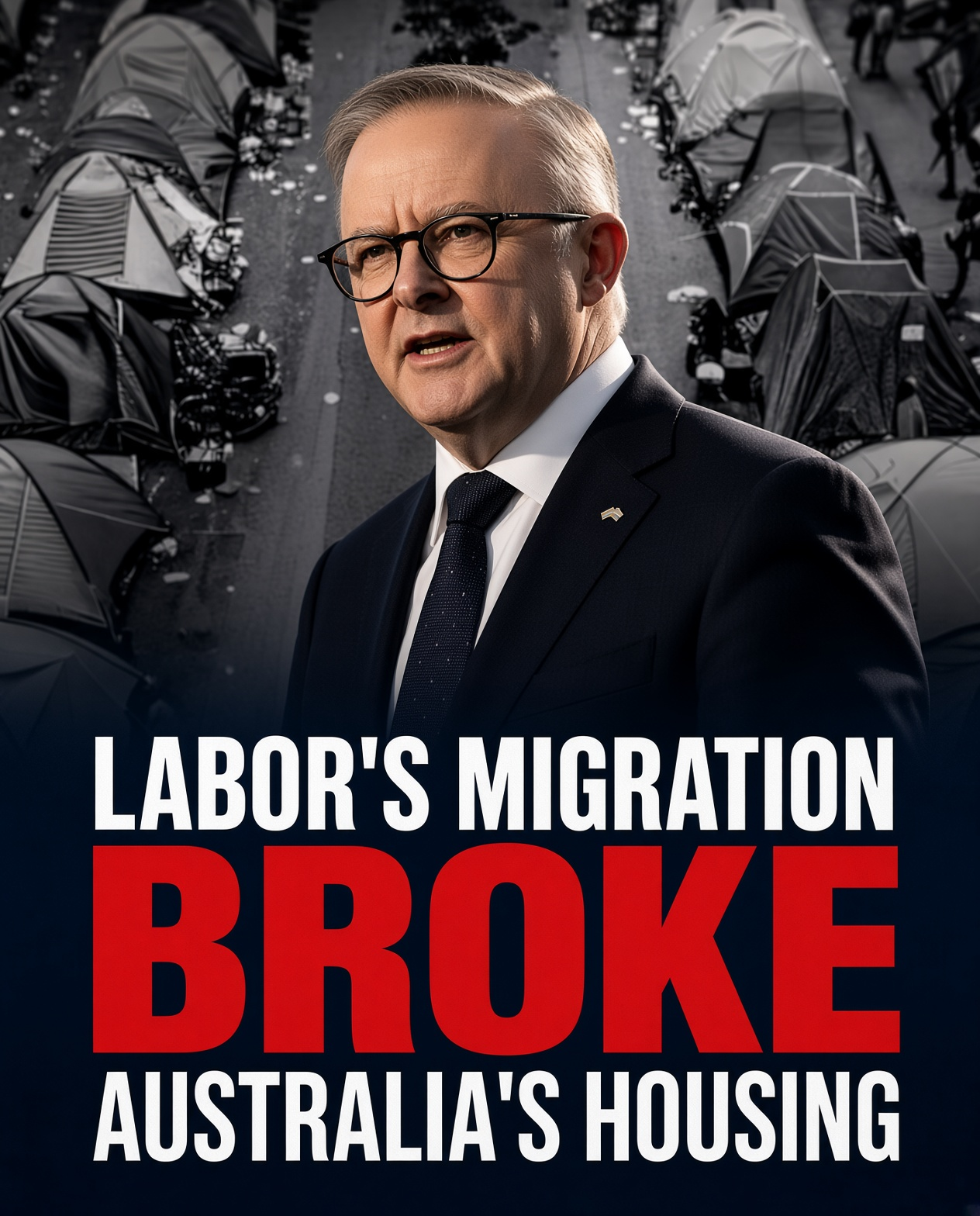
One Nation has intensified its attack on the Albanese government over Australia’s housing crisis, arguing that record post-pandemic migration was allowed to run far ahead of the country’s ability to build enough homes.
The party says young Australians and families are paying the price through higher rents, intense competition for homes and increasingly difficult paths into home ownership.
“Labor opened the floodgates on migration and now everyday Australians are paying the price with nowhere to live,” One Nation said in its latest intervention on housing.
“Net overseas migration blew out to record highs under this government, hitting nearly 550,000 in a single year, while home building barely moved and rents and mortgages kept climbing out of reach.”
The broad claim about record migration is supported by official Australian Bureau of Statistics figures, although the precise record was 536,000 rather than 550,000.
Net overseas migration reached 536,000 in the 2022–23 financial year — the highest annual level recorded by the ABS — after Australia reopened its international borders following the COVID-19 pandemic.
That represented an extraordinary increase in population through migration over a relatively short period.
The figure subsequently fell to 446,000 in 2023–24 as migrant arrivals declined and departures increased.
The ABS has explicitly described the record surge as being consistent with a catch-up in arrivals following almost two years of pandemic border restrictions.
That context matters.
Australia did not simply move from ordinary migration levels to a record intake in isolation. COVID border closures had suppressed international movement dramatically before restrictions were lifted, creating unusual post-pandemic movements in students, workers and other temporary visa holders.
But the rebound occurred at an exceptionally difficult time for Australia’s housing system.
New housing construction was already constrained by labour shortages, rising material costs, builder insolvencies and planning and infrastructure bottlenecks.
Population growth accelerated much faster than the supply response.
It is that mismatch that One Nation has seized on.
“You can’t bring in a city’s worth of people every year and expect the housing market to cope,” the party said.
“Labor kept the migration tap running flat out while young Australians got priced out of their own suburbs and families were pushed into cars and caravan parks.”
The language is political, but the relationship between rapid population growth and housing demand is real.
Every additional household needs somewhere to live.
When the population expands faster than the housing stock — particularly in cities already experiencing low rental vacancy rates — competition for available homes increases.
That can put upward pressure on rents and prices, although the size of the effect depends on where migrants settle, household formation, the type of accommodation required and how quickly housing supply responds.
Australia’s problem is that supply has struggled to respond quickly.
The latest ABS building activity figures show 48,012 dwellings were commenced nationally in the March quarter of 2026 in seasonally adjusted terms.
That was an 11.2 per cent fall from the previous quarter.
Dwelling completions have also remained well below the sustained pace Australia needs if it is to meet the Albanese government’s headline national housing target.
The National Housing Accord seeks to deliver 1.2 million well-located homes over five years from July 2024 to June 2029.
Meeting that goal would require an average of about 240,000 additional dwellings a year.
The National Housing Supply and Affordability Council’s 2026 assessment suggests Australia is unlikely to reach that number within the original timeframe.
Based on conditions before the latest international economic disruptions were incorporated, the council estimated approximately 980,000 homes could be delivered during the five-year Accord period.
That represents an improvement of about 42,000 homes compared with its previous forecast.
But it would still leave the country about 220,000 dwellings short of the 1.2 million target by June 2029.
The council projected the cumulative 1.2 million figure would instead be reached around September 2030 — more than a year after the original deadline.
That supply shortage is central to the migration debate.
If housing construction could rapidly increase whenever population growth accelerated, migration would create much less immediate pressure on rents and prices.
Australia’s construction system has not demonstrated that capacity.
Housing takes years to plan, finance, approve and build.
Population can change far more quickly.
The result is a lag in which additional demand arrives before the corresponding supply can be delivered.
One Nation argues the federal government should therefore use migration as the faster lever.
“One Nation says enough is enough: cut migration back to sustainable levels, prioritise Australians who are already here, and put housing supply ahead of ministers chasing headline growth numbers,” the party said.
Pauline Hanson has proposed reducing Australia’s permanent migration intake to 130,000 places a year.
That proposal has become one of the central policies behind One Nation’s dramatic rise in national polling.
But there is an important distinction between that 130,000 figure and the record migration numbers the party cites when discussing housing.
One Nation’s proposed 130,000 cap applies to permanent migration, not net overseas migration.
Hanson clarified that distinction last week after repeated questions about exactly what her policy would cover.
Permanent migration and NOM are different statistical concepts.
The permanent migration program covers permanent visa places provided through streams including skilled and family migration.
NOM, by contrast, measures the net population change produced by people arriving in and departing from Australia under the ABS residence rules.
It therefore captures large numbers of temporary migrants, including international students and temporary workers, as well as Australians moving overseas and returning home.
A person does not have to receive a permanent visa during a particular year to contribute to that year’s NOM.
That distinction explains how Australia can operate a permanent migration program of fewer than 200,000 places while recording net overseas migration substantially above that figure.
International students have been particularly important to the post-pandemic migration surge.
The ABS reported that temporary students were the largest group of migrant arrivals in 2023–24, accounting for 207,000 arrivals under its migration measurement.
One Nation’s permanent migration cap would therefore not, by itself, guarantee NOM fell to 130,000.
Hanson has said temporary visitors including backpackers and tourists would continue to come to Australia, while the party would retain access to some temporary workers.
The ultimate population effect of One Nation’s policy would consequently depend on the complete package of permanent and temporary visa settings, departures and the behaviour of people already in Australia.
The distinction is important because migration policy has increasingly become intertwined with the housing debate.
One Nation is not alone in arguing that population growth should be better aligned with housing construction.
Opposition Leader Angus Taylor has also proposed linking migration levels to the number of homes Australia builds.
The Coalition’s proposed framework would use housing completions as a constraint on net migration, based on the argument that the country should not continue adding people faster than it can accommodate them.
Taylor has repeatedly argued that “migration has run miles ahead of housing”.
The increasing overlap between Coalition and One Nation rhetoric demonstrates how dramatically housing has changed the immigration debate.
For decades, arguments over migration concentrated heavily on economic growth, skills shortages, multiculturalism and border control.
Housing capacity has now moved close to the centre of the discussion.
The political reason is obvious.
Housing costs affect voters directly.
A young worker unable to find an affordable rental does not experience population growth as an abstract macroeconomic statistic.
A family trying to buy its first home experiences affordability through mortgage repayments, deposits and the number of competing buyers at an inspection.
For those households, One Nation’s argument has intuitive appeal: fewer additional people competing for a constrained number of homes should reduce pressure.
Economic research generally supports the proposition that population growth increases housing demand.
Research cited in Australia’s migration debate has estimated that significantly lower net migration would leave rents and house prices lower than they otherwise would have been.
But that is not the same as saying migration alone caused Australia’s housing crisis.
The National Housing Supply and Affordability Council describes a housing system confronting multiple structural problems.
Construction productivity and capacity remain major constraints.
Building costs have increased substantially.
Infrastructure availability can determine whether land zoned for housing can actually be developed.
Planning systems can delay projects.
High financing costs can make apartment developments commercially unviable even after approval.
Shortages of skilled construction workers limit how quickly additional homes can be built.
Australia also has a longstanding shortage of social and affordable housing for people who cannot compete successfully in the private market.
Those problems would not disappear if migration stopped tomorrow.
The Housing Industry Association has warned that Australia would still need to build more than 100,000 homes every year even with zero population growth because of replacement demand, ageing housing stock and changing household structures.
That makes the housing crisis simultaneously a demand problem and a supply problem.
Migration affects the demand side quickly.
Planning reform, infrastructure investment and construction capacity determine whether supply can catch up.
The political disagreement is increasingly about which side governments should adjust first.
One Nation says migration should be reduced immediately because increasing construction capacity takes too long.
The Albanese government has instead pursued a combination of migration changes and policies intended to increase housing supply.
Its centrepiece is the National Housing Accord target of 1.2 million homes.
The federal government has also established the Housing Australia Future Fund, expanded incentives for states and territories to accelerate residential development, invested in enabling infrastructure and pursued planning reforms through agreements with other levels of government.
The government argues migration also provides economic benefits and supplies workers Australia needs, including in industries already experiencing labour shortages.
That produces another complication in One Nation’s proposed solution.
Some of the workers required to build additional homes are themselves migrants.
Construction groups have repeatedly warned that labour shortages are limiting housing output and have called for migration settings that attract skilled tradespeople.
Hanson has said she does not care if businesses suffer from lower migration and argues employers should do more to train and employ Australians.
But a sharp reduction in skilled workers without a corresponding increase in domestic construction labour could make the supply side of the housing equation harder to solve.
That does not invalidate the argument for lower migration.
It demonstrates the trade-off.
Reducing population growth can reduce the rate at which housing demand increases.
Reducing access to workers needed to build homes can constrain the rate at which supply increases.
The composition of migration therefore matters as much as the headline number.
A construction worker, doctor, international student and dependent family member may all contribute to population growth, but their economic effects are not identical.
That is why migration policy cannot be evaluated solely by comparing the number of arrivals with the number of homes completed.
A dwelling can also house more than one person, meaning a one-for-one comparison between people and homes is inherently imperfect.
Household size, geographic distribution and existing spare capacity all influence the effect on the housing market.
Even so, the scale of Australia’s recent migration surge was exceptional.
The 536,000 NOM result in 2022–23 represented more than half a million additional people through overseas migration in just 12 months.
The government inherited the reopening of Australia’s international borders from the Morrison government, but the record annual NOM figure occurred after Labor took office in May 2022.
That gives One Nation a factual basis for saying record migration occurred “under this government”.
It does not establish that Labor deliberately set a target of 536,000.
NOM is an outcome rather than a government visa quota.
It is affected by temporary arrivals, departures, Australians moving internationally and how long people remain in the country.
The distinction has frequently been blurred in political debate.
The permanent migration program is a policy setting governments can directly cap.
NOM is the population outcome produced by a much broader set of movements.
The Albanese government has since introduced measures intended to reduce migration from its post-pandemic peak, particularly through changes affecting international students and temporary visa pathways.
The ABS figures already show NOM declining from its record level.
But the political consequences of the surge have persisted because housing supply cannot adjust retrospectively.
Homes that were not built during the fastest period of population growth cannot be created instantly once migration begins falling.
Rental markets can remain tight and affordability can remain poor long after the rate of population growth moderates.
That delayed effect is helping One Nation keep migration at the centre of the housing argument.
The party’s language — that Australians have been “priced out of their own suburbs” — is designed to connect a national population statistic with the lived experience of voters struggling to secure housing.
There is also a risk in taking that argument too far.
Migrants are participants in Australia’s housing market, but they are not responsible for planning failures, construction costs, infrastructure bottlenecks or decades of inadequate social housing investment.
Many migrants themselves face high rents and housing insecurity.
International students and temporary workers are particularly concentrated in rental markets and can be among those most exposed when vacancy rates are extremely low.
A serious housing debate therefore requires separating the effect of population growth from blame directed at the people who make up that growth.
Governments determine migration settings.
Governments also influence planning, infrastructure and housing policy.
The question for voters is whether those policies were properly coordinated.
On that point, the numbers present a difficult picture for Labor.
Australia experienced record net overseas migration at the same time the housing system lacked the capacity to expand at anything approaching the same speed.
The country is now forecast to miss the original timetable for the government’s 1.2 million-home target.
Those facts do not prove migration caused every element of the affordability crisis.
They do support the argument that rapid population growth added demand to a market already suffering severe supply constraints.
That is the political opening One Nation is exploiting.
Hanson’s answer is to lower permanent migration sharply and give the housing system time to catch up.
The government’s answer is to moderate migration from its post-pandemic peak while accelerating construction and preserving the economic and workforce benefits of immigration.
Neither approach changes the fundamental arithmetic confronting Australia.
People need homes.
If the population grows quickly while housing grows slowly, competition for accommodation intensifies.
If Australia wants to maintain a large migration program without worsening housing pressure, it needs to demonstrate that it can build substantially more homes.
If it cannot build them quickly enough, political pressure to reduce migration will continue to grow.
For One Nation, that connection has become one of its most powerful arguments against the Albanese government — and with housing affordability still dominating household finances, it is unlikely to disappear from Australia’s political debate any time soon.