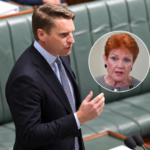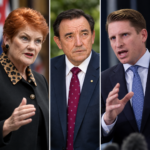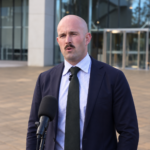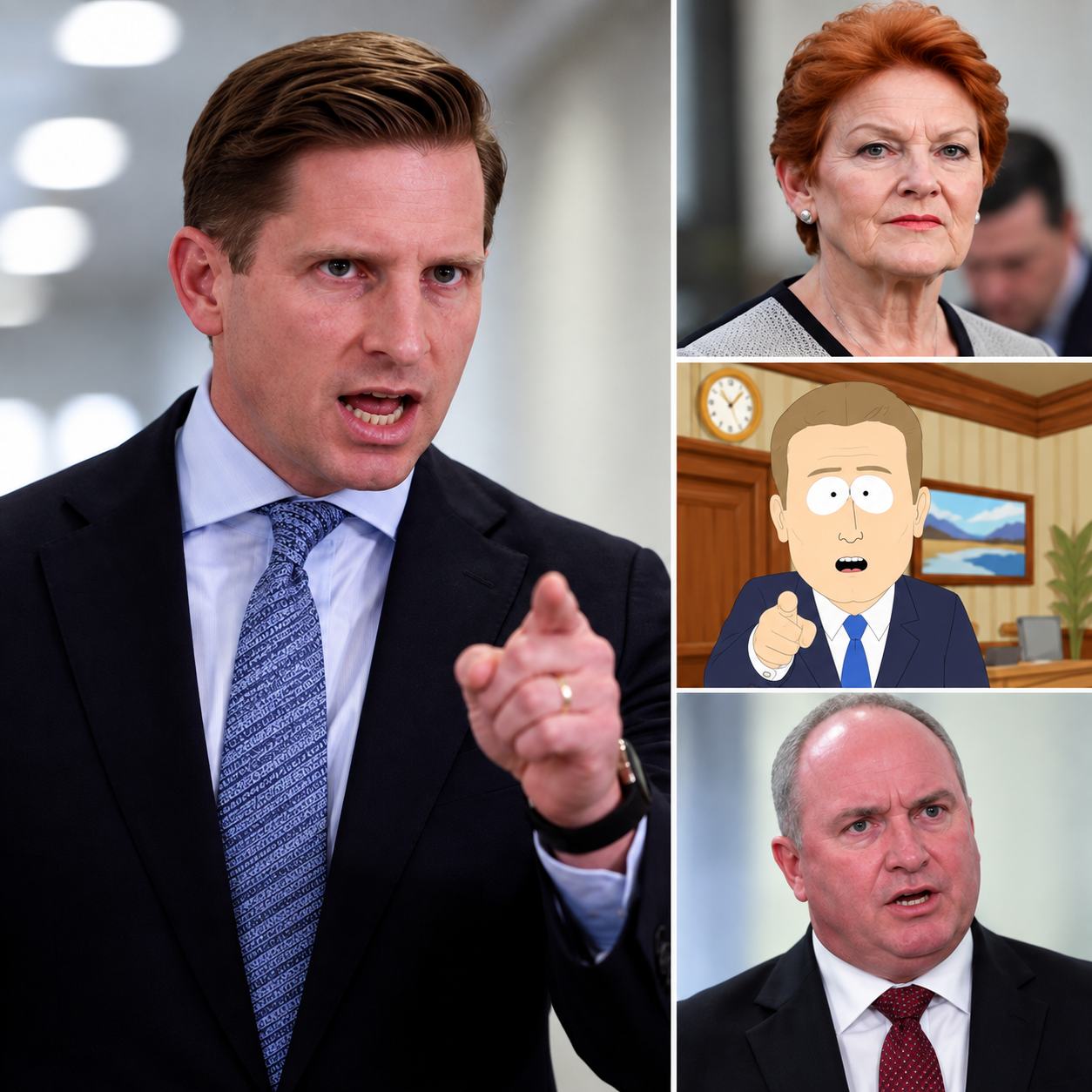
Andrew Hastie has made peace with Barnaby Joyce but intensified his confrontation with Pauline Hanson, declaring the One Nation leader is “still a lying coward” and promising to go “all the way” in a political fight that is rapidly becoming a test of both parties’ strength on the conservative right.
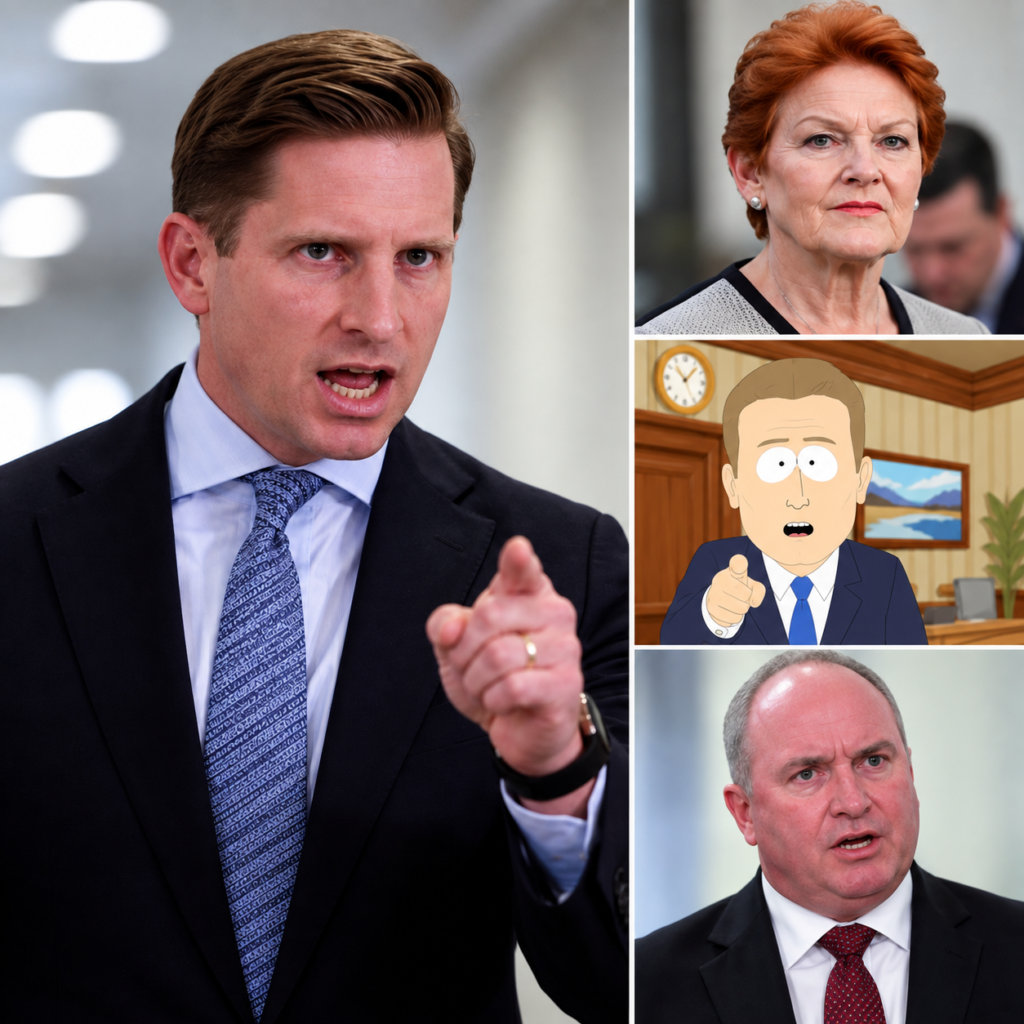
The Liberal frontbencher and former SAS captain said he had accepted Joyce’s explanation that the former deputy prime minister did not know about the controversial One Nation cartoon when he initially defended Hanson.
But Hastie offered no such reconciliation to the One Nation leader.
“I put the challenge to her — she could have accepted that she’d got it wrong and pulled it down, but she refused to do so,” Hastie said.
He said Hanson remained a “lying coward” because she continued to deny personally calling him a traitor while defending a cartoon authorised and promoted through her political operation that uses the description repeatedly.
The dispute has now consumed almost a week of federal politics and shows no sign of fading.
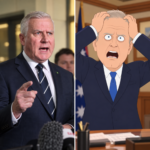
At the centre of it is an episode of One Nation’s animated Please Explain series titled Don’t Be Hastie.
The cartoon attacks Hastie over several issues, including his evidence during Ben Roberts-Smith’s failed defamation litigation and his eventual support for amended federal anti-hate legislation.
Hastie says the word “traitor” is directed at him eight times.
He has demanded that Hanson make a straightforward choice: openly stand behind the accusation or remove the video.
Hanson has done neither.
She says she has never personally called Hastie a traitor and has repeatedly defended the cartoon as satire.
She has refused calls to delete it and at one point dismissed the growing controversy as a “storm in a teacup”, later suggesting critics should “take a chill pill”.
That distinction between Hanson’s personal words and material distributed under her name is exactly what Hastie rejects.
He argues that a politician cannot authorise, publish and promote political content and then disclaim responsibility for its central allegation when challenged.
“This isn’t Agro’s Cartoon Connection,” Hastie said during an earlier interview. “This is Parliament House with serious people.”
The disagreement with Joyce has taken a different course.
Hastie initially branded both Hanson and Joyce “lying cowards” after Joyce publicly supported Hanson’s insistence that she had not called the Liberal MP a traitor.
Joyce later said he had not seen the cartoon at the time.
He subsequently distanced himself from its language, said he did not believe Hastie was a traitor and offered an apology for the offence caused.
Hastie said the pair then exchanged text messages.
“He explained his position and he said that he didn’t know about the cartoon, and then he went on and apologised,” Hastie said.
“So, I accept that. I accept his explanation.”
Guardian Australia separately reported Hastie saying he now understood Hanson to be “the only lying coward” after Joyce reached out.
The reconciliation does not mean Hastie has softened towards Joyce’s decision to leave the Nationals and join One Nation.
He said he felt sorry for the former deputy prime minister, suggesting Joyce had moved from a party that twice made him Australia’s deputy leader into an organisation where he was now required to repeatedly defend or explain Hanson’s controversies.
“He left a party that made him deputy prime minister twice to jump in with this rabble,” Hastie said.
He accused One Nation of having “no principles” and being “all over the shop”.
Joyce has rejected suggestions he regrets the move.
He has argued that he joined One Nation because he believed Australian politics required a major disruption and has denied suffering any “buyer’s remorse”.
The fight with Hanson, meanwhile, has become significantly more personal.
Hastie now says the way she responded under pressure demonstrates she is not suitable to become prime minister.
“I think she’s revealed in the last week that she doesn’t have what it takes to be Prime Minister of this country,” he said.
Hastie accused Hanson of failing to accept responsibility when challenged and of relying on cartoons rather than directly defending the allegations made through them.
He has promised the confrontation will continue.
“I’m not backing down,” he said on Sunday.
In an earlier News24 interview, Hastie made the stakes even clearer.
“I’m putting my whole career on the line here,” he said. “I will go all the way with One Nation to the next election.”
He said he was prepared to make the contest “a very painful process” if One Nation chose to target him.
Another report on Sunday quoted Hastie telling Joyce by text that the events of the previous week should be considered merely “a demonstration”.
“They haven’t seen anything yet,” he said.
The language matters because this is no longer simply an argument over whether a cartoon went too far.
One Nation sees Hastie’s Western Australian electorate of Canning as a potentially important target at the next federal election.
The party’s confidence increased after it won the state seat of Secret Harbour in a recent by-election. That electorate overlaps parts of Hastie’s federal seat.
Hastie therefore has a direct electoral reason not to allow One Nation to define him as disloyal to his country or to conservative values.
But he has framed his response as broader than personal political survival.
The most serious part of the cartoon concerns his military service and his role as a witness in the Roberts-Smith litigation.
Hastie served for almost 13 years in the Australian Defence Force, including with the Special Air Service Regiment, and deployed twice to Afghanistan.
He later gave evidence in the Federal Court during Roberts-Smith’s defamation case.
Critically, Hastie did not simply volunteer to appear in order to attack a former SAS colleague.
He was subpoenaed.
Reporting from the case described him as a reluctant witness, and he told the court at the time that he did not want to be there.
Justice Anthony Besanko later described him as a straightforward witness.
That context has become central to Hastie’s response to being labelled a traitor.
His argument is that obeying a subpoena and giving truthful evidence in an Australian court is not betrayal — it is part of the rule of law soldiers are expected to defend.
More than 20 former SAS personnel gave evidence during the litigation.
Hastie has consequently argued that the attack raises a question much larger than his own reputation: whether veterans who participate honestly in court proceedings can be smeared as disloyal when their evidence becomes politically inconvenient.
RSL Australia entered the dispute on precisely those grounds.
The organisation said using a veteran’s military service as the basis for calling them a traitor went beyond normal political disagreement.
It described the language as a slur and warned that portraying service as betrayal sent a corrosive message to the wider veteran community.
The criticism has spread across the political spectrum.
Independent senator and Army veteran Jacqui Lambie has launched a furious attack on Hanson and urged veterans considering One Nation to think twice.
Opposition Leader Angus Taylor has said the cartoon should be removed.
Nationals leader Matt Canavan condemned the language.
Former prime minister Tony Abbott — despite his long-standing support for Roberts-Smith — has also said One Nation should take the cartoon down.
One Nation’s Western Australian leader, Rod Caddies, has distanced himself from the attack.
Hanson has nevertheless continued to stand by the video.
One report on Sunday said the cartoon had quietly been unpinned from the top of her X feed over the weekend, but it had not been deleted.
The distinction will matter little to Hastie, whose demand has consistently been that Hanson either remove the content or accept responsibility for what it says.
The Roberts-Smith context also requires careful legal distinction.
Roberts-Smith lost his defamation action in 2023 after Justice Besanko found several serious imputations had been proved to the civil standard.
His appeal was dismissed in 2025.
Those civil findings are separate from the criminal process now under way.
Roberts-Smith was arrested in April 2026 and charged with five counts of the war crime of murder concerning alleged killings of Afghan men between 2009 and 2012.
He denies wrongdoing, and the criminal allegations remain to be determined.
One Nation and prominent supporters of Roberts-Smith have strongly criticised the treatment of the former soldier and the broader investigations into alleged Australian war crimes.
Hastie has taken a sharply different position.
He has repeatedly argued that the Australian Defence Force must maintain high standards even in combat and that loyalty cannot override the Geneva Conventions, the rule of law or accountability for battlefield conduct.
The feud expanded again this weekend when Hastie challenged Hanson to explain her position on Australia’s war-crimes laws after she questioned 2024 legislative changes relevant to prosecutions.
Hastie said the underlying standard was simple: Australian soldiers should not kill combatants who have surrendered or people who are otherwise protected by the laws of armed conflict.
That argument reinforces why the word “traitor” has become so politically explosive.
For Hanson and her supporters, Hastie has been portrayed as a conservative politician who betrayed expectations on several issues and helped give damaging evidence against a decorated former soldier.
For Hastie, that description turns obedience to Australian law and military standards into evidence of disloyalty.
The dispute is also feeding speculation about his future inside the Liberal Party.
One Nation has suggested Hastie is exploiting the confrontation to raise his profile ahead of a possible leadership challenge.
He rejects that.
Hastie says Angus Taylor remains Liberal leader and points to his own conduct as evidence of loyalty.
“Angus Taylor is the leader. I’ve supported him. Judge me by my actions,” he said.
Yet when pressed on whether he retains longer-term leadership ambitions, Hastie did not pretend ambition is absent from federal politics.
He borrowed a well-known political metaphor.
“Every single person in the parliament has a baton in their knapsack,” he said.
“Some have it buried beneath their lunchbox. Some have it closer to the top.”
Asked where his own baton was, Hastie replied: “Well, who knows? Somewhere in there.”
The answer will inevitably sustain leadership speculation, but it does not amount to an announced challenge to Taylor.
More immediately, Hastie has another contest in mind.
He is signalling that One Nation should expect a sustained political counterattack through to the next election.
That strategy carries risk.
Hanson has a large and highly motivated supporter base, and some Liberals have privately questioned whether confronting her directly may strengthen One Nation by feeding its anti-establishment narrative.
Hastie appears to have made the opposite calculation.
His position is that failing to challenge an accusation this serious would itself signal weakness.
He has said threats associated with supporters of Roberts-Smith have already required him to increase his personal security.
Even so, he is making clear he will not retreat.
The feud has consequently become a much larger contest about the future of Australian conservatism.
One Nation is attempting to present itself as the authentic alternative for voters who believe the Coalition has compromised too often on immigration, climate policy, cultural issues and institutional power.
Hastie is trying to demonstrate that a conservative Liberal can challenge One Nation aggressively without adopting its methods or accepting its version of patriotism.
Joyce has found a way out of his personal confrontation with Hastie through an apology.
Hanson has chosen the opposite path.
And after a week in which the cartoon attracted condemnation from veterans, senior Liberals, independents and even One Nation figures, Hastie says the conflict is only beginning.
Whether that damages Hanson, strengthens her or reshapes the contest inside the Coalition will ultimately be decided by voters.
But one thing is now clear: Hastie has no intention of allowing the “traitor” label to pass unanswered.