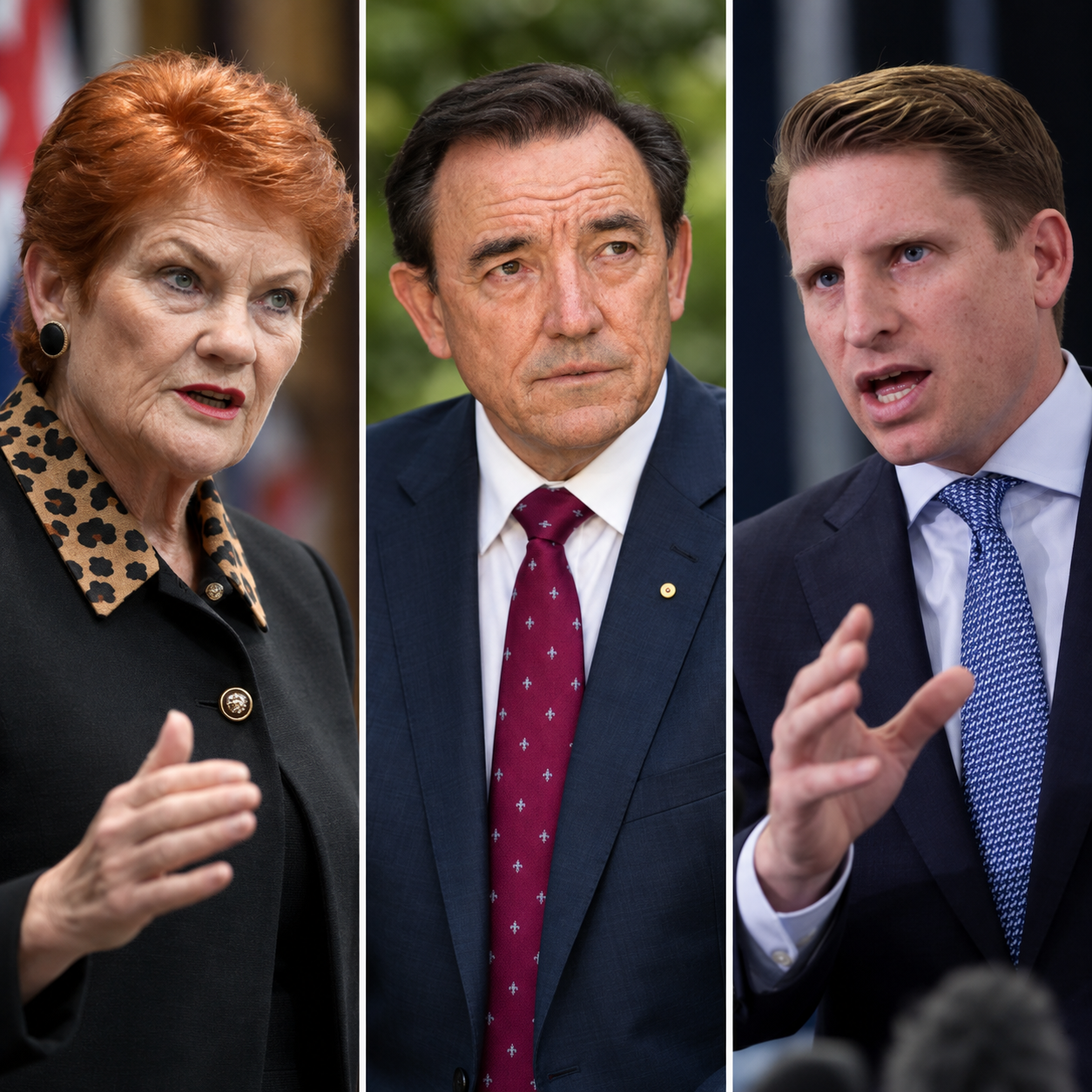
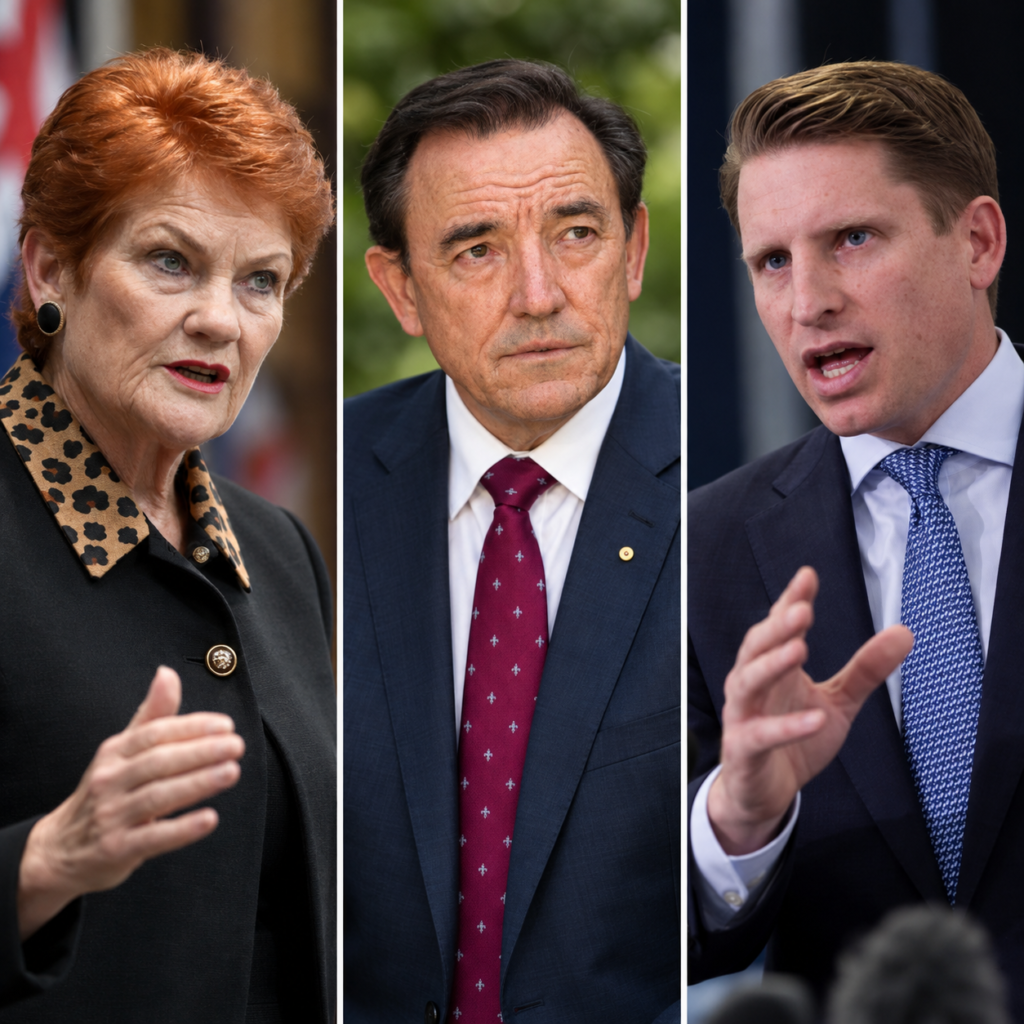
RSL Australia has come under fire from veterans and other critics after entering the increasingly bitter dispute between Liberal MP Andrew Hastie and Pauline Hanson over a One Nation cartoon that repeatedly brands the former SAS officer a “traitor”.
The national veterans organisation intervened on Thursday, arguing that the controversy had moved beyond ordinary political disagreement because Hastie’s military service and his conduct as a former Australian soldier were being used as part of the attack.
The dispute centres on a One Nation animated video titled Don’t Be Hastie, published in July and authorised by Senator Hanson.
The cartoon mocks Hastie over two issues that have generated anger among sections of the political right: his evidence in Ben Roberts-Smith’s defamation proceedings and his decision to support a heavily amended version of the Albanese government’s anti-hate legislation after initially saying he would vote against the proposal.
The video describes Hastie as a “traitor” multiple times.
Hastie, a former Special Air Service Regiment captain who served in Afghanistan, demanded that Hanson either take responsibility for the accusation or remove the video.
Hanson has refused to do so, saying the production is satire and insisting she has never personally called Hastie a traitor.
RSL Australia rejected the idea that the distinction resolved the controversy.
“When a person’s military service is used as the punchline, when the word ‘traitor’ is thrown at someone who has worn the uniform and deployed on operations, that stops being politics,” the organisation said.
The RSL argued that former Defence Force personnel remained accountable for their conduct after leaving the military but said disagreement over their actions should not result in their service being recast as disloyalty to Australia.
It described calling a veteran a traitor as a slur and urged politicians across the spectrum to maintain a distinction between scrutinising a former soldier and using their military record as a political weapon.
The intervention drew support from critics of the One Nation video, but it also prompted an immediate backlash from people who questioned why the veterans organisation had chosen this particular dispute as the moment to take such a forceful public position.
Former special forces officer Heston Russell was among the most prominent critics.
Russell, who successfully sued the ABC for defamation in 2023, accused the RSL of failing to speak with the same intensity when Australian veterans faced allegations of misconduct and war crimes.
“Where were you when veterans were actually being accused of being war criminals?” Russell asked.
He contrasted the Hastie dispute with his own lengthy legal battle against the national broadcaster and with a separate controversy involving inaccurate editing of Australian commando footage from Afghanistan.
Other commenters echoed the criticism, arguing that the RSL had been more willing to defend a serving politician from an insulting cartoon than veterans whose reputations had been challenged by serious allegations arising from Australia’s Afghanistan deployment.
Those comparisons have become central to the backlash, but the different cases carry important legal distinctions.
Russell sued the ABC over 2021 reports that conveyed allegations involving the killing of an Afghan prisoner by members of a platoon he had commanded.
Federal Court Justice Michael Lee found the publications defamatory and rejected the ABC’s public-interest defence. Russell was awarded $390,000 in damages, with the final amount rising above $400,000 when interest was included.
The later controversy over additional gunshot sounds involved separate ABC reporting from 2022.
An independent review commissioned by the broadcaster found that five additional gunshot sounds had been “inadvertently but inaccurately” introduced into a 56-second video clip showing Australian commandos operating from a helicopter in Afghanistan.
The review found serious editing failures, but the available findings did not establish that journalists had deliberately inserted the sounds to manufacture evidence against Russell or other soldiers.
That distinction matters because the two controversies are frequently combined in political commentary despite involving different publications and different issues.
The same care is required when discussing Hastie’s involvement in the Roberts-Smith litigation.
Hastie did not simply volunteer to enter court to attack a former SAS colleague.
He was subpoenaed to give evidence during Roberts-Smith’s long-running defamation case against Nine newspapers and journalists Nick McKenzie and Chris Masters.
Hastie has said repeatedly that he regarded giving truthful evidence under oath as an obligation under the rule of law and consistent with the standards expected of Australian soldiers.
Reporting on the 2022 trial shows he was a reluctant witness rather than someone eager to participate in the case.
The defamation proceeding ultimately ended against Roberts-Smith.
In 2023, Federal Court Justice Anthony Besanko found that Nine had proved the substantial truth of several serious imputations about Roberts-Smith to the civil standard of the balance of probabilities.
Roberts-Smith appealed, but the Full Court of the Federal Court dismissed that appeal in 2025.
Those findings were civil findings, not criminal convictions.
The legal situation changed again in April this year when Roberts-Smith was arrested and charged with five counts of the war crime of murder arising from alleged killings in Afghanistan between 2009 and 2012.
Prosecutors allege the victims were detained, unarmed and under the control of Australian Defence Force personnel when they were killed.
Roberts-Smith denies wrongdoing. The criminal charges remain before the courts and there has been no finding of guilt to the criminal standard of proof.
The One Nation cartoon nevertheless uses Hastie’s evidence in the earlier civil proceeding as part of a wider argument that the Liberal MP has betrayed people who once regarded him as an ally.
The other major target of the cartoon is his vote on federal anti-hate legislation in January.
Hastie initially took an unequivocal position against Labor’s proposed laws.
He warned that the original bill threatened freedom of conscience, speech and religion and publicly said he would vote against it.
That original package subsequently changed significantly.
Labor removed its proposed racial-vilification offence after the provision drew concerns from legal experts and politicians across the ideological spectrum, while the Liberals negotiated further changes to the remaining legislation.
The final bill focused on measures including a regime to ban hate groups and stronger provisions dealing with extremist activity.
Hastie then voted for the amended legislation alongside most Liberal MPs.
His critics say the vote represented a broken promise. Hastie’s position is that the legislation he ultimately supported was materially different from the bill he had pledged to oppose.
The distinction has done little to calm the political fight.
Hastie accused Hanson and Barnaby Joyce of being “lying cowards” this week, arguing that they could not deny calling him a traitor while defending a One Nation video that used the term repeatedly.
He also questioned what the accusation implied about the other SAS veterans who gave evidence in the Roberts-Smith proceedings.
The dispute has drawn condemnation from across politics.
Independent senator and Army veteran Jacqui Lambie attacked Hanson over the cartoon, while Opposition Leader Angus Taylor and former prime minister Tony Abbott have also said the video should be removed.
RSL national president Peter Tinley has argued that the word “traitor” carries particular weight when directed at veterans because of the oath, service and operational sacrifices associated with military duty.
Yet the organisation’s decision to intervene has exposed it to a separate debate about consistency.
Critics including Russell argue that veteran organisations should have been equally forceful when other soldiers faced highly damaging public allegations.
Supporters of the RSL position counter that defending Hastie from the language of treason does not require the organisation to reject legitimate investigations, journalism or court processes concerning alleged misconduct by veterans.
The arguments reflect a much deeper division over Australia’s reckoning with its Afghanistan war.
For some former soldiers and their supporters, the years of war-crimes investigations, media reporting and public scrutiny have left a sense that Australian special forces personnel were condemned collectively for alleged conduct by individuals.
For others, military service cannot shield anyone from investigation, and loyalty between soldiers cannot override obligations to courts, investigators or the law.
Hastie has made that second principle central to his defence.
He says obeying a subpoena and giving evidence under oath should not be regarded as betrayal, regardless of whether the evidence harms the reputation or legal position of a former comrade.
The latest developments have also weakened One Nation’s ability to present a united front in the dispute.
Barnaby Joyce, who was not a member of One Nation when the cartoon was produced, has now apologised to Hastie.
Hastie accepted Joyce’s apology on Friday, drawing a distinction between the former Nationals leader and Hanson.
Hanson, meanwhile, has doubled down.
She has continued to reject demands that the video be removed and has told critics to “chill”, maintaining that the cartoon is satire and that the controversy has been exaggerated.
The video remained prominently displayed on her social media as the dispute continued.
That leaves the argument increasingly focused on Hanson herself and on a basic question about political responsibility: whether authorising and distributing satire that repeatedly calls a rival a traitor is meaningfully different from making the accusation directly.
For the RSL, the answer is effectively no when military service is being used to give the insult its force.
For Hanson, political satire remains political satire.
For critics of the RSL, however, another question now sits alongside that dispute — whether Australia’s largest veterans organisation applies the same standard of defence consistently when military reputations come under attack.
The argument therefore reaches well beyond one cartoon.
It touches on freedom of political expression, responsibility for satire, the meaning of loyalty between soldiers, the duty to give evidence under oath and the unresolved bitterness surrounding Australia’s Afghanistan war.
With Roberts-Smith’s criminal proceedings continuing and One Nation preparing to challenge Hastie in his Western Australian seat of Canning at the next federal election, those tensions are unlikely to disappear soon.
The cartoon may have been intended as a political attack on one Liberal MP. Instead, it has opened a broader argument about who gets to define loyalty, betrayal and honour among Australians who have worn the uniform.