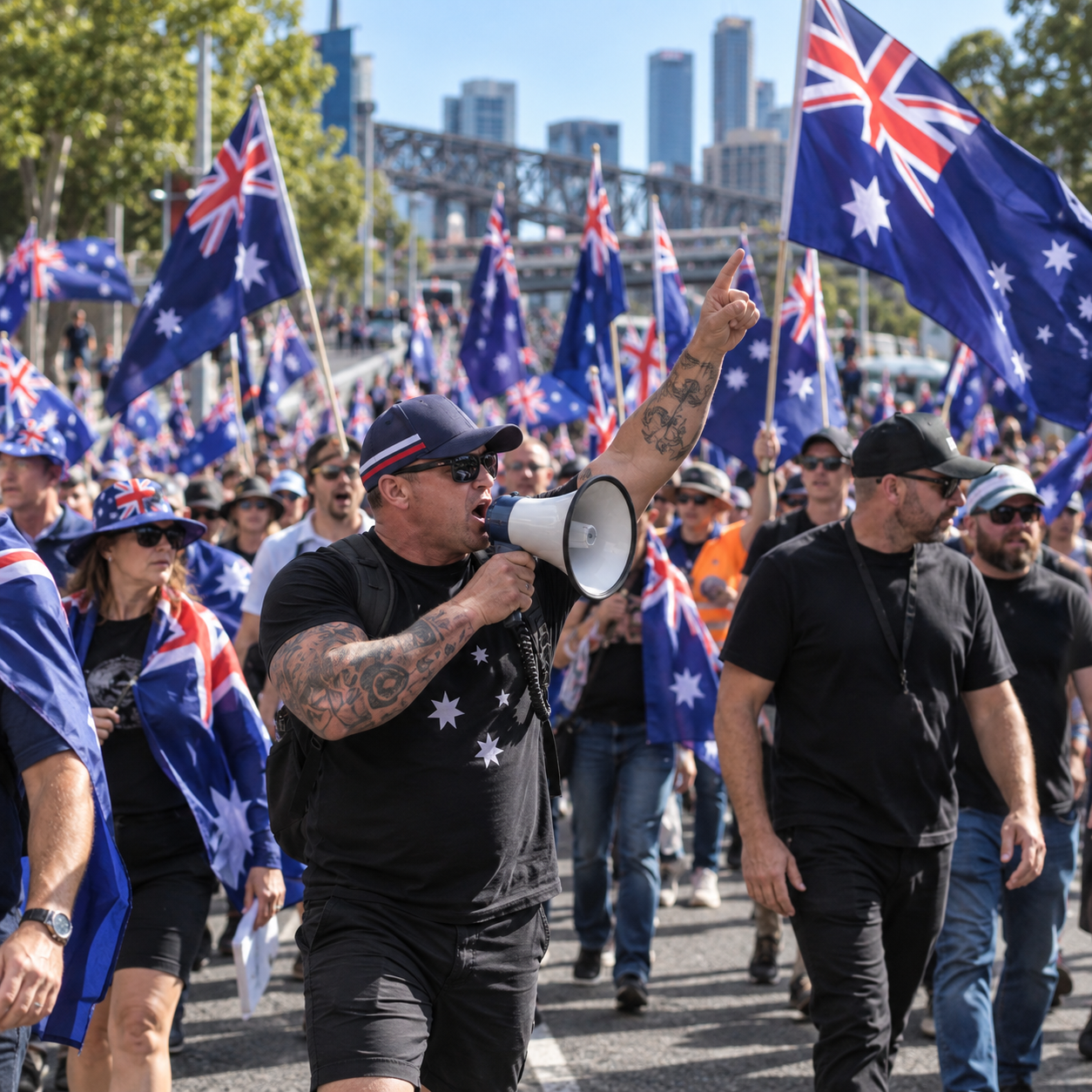
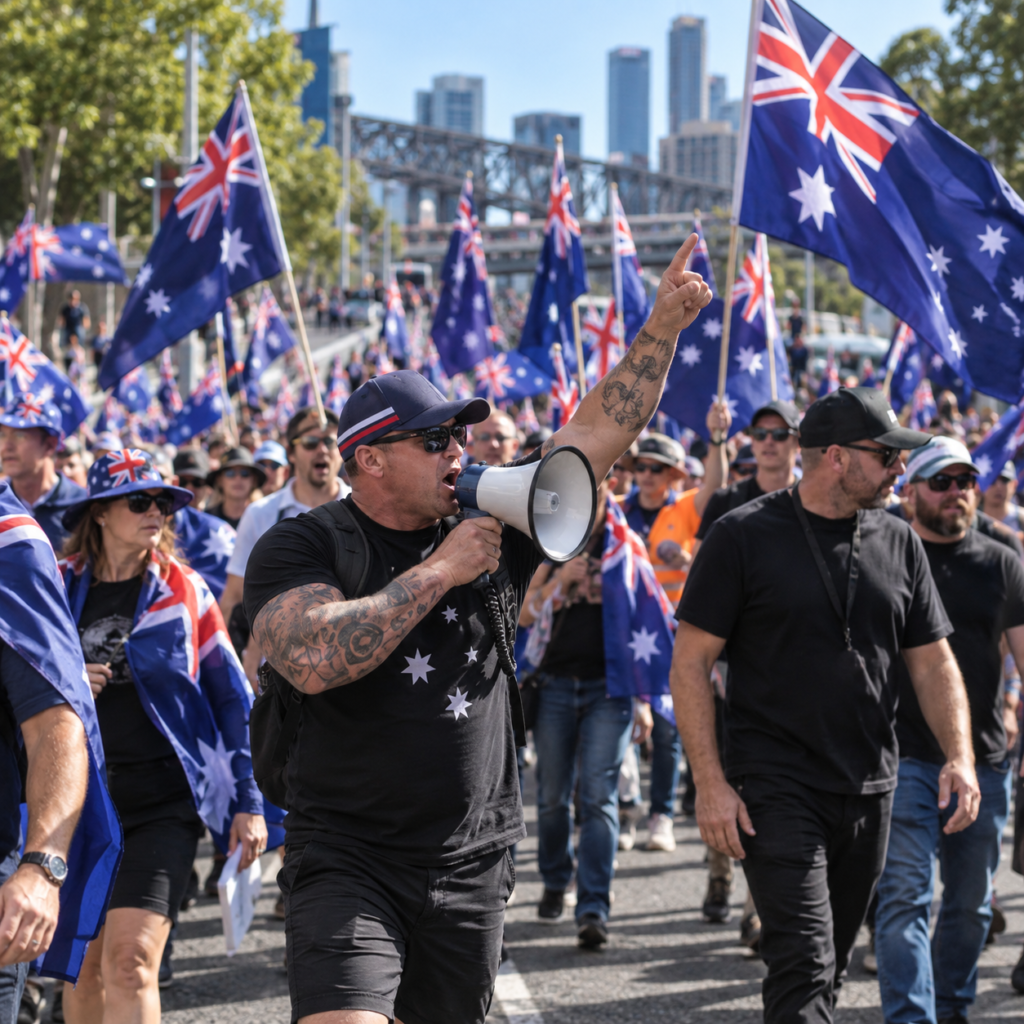
Thousands of protesters have marched through central Brisbane calling for a dramatic reduction in immigration and tougher restrictions on foreign political influence, as migration becomes an increasingly potent fault line in Australian politics.
The Australia Marches demonstration began at Emma Miller Place at midday on Sunday before participants moved through the city towards Queensland Parliament, where organisers and speakers addressed the crowd.
Marchers carried Australian flags and a large banner reading “Save the nation, stop immigration”, while chants included the familiar “Aussie, Aussie, Aussie, oi, oi, oi” and attacks on Prime Minister Anthony Albanese.
Many attendees wore orange One Nation shirts, although the event was organised by Australia Marches and the Australian Lobby Group rather than by the political party itself.
Organisers estimated the crowd at about 3,000.
That figure has not been independently confirmed by Queensland Police, and no official police attendance estimate was publicly available by Sunday evening.
What is clear from footage of the demonstration is that the event attracted a substantial crowd and marked the opening of a planned national tour through Australian capital cities between September and November.
The tour’s two central demands are a major reduction in immigration and what organisers describe as an end to foreign lobbying and political influence.
A mock coffin was carried in the Brisbane march to symbolise the latter campaign.
Scott Challen, an organiser with Australia Marches and director of the Australian Lobby Group, has argued that Australia’s population has been growing faster than its housing and infrastructure can sustainably accommodate.
He has called for what the movement describes as a hard five-year immigration halt, accompanied by major reductions in temporary visas, stronger enforcement against visa breaches and a fundamental review of Australia’s migration settings.
“Australia cannot keep increasing its population faster than we can build the houses, roads and infrastructure required to support it,” Challen said ahead of the rally.
The campaign is considerably more restrictive than the migration positions currently advocated by either Labor or the Coalition.
The Albanese government expects net overseas migration to continue falling and has forecast a level of about 225,000 by 2027-28.
The federal opposition wants a steeper reduction, with Opposition Leader Angus Taylor arguing for net overseas migration below 170,000.
One Nation has advocated an even lower figure of about 130,000.
The Australia Marches campaign goes further again by proposing an effective freeze on much non-essential migration for five years.
That would represent a profound change to the system through which Australia recruits international students, skilled workers, temporary employees and family migrants.
The rally therefore reflects an immigration debate that has shifted significantly since the extraordinary post-pandemic surge in population movement.
Australian Bureau of Statistics figures show net overseas migration reached 538,000 in the 2022-23 financial year.
It then fell to 429,000 in 2023-24 and 306,000 in 2024-25.
The latest rolling annual population figures show net overseas migration of about 301,000 in the year ending December 2025.
That means migration has already fallen substantially from its peak, although it remains higher than the levels recorded in many years before the pandemic.
Australia’s population stood at about 27.8 million at the end of 2025, having grown by 1.5 per cent over the previous year. Overseas migration accounted for about 301,000 of the 412,500 increase.
Those figures help explain why migration continues to resonate politically despite the recent decline.
Australia is still confronting a severe shortage of housing in many cities, rents remain under pressure and governments are struggling to deliver transport, schools, hospitals and other infrastructure at the pace demanded by population growth.
Migration is not the sole cause of those problems.
Housing supply has also been constrained by planning delays, construction costs, labour shortages, infrastructure bottlenecks and weak productivity in residential building.
But rapid population growth adds immediate demand to a housing system that was already failing to build enough homes.
That connection has become a central argument for groups demanding much lower migration.
Supporters of a strong migration program counter that many of the people entering Australia are themselves required to address shortages in construction, healthcare, aged care and other essential sectors.
International education is also one of Australia’s major export industries, while temporary workers are deeply embedded in sectors including agriculture, hospitality and regional services.
The result is a policy dilemma that cannot be resolved simply by observing that migration increases demand.
Cutting migration sharply could reduce population pressure but also remove workers needed to expand housing supply and provide services.
The Brisbane march nevertheless showed that for many participants the political threshold has already been crossed.
Organisers framed their campaign not as a minor adjustment to visa settings but as an attempt to force a wholesale rethink of Australia’s population model.
During the march, Challen led supporters in chants calling for an end to mass immigration and rejecting accusations of racism.
The insistence on that distinction has become a recurring theme at Australia Marches events.
Organisers say their opposition is directed at the scale of migration and government policy rather than individual migrants or particular ethnic groups.
Critics of the broader anti-immigration movement argue that rallies of this kind can also attract racial nationalism and hostility towards migrants, particularly online.
Challen has previously sought to distance his organisation from neo-Nazi groups.
At an Australia Day rally earlier this year, he said Australia Marches had split from another protest movement because he objected to National Socialist Network involvement.
Sunday’s Brisbane event also contained visible support for One Nation, whose rapid political rise has forced both major parties to reconsider how they talk about immigration.
Pauline Hanson had originally been advertised as one of the rally’s headline speakers.
She withdrew before the event, citing security advice.
The Australian Lobby Group said Hanson’s office had been unable to secure an Australian Federal Police protection resource for the appearance and claimed “hard budget restraints” imposed by the Albanese government were responsible.
That explanation has not been independently established.
The AFP does not publicly discuss the detailed protective arrangements provided to parliamentarians and high office holders.
Hanson has separately said she has required federal police protection while attending some public events because of threats against her.
Threats and offensive communications directed at Australian politicians have increased, and AFP Commissioner Krissy Barrett has warned about a wider rise in politically motivated hostility and willingness to mobilise towards violence.
But the AFP’s refusal to disclose operational protection arrangements means it is not possible to independently establish from public information whether a budget decision caused Hanson’s withdrawal from Sunday’s event.
Organisers urged supporters to attend despite her absence.
Sam Bamford, co-founder of the Australian Lobby Group and host of the 2 Worlds Collide podcast, was among those associated with the campaign.
Bamford, a military veteran, has become a prominent voice in nationalist and migration debates and has interviewed political figures including Coalition senator Jacinta Nampijinpa Price.
Right-wing online personalities also attended the Brisbane gathering.
Footage from the march showed signs supporting former SAS soldier and Victoria Cross recipient Ben Roberts-Smith.
Roberts-Smith is currently facing five criminal charges of the war crime of murder over alleged killings in Afghanistan between 2009 and 2012. He denies wrongdoing, and the criminal allegations have not been determined.
The presence of such material illustrated how Sunday’s demonstration drew together several political causes extending beyond immigration alone.
The other major theme was foreign influence.
Australia Marches and the Australian Lobby Group want much stronger restrictions on foreign lobbying, presenting the issue as a question of national sovereignty.
Australia already regulates some forms of foreign political influence.
The Foreign Influence Transparency Scheme requires individuals and organisations to register certain political or governmental influence activities undertaken in Australia on behalf of foreign principals.
Those principals can include foreign governments, foreign political organisations and foreign government-related entities or individuals.
Registrable activities can include parliamentary lobbying, general political lobbying, public communications and the disbursement of money.
Failure to register when legally required can be a criminal offence.
Australia also restricts foreign political donations under the Commonwealth Electoral Act.
Foreign influence itself is not automatically illegal.
The legal system draws an important distinction between transparent foreign influence — such as declared lobbying or diplomacy — and foreign interference involving clandestine, deceptive, threatening or coercive conduct.
The latter can constitute serious criminal offending.
The protesters’ demand to “end foreign lobbying” therefore represents a call to go considerably further than current Australian law, which generally seeks to expose and regulate legitimate foreign influence rather than ban every instance of it.
Exactly where organisers would draw that line remains an important policy question.
Foreign governments routinely advocate to Australian ministers, Australian companies employ international lobbying firms and businesses with overseas owners seek to influence regulation affecting their interests.
A blanket prohibition would therefore require decisions about diplomacy, trade, multinational companies, diaspora organisations and foreign-government-linked entities that extend well beyond political donations.
For rally supporters, however, the principle is simpler: decisions about Australia should, in their view, be shaped by Australians rather than foreign governments or foreign-funded interests.
The movement now plans to take that message around the country.
Its published tour schedule lists Darwin on October 4, Perth on October 18, Adelaide on October 25, Hobart on October 31, Melbourne on November 1, Sydney on November 8 and Canberra on November 14.
The Brisbane launch also came at a moment when migration is moving towards the centre of federal political competition.
Albanese and Taylor held discussions this week about possible bipartisan reforms to tackle visa-hopping and other alleged abuses of temporary migration programs.
Those discussions have been driven partly by the practical need to reduce net migration and partly by the political threat posed by One Nation.
Yet neither major party is approaching the kind of five-year restriction demanded in Brisbane.
That gap is precisely what Australia Marches is seeking to exploit.
Its supporters believe mainstream politics has adjusted migration policy too slowly and only after sustained public pressure.
Its opponents argue that the movement’s preferred solution risks damaging the economy, universities, essential services and multicultural social cohesion.
The argument is likely to intensify as the tour moves through the country.
Sunday’s march did not establish that most Australians support a five-year immigration freeze, nor does a rally crowd substitute for representative polling.
It did demonstrate that organised opposition to high migration now has sufficient energy to put thousands of people on the streets of a major capital city and sustain a national campaign.
With official migration already falling but still well above the levels demanded by One Nation and protest organisers, the political fight is shifting from whether migration should come down to how far and how quickly Australia should go.