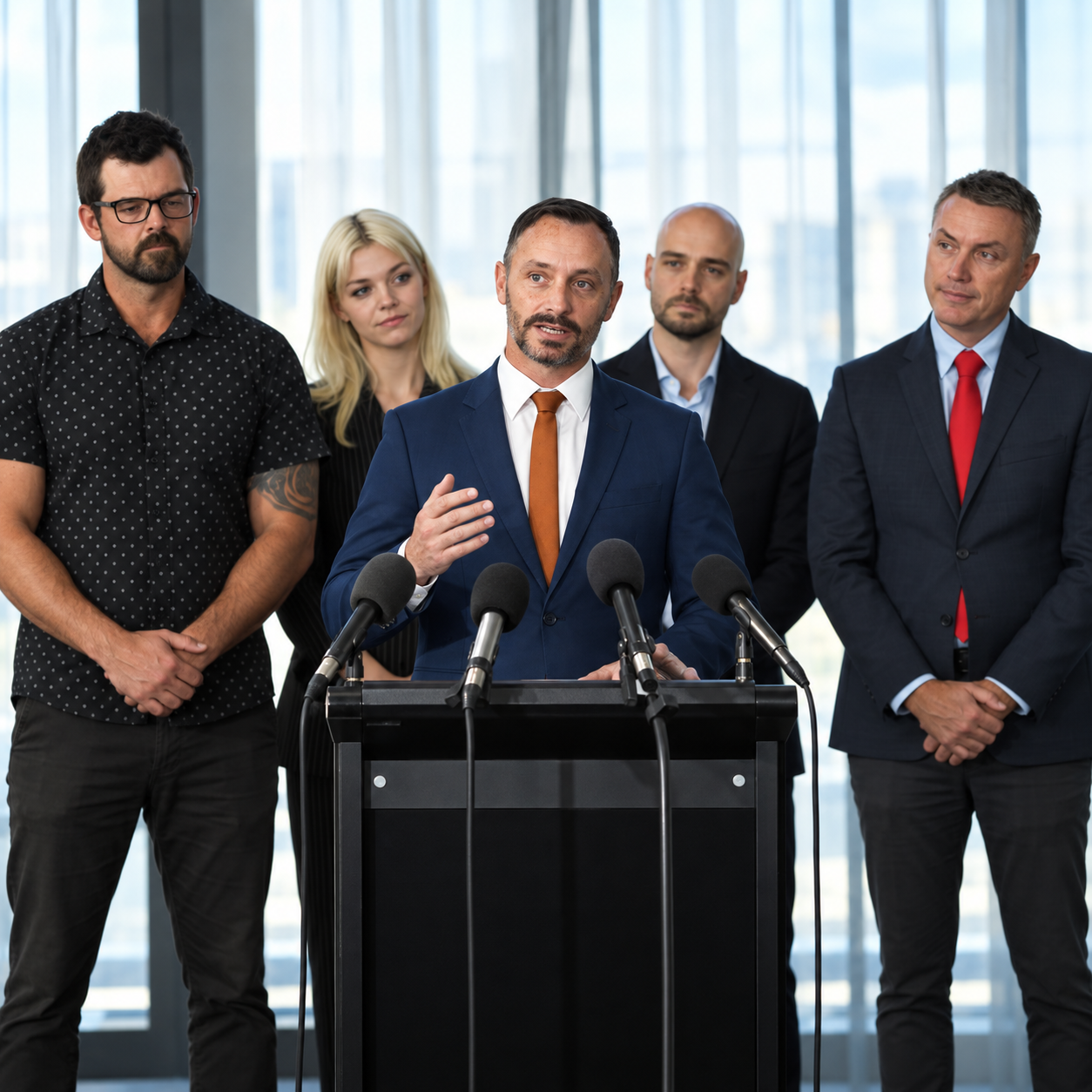
One Nation’s Victorian leader Warren Pickering has attempted to turn an intensely personal week of media scrutiny into a political argument about redemption, privacy and the standards applied to candidates who come to public life with complicated histories.
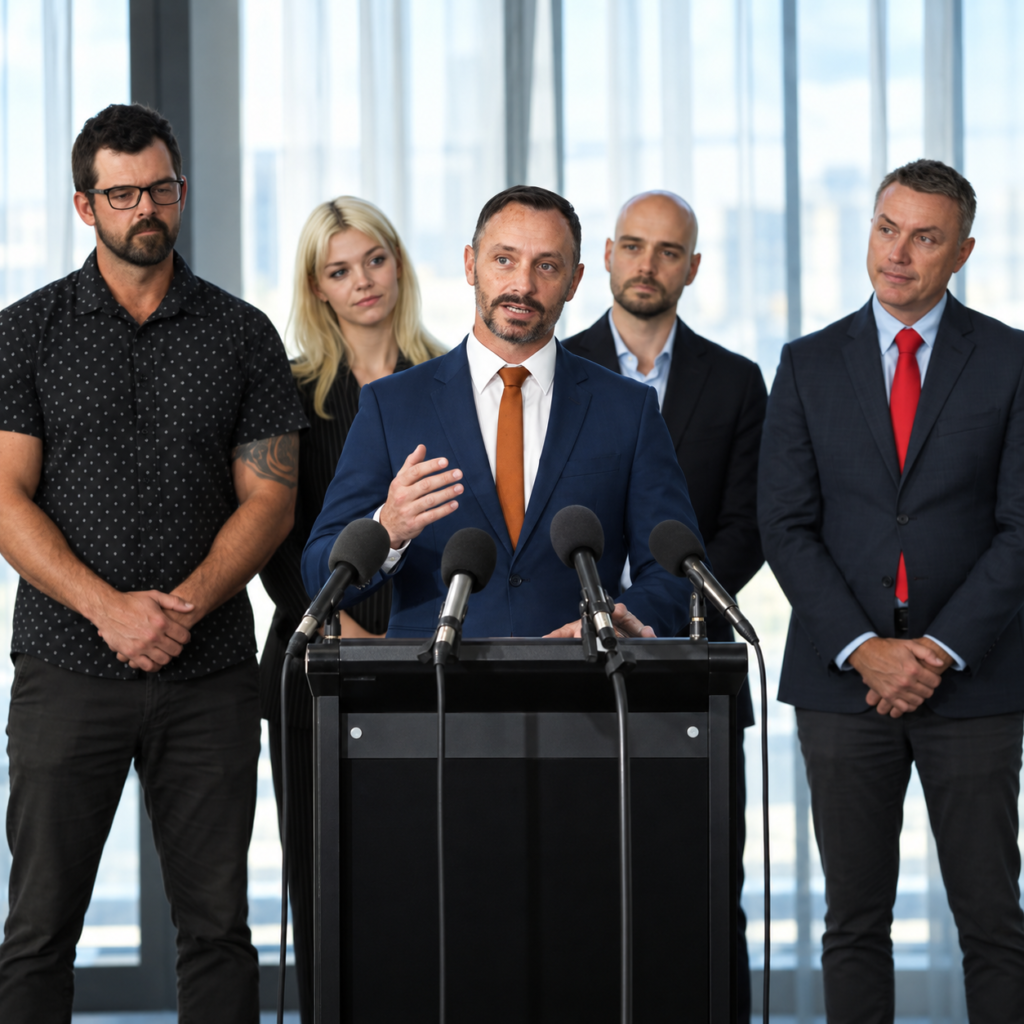
At an extraordinary Melbourne press conference on Tuesday, Pickering stood alongside his daughter, stepson and senior One Nation officials to answer allegations and historical matters reported by The Australian, including past illicit drug use, drink-driving, a First Home Owner Grant repayment and deeply personal material from his former relationship.
The 43-year-old did not emerge from the appearance claiming he had lived a blameless life.
Instead, he acknowledged using drugs including amphetamines or speed, ecstasy and marijuana when he was younger, confirmed losing his driver’s licence three times for drink-driving and expressed regret over the effect his earlier behaviour had on the people around him.
At the same time, he drew a firm line around allegations he continues to dispute, particularly claims by former partner Jo Scott that he had been a long-term user of crystal methamphetamine, or ice, and had used it around children.
Pickering denied those claims.
The result is more complicated than either of the competing political narratives now surrounding him. The newspaper’s reporting was not simply demolished: some significant elements have subsequently been confirmed by Pickering himself. But neither have the most serious disputed allegations been established as fact.
Pickering abandons the image of a blanket denial
Before Tuesday’s appearance, One Nation had broadly rejected the allegations published about its Victorian leader.
Pauline Hanson told reporters on Monday that allegations had been put to Pickering and denied.
His press conference made the picture more nuanced.
Pickering admitted illicit drug use in his 20s and said he had never claimed to have been an angel. He acknowledged decisions that hurt his family and said voters were entitled to consider those mistakes when judging him.
But he rejected Scott’s claim that he had used ice for years, including after joining the Australian Defence Force.
Asked directly whether ice was among the drugs he had used, Pickering said it was not.
He also described the allegation that he smoked ice in a house with children as among the most serious and inaccurate claims made against him.
Those competing accounts remain unresolved. Scott has maintained her version publicly, while Pickering has denied it. No court has determined who is correct on those allegations.
The $13,500 grant issue is real — but the debt was later settled
Another major strand of the scrutiny concerned a First Home Owner Grant connected with a property Pickering and Scott built in Mernda when they were a young family.
Documents reported by The Australian showed the Victorian State Revenue Office questioned Pickering’s eligibility and ultimately issued a demand in 2010 for repayment of $13,500.
The issue related to previous residential-property interests attributed to Scott.
Early reporting raised the question of whether the money had ever been repaid because taxpayer confidentiality prevented the State Revenue Office from discussing an individual file.
After Pickering’s press conference, however, The Australian itself reported that the debt had been settled.
Pickering and One Nation say he contacted the State Revenue Office after the newspaper raised the historic matter and was told the account had long since been closed.
Pickering has publicly put the resolution in 2010, around the time the property was sold.
The precise administrative history cannot currently be independently reconstructed from public State Revenue Office records because the agency does not release individual taxpayer information.
What can be said is that the original repayment demand existed and later reporting now says the debt was settled.
Why his partner’s property history mattered
One Nation has portrayed the grant issue as a technical complication affecting a young tradesman who believed he was a first-home buyer because he had personally never owned property.
That description explains Pickering’s perspective but does not remove the legal eligibility issue.
Victoria’s First Home Owner Grant legislation considers more than an individual applicant’s own property history.
The law has long included restrictions where either an applicant or the applicant’s spouse or partner previously held certain residential-property interests.
For property held before 1 July 2000, a relevant interest held by a partner can make an applicant ineligible even if the applicant personally had never owned a home.
That means the State Revenue Office’s inquiry was not inherently frivolous simply because Pickering himself was a first-time owner.
At the same time, an administrative repayment issue should not automatically be described as fraud.
The Commissioner can require an ineligible grant to be repaid and can impose penalties in certain circumstances, including where dishonesty is established. The public reporting surrounding Pickering does not establish that he was convicted of fraud or another criminal offence over the grant.
The appropriate distinction is therefore between ineligibility and criminal wrongdoing.
His children publicly defend the man who raised them
The most emotionally charged aspect of Tuesday’s appearance was the presence of Pickering’s family.
His daughter Jhett and eldest stepson Johnny stood beside him as he answered questions about years that predated his political career.
Both defended Pickering strongly.
Johnny said the children’s lives would have been worse without him and praised the changes Pickering had made in his life.
He also strongly attacked his estranged mother and disputed her account of the family’s history.
Those comments added another perspective that had largely been absent from the original reporting, but they also demonstrate why the story requires editorial caution.
This is partly a political accountability story involving the person One Nation has selected to lead its Victorian campaign.
It is also a long-running family dispute in which relatives are making serious claims about one another.
The support of Pickering’s adult children is relevant evidence of their own experiences with him. It does not independently prove that every allegation made by another family member is false.
Likewise, allegations made by an estranged former partner should not automatically be treated as established simply because they are detailed or supported by documents relating to other parts of the relationship.
One Nation says the Army changed Pickering’s life
Pickering and Hanson have placed his Australian Defence Force service at the centre of their response.
Pickering says he stopped using illicit drugs before joining the Army in 2013 and disclosed his previous use during the enlistment process.
Hanson says he subsequently held a Negative Vetting Level 2 security clearance, served operationally across eight countries and remains connected to the ADF through the standby reserves.
Pickering has described military service as the moment his life changed direction, giving him discipline, responsibility and a sense of purpose through service to others.
It is a powerful part of One Nation’s argument that voters should assess the whole of a person’s life rather than freeze their character at its lowest point.
But security vetting should not be overstated.
An ADF enlistment process or government security clearance assesses suitability for a particular role at a particular time. It is not a judicial finding that every allegation about a person’s earlier private conduct is untrue.
Nor does Defence vetting answer the separate political question of what One Nation knew before making Pickering its Victorian leader.
‘Sexual deviance’ headline also needs context
A handwritten historical note attributed to Pickering used the phrase “sexual deviance”, wording that inevitably became part of the media coverage.
James Ashby, One Nation’s national director, told reporters the phrase related to a consensual open relationship and a period when Pickering was exploring his sexuality.
Pickering also discussed having carried shame around that period because of his conservative upbringing.
There is currently no public evidence establishing that the phrase referred to criminal sexual conduct.
Reporting it without the later explanation risks allowing a highly loaded expression to imply something much more serious than what Pickering and One Nation say it described.
Was the reporting a Liberal ‘hit job’?
One Nation supporters have gone much further than simply challenging individual claims.
They have accused The Australian of deliberately targeting Pickering because One Nation is threatening Liberal support ahead of Victoria’s November election and because the party is rising nationally.
That is a political allegation for which no public evidence has yet been produced.
No material currently establishes that the newspaper received instructions from the Liberal Party, coordinated its stories with Liberal candidates or published the material for the purpose of protecting the Liberals.
The timing inevitably makes the coverage politically consequential. Pickering is not an anonymous private citizen: he is One Nation’s Victorian leader and a candidate seeking elected office while presenting himself as part of a party campaigning heavily on law, personal responsibility and institutional accountability.
That gives legitimate public-interest grounds for examining his criminal-history disclosures, drink-driving record, financial dealings and what his party knew before selecting him.
It does not mean every detail of an old relationship automatically belongs on a front page.
Questions about proportionality, tone, prominence and whether highly intimate family material genuinely informs voters are legitimate media-ethics questions.
But those questions are different from proving political collusion or fabrication.
The reporting uncovered facts as well as disputed allegations
Calling the entire episode a fabricated scandal is also difficult to reconcile with Pickering’s own admissions.
He has now confirmed past drug use.
He has confirmed multiple drink-driving incidents.
State Revenue Office documents did show a historic $13,500 repayment demand, although the debt was ultimately settled.
His family history clearly involved serious difficulties, something Pickering himself has acknowledged.
What remains disputed are some of the most damaging allegations, particularly the claims concerning prolonged ice use and drug-taking around children.
That distinction is what responsible reporting must preserve.
A newsroom should not transform an allegation into a conviction simply because the subject admits other wrongdoing. Equally, a political party cannot make documented issues disappear by labelling the entire body of reporting a smear.
A legitimate candidate-vetting question remains
The controversy also continues to raise questions about One Nation’s own processes.
Reporting indicates Scott contacted Hanson’s parliamentary office before Pickering was elevated to lead the Victorian campaign.
That does not mean her allegations were necessarily true or that One Nation was required to accept them.
But voters are entitled to ask what the party knew, what material it examined and what standard it applied before selecting Pickering for such a senior position.
One Nation’s response is that it does not seek candidates with perfectly curated lives.
Ashby has argued that the party recruits people with “lived experience” rather than candidates produced in political “petri dishes”.
That philosophy may appeal to voters who believe a person can make serious mistakes, take responsibility and still become capable of public service.
It also means the party must be prepared to explain how it distinguishes genuine rehabilitation from risks that remain relevant to public office.
The redemption argument is now the campaign
Pauline Hanson has made clear she is not abandoning Pickering.
She has described his history as a story of personal redemption, pointing to military service, his relationship with his children and his willingness to stand in front of cameras and acknowledge conduct he regrets.
The approach turns a conventional political scandal on its head.
Rather than asking voters to believe there was nothing to see, One Nation is asking them to consider whether a flawed past can itself demonstrate character when followed by substantial change.
That argument does not erase legitimate scrutiny.
Nor does scrutiny mean every allegation should be accepted, every family conflict published without context or every administrative dispute presented as criminal conduct.
Pickering’s record now contains both inconvenient facts and contested claims.
For voters, the relevant question is no longer whether he has made mistakes. He has admitted that himself.
The question is whether those mistakes, the matters he still disputes and the life he says he built afterwards make him more or less suitable to lead One Nation into Victoria’s 28 November election.
That judgment ultimately belongs neither to The Australian nor to One Nation.
It belongs to the voters.