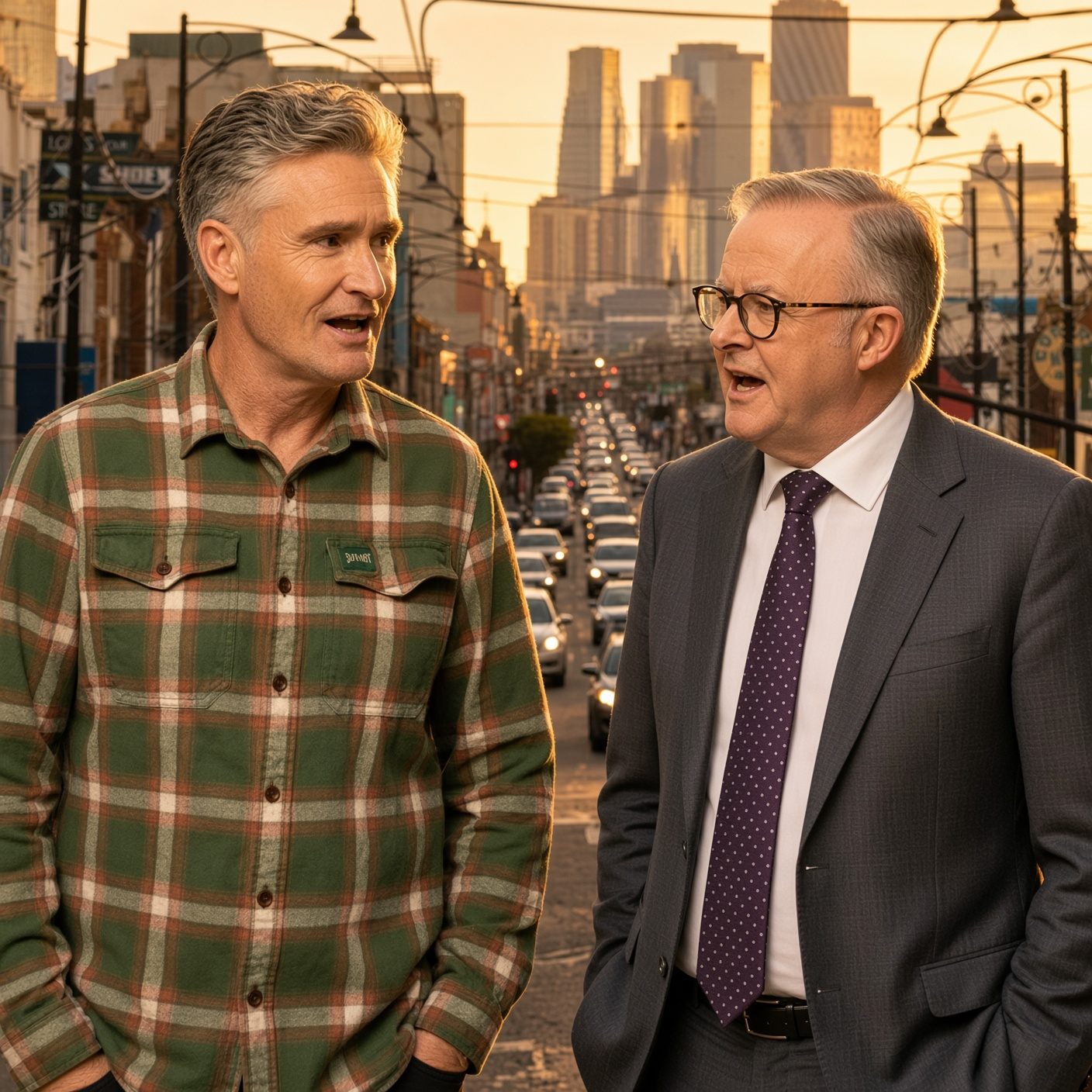
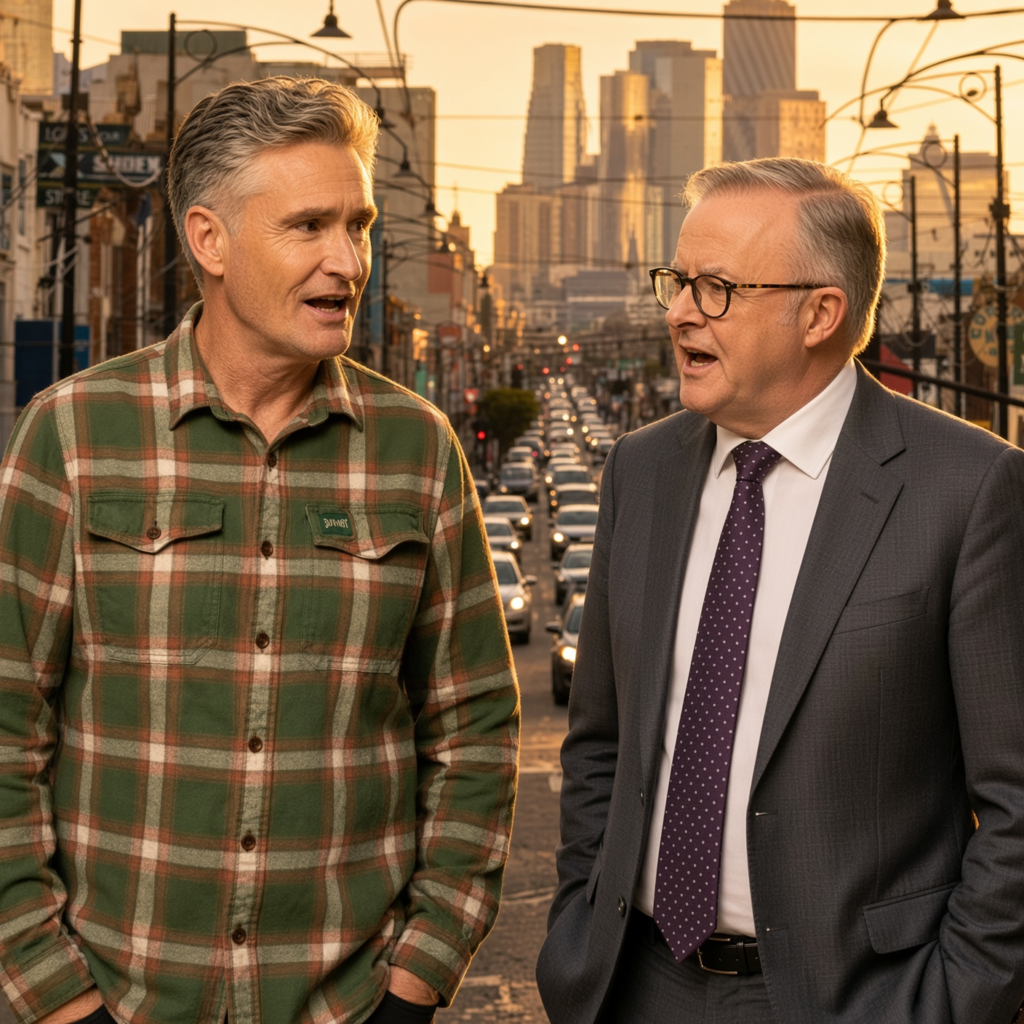
Dave Hughes has gone from publicly helping Anthony Albanese look good to becoming one of the Prime Minister’s loudest celebrity critics, but the comedian insists Australians should not mistake his political anger for a conversion to the right.
The 55-year-old entertainer, who describes himself as a lifelong Labor voter, has spent months attacking the Albanese government over tax policy, public debt, housing and what he regards as a breakdown of trust between politicians and voters.
It is a striking change for a man who says he voted for Albanese and now looks back on his years in mainstream television and radio as a period in which he helped promote the future prime minister.
Hughes has said that when Albanese was climbing towards the top job, people in his media world were effectively “pumping up his tyres”.
He now regrets his own role in that enthusiasm.
But in a new interview explaining his increasingly political public persona, Hughes rejected the idea that he has simply moved from Labor into a permanent conservative camp.
His support for the Liberals, he says, is conditional.
If they win government and repeat the behaviour he is currently condemning, Hughes says he will be “just as loud about them as well”.
That distinction helps explain why his change has attracted more attention than an ordinary celebrity endorsement.
Hughes has not spent his career as a conservative commentator waiting for an opportunity to attack a Labor prime minister.
He grew up in a working-class family in Warrnambool, has repeatedly described Labor voting as part of his family background and continued backing the party long after becoming one of Australia’s highest-profile comedians.
His father was a factory worker and union member and his mother was a nurse.
For decades, voting Labor appeared to Hughes to be almost automatic.
The rupture came after the Albanese government’s 2026–27 Budget.
Labor announced major changes to negative gearing and capital gains tax after having gone into the 2025 federal election saying it did not intend to make those changes.
For Hughes, the central problem is not merely whether the new tax policy is economically good or bad.
It is whether a government should make a substantial policy change so soon after an election without first asking voters to endorse it.
He has repeatedly argued that the government did not have a mandate for the reforms.
The measures themselves are significant.
From July 1, 2027, Labor will replace the existing 50 per cent capital gains tax discount with inflation-adjusted cost-base indexation and introduce a minimum tax rate of 30 per cent on real capital gains.
The changes are prospective, meaning gains accumulated before that date retain treatment under the existing system.
Investors buying eligible new homes will also retain a choice between the existing 50 per cent discount and the new arrangements.
Negative gearing for residential property will meanwhile be restricted largely to new builds from the 2027–28 financial year.
Properties held before the Budget announcement are grandfathered.
Labor says the reforms are intended to redirect tax incentives towards new housing supply, reduce distortions favouring asset ownership and make it easier for first-home buyers to compete.
Treasurer Jim Chalmers argues the package will help rebalance a tax system that has treated income from assets more generously than income from work.
Hughes sees it very differently.
He believes reducing incentives for investment will make it harder for ordinary Australians to build wealth outside wages and risks weakening investment at a time when households and businesses are already under pressure.
His anger has frequently focused as much on the process as the policy.
Hughes has said he would not have voted for Labor had he known the government intended to make the changes.
Albanese has not denied changing position.
Questioned about the issue in May, the Prime Minister said circumstances had changed and argued that the government had already attempted numerous measures to improve housing supply but needed to do more as home ownership moved further out of reach for younger Australians.
That explanation has not persuaded Hughes.
His social-media videos have become increasingly combative, drawing hundreds of thousands of views and occasionally moving into the millions.
His trademark rasping delivery and exaggerated frustration — long ingredients of his stand-up comedy — are now being directed towards debt, taxation and government spending rather than domestic annoyances.
The shift has made him a target inside the comedy industry.
Other comedians have mocked his political rants, while critics have pointed to his own wealth and property holdings and questioned whether a successful entertainer with a multimillion-dollar portfolio can credibly present himself as speaking for Australians struggling to buy their first home.
Hughes rejects that criticism.
He says his existing properties are not the reason for his opposition to Labor’s changes and notes that the grandfathering arrangements mean much of his own position is protected.
His stated concern is that younger Australians should have opportunities to build assets and financial independence.
That does not mean every economic claim Hughes has made is correct.
An extensive profile published by The Age in July noted several factual problems in his commentary.
Hughes had incorrectly described Australia as the highest-taxed country in the world.
He had also claimed that most of the money spent on Victoria’s Big Build was being stolen, despite serious corruption allegations surrounding parts of the construction sector not supporting such a sweeping assertion.
The same profile characterised his commentary as forceful and persuasive but not consistently accurate.
That is an important qualification as Hughes moves from entertainment into political influence.
He is a comedian expressing political opinions, not an economist, auditor or public-finance authority.
His popularity does not make every claim correct, just as his wealth does not automatically make every criticism self-interested.
What is undeniable is that his political involvement has moved well beyond an occasional angry Instagram post.
In August, Hughes appeared at the Liberal Party’s Western Victoria Region campaign launch in Geelong alongside Victorian Opposition Leader Jess Wilson.
He publicly backed Wilson and said he intends to vote Liberal at the November state election after years of supporting Labor.
Hughes has been particularly critical of Victoria’s long period of Labor government, attacking state debt, infrastructure costs, alleged corruption in construction and what he sees as deteriorating public services.
He has said Victoria needs a change of government.
Yet he continues to resist the suggestion that this makes him a permanent Liberal.
Earlier this year, when pressed on whether his politics were drifting towards Pauline Hanson’s One Nation, Hughes reacted sharply.
He said he was not with One Nation and was “not with any political party”.
He has also repeatedly ruled out running for Parliament himself.
His position is better understood as an anti-incumbent one: Labor currently holds power federally and in Victoria, so Labor is currently receiving most of his anger.
Hughes says that would change if political power changed hands.
The Liberals, in other words, are benefiting from his anger without receiving a promise of loyalty.
That is politically more interesting than a simple story of a celebrity moving from left to right.
Traditional party identification has been weakening across Australia.
Voters are increasingly willing to move between Labor, the Coalition, minor parties and independents rather than treating support for one side as a lifetime commitment.
Hughes is an unusually visible example of that process.
He previously felt culturally and personally comfortable with Labor.
He now says the party has lost his trust.
The Liberals have an opportunity to benefit from that break, but he is making clear they would need to keep earning his support.
There is another reason his criticism matters to Labor.
Hughes spent much of his career in the kind of mainstream entertainment environment in which centre-left political attitudes have often been commonplace.
He was an original host of The Project, one of Australia’s most prominent combinations of news, comedy and current affairs.
He also interviewed Albanese on commercial radio during the 2022 election campaign.
In one exchange, Hughes explicitly endorsed Labor’s argument that workers on low wages needed pay rises at least keeping pace with inflation.
Albanese jokingly thanked him for the endorsement.
Only days after Labor won that election, Albanese returned to Hughes’s radio show in a warm interview in which the presenters joked about whether life might now be easier under the new prime minister.
The relationship was hardly that of a hostile political journalist interrogating an opponent.
That history gives Hughes’s current criticism a different tone.
He is not discovering Albanese for the first time from the opposition benches.
He once wanted him to succeed.
Whether Hughes’s journey represents anything larger than one celebrity’s frustration is much harder to establish.
There is no polling that can tell Australians how many former Labor voters have changed their minds for precisely the same reasons.
Nor should viral social-media engagement be confused with representative public opinion.
People who strongly agree or disagree with Hughes are more likely to comment, repost and argue than Australians who are indifferent to him.
But his experience does illustrate a problem every government eventually encounters.
The politically dangerous critic is not always someone who never liked you.
Sometimes it is someone who voted for you, defended you and then decided you broke their trust.
Hughes says that is where he now stands.
His current support for Jess Wilson and the Victorian Liberals is real.
So is his anger towards Albanese and Chalmers.
But he insists neither should be interpreted as a promise that the Liberals will receive favourable treatment once they hold power.
If they disappoint him, Hughes says, they will hear the same voice Labor is hearing now.
For a comedian whose career has been built on loudly complaining about whatever irritates him, that may be the most consistent political position he has taken.