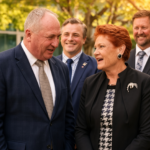
Pauline Hanson has taken One Nation’s Victorian campaign into one of the most financially pressured and politically vulnerable electorates in the state, betting that mortgage stress and frustration with the major parties can transform Pakenham from a Labor-held marginal into a lower-house breakthrough.
The outer south-eastern Melbourne electorate has become an obvious test case for One Nation ahead of Victoria’s November 28 election.
It combines an exceptionally narrow Labor margin, the retirement of its sitting MP, serious household financial pressure and a One Nation candidate with a statewide leadership profile.
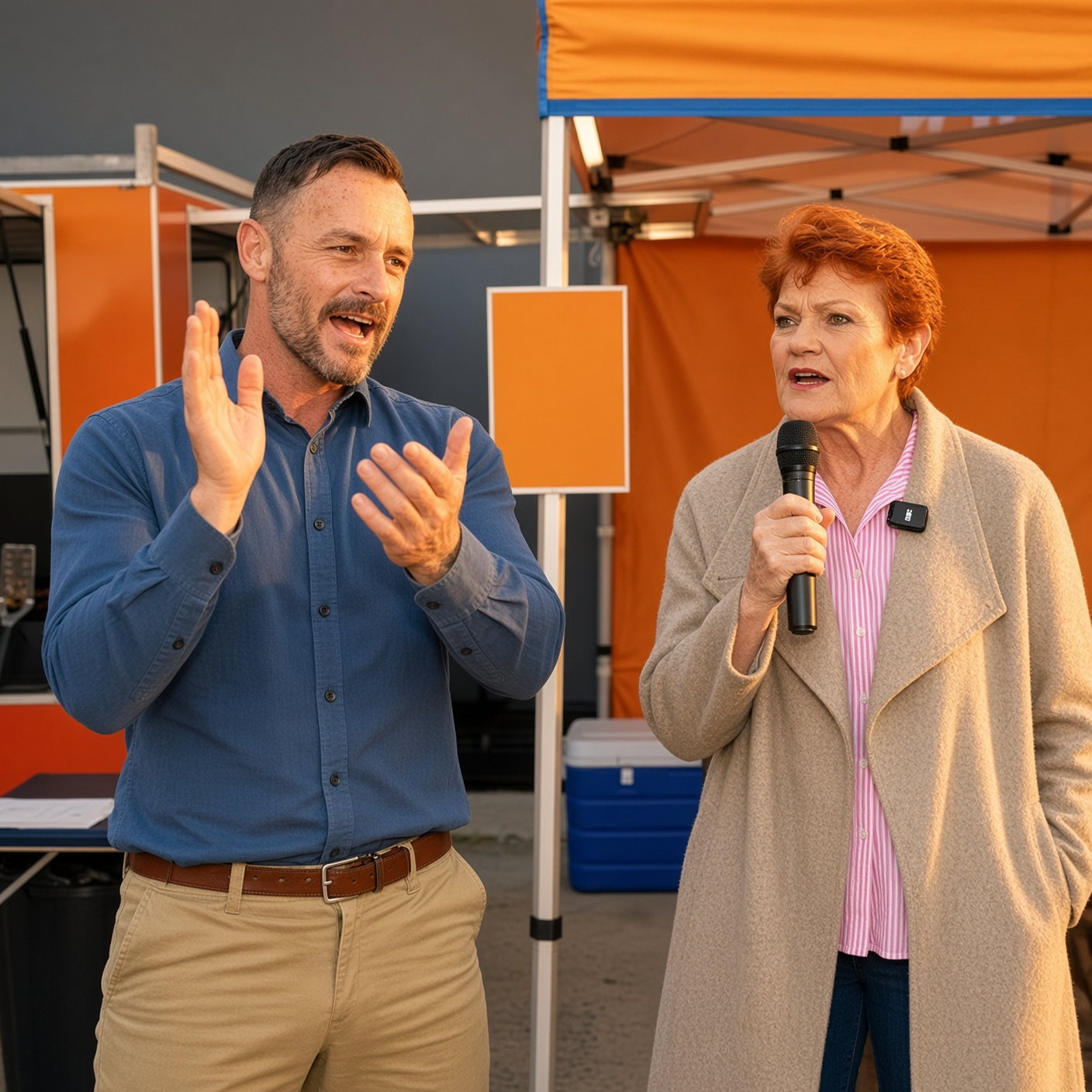
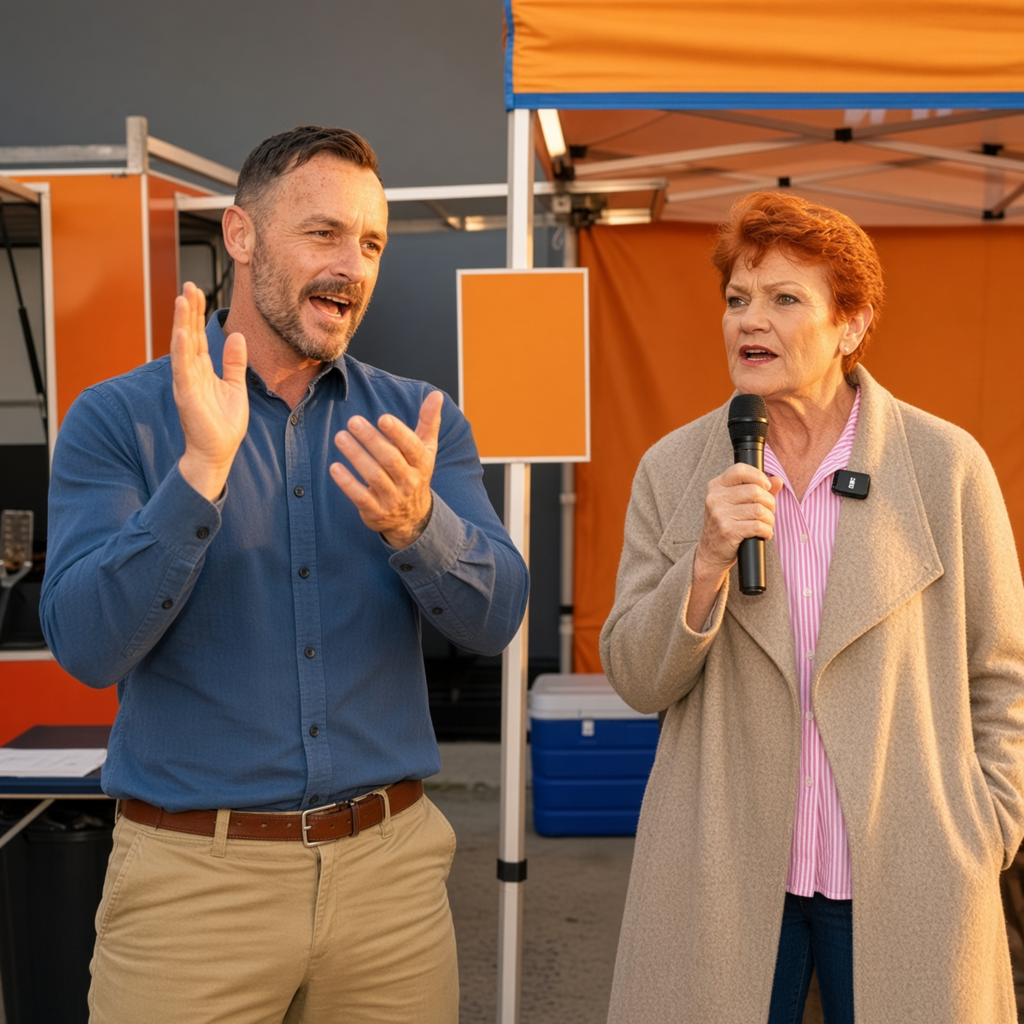
Hanson’s recent appearance alongside Victorian One Nation leader Warren Pickering at a community barbecue in Pakenham was therefore more than an ordinary campaign stop.
ABC’s 7.30 confirmed the pair were campaigning together in the electorate, about 50 kilometres from central Melbourne, as One Nation intensified its push into the city’s outer suburbs.
Pickering is the party’s candidate for Pakenham and One Nation’s Victorian leader.
The seat is exactly the type of electorate political analysts have identified as increasingly vulnerable to a party attempting to turn dissatisfaction with living standards into an anti-establishment vote.
Former Labor strategist and RedBridge director Kos Samaras has described Pakenham as “classic One Nation territory”.
His argument is centred less on ideology than on household economics.
Pakenham and surrounding parts of Melbourne’s outer south-east contain large numbers of working households facing mortgages, long commutes and rising everyday expenses while living in communities that have expanded rapidly.
Guardian Australia reported Samaras’s assessment that working-class pockets in the region were being heavily affected by cost-of-living pressure and a perception that quality of life was no longer improving.
Veteran political strategist Toby Ralph made a similar point on ABC’s 7.30, saying One Nation’s Victorian support was particularly concentrated in outer and peri-urban communities including Pakenham, Cranbourne and Melton.
He identified heavy mortgages and a belief among some voters that the political system was ignoring them as important characteristics of those areas.
Those observations have gained additional significance because Pakenham is now sitting at the top of a national mortgage-arrears table.
S&P Global Ratings data reported in late August showed postcode 3810 recording 2.88 per cent of loans in arrears as of June 30.
That was the highest rate among the postcodes included in the published national ranking, ahead of Constitution Hill in New South Wales at 2.42 per cent and Point Cook in Victoria at 2.40 per cent.
The postcode includes Pakenham, Pakenham South, Pakenham Upper and Rythdale.
Mortgage arrears do not mean 2.88 per cent of all households in the area are facing foreclosure, nor do they establish that every homeowner is experiencing serious financial distress.
But they are a useful indicator of borrowers struggling to remain current on scheduled repayments.
S&P director Erin Kitson said the pattern was particularly visible in outer suburban areas that expanded rapidly when they offered relatively affordable entry points into home ownership.
Those communities attracted many first-home buyers, including people who entered the market with relatively small deposits and had less time to build equity.
That can make financial pressure more difficult to escape.
A homeowner with substantial equity may be able to sell a property and clear the debt if repayments become unsustainable.
Someone who bought more recently with a small deposit has less room to manoeuvre, particularly if property values have softened.
For politicians, that financial backdrop is powerful because household economic pressure is experienced directly rather than through national statistics.
A family does not need to understand quarterly GDP figures to know that its mortgage repayment has risen, insurance is more expensive or less money remains after groceries and electricity bills.
One Nation is attempting to connect that personal experience with a broader political argument about government priorities.
But economic stress alone does not establish how Pakenham will vote.
Mortgage holders experiencing the same financial pressure can reach very different conclusions about migration, taxation, energy, infrastructure and which level of government is responsible.
Labor, the Liberals and One Nation will therefore all be competing to define the cause of voters’ frustration and offer the most credible solution.
What makes Pakenham particularly dangerous for Labor is how little electoral movement would theoretically be required to change hands.
At the 2022 Victorian election, Labor’s Emma Vulin received 33.84 per cent of first preferences.
Liberal candidate David Farrelly received 32.43 per cent.
One Nation’s Angela Siladji was a minor presence at that election, receiving only 3.40 per cent.
After the full distribution of preferences, Vulin finished with 19,587 votes against Farrelly’s 19,280.
The final difference was just 307 votes, giving Labor 50.39 per cent to the Liberals’ 49.61 per cent.
That official Victorian Electoral Commission figure is slightly different from the 304-vote margin appearing in some media reports.
Either way, Pakenham entered the current political cycle as one of Labor’s most precarious seats.
Labor will also go into the election without the sitting-member advantage it enjoyed in 2022.
Vulin announced in September last year that she would not seek another term after being diagnosed with motor neurone disease.
The government has publicly praised her work in the electorate, including advocacy for schools, transport projects and the new Pakenham Community Hospital.
Labor has selected Alessandra Soliven to contest the seat in her place.
The loss of an incumbent does not automatically produce a swing, but it removes personal recognition and constituent relationships that can sometimes help a marginal MP outperform their party’s broader support.
That creates a more open contest at precisely the moment One Nation is seeking to establish itself as a serious third force in Victoria.
Pickering’s candidacy is central to that strategy.
One Nation describes him as having experience in farming, construction, military service and mining, and Hanson has installed him as the public face of the party’s state campaign.
The party says it intends to contest seats across Victoria rather than concentrate solely on upper-house representation.
Pakenham gives it an opportunity to demonstrate whether its recent polling strength can be converted into a Legislative Assembly seat.
The challenge is enormous when measured against One Nation’s last result there.
Moving from 3.4 per cent of the primary vote in 2022 to winning Pakenham four years later would constitute an extraordinary realignment.
But events in Western Australia explain why the major parties are less inclined to dismiss such a possibility than they might have been only months ago.
At the Secret Harbour by-election on August 29, One Nation’s Luke Herdegen won a state lower-house seat previously held comfortably by Labor.
One Nation recorded 39.1 per cent of the primary vote, a rise of 30.7 percentage points.
Labor fell to 24.1 per cent and the Liberals finished third on 17.2 per cent.
After preferences, Herdegen led Labor by 57.2 per cent to 42.8 per cent.
The result was particularly striking because the seat had previously been considered safe Labor territory with a margin of 11.5 per cent.
Secret Harbour also shares several broad characteristics with electorates such as Pakenham.
It is outer suburban, contains many young working families and includes large numbers of voters with vocational rather than university qualifications.
Those similarities have encouraged comparisons between the two contests.
But the comparison has limits.
Secret Harbour was a by-election triggered by the resignation of a sitting MP.
By-elections regularly produce unusually large swings because voters can punish governments without deciding who will govern the state for the following four years.
Pakenham will vote as part of a statewide general election.
Labor, the Coalition and One Nation will all field broader campaigns, government formation will be at stake and preference flows may be very different.
ABC’s own election analysis cautioned that by-election results can easily be overinterpreted.
Secret Harbour therefore demonstrates that a dramatic One Nation breakthrough in an outer-suburban electorate is possible; it does not establish that Pakenham will repeat it.
One Nation also faces a different opponent structure in Victoria.
The Liberal Party came within 307 votes of winning Pakenham in 2022 and will have its own argument that voters seeking to remove Labor should back a party capable of forming government.
A strong One Nation vote could hurt Labor by attracting disillusioned former Labor supporters.
It could also hurt the Liberals if anti-government conservative voters move to One Nation instead.
Under full preferential voting, the order in which Labor, Liberal and One Nation candidates finish will be crucial.
If One Nation remains third, its preferences could help determine whether Labor or the Liberals win.
If Pickering reaches the final two candidates, the entire preference equation changes.
No reliable public seat poll currently proves which scenario will occur.
That is why statements that Pakenham is already One Nation’s to lose go beyond the evidence.
The party has a plausible opportunity, not ownership of the electorate.
There are also policy risks for One Nation.
Hanson and Pickering have campaigned on delaying the closure of coal-fired generation and removing Victoria’s prohibition on nuclear power.
Those positions may appeal to voters focused on electricity prices and energy reliability, but they can also divide an electorate in ways that cost-of-living messaging alone does not.
Pickering himself will face increasing scrutiny as the campaign develops, particularly because he is not merely a local candidate but One Nation’s Victorian leader.
Labor will meanwhile argue that voters should judge the government on tangible investment in the growth corridor.
Pakenham has received new rail infrastructure, schools and other public projects, while the Pakenham Community Hospital is under construction.
The government can point to that spending as evidence the outer south-east has not been ignored.
One Nation’s task is to persuade voters that government investment has failed to keep pace with the pressures they experience personally.
The Liberal task is different again: to convince voters dissatisfied with Labor that they do not need a third party to deliver change.
That three-way competition makes Pakenham more politically revealing than its 0.4-point margin alone would suggest.
If One Nation can build a winning lower-house coalition there, it would show the party is capable of moving beyond regional protest votes and upper-house representation into Melbourne’s mortgage belt.
If the Liberals recover the seat instead, it would suggest conventional major-party swings remain the dominant response to Labor dissatisfaction.
If Labor survives, it would demonstrate that financial stress and anti-government sentiment do not automatically translate into a One Nation breakthrough.
What can already be established is that Hanson has chosen a battleground where Labor’s vulnerability is not theoretical.
The margin is real.
The sitting MP is leaving.
The mortgage-arrears data is severe compared with other Australian postcodes.
One Nation’s state leader is personally contesting the electorate, and the federal leader has been campaigning beside him.
Those ingredients make Pakenham one of the clearest tests of an emerging question in Australian politics.
When working households under financial pressure decide the major parties are no longer delivering for them, where do their votes actually go?
Victoria will get part of the answer on November 28.