Pauline Hanson has emerged as the most trusted political leader tested in a new national survey as Australians report a dramatic collapse in confidence that hard work, government and the wider system will deliver them a better future.
The Australia Project 2026, produced by Melbourne-based research and strategy firm The Lab, surveyed 2,000 Australians between April 1 and April 14 and found striking evidence of frustration with the country’s economic and political direction.
Seventy-nine per cent of participants agreed that society was “stacked against ordinary people”, compared with 58 per cent in the previous year’s research.
Another 65 per cent said they felt they could not get ahead regardless of how hard they worked, while half of those surveyed said they were exhausted with politics.
The researchers also reported confidence in Australia’s future falling to a five-year low, adding to a picture of a country where economic stress is increasingly translating into distrust of political institutions.
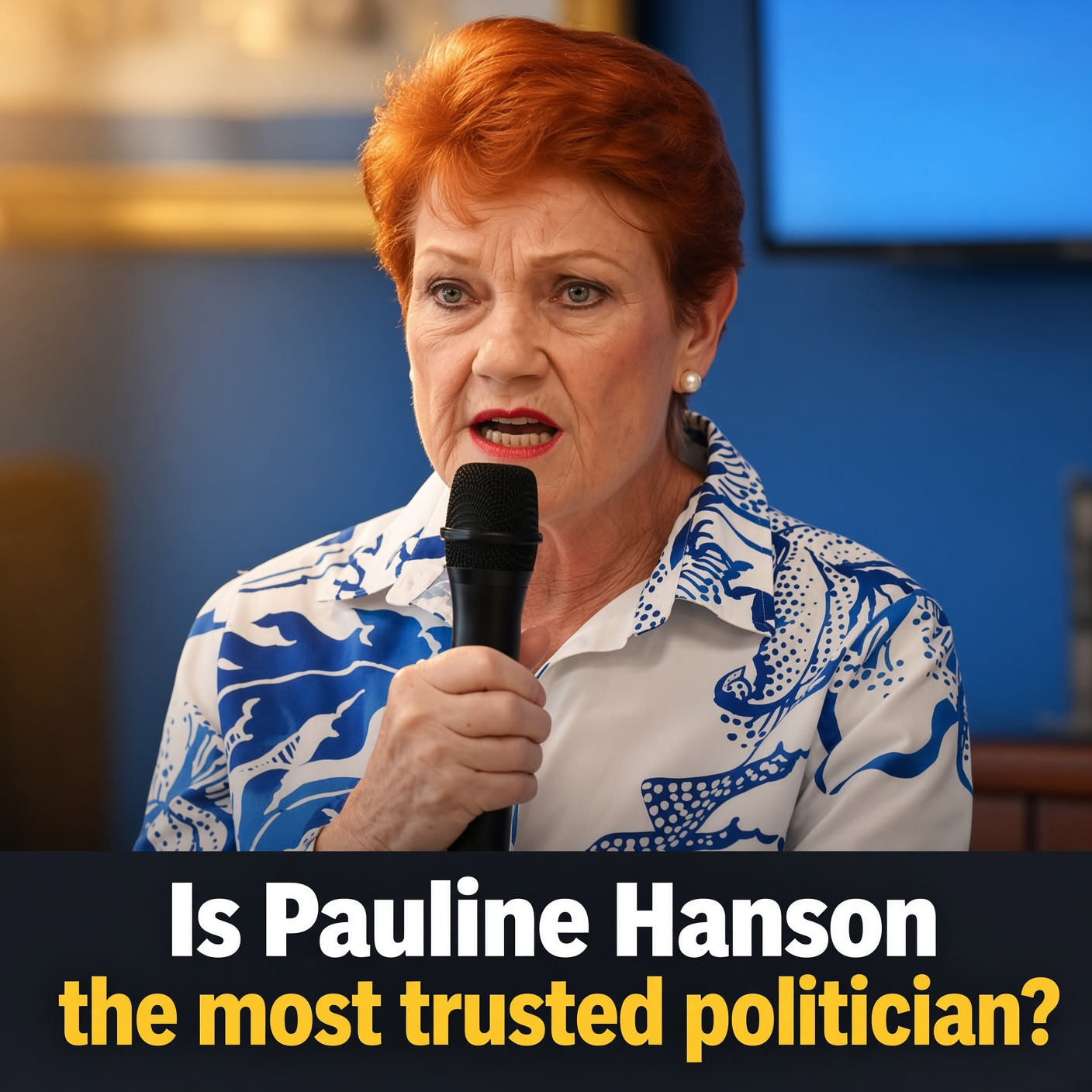
Against that backdrop, Hanson recorded the strongest result when participants were asked about trust in political leaders.
Thirty-eight per cent nominated the One Nation leader, compared with 33 per cent for Prime Minister Anthony Albanese and 20 per cent for Opposition Leader Angus Taylor.
Hanson performed particularly strongly among Australians aged 45 and over and among people living in regional areas.
The result is significant, but it requires an important qualification.
The Australia Project was not asking respondents which party they intended to support at an election.
The Lab chief executive Neale Cotton stressed that the finding measured trust rather than voting intention, warning against interpreting Hanson’s 38 per cent result as equivalent to electoral support for One Nation.
That distinction matters because Australians can regard a politician as authentic, consistent or willing to articulate their frustrations without necessarily being prepared to vote for that politician’s party.
Cotton suggested Hanson’s decades-long political message may be particularly well suited to the current mood.
For almost 30 years, Hanson has portrayed Australian politics as being dominated by major parties and institutions that have lost touch with ordinary voters.
When more Australians themselves begin to believe the system is working against ordinary people, the consistency of that anti-establishment message can become an important political advantage.
That does not mean Australians suddenly agree with every One Nation policy.
It does suggest the political environment has moved closer to the territory Hanson has occupied for much of her career.
The change in sentiment recorded by The Lab is particularly striking because of its scale.
A 21-percentage-point increase in a single year in the share of Australians who believe society is stacked against ordinary people represents a substantial shift in public mood.
The Lab director Paul Labagnara described this year’s movements in confidence as among the sharpest he had seen during the project’s history.
The Australia Project has examined Australian attitudes for more than a decade, looking beyond conventional election polling to questions about cultural values, economic security, trust and expectations for the future.
Labagnara said the latest results appeared to reflect the cumulative effect of several pressures rather than a reaction to one isolated political event.
Housing affordability remains severe. Household budgets have been squeezed by living costs. Australians have faced renewed interest-rate pressure. Global conflict has contributed to uncertainty around fuel and energy costs. Online political debate has become increasingly polarised.
The survey was conducted during an especially unsettled period.
The Reserve Bank had increased the cash rate by 25 basis points in February and again in March, taking it from 3.60 per cent at the end of 2025 to 4.10 per cent during the survey period.
A third rise followed in May, taking the cash rate to 4.35 per cent, where the Reserve Bank was still holding it in August.
The RBA said the increases were required after inflation accelerated during the second half of 2025, with the Middle East conflict and higher fuel prices adding another source of pressure.
For households already paying large mortgages or struggling with rent, those pressures provide an important backdrop to the survey’s finding that nearly two-thirds of Australians feel hard work is no longer enough to get ahead.
That sentiment reaches beyond immediate financial hardship.
The traditional Australian promise has long been that a steady job, disciplined saving and sustained effort can deliver improving living standards, secure housing and greater opportunities for the next generation.
When people begin to doubt that relationship between effort and reward, the political consequences can be profound.
Voters become less attached to governments defending existing institutions and more receptive to politicians promising to challenge them.
The finding that 50 per cent of participants were exhausted with politics also presents a problem for both major parties.
Political disengagement does not necessarily mean Australians are apathetic about the issues affecting them.
It can mean precisely the opposite: people care about housing, living costs, healthcare, immigration, energy and their children’s futures but have lost confidence that familiar political arguments will solve those problems.
Labagnara said qualitative responses to the research included Australians describing a feeling of moving from one crisis to another.
He argued the major parties needed to provide greater clarity about where the country was heading, particularly on cost of living and long-term economic security.
That broader sense of disillusionment is now being reflected in conventional political polling as well.
The latest Newspoll, conducted shortly before One Nation’s breakthrough victory in the Western Australian seat of Secret Harbour, placed One Nation on 30 per cent of the national primary vote.
Labor was on 29 per cent and the Coalition on 19 per cent.
It represented an extraordinary position for a party that spent much of its history on the fringes of federal politics.
The Secret Harbour result added another tangible sign of the shift.
One Nation candidate Luke Herdegen won the traditionally Labor-held seat at the August 29 by-election, delivering the party its first lower-house seat in Western Australia.
But the same polling also demonstrates why Hanson’s trust result should not be interpreted as evidence that she has overtaken Albanese as the electorate’s preferred choice to lead the country.
When Newspoll respondents were given a three-way leadership choice, Albanese remained ahead on 46 per cent, Hanson recorded 31 per cent and Taylor 23 per cent.
When preferences were distributed between Albanese and Hanson, the Prime Minister retained a 56 to 44 per cent advantage.
The contrast is revealing.
Hanson can simultaneously be the leader recording the highest trust figure in one survey while Albanese remains preferred to her in a direct leadership contest in another.
The measurements answer different questions.
Trust can be driven by consistency, perceived authenticity and the belief that a politician says what they genuinely think. Voting decisions require voters to consider a much wider range of issues, including policies, competence, candidates, party preferences and who they want to form government.
For One Nation, however, the direction of travel remains politically significant.
The party’s traditional strength has been its ability to convert dissatisfaction with established politics into support from voters who feel ignored by the major parties.
The Australia Project findings suggest the pool of Australians feeling that way has expanded dramatically.
Hanson’s strongest trust results among older and regional Australians are also consistent with areas where One Nation has traditionally found fertile political ground.
The greater challenge for Labor and the Coalition is that dissatisfaction is no longer confined neatly to a single ideological group.
Housing affordability affects younger Australians and renters. Higher mortgage repayments hit middle-income homeowners. Energy and fuel costs affect households and businesses. Regional communities have distinct concerns around infrastructure, employment and services.
Different groups may disagree sharply about the solution while sharing the view that the existing system is not delivering for them.
Labor has responded to One Nation’s rise by drawing an increasingly explicit political contrast.
Albanese recently told Queensland Labor delegates that “hard right populists” were on the march internationally and argued that Labor needed to defeat political movements based on division and misleading claims.
Hanson has responded by presenting those attacks as further evidence that established political parties are unwilling to listen to Australians who reject their agenda.
The Coalition faces a different and potentially more serious structural challenge.
One Nation’s growth has drawn heavily from voters who might traditionally have regarded the Liberal and National parties as their natural home.
With the Coalition recording only 19 per cent in the latest Newspoll, Taylor must find a way to win back conservative and economically frustrated voters without simply reproducing One Nation’s platform.
The Lab’s findings therefore matter for all three leaders.
Hanson can point to evidence that her anti-establishment message is resonating far beyond One Nation’s historic base.
Albanese can point to polling showing that Australians still prefer him over Hanson when asked who should lead.
Taylor faces the urgent task of rebuilding trust in an opposition that is currently being squeezed by both Labor and One Nation.
The bigger warning, though, sits above the contest between individual parties.
When 79 per cent of respondents say the system is stacked against ordinary people and 65 per cent say hard work no longer guarantees progress, the problem is not simply that voters dislike a particular government.
It indicates a weakening belief in the basic economic and political bargain Australians expect their country to provide.
That is fertile territory for any anti-establishment movement.
Whether Hanson can convert that trust into enough votes and seats to fundamentally reshape Australian government remains a very different question.
But the major parties now have clear evidence of what they are competing against: not merely Pauline Hanson, but a rapidly expanding conviction among Australians that the political system itself is no longer working for people like them.