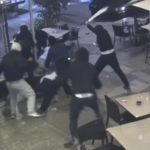
A Brisbane man who wielded a machete during a violent road-rage confrontation before turning on a truck driver who was filming the incident has been released on immediate parole after spending more than a year in custody awaiting sentence.

Echibaketa Byamungu was sentenced in the Queensland District Court on Tuesday to three years’ imprisonment over the violent August 2025 incident on Persse Road at Runcorn.
Judge Deborah Holliday ordered his immediate release on parole after taking into account the approximately 370 days he had already spent in custody on remand.
The result means Byamungu did not simply receive a non-custodial penalty. He was sentenced to imprisonment, but was eligible to leave custody immediately under parole supervision because of the substantial period already served before sentence.
The court heard the confrontation unfolded on August 27, 2025, when Byamungu and another man became involved in a dispute with occupants of other vehicles on the busy south Brisbane road.
Footage of the incident shows Byamungu carrying a hammer at one point and later holding a long machete as the confrontation escalated.
Truck driver William Hughes became involved after he stopped behind the disturbance and began recording what was happening.
According to facts reported from the District Court proceedings, Byamungu’s co-accused, Joseph Kalwisha, allegedly approached Hughes’ truck, reached into the cab and removed the keys while demanding access to the recording.
Prosecutors allege Kalwisha then attempted to use the keys as a weapon, bit Hughes multiple times and tried to bite his face during the struggle.
Those allegations against Kalwisha remain before the courts. He has not been convicted over the Runcorn incident and is entitled to the presumption of innocence.
Byamungu, by contrast, has admitted his own criminal conduct.
The District Court heard that he approached Hughes’ truck armed with a machete and thrust the weapon towards the cab through a window.
He was also involved in violence against another man during the confrontation.
Byamungu pleaded guilty to offences including common assault, attempted armed robbery with personal violence and assault occasioning bodily harm, as well as weapons and drug-related offences arising from the incident.
Judge Holliday described the episode as a “shocking example of public violence”.
The court noted that Byamungu had possession of a machete on two separate occasions during the events of that morning, a feature that significantly increased the seriousness of his conduct.
The public setting also mattered.
The confrontation took place on an active suburban road where passing motorists and other members of the community had no involvement in the original dispute but were exposed to the danger created by weapons and escalating violence.
Hughes told the court that the attack had left a lasting psychological impact.
Outside court after sentence, he said Byamungu’s release meant the community would now see whether the offender could remain out of trouble.
The case has attracted particular attention because of what had happened only one day earlier.
On August 26, 2025, Byamungu appeared in Brisbane Magistrates Court and pleaded guilty to assaulting Brisbane City Council bus driver Chun-hung Chiang in a separate incident that had been captured on video and widely circulated online.
The bus assault had occurred at South Bank in June.
The court heard Chiang asked Byamungu to leave the bus after previous interactions between them. During the confrontation, Chiang used physical force while attempting to remove him.
Byamungu then struck the driver repeatedly.
A passenger’s video captured members of the public telling him to stop as he hit Chiang around the head and face.
When the bus case returned to court for sentencing on August 28, 2025, there had been a dramatic change in circumstances.
Byamungu appeared by video link from the Richlands watch house because he had been arrested over fresh offences arising from the Runcorn confrontation the previous morning.
His lawyer told the magistrate that the new arrest had taken him by surprise.
Deputy Chief Magistrate Anthony Gett nevertheless proceeded with sentencing on the bus assault.
He described Byamungu’s response to the bus driver as “grossly disproportionate” and said the offending had been fuelled by rage.
The magistrate imposed a six-month jail sentence suspended for an operational period of 18 months and ordered Byamungu to pay Chiang $1,000 in compensation.
The timing means the Runcorn violence did not occur after Byamungu had walked out of court following the suspended sentence, as some accounts have implied.
It occurred after his guilty plea in the bus case but before sentence was formally imposed.
By the time the suspended sentence was handed down, Byamungu was already back in custody over the new allegations.
His personal background has also been described inaccurately in some coverage of the latest sentence.
Byamungu has frequently been labelled a “Congolese refugee”.
During the earlier Magistrates Court proceedings, however, the ABC reported that the court was told he was born in a refugee camp in Tanzania, lived there until he was seven and then moved to Queensland.
The court was also told he had since become an Australian citizen.
His lawyers have referred to childhood trauma associated with war and his family’s African background when making sentencing submissions.
Those circumstances can be relevant to sentencing because courts consider an offender’s upbringing, rehabilitation prospects and personal history.
They do not excuse criminal conduct.
In the latest proceeding, Judge Holliday weighed Byamungu’s background alongside the seriousness of the violence, his early guilty pleas, expressions of remorse and comparatively limited prior criminal history.
His defence submitted that he had completed school, maintained employment and had realistic prospects of rehabilitation.
The court also considered the prosecution case that the co-accused played a more significant role in instigating parts of the confrontation.
That did not remove Byamungu’s individual responsibility for approaching the truck with a machete or for the offences to which he pleaded guilty.
It was nevertheless relevant to determining an appropriate sentence for his particular conduct rather than sentencing him for allegations against somebody else.
The distinction is especially important because Kalwisha’s case has not yet been determined.
He faces charges arising from the Runcorn incident, including allegations of attempted armed robbery with personal violence and assault.
Media reporting indicates his matter is due to return to court on September 17.
Until pleas are entered and the allegations are resolved through the court process, they remain allegations.
The ethnicity of the people involved has featured prominently in some reporting and social-media commentary about the case.
But racial descriptions add little to the legal facts before the court.
The case concerns identifiable individuals and their alleged or admitted conduct, not broader African, Congolese, Zambian, Afghan or refugee communities.
It is also inaccurate to use Byamungu’s childhood refugee background as though it describes his current citizenship status when court reporting establishes that he is an Australian citizen.
The more substantial public-interest question is the sequence of offending and the operation of Queensland’s sentencing system.
Byamungu had been on bail when the bus-driver assault occurred and later pleaded guilty to that offence.
Before he could be sentenced for it, he became involved in the serious Runcorn incident.
He then remained in custody for approximately a year while that case progressed.
When Judge Holliday imposed the three-year sentence this week, that time on remand could not simply be ignored.
Time spent in custody before sentence is a significant factor in determining how much of a prison term remains to be served.
The immediate parole decision has inevitably created a striking headline: a man convicted over an incident involving a machete walked out of court.
But the full chronology shows that he had already spent 370 days behind bars before doing so.
That does not settle the debate over whether the sentence was sufficiently severe.
Victims, members of the public and prosecutors can reasonably regard the use of a machete during a roadside confrontation as extremely serious offending.
Hughes’ own comments make clear that the consequences did not end when the physical struggle was over.
At the same time, courts are required to sentence an offender according to the offences actually proved, the person’s individual role, guilty pleas, prior history, rehabilitation prospects and time already spent in custody.
Judge Holliday’s remarks show that she regarded the violence as shocking while ultimately determining that immediate parole after the lengthy remand period was appropriate within the overall three-year sentence.
Byamungu is therefore no longer being held in full-time custody over the Runcorn case, but he is not in the same legal position as a person who was acquitted or received no prison sentence.
He is a convicted offender serving a three-year sentence in the community on parole and remains subject to the conditions and supervision attached to that release.
The case of his alleged co-offender remains unresolved.
For Hughes, the court proceedings have at least produced a conviction and sentence against one of the men involved in the violence he encountered while simply driving through Runcorn and recording what was happening in front of him.
Whether Byamungu can now fulfil the rehabilitation prospects put forward on his behalf will be tested outside prison.