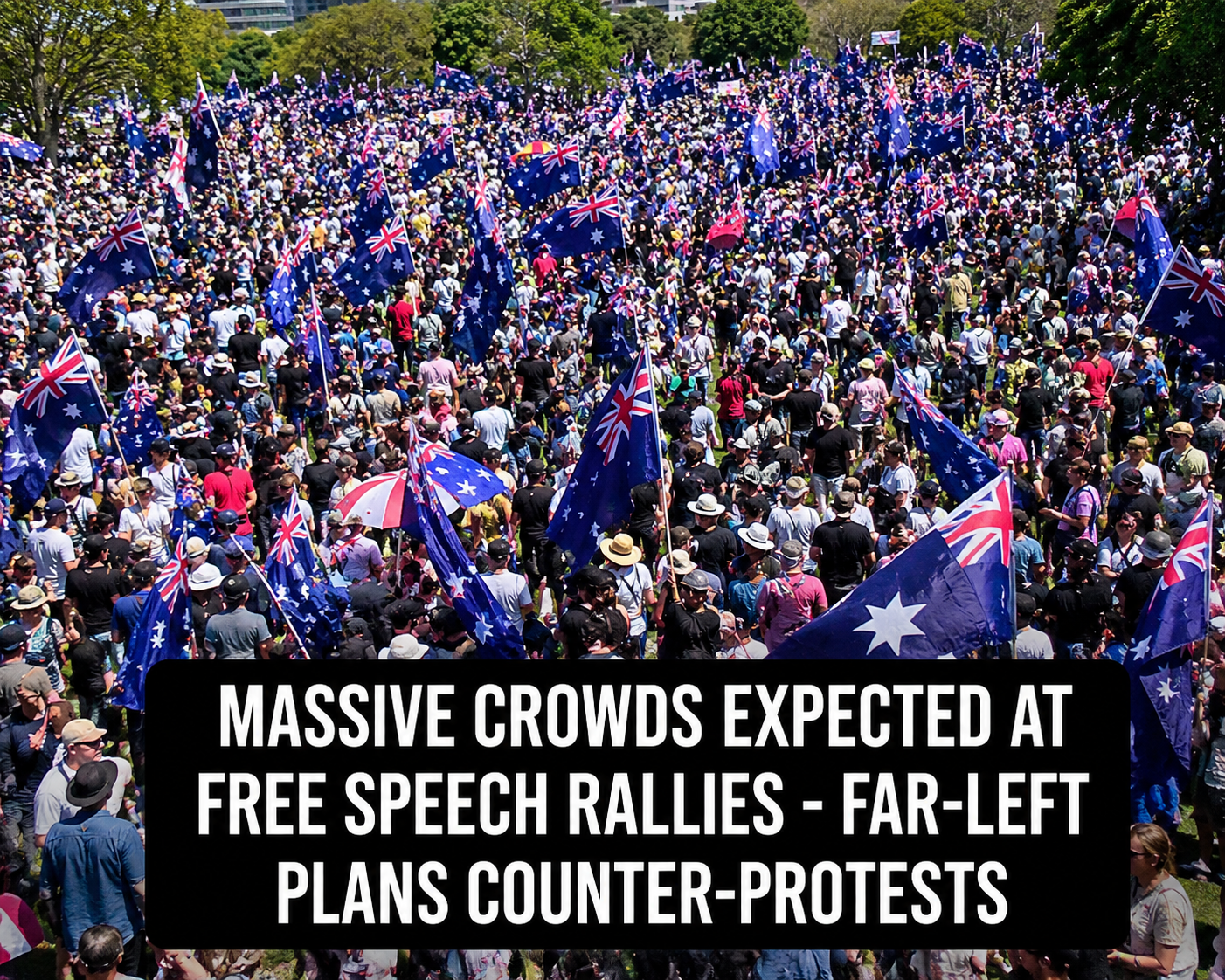
Rival demonstrations are set to take place across Australian capitals on Sunday as March for Australia returns to the streets with a new campaign centred on free speech, while anti-racism groups organise counter-protests amid an increasingly heated national argument over hate laws, political expression and immigration.
March for Australia has confirmed demonstrations in Sydney, Melbourne, Brisbane, Canberra, Adelaide and Perth on August 30, marking roughly a year since the movement emerged through nationwide anti-immigration rallies.
This time organisers are placing freedom of speech at the centre of their campaign.
The demonstrations are scheduled to begin at noon in Sydney, Melbourne, Brisbane, Canberra and Adelaide, with Perth starting at 1pm. Organisers have called on participants to carry Australian flags and say the events are intended to be peaceful.
Counter-demonstrations are also being promoted in several capitals, setting up another potentially tense day for police after previous March for Australia events brought opposing political groups into close proximity.
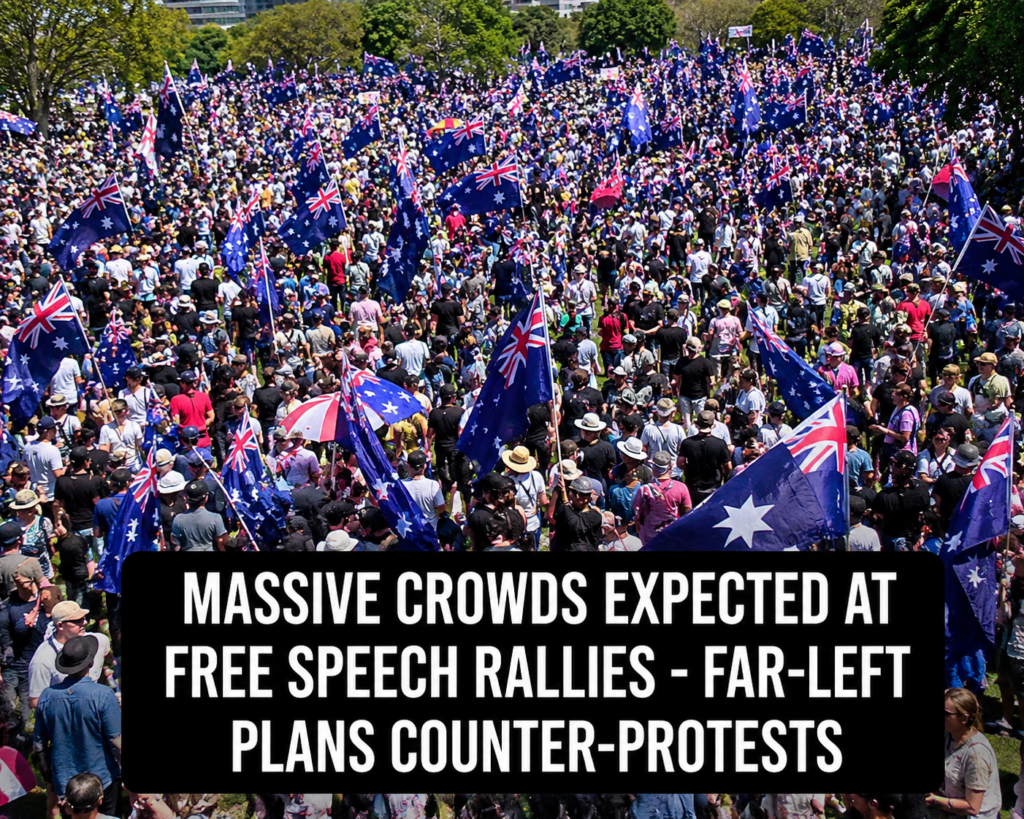
How large Sunday’s crowds will ultimately be remains unknown. Organisers are predicting a significant turnout, but no reliable crowd estimate can exist until the demonstrations take place.
Six capitals confirmed for Sunday
March for Australia’s official schedule lists events at Belmore Park in Sydney, the steps of Flinders Street Station in Melbourne, Roma Street Parklands in Brisbane, Parliament House Lawns in Canberra, Rundle Park in Adelaide and Langley Park in Perth.
The eastern-state rallies are scheduled from noon until 2pm. Perth’s event is listed from 1pm until 3pm.
The organisation describes the campaign as a defence of political expression and argues that federal and state restrictions have gone too far in attempting to regulate offensive, hateful or extremist conduct.
Its published demands include repealing laws it considers restrictions on political speech, ending government regulation of online discourse, abolishing the eSafety Commissioner and holding a referendum to provide constitutional protection for freedom of speech.
Those demands go considerably further than opposition to one particular piece of legislation and would involve substantial changes to Australia’s existing regulatory system.
Australia does not have an American-style constitutional First Amendment guaranteeing a general right to free speech. The High Court has recognised an implied freedom of political communication, but that operates primarily as a restriction on legislative and executive power rather than a broad personal right to say anything without legal consequence.
That distinction has become increasingly important as activists challenge the Albanese government’s new hate and extremism laws.
Latham and Ruddick among Sydney speakers
The Sydney demonstration is expected to have the most prominent political speaker line-up announced so far.
Independent NSW upper house MP and former federal Labor leader Mark Latham is scheduled to address the crowd at Belmore Park.
He will be joined by Libertarian Party NSW Legislative Council member John Ruddick, former federal Liberal MP and political commentator Ross Cameron, Revive Australia founder and Sydney March for Australia organiser Brian Marlow, and Father Chris Yates.
Ruddick has previously participated in March for Australia demonstrations and has argued publicly for both stronger free-speech protections and a major reduction in immigration.
He has also previously rejected some of the more extreme ideas associated with figures who have attended or promoted the rallies.
That distinction matters because March for Australia has faced sustained scrutiny over the political backgrounds and online activity of some people involved in its organisation and promotion.
An ABC News Verify investigation before the first August 2025 rallies identified organisers and promoters with links to white-nationalist ideas and found that an early version of the movement’s website had referred to “remigration”, a term associated in Europe and elsewhere with proposals for large-scale removal of migrants.
March for Australia organisers at the time rejected claims that the National Socialist Network was behind their events and said they were not acting on behalf of that organisation.
ABC found no evidence that the NSN itself had organised the original marches.
Counter-protests are being organised
Opponents of March for Australia are also preparing demonstrations on Sunday.
In Sydney, the Campaign Against Racism and Fascism is promoting a “Rally Against Racism and the Far Right” at the Archibald Fountain in Hyde Park from noon, placing the rival events in the same central-city area at approximately the same time.
Its organisers accuse March for Australia of promoting far-right and anti-immigration politics and say they want a large public demonstration against those ideas.
In Brisbane, a “March for a Diverse Australia” has been advertised at Queens Gardens.
Adelaide activists have organised a “Yes to Free Speech — No to Racism” rally beginning at Hindmarsh Square before a planned march towards Victoria Square.
That event is explicitly presenting itself as both pro-free-speech and opposed to what organisers describe as racism and fascism, illustrating that the political dispute is not simply divided between people who support free expression and people who oppose it.
Melbourne activists have also been organising opposition to the March for Australia gathering and support around Camp Sovereignty, the Indigenous protest site that became the focus of violence following last year’s August rally.
Police preparations will be closely watched, particularly in Melbourne and Sydney, where previous demonstrations have required substantial operations to keep opposing groups separated.
Previous marches have produced both large crowds and controversy
March for Australia first attracted national attention on August 31 last year when anti-immigration demonstrations were held across the country.
The movement drew participants concerned about migration levels, housing pressure and national identity, alongside politicians and activists from different parts of the political right.
The rallies also attracted neo-Nazis and other extreme-right figures, generating controversy over the extent to which extremist groups were attempting to exploit larger demonstrations involving people with a wider range of views.
Organisers repeatedly sought to distance the movement from formal neo-Nazi organisations.
Turnout varied considerably between cities and between successive demonstrations.
In Adelaide in August 2025, South Australia Police estimated about 15,000 people participated across the March for Australia demonstration and its counter-rally. In Melbourne on Australia Day this year, about 2,000 people attended the March for Australia event.
That history makes it plausible that Sunday’s rallies could attract substantial crowds, but claims that “massive” numbers are certain remain predictions rather than established facts.
The previous events have also demonstrated the risk created when politically hostile groups gather in the same areas.
During the August 2025 Melbourne demonstrations, hundreds of police were deployed to keep groups apart as protesters moved through the CBD. Clashes and confrontations occurred despite police lines.
Those experiences are likely to shape policing arrangements on Sunday.
Free speech campaign comes after major new hate laws
The immediate political backdrop to the demonstrations is the significant expansion of Commonwealth hate and extremism laws in 2026.
Parliament passed the Combatting Antisemitism, Hate and Extremism legislation in January following intense political debate over antisemitism, extremist organisations and politically motivated violence.
The reforms increased penalties for existing offences, created aggravated offences in certain circumstances, expanded migration powers relating to hate-motivated conduct and established a federal framework for declaring organisations to be prohibited hate groups.
The government says the legislation targets conduct connected with hatred, violence and extremism rather than ordinary political disagreement.
Official Attorney-General’s Department guidance explicitly states that the Act does not criminalise non-violent political opinions, mere expressions of belief or legitimate non-violent criticism of governments and political ideologies.
Critics dispute whether the safeguards are sufficient.
They argue that the breadth of the prohibited-group regime and the penalties associated with involvement in a listed organisation create a chilling effect on political association and expression.
That constitutional and civil-liberties argument has now moved beyond rallies and into the High Court.
White Australia ban is being challenged in the High Court
The Albanese government’s prohibited hate group powers were used against White Australia earlier this year.
Regulations specifying White Australia as a prohibited hate group were signed on May 15 and came into effect the following day.
Under the legislation, the government must satisfy statutory requirements relating to an organisation’s involvement in, preparation for, assistance with or advocacy of conduct constituting a hate crime before listing it.
The listing carries serious criminal consequences for certain forms of participation in or support for the organisation.
White Australia has challenged the regime in the High Court.
The constitutional case asks whether the prohibited hate group provisions impermissibly burden the implied freedom of political communication, whether the Commonwealth has sufficient legislative power for the regime and whether aspects of the legislation conflict with the constitutional separation of judicial power.
The existence of the challenge does not mean the legislation is invalid. Unless and until the High Court rules otherwise, the law and the listing remain operative.
But the case gives Sunday’s free-speech campaign a concrete legal controversy around which to mobilise.
March for Australia organiser Hugo Lennon has repeatedly attacked the new regime and called for constitutional protection of free speech.
He argues that political views which should be contested democratically are increasingly being subjected to government regulation.
The government takes the opposite view: that the prohibited-group laws are directed at organisations associated with specified forms of hate crime and do not criminalise ordinary non-violent political advocacy.
Immigration remains intertwined with the campaign
Although organisers have rebranded Sunday’s nationwide action around free speech, immigration remains deeply connected to the movement.
The first March for Australia rallies were primarily promoted around opposition to what organisers called “mass immigration”, and immigration continues to feature prominently in the messaging of leading activists.
Lennon says the movement helped force immigration into the centre of national political debate and points to One Nation’s recent polling rise as evidence that voters are increasingly dissatisfied with the major parties.
That is his political assessment rather than an established causal relationship. Immigration had already become a major federal issue through the housing shortage, the post-pandemic surge in net overseas migration and an increasingly competitive debate between Labor, the Coalition and One Nation.
There is, however, clear evidence that voter concern about migration has increased and that One Nation has benefited from a broader shift in the political environment.
Relations between some March for Australia activists and One Nation have recently become strained.
Hardline anti-immigration figures have criticised the party following conflicting explanations of its proposed 130,000 net overseas migration target, particularly over the treatment of temporary and Pacific labour workers.
That dispute means Sunday’s rallies are not straightforward One Nation events, despite overlap between some of the political issues and constituencies involved.
Sunday will test both the movement and police
For March for Australia, the August 30 demonstrations will provide the clearest indication yet of whether it can shift from an anti-immigration protest movement into a broader campaign around civil liberties and political speech.
For its opponents, the rallies are an opportunity to challenge what they regard as an attempt to mainstream far-right politics under the banner of free expression.
Neither side’s characterisation should be accepted as a complete description of everyone who attends.
People can oppose new hate laws without supporting racism or extremist organisations. Equally, describing an event as a free-speech rally does not erase documented links between some figures involved in the broader movement and extreme-right ideas.
That complexity is likely to define Sunday’s demonstrations.
Police will also face the practical task of allowing lawful political protest while preventing confrontations between groups whose views are fundamentally opposed.
The organisers of March for Australia are telling participants to demonstrate peacefully and follow police instructions. Counter-rally organisers in Adelaide have similarly said they intend to remain at a safe distance rather than engage in street confrontations.
The scale of the rallies will not be known until crowds assemble.
What is already clear is that the political argument surrounding them has changed substantially since the movement first marched a year ago.
Immigration remains part of the agenda, but Sunday’s events arrive amid a live constitutional challenge, new federal powers to prohibit hate groups and an increasingly contentious argument over where Australia should draw the boundary between protecting political expression and restricting conduct associated with hatred and extremism.
With rallies and counter-protests scheduled across multiple capitals, August 30 is set to become another public test of that boundary — not only for the activists on both sides, but for police, lawmakers and a country still debating how far freedom of political speech should extend when it collides with laws designed to prevent hate and extremist violence.