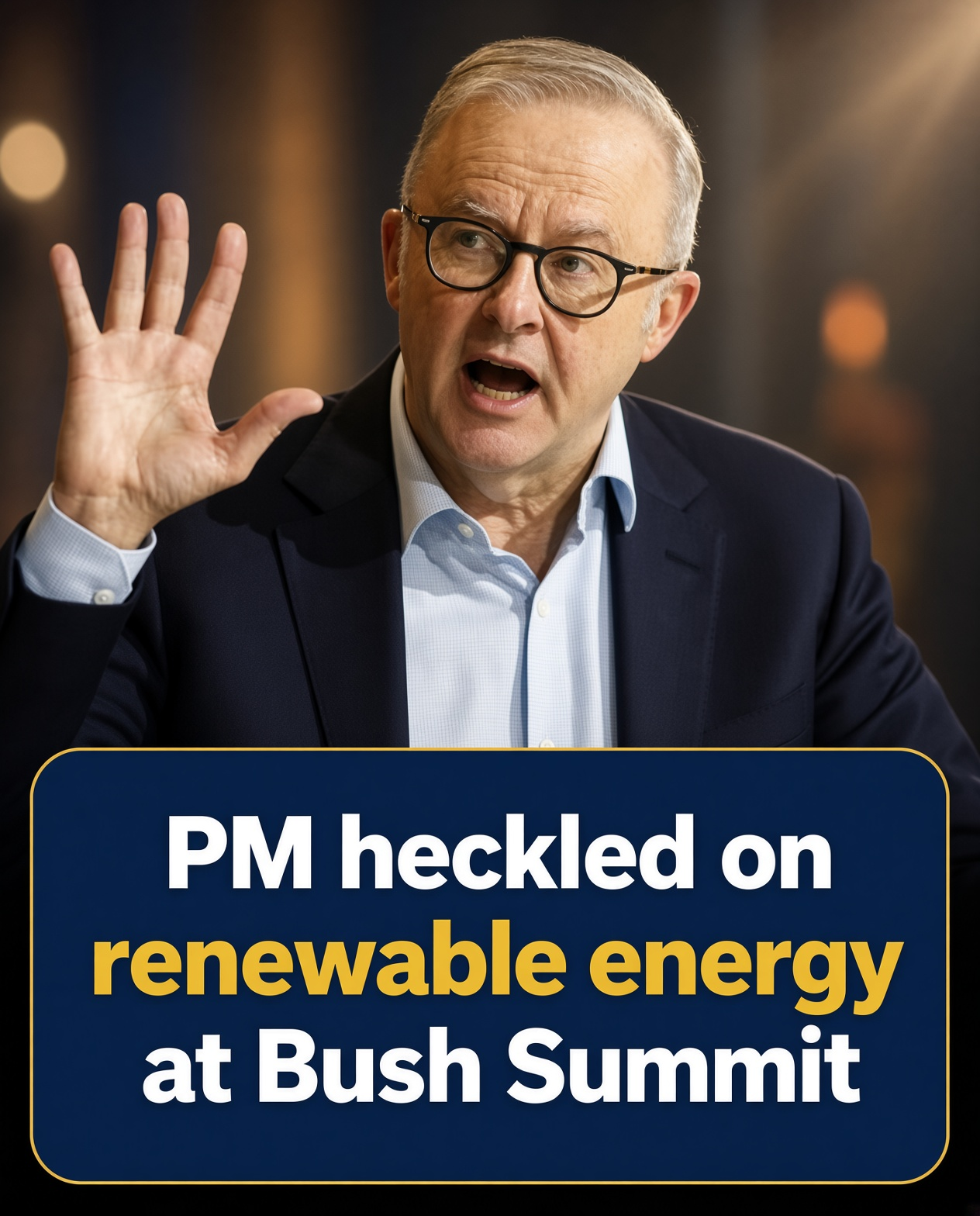
Anthony Albanese has faced a hostile reception from sections of a regional audience in Dubbo as frustration over renewable energy, regulation, migration and the use of productive farmland erupted at the 2026 National Bush Summit.
The Prime Minister was jeered while defending his government’s record before an audience dominated by regional Australians, farmers and business figures, turning what was intended as a discussion about the future of the bush into a revealing demonstration of the political pressure confronting Labor outside the major cities.
But Albanese was not the only leader facing uncomfortable questions.
Pauline Hanson and Nationals leader Matt Canavan engaged in a tense public exchange over whether Australia’s conservative parties should work together, while Opposition Leader Angus Taylor was challenged to explain how the Coalition could distinguish itself from a surging One Nation.
The result was an unusually revealing day in Dubbo: Labor confronting anger from the bush while the Nationals, Liberals and One Nation fought over who should inherit that discontent.
Albanese gets a rough reception in Dubbo
Albanese appeared at the National Bush Summit on Thursday, August 27.
The two-day event at the Dubbo Regional Theatre and Convention Centre brought together political leaders, farmers, business figures and regional representatives to discuss agriculture, energy, housing, healthcare, infrastructure and regional employment.
The Prime Minister quickly discovered that his audience was prepared to make its dissatisfaction heard.
‘Farmers see your government as the enemy’
One of the sharpest moments came when Albanese was confronted over the perception that farmers increasingly regard the federal government as hostile to their interests.
Asked about excessive regulation, Albanese acknowledged there was a problem.
“What worries me is over-regulation,” he said.
That response itself drew jeers from sections of the audience.
Albanese says Australia has too much government
The Prime Minister argued that regulatory complexity does not originate solely in Canberra.
Australia’s three layers of government — federal, state and local — frequently impose overlapping requirements on businesses and landholders.
“If we’re starting Australia again, you wouldn’t have three levels of government,” Albanese said.
He pointed to his government’s removal of approximately 1,000 tariffs as evidence that Canberra had attempted to reduce unnecessary burdens.
But that defence did not eliminate the frustration evident in the room.
Rushy Lagoon became another flashpoint
Albanese was also challenged over the controversial acquisition of Rushy Lagoon in Tasmania.
The massive agricultural property was acquired by a consortium involving overseas capital, with financing involving the government-backed Clean Energy Finance Corporation.
The proposed conversion of substantial productive farmland towards forestry and carbon-related purposes has become a political weapon for the Coalition and One Nation.
The Prime Minister acknowledged the controversy.
He said his personal view was that agriculture and sustainability both needed to be prioritised, while emphasising the CEFC operates independently.
The ‘pub test’ was put directly to Albanese
Daily Telegraph editor Ben English challenged the Prime Minister on whether the Rushy Lagoon transaction passed what he described as the “pub test”.
Albanese responded that he understood why the transaction was controversial.
The exchange went to a broader concern repeatedly expressed at the Summit: whether climate and carbon policies are beginning to compete directly with food production and the interests of farming communities.
Renewable energy was another source of anger
Regional communities have become central to Australia’s energy transition because much of the new transmission infrastructure, wind generation and solar development must be constructed outside the capital cities.
That has generated growing conflict over land access, compensation, environmental impacts and the treatment of farmers.
Those frustrations were prominent throughout the Dubbo Summit.
Even Matt Kean acknowledged the rollout has problems
Climate Change Authority chair Matt Kean defended Australia’s clean-energy transition but conceded the process of placing renewable infrastructure on agricultural land required improvement.
“We need to fix the process here,” Kean said.
That admission was notable given the hostility towards elements of the renewable rollout among sections of the regional audience.
NSW Premier Chris Minns says the bush is ‘copping it’
NSW Labor Premier Chris Minns also acknowledged the disproportionate burden being carried by regional communities.
He said people in the bush were “copping it” from the renewable rollout.
Minns nevertheless argued that the impending closure of coal-fired generation meant governments needed replacement capacity quickly, and that nuclear power could not be delivered within the required timeframe.
Farmers demanded stronger protections
Farmer Emma Webb used the Summit to demand stronger protection for landholders dealing with renewable-energy companies.
She described the rollout as rushed and accused developers of unchecked corporate behaviour.
Her intervention reflected a wider argument heard throughout the event: regional communities do not necessarily oppose national energy security, but many believe they are carrying costs decided by metropolitan governments.
Migration produced an unexpected divide
If Albanese expected lower migration to be universally popular in regional Australia, the Summit demonstrated why the issue is more complicated.
The Prime Minister was questioned about whether Labor’s planned reductions were a political response to One Nation’s surge.
He rejected that suggestion.
Albanese said net overseas migration had already fallen substantially from its post-COVID peak and argued the government had begun reducing the numbers before One Nation’s recent polling rise.
Albanese says Labor will target people gaming the system
The government is still developing its delayed migration overhaul.
At Dubbo, Albanese said one priority would be temporary migrants who exhaust their entitlement to remain in Australia but use repeated appeals to extend their stay.
He argued migration control depends not only on managing arrivals but ensuring people leave when their lawful entitlement to remain expires.
But the bush still needs migrant workers
This is where the migration debate collided with regional economic reality.
Australian agriculture remains heavily dependent on temporary overseas workers.
Farmers and regional employers repeatedly warned against blunt reductions that could remove workers they cannot replace domestically.
Roger Fletcher told Canberra not to ‘mess with the bush’
Dubbo agricultural exporter Roger Fletcher delivered one of the strongest warnings.
He said he was deeply concerned that migration reductions could remove backpackers and other overseas workers essential to farming.
Fletcher argued that what may appear to be a population problem in metropolitan Australia can look completely different from a regional labour-market perspective.
Peter Malinauskas went even further
South Australian Labor Premier Peter Malinauskas openly challenged the framing of Australia’s migration debate.
He argued that Australia has a housing shortage rather than a migration crisis.
Malinauskas said his state did not have enough younger workers to replace people leaving the workforce and warned that excessive migration cuts could cause Australia to sacrifice economic opportunities.
His remarks were met with loud applause and cheers.
Fruit can be left on the ground without workers
Malinauskas used agriculture to make his case.
Regional employers can simultaneously face housing shortages and severe labour shortages.
Cutting migration may reduce demand for housing, but it can also reduce the workforce needed to harvest food, build homes, staff hospitals and care for older Australians.
That contradiction now sits at the centre of Australia’s migration debate.
Albanese pointed to regional hospitals
The Prime Minister made a similar argument when discussing health services.
He said skilled migration was essential because regional hospitals depend heavily on overseas-born doctors, nurses and ancillary workers.
Albanese specifically pointed to Irish nurses and Nepalese workers as examples of people filling positions that would otherwise be extremely difficult to staff.
But One Nation’s rise was impossible to escape
The political backdrop to almost every migration question was Pauline Hanson.
One Nation’s support has risen sharply as immigration, housing and dissatisfaction with the major parties become increasingly prominent concerns.
Albanese acknowledged there was currently a spike in support for One Nation but rejected the claim that Labor had begun lowering migration because of Hanson.
Then Hanson took the stage
If Albanese’s appearance demonstrated Labor’s regional problem, the exchange between Hanson and Matt Canavan demonstrated the Coalition’s.
The One Nation leader sat alongside the Nationals leader for a panel discussion.
The conversation quickly became a debate about the future of conservative politics.
Hanson wants the right to work together
Hanson argued that conservative parties should stop treating each other as their primary opponents.
She identified Labor and the Greens as the common political enemy and called for greater co-operation across the right.
“That’s why we, as the conservative side, have to start working together,” Hanson said.
Canavan would not give her what she wanted
The Nationals leader declined to embrace Hanson’s invitation.
Canavan instead stressed his focus was on outcomes for Australia rather than One Nation’s political fortunes.
He argued that more than half of Australia’s population was concentrated in five cities and said political leaders should focus on developing the rest of the country.
‘Stop knocking me’
Hanson became visibly frustrated with Canavan’s response.
“Stop knocking me,” she told him.
She complained about being treated as though she were irrelevant and had nothing to contribute to Australian politics.
Hanson then pointed to One Nation’s long-standing opposition to net zero as evidence that her party had been ahead of the Nationals on an issue now central to conservative politics.
Canavan hit back
The Nationals leader was not persuaded.
The two politicians traded arguments over the Coalition’s history on net zero, agricultural policy and One Nation’s record.
After Hanson criticised the Nationals’ voting history, Canavan responded that the exchange demonstrated why the parties were not on the same side.
It was a striking public rejection of Hanson’s proposed conservative rapprochement.
Barnaby Joyce was hovering over the argument
The dispute also carried the shadow of Barnaby Joyce’s departure from the Nationals.
Canavan said he remained personally friendly with Joyce but was disappointed by his decision to leave the party.
He argued that political parties were built not merely by their MPs but by volunteers who had worked to elect them.
Hanson defended Joyce
Hanson rejected the suggestion that Joyce’s departure could simply be reduced to his difficult relationship with former Nationals leader David Littleproud.
She pointed instead to policy disagreements, particularly the Coalition’s previous support for net zero.
The disagreement was significant because Joyce’s movement towards One Nation has strengthened Hanson’s claim that her party is increasingly becoming a home for disaffected conservative voters.
Canavan has a difficult balancing act
Ideologically, Canavan shares positions with One Nation on several major issues.
He has long been a prominent critic of net zero and an advocate for coal, gas and nuclear energy.
Yet as Nationals leader, he must also protect his party from a competitor targeting precisely the same regional and conservative electorate.
Working too closely with Hanson risks strengthening One Nation.
Attacking her too aggressively risks alienating voters considering leaving the Coalition for her party.
Hanson understands the dilemma
Her appeal for conservative co-operation can be read in two ways.
On its face, it is an invitation to defeat Labor and the Greens.
Politically, it also places pressure on the Coalition to acknowledge One Nation as an increasingly important force on the right.
That explains why Canavan was reluctant to accept the premise.
Angus Taylor faced the same One Nation question
Opposition Leader Angus Taylor was also challenged over Hanson’s rise.
He was asked what the Coalition could offer voters that One Nation could not.
Taylor responded with four broad priorities.
He pledged to reverse Labor tax changes, reduce energy costs, limit immigration according to Australia’s capacity to provide housing and restrict welfare programs such as the NDIS to Australian citizens.
Taylor went hard on Rushy Lagoon
The Opposition Leader also used the controversy surrounding the Tasmanian property to sharpen his attack on Labor’s climate policies.
Taylor argued productive agricultural land should remain dedicated to growing food and fibre rather than being converted for carbon farming.
He described the Rushy Lagoon situation as a “disgrace” and promised such transactions would not occur under a Taylor-Canavan government.
The Coalition is trying to reclaim regional voters
Taylor’s strategy was clear.
He sought to present the Coalition as capable of delivering many of the outcomes attracting voters towards One Nation without the uncertainty of switching to a smaller party.
Energy, migration, agricultural land and government regulation are all areas where the opposition increasingly wants to draw a sharper line against Labor.
But One Nation can argue it got there first
Hanson’s counterargument is equally straightforward.
On issues such as net zero, migration and criticism of the major parties, One Nation argues it held these positions before the Coalition began changing direction.
That creates an authenticity problem for the Liberals and Nationals.
Every time they move closer to Hanson’s position, One Nation can claim vindication.
Every time they remain apart, Hanson can accuse them of failing conservative voters.
The Bush Summit exposed three separate political battles
The first is Labor versus regional Australia.
The Prime Minister’s hostile reception demonstrated genuine frustration over regulation, renewables and land-use policy.
It would be excessive to claim every person in the room opposed Albanese, but the jeers were real and politically significant.
The second battle is Coalition versus One Nation
Hanson is no longer merely attacking Labor.
She is competing directly for voters who historically belonged to the Nationals and Liberals.
Her confrontation with Canavan made that struggle unusually visible.
The third is within regional Australia itself
The Summit also demonstrated why regional politics cannot be reduced to a simple anti-government revolt.
Farmers can oppose renewable infrastructure while demanding migrant workers.
Regional voters can want lower national migration while hospitals desperately need foreign-trained nurses.
Communities can demand cheaper electricity while disagreeing over nuclear, gas and renewable energy.
The bush is politically angry, but it is not politically uniform.
That may be the most important lesson from Dubbo
Albanese has a serious regional credibility problem.
But the Coalition cannot assume every frustrated voter will automatically return to the Liberals or Nationals.
One Nation is increasingly competing for those votes.
And Hanson is now openly arguing that the established conservative parties should treat her not as an outsider but as a potential partner.
Canavan’s response showed just how uncomfortable that proposition remains.
Dubbo offered a preview of Australia’s next political contest
Labor will argue that managing government requires compromises on migration, energy and economic policy that protest parties can avoid.
The Coalition will argue that it can reverse Labor’s direction without the risks associated with One Nation.
Hanson will argue that both major blocs ignored regional voters until electoral pressure forced them to listen.
All three messages were on display at the National Bush Summit.
But the image likely to linger is that of a Prime Minister being jeered in regional New South Wales while the political parties to his right argued among themselves over who best represents the Australians expressing that anger.
For Albanese, Dubbo was a warning about regional discontent. For Canavan and Taylor, it was a warning that they no longer own the conservative vote. And for Hanson, the confrontation offered another opportunity to make the case that One Nation has moved from