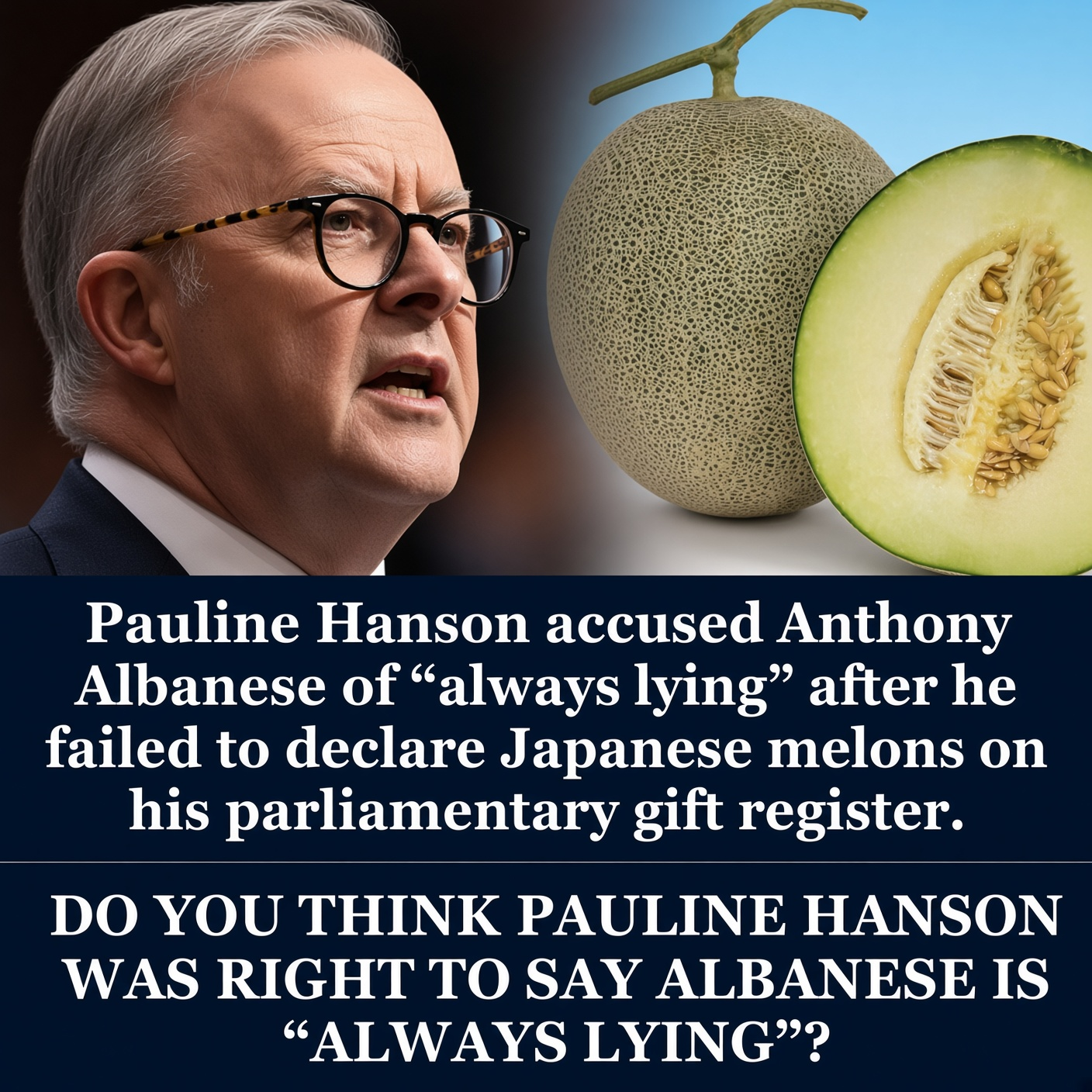
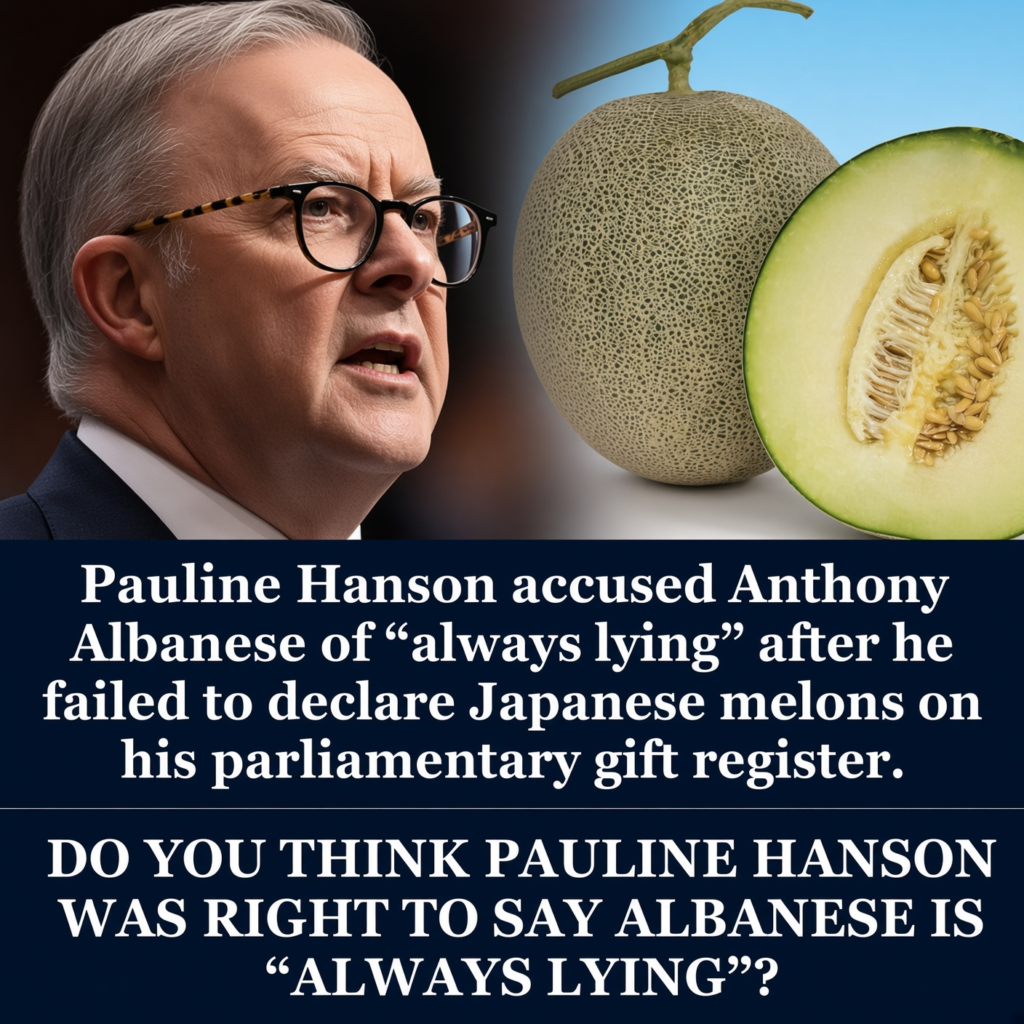
Pauline Hanson has turned the extraordinary political saga surrounding Anthony Albanese and a gift of Japanese Crown Melons into a new argument over transparency, demanding to know why the fruit does not appear on the Prime Minister’s public register of interests.
The One Nation leader has seized on what has become known as “Melongate”, accusing Albanese of failing to give Australians a straight account of the gift and questioning why his controversial appearance on the Bush Deep podcast appears to be missing a transcript from the Prime Minister’s official collection of media material.
Hanson’s intervention adds a new dimension to a controversy that began with a light-hearted podcast discussion, developed into accusations of sexual innuendo involving Japanese Prime Minister Sanae Takaichi and has since spilled into Question Time, diplomatic correspondence and a political argument over Australia–Japan relations.
Her latest question is considerably simpler.
Where are the melons — and should they have been publicly declared?
The answer depends on the parliamentary disclosure rules and, crucially, the value placed on the fruit.
Albanese’s office says there was no requirement to put the melons on his public register.
The Prime Minister’s Office has said the Crown Melons were worth approximately $200 each.
Because they were received from an official foreign government source, the office says they fell below the threshold at which a gift must be disclosed on the public parliamentary register.
That explanation is consistent with the relevant parliamentary rules.
Members of the House of Representatives are required to disclose gifts valued at more than $750 when they come from an official source, which includes an Australian or foreign national, state, provincial or local government.
For gifts from other sources, the threshold is lower: more than $300.
The distinction matters because the debate has sometimes treated the existence of a valuable diplomatic gift and the obligation to put that gift on the public register as though they were the same thing.
They are not.
If the government’s approximately $200-per-melon valuation is accepted, the fruit did not cross the $750 threshold applicable to gifts from an official government source.
The Prime Minister’s Office has also said the melons were nevertheless recorded internally.
That means the absence of the fruit from Albanese’s public parliamentary declaration is not, on the information currently available, evidence by itself that he breached the disclosure rules.
Hanson is challenging the valuation and the broader transparency surrounding the gift rather than pointing to a demonstrated breach.
Her argument is fuelled by the extraordinary reputation of Japanese Crown Melons.
These are not ordinary pieces of fruit.
Premium Japanese melons can command prices that appear astonishing by Australian supermarket standards, particularly at luxury retailers and auctions.
That has allowed Albanese’s opponents to ask whether a $200 valuation accurately captures the value of the particular fruit he received.
Hanson has highlighted reports of Japanese melons selling for thousands — and in exceptional cases vastly more — as she presses the government over why the gift was not publicly declared.
But those headline prices require context.
The spectacular sums occasionally paid for premium Japanese fruit at ceremonial or promotional auctions do not establish the market value of every Crown Melon. Using an exceptional auction result as the automatic valuation for a diplomatic gift would therefore be misleading.
The relevant question is the reasonable value of the specific melons given to Albanese, not the highest price ever attached to comparable fruit.
At present, the Prime Minister’s Office says that figure was approximately $200 each.
Hanson is entitled to challenge that assessment. Demonstrating that it was wrong requires more than establishing that some Japanese melons can be extraordinarily expensive.
“Prime Minister, where’s the melon?”
That was the line Hanson used to finish her latest attack.
She accused Albanese of failing to meet the transparency standard Australians should expect from a government elected promising accountability.
Hanson also drew a comparison with gifts she herself has received, including a toy bulldozer from mining billionaire Gina Rinehart.
The orange model bulldozer was presented to Hanson at an event in June, part of a highly public political relationship between the One Nation leader and Australia’s richest person.
Hanson argues she has faced intense scrutiny over gifts and benefits associated with Rinehart and therefore Albanese should be subjected to equivalent scrutiny over the Japanese fruit.
There is an important qualification to that comparison.
Disclosure obligations depend not only on the object received but also on its value and its source.
A gift from a private individual or non-government organisation is subject to the lower $300 threshold, while an official government gift attracts the $750 threshold.
The parliamentary rules themselves therefore recognise a difference between the categories.
Hanson has also faced previous questions about the timeliness of her own declarations.
Earlier this year she updated her register after media inquiries concerning travel on an aircraft associated with Rinehart. That history does not resolve whether Albanese’s disclosure was adequate, but it complicates attempts to present the issue as a simple contrast between one politician who always declares gifts and another who does not.
Each gift must be assessed under the rules applying to it.
The missing transcript has given Hanson another line of attack.
Albanese’s appearance on Nikki Osborne’s Bush Deep podcast has already caused more political trouble than almost anyone involved could have anticipated.
Hanson has questioned why the interview does not appear with a transcript among the Prime Minister’s official media material, arguing its absence is conspicuous given the controversy surrounding what was said.
Prime ministers routinely publish transcripts of press conferences, radio interviews, television appearances, speeches and other media engagements through their official websites.
Not every appearance necessarily produces an official transcript, and the absence of one does not itself establish that material has been deliberately concealed.
Nevertheless, the unusual level of public interest in the Bush Deep appearance makes the absence politically useful to Albanese’s critics.
It also matters because the precise wording and sequence of the podcast have become central to claims about what Albanese did and did not say.
Some descriptions circulating online have inaccurately attributed the Pamela Anderson reference directly to Albanese.
It was podcast host Osborne who introduced that reference.
Albanese spoke about receiving the melons and made hand gestures in front of his chest while doing so. He has denied that those gestures carried the sexual meaning his critics have attached to them.
That factual distinction has become crucial as the controversy has grown.
It is possible to regard Albanese’s participation in the exchange as inappropriate without attributing words to him that he did not say.
Hanson is not accepting his explanation.
The One Nation leader has accused the Prime Minister of continuing to misrepresent what occurred rather than acknowledging an obvious mistake.
She has been particularly critical of his refusal to apologise to Takaichi.
Albanese was twice asked in the House of Representatives this week whether he would apologise to the Japanese Prime Minister.
He did not provide the requested apology.
Instead, he rejected the premise of the questioning and emphasised the strength of the relationship between Australia and Japan, pointing to cooperation on defence, critical minerals, cyber security and other strategic priorities.
Foreign Minister Penny Wong has similarly accused the opposition of attempting to manufacture a diplomatic dispute from the episode.
There is evidence supporting the government’s claim that the diplomatic consequences have been exaggerated.
Japan’s serving ambassador to Australia, Kazuhiro Suzuki, has publicly played down the controversy, saying Tokyo had received assurances about the context and emphasising the friendly relationship between Albanese and Takaichi.
A leaked Japanese diplomatic communication has also reportedly indicated that officials believed Australian reporting had sensationalised the incident and that Albanese had not intended offence.
That makes an important distinction necessary.
Hanson can believe Albanese behaved badly without there being a diplomatic crisis.
She can demand an apology even if Japan is not demanding one.
And the Japanese government can decide that maintaining a close strategic relationship with Australia is vastly more important than prolonging a controversy over a podcast.
Those positions are not mutually exclusive.
The declaration issue is different because it can be tested against written rules.
The question is not whether Albanese’s gestures looked appropriate or whether Takaichi was personally offended.
It is whether the gift met the threshold for disclosure.
The House rules require members to register gifts exceeding $750 from official sources and $300 from other sources.
A gift from the Japanese prime minister plainly falls within the official-source category.
Therefore, if the relevant value was below $750, Albanese was not required under that provision to put it on his public register.
His office says it was.
That does not prevent a legitimate argument over whether the valuation should be independently substantiated or whether prime ministers should voluntarily disclose diplomatically sensitive gifts even when they fall beneath the mandatory threshold.
Those are questions of transparency beyond minimum compliance.
Governments regularly discover that meeting the technical wording of a rule does not necessarily end a political argument about disclosure.
Hanson is attempting to exploit precisely that gap.
Her attack effectively asks why Albanese should rely on a threshold at all when voluntarily listing the gift could remove uncertainty.
The government can respond that registers become less useful if politicians are expected to declare every modest official gift irrespective of the rules.
That is a legitimate administrative argument too.
The controversy has now travelled a remarkable distance from its origin.
What began with Albanese recounting a diplomatic gift on a comedy podcast has produced demands for an apology, exchanges in both houses of parliament, scrutiny of diplomatic communications, questions about the leaking of a Japanese cable and now a dispute over parliamentary disclosure requirements.
It has also exposed the risks politicians take when they move from conventional interviews into entertainment formats.
The appeal of podcasts is obvious. They allow politicians to reach audiences who may never watch a parliamentary press conference and give leaders space to appear informal and spontaneous.
The disadvantage is equally obvious: informal and spontaneous remarks remain capable of becoming formal political problems.
Albanese has already apologised for a separate segment of the same podcast in which he participated in a “shag, marry or date” discussion involving Kylie Minogue, Nicole Kidman and Rhonda Burchmore.
On the melon exchange, however, he has taken a different position, insisting the interpretation advanced by his opponents is wrong.
The longer the dispute continues, the more peripheral issues are becoming attached to it.
For Hanson, the register and the missing transcript allow her to move beyond a subjective argument about body language and into a politically potent question about transparency.
But the evidence currently available does not establish that Albanese was legally or procedurally required to declare the melons on his parliamentary register.
The $750 threshold for official gifts is real.
The Prime Minister’s Office says the fruit was valued below it.
Anyone alleging a breach therefore needs to establish that the relevant valuation exceeded that threshold or that another disclosure requirement applied.
Until then, the strongest version of Hanson’s argument is not that Albanese has been proven to have broken the rules.
It is that a controversy already plagued by questions over context and explanation could have been handled with greater voluntary transparency.
That may explain why her final question has proved so effective.
After days of arguments about gestures, apologies, diplomatic cables and Japan’s reaction, Hanson has reduced the latest phase of Melongate to four words.