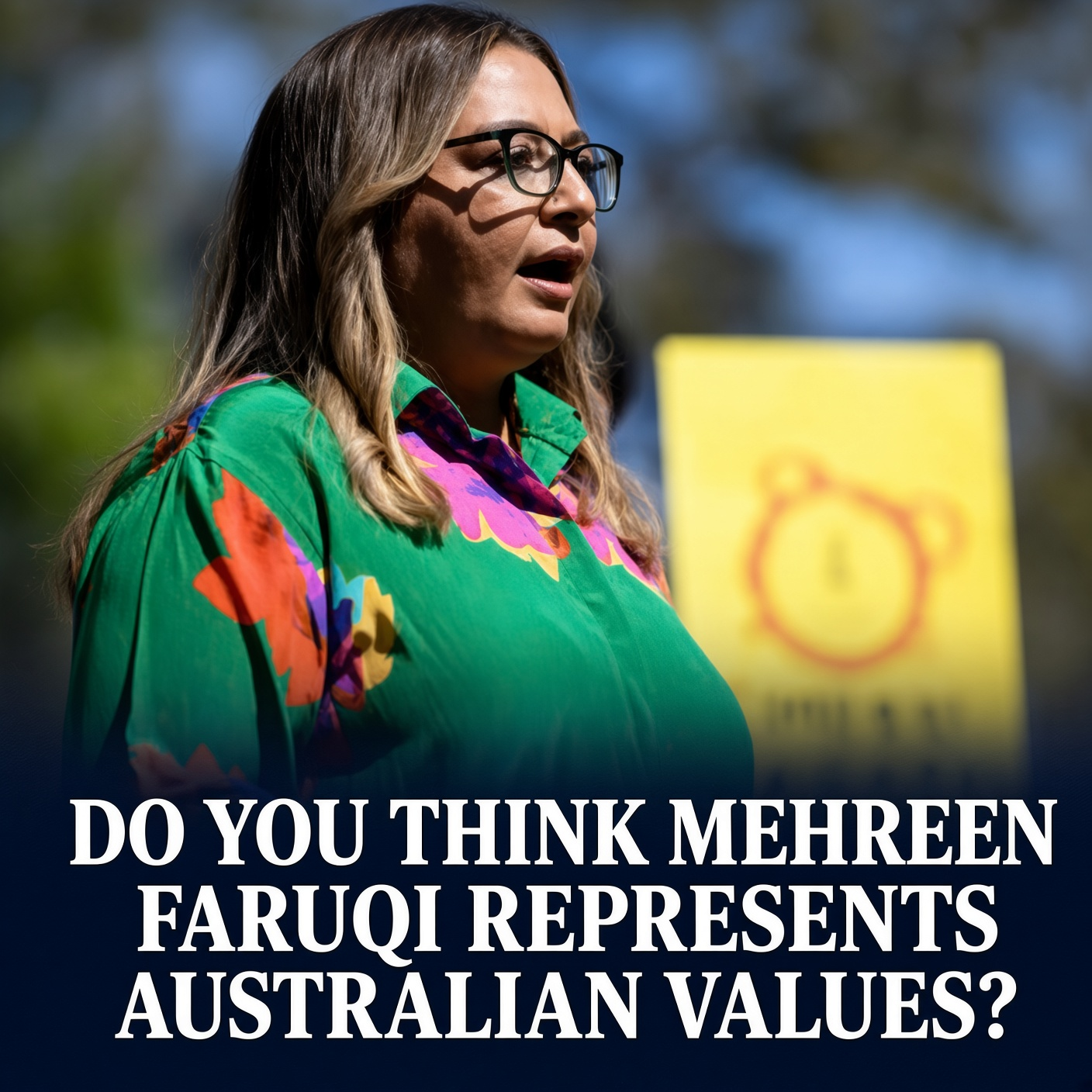
Long before Mehreen Faruqi entered Australian politics, became a Greens senator and rose to the party’s deputy leadership, she was a little girl in Lahore learning what war sounded like.
Faruqi has described Lahore as the “best city in Pakistan”, a place for which she retains enormous affection. But some of her earliest memories of the city are inseparable from fear.
Speaking to Annabel Crabb on ABC’s Kitchen Cabinet, the NSW senator recalled being only two years old and sitting on her mother’s lap in a trench as conflict between India and Pakistan unfolded around them.
She remembered having a pencil placed between her teeth to stop them chattering as explosions sounded nearby.
For a child, Faruqi said, the experience of watching aircraft being shot from the sky, hearing bombs and listening to evening sirens was terrifying.
She also remembered something less tangible but equally disturbing: people who had lived alongside one another finding themselves suddenly divided into enemies.
It is a striking beginning to the story of a woman who would eventually move thousands of kilometres from Pakistan, establish a career as an environmental engineer and academic, enter an Australian parliament and ultimately take a seat in the federal Senate.
Her appearance on Kitchen Cabinet offers a more personal account of that journey — one that begins not in Canberra, but in the streets and university community of Lahore.
Lahore remained home despite the memories of conflict.
Faruqi was born in Lahore in 1963 and grew up in a middle-class family with three siblings.
Her connection with engineering began at home. Her father was a civil engineer and professor at Lahore’s University of Engineering and Technology, and the family lived on the university campus.
Faruqi has previously described the fierce pride Lahoris have in their city, invoking the local saying that someone who has not seen Lahore has not really been born.
But her childhood also introduced her early to inequality.
She has recalled challenging her mother over why her two older brothers could do things she was not permitted to do as a girl — including flying kites from the roof or playing cricket in the street.
Those arguments may appear small compared with the political battles Faruqi would later fight, but they form part of the way she explains her development as an advocate for gender equality.
Engineering eventually became her profession.
Faruqi studied civil engineering at the University of Engineering and Technology in Lahore and went on to work as a structural engineer.
It was at work that another decisive part of her life began.
She remembers seeing Omar on her first day.
Faruqi was 25 and working as an engineer when she encountered the man who would become her husband.
She told Crabb she saw Omar in the lobby on her first day at work and remembered the encounter with remarkable clarity. For her, she said, the attraction was immediate — and she believed it was the same for him.
The couple’s marriage was arranged.
That description has sometimes created confusion in Australia, something Faruqi addressed directly during the program.
She stressed that an arranged marriage should not automatically be equated with a forced marriage.
In her account, the arrangement involved family participation in bringing the couple together rather than compelling her to marry somebody against her wishes.
Faruqi said Australian newspaper headlines had previously portrayed her support for her own arranged marriage as somehow incompatible with being a feminist.
For her, that reaction reflected a failure to understand the distinction between an arranged marriage entered voluntarily and a forced marriage in which genuine consent is absent.
The difference is important well beyond Faruqi’s personal story.
Forced marriage is an abuse involving coercion and the absence of free consent. An arranged marriage can involve families helping identify or introduce a prospective partner while leaving the individuals themselves with the decision about whether to marry.
Faruqi’s account is firmly of the latter.
She described herself as lucky in finding Omar.
The two engineers began building a family together in Pakistan. But as their lives progressed, Faruqi said they became increasingly uncomfortable with the direction in which the country was moving.
Corruption helped push the family towards a life-changing decision.
By then, Faruqi and Omar had a young child.
She told the ABC that growing corruption in Pakistan made them question whether they wanted their child to grow up having to battle against a dysfunctional system.
The answer eventually became no.
Rather than simply accepting those circumstances, they began considering a future somewhere else.
Australia became that future.
In 1992, Faruqi, Omar and their young child migrated to Australia.
They arrived with two suitcases.
Faruqi came as a skilled migrant, beginning a second chapter in an engineering career that would eventually intersect with academia, environmental policy and politics.
There was already a family connection with Australian higher education. Her father had previously studied at the University of New South Wales under the Colombo Plan during the 1950s.
Decades later, his daughter followed a path through the same university.
Faruqi completed a Master of Engineering Science at UNSW in 1994 and later earned a doctorate in environmental engineering in 2000.
Her doctoral research examined wastewater treatment and biogas recovery — a reminder that before becoming nationally known for political arguments, Faruqi’s professional world was engineering and environmental management.
She subsequently worked across environmental engineering, local government and higher education.
Her professional career included senior roles concerned with sustainability and environmental management, and she later became an associate professor and academic director at UNSW’s Australian School of Management.
That technical background would become an important part of her political identity.
Politics came later.
Faruqi entered the New South Wales Legislative Council for the Greens in 2013.
Her election carried particular historical significance: she became the first Muslim woman to sit in an Australian parliament.
Five years later, her political career moved to Canberra.
After Greens senator Lee Rhiannon resigned in August 2018, Faruqi was chosen by the NSW Parliament to fill the resulting Senate vacancy.
She was sworn in later that month and subsequently elected to the Senate in her own right in 2019.
Parliamentary records list her as a Greens senator for New South Wales from 2018, and she has since become deputy leader of the Australian Greens.
Her journey from engineering in Lahore to the federal parliament is therefore also a story about one of the profound demographic changes that has reshaped modern Australia.
A skilled migrant arrived with professional qualifications, continued her education in Australia and ultimately became part of the institution responsible for writing the country’s laws.
But Faruqi’s reflections make clear that reaching Parliament did not eliminate questions about belonging.
More than three decades after migrating, she says her Australianness can still feel conditional.
That was another central theme of her conversation with Crabb.
Faruqi has been one of the most outspoken politicians in Canberra on racism, multiculturalism and discrimination. She has also been a polarising political figure, particularly because of her positions on Israel and Gaza, environmental policy and other issues on which the Greens have clashed sharply with Labor and the Coalition.
Political disagreement with those positions is part of democratic life.
Faruqi’s contention is that some attacks directed at her go beyond disagreement with policy and instead question whether somebody with her background can fully belong in Australia.
She told the ABC she feels her Australian identity is sometimes treated as conditional — something that can be withdrawn when she says or does something others dislike.
That experience is particularly notable given the length of her connection with the country.
Faruqi arrived in 1992. She studied here, raised a family here, built an engineering and academic career here and has served in both state and federal parliaments.
Yet she has described continuing to encounter hostility linked not merely to her politics but to her Muslim identity and migrant background.
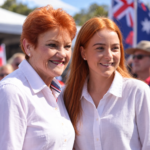
The issue became particularly visible through a long-running legal dispute with Pauline Hanson.
After Queen Elizabeth II died in September 2022, Faruqi posted a message criticising the British Empire and saying she could not mourn the leader of what she called a racist empire built on stolen lives, land and wealth.
Hanson responded by telling Faruqi to “piss off back to Pakistan”.
Faruqi took legal action.
In 2024, the Federal Court found Hanson’s post constituted unlawful racial discrimination under section 18C of the Racial Discrimination Act.
Hanson challenged the decision, and the legal battle continued through the courts.
The episode illustrates the unusual position Faruqi occupies in Australian public life.
She is simultaneously a powerful political figure whose statements deserve the same scrutiny and criticism as those of any other senior politician, and a migrant politician who says some responses to her cross the line from political disagreement into racial exclusion.
Her personal story helps explain why that distinction matters so much to her.
The child who remembered war later made migration central to her own family’s future.
Faruqi’s childhood experiences did not lead directly or inevitably to any particular political ideology. Personal history rarely works so neatly.
But the themes running through her account are recognisable in her later public life: conflict, inequality, migration, gender, belonging and the ability of political systems to shape individual lives.
She remembers Lahore with love rather than simply as a place she escaped.
That matters.
Migration stories are sometimes reduced to a simple narrative in which someone leaves a bad country for a good one. Faruqi’s account is more complicated.
Lahore was home. It was where she grew up, studied, became an engineer, met her husband and started a family.
It was also a place where she experienced the fear of war as a child and where, as an adult, she and her husband became sufficiently concerned about corruption to imagine a future elsewhere for their child.
Australia offered that alternative.
But migration did not erase Pakistan from her identity any more than becoming Australian required her to forget Lahore.
That tension — between the place someone comes from and the country they choose to make home — sits at the centre of many Australian migration stories.
Faruqi’s happens to have unfolded all the way to the floor of the Senate.
Her politics remain divisive. Australians can strongly disagree with her positions on foreign policy, climate, taxation, education or almost anything else she advocates.
Her appearance on Kitchen Cabinet does not ask viewers to abandon those disagreements.
It does something different.
It provides the biography behind the politician: a child sheltering from bombing in Lahore; a young engineer spotting another engineer across a workplace lobby; a voluntary arranged marriage that she believes Australian audiences often misunderstand; parents deciding their child deserved a different future; and a family arriving in Australia with two suitcases in 1992.
Three decades later, one of those migrants sits in the Australian Senate.
Whatever Australians make of Mehreen Faruqi’s politics, that journey is now part of Australia’s political story too.