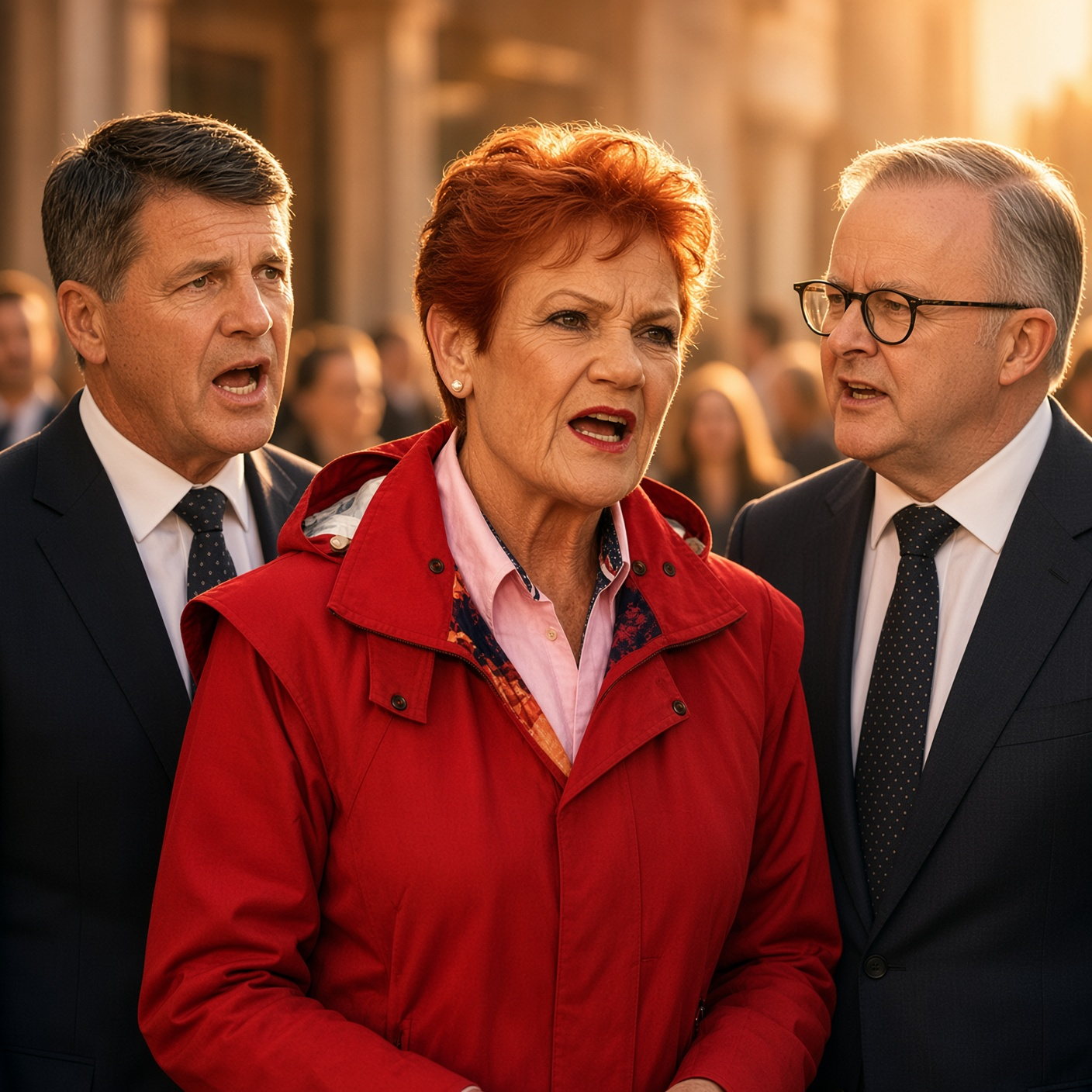
Pauline Hanson’s One Nation has surged back to the top of the primary-vote standings in a new national poll, days after Prime Minister Anthony Albanese declared Labor had a duty to history to defeat the rapidly growing minor party.
The latest News24/YouGov Pulse has One Nation on 30 per cent of the primary vote, ahead of Labor on 26 per cent and the Coalition on 18 per cent.
The survey of 1,510 Australian voters was conducted between September 1 and September 8 and represents a four-point increase for One Nation compared with the previous poll.
Labor fell three points to 26 per cent, while the result gives Hanson’s party its biggest lead over Labor recorded in the Pulse series.
The numbers arrived immediately after an extraordinary escalation in the political battle between Labor and One Nation, with Albanese using a speech to the Queensland Labor State Conference to frame the rise of right-wing populism as a challenge his party had an obligation to confront.
Speaking in Brisbane on August 30, the Prime Minister warned that “hard-right populists” were advancing around the world and accused them of promoting politics that was “dangerous, divisive and downright dishonest”.
“We simply must defeat them. We owe it to history,” Albanese told delegates.
“And we will defeat them.”
He accused such movements of bending facts, spreading misinformation and disinformation and attempting to turn Australians against each other, before directly targeting Hanson’s party.
“Parties like One Nation have no serious answers to our problems,” he said.
The remarks were a significant shift in tone from a Prime Minister confronting a political landscape in which One Nation can no longer easily be treated as a peripheral protest party.
But while the latest polling has inevitably intensified debate over whether Labor’s attacks are working, the numbers do not establish that Albanese’s speech caused One Nation’s increase.
The survey began shortly after the comments were made, and voter support can move for many reasons, including cost-of-living pressures, migration, dissatisfaction with the major parties and One Nation’s highly visible campaigning.
What the poll does demonstrate is that Labor’s increasingly aggressive attempt to define Hanson as a dangerous political opponent has so far coincided with, rather than halted, One Nation’s national momentum.
Labor broadens its attack on Hanson
The Prime Minister was not the only senior Labor figure to escalate the rhetoric.
Attorney-General Michelle Rowland entered the dispute on September 1 after Hanson accused Albanese of contributing to a dangerous political climate.
Hanson had argued that describing her party as dangerous and divisive could encourage threats against her and said she was increasingly concerned about her personal security.
Rowland rejected that argument and instead called on Hanson to examine the conduct and rhetoric associated with her own party.
She referred to people Hanson had associated with and said that when a party had been “infiltrated by extremists and neo-Nazis”, politicians needed to consider the consequences of the political environment they helped create.
The Attorney-General’s remarks were not a claim that all One Nation members or voters were extremists. They were made as part of a broader argument about political rhetoric, individuals associated with extremist movements and the growing security threats facing Australian politicians.
Hanson strongly rejected Rowland’s comments, describing them as slanderous and demanding an apology.
She also accused Labor of applying a double standard by condemning inflammatory political language while using increasingly forceful language against One Nation.
The clash occurred against a genuine security concern in Canberra.
Threats and harassment directed at elected representatives have risen significantly, and authorities have repeatedly warned about politically motivated violence and extremism.
That context has made the language used by all parties increasingly sensitive.
One Nation’s rise is no longer confined to opinion polls
Labor’s concern about Hanson did not emerge in isolation.
Only hours before Albanese’s Brisbane speech, One Nation had scored a historic victory in the Western Australian state seat of Secret Harbour.
Luke Herdegen won the previously safe Labor electorate, delivering One Nation its first lower-house seat in Western Australia.
With most votes counted, ABC election figures showed One Nation on 39.1 per cent of first preferences compared with Labor’s 24.1 per cent.
After preferences, One Nation led Labor 57.2 per cent to 42.8 per cent, representing an enormous swing against a seat Labor had previously held with an 11.5 per cent margin.
The result was particularly significant because Secret Harbour is an outer-metropolitan electorate in Perth’s south rather than a remote regional seat traditionally associated with populist protest movements.
It reinforced concerns inside both major parties that One Nation was finding support among voters experiencing housing pressure, higher living costs and dissatisfaction with established political institutions.
That electoral breakthrough was followed by the latest YouGov result showing Hanson ahead nationally on first preferences.
Taken together, the developments explain why Albanese has begun treating One Nation as a central political opponent rather than simply leaving the Coalition to compete with Hanson for conservative voters.
Thirty per cent does not mean Hanson is winning government
The headline primary-vote figure is dramatic, but it requires important context.
Australian federal elections are decided through preferential voting in individual House of Representatives electorates, not by awarding government to the party with the highest national primary vote.
When YouGov asked respondents how they would allocate preferences in a hypothetical Labor-versus-One Nation contest, Labor remained ahead 53 per cent to 47 per cent.
Labor also leads the Coalition 52–48 on the corresponding measure.
Albanese remains personally ahead of Hanson as preferred prime minister, leading her 51 per cent to 40 per cent in the same survey.
The results therefore reveal two political realities at once.
One Nation currently has a larger pool of first-preference support than either major-party grouping in this poll, but Labor retains advantages when voters are forced to choose between two competing governing alternatives.
There is also no straightforward method of converting a 30 per cent national One Nation vote into a projected number of House of Representatives seats.
Its success would depend heavily on where its voters live, whether its candidates finish in the final two in individual electorates and how Labor, Liberal, National, Greens and independent preferences flow.
The Coalition faces particularly difficult strategic questions if current polling persists.
At 18 per cent, its support in the latest Pulse is substantially below One Nation’s.
In electorates where both compete strongly, Liberal or National candidates could find themselves eliminated before the final count, leaving their preferences to help determine contests between Labor and One Nation.
That would represent a fundamental change in Australian federal politics.
A contest over why voters are leaving the major parties
Labor’s public response has increasingly focused on One Nation’s values, rhetoric and policy credibility.
Albanese’s Queensland speech accused populist movements of offering division rather than solutions and framed Labor’s support for multiculturalism as a direct contrast.
One Nation’s response has been to argue that Labor is insulting Australians who are dissatisfied with migration levels, living costs and government policy.
That disagreement goes to the heart of the emerging electoral contest.
If voters shifting to Hanson are primarily motivated by cultural and ideological questions, Labor may believe a direct argument over political values can limit One Nation’s growth.
But if large numbers are moving because they believe the major parties have failed to address household financial pressures, housing or migration, attacking One Nation itself may do little to win them back.
Recent polling suggests migration remains one of Hanson’s strongest political issues, while the party has sought to position itself as an advocate for households struggling with rents, mortgages and everyday expenses.
Its policies have also faced significant scrutiny.
One Nation has endured confusion over its migration numbers and criticism of a plan that would allow eligible workers paying rent or a mortgage to divert part of their compulsory superannuation contributions into take-home pay for up to three years.
Labor argues the superannuation policy would undermine retirement savings and create inflationary risks.
Yet those policy attacks have not, at least so far, prevented One Nation from rising in the polls.
Hanson’s challenge is now different
One Nation’s position brings its own risks.
A party receiving 30 per cent support will face a level of scrutiny very different from one polling in single figures.
Its candidates, internal discipline, economic policies and readiness for government will increasingly be examined against the standards applied to major parties.
Hanson must also convert national dissatisfaction into durable electorate-level organisation if One Nation wants to turn polling strength into a large parliamentary presence.
The Secret Harbour result shows that is possible in at least some electorates, but a federal campaign across dozens of competitive seats is a far larger undertaking.
Labor, meanwhile, now faces the uncomfortable challenge of attacking One Nation without reinforcing Hanson’s argument that Australia’s political establishment is united against her voters.
The Coalition has an equally serious dilemma: confronting Hanson too aggressively risks alienating voters it hopes to recover, while ignoring her rise risks allowing One Nation to replace it as the dominant vehicle for anti-Labor voters in parts of the country.
The latest poll does not prove Albanese’s attack caused a backlash, nor does it predict who will win Australia’s next federal election.
But its political message is difficult to miss.
Less than two weeks after a historic state by-election victory and days after the Prime Minister declared Labor had an obligation to defeat One Nation, Pauline Hanson’s party is sitting on 30 per cent and leading both traditional sides of Australian politics on primary voting intention.
For Albanese, the task he described as something Labor “owes to history” is becoming more difficult rather than less.