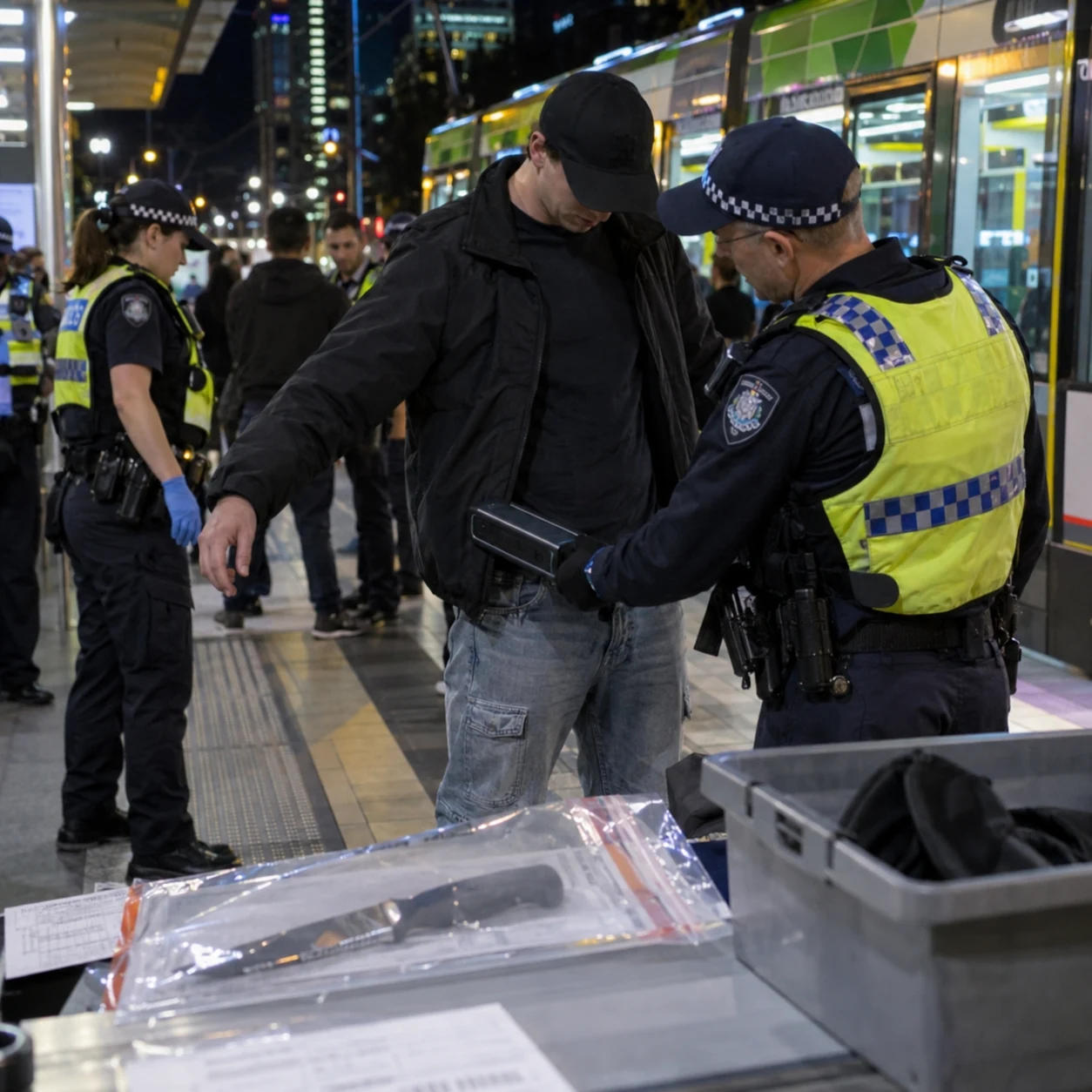
Victorian Labor has promised to expand police powers to search people for knives in public places if it wins the November state election, bringing the government and opposition closer on a policy that supporters say could prevent violent attacks but critics warn may increase intrusive searches without clear evidence of reducing knife crime.
The proposal is modelled on Queensland’s “Jack’s Law”, which allows police to use handheld metal-detecting wands to scan for weapons in specified circumstances. Labor says it would provide Victoria Police with 1,200 additional wands and broaden where suspicionless searches can occur from early next year if the government is returned.
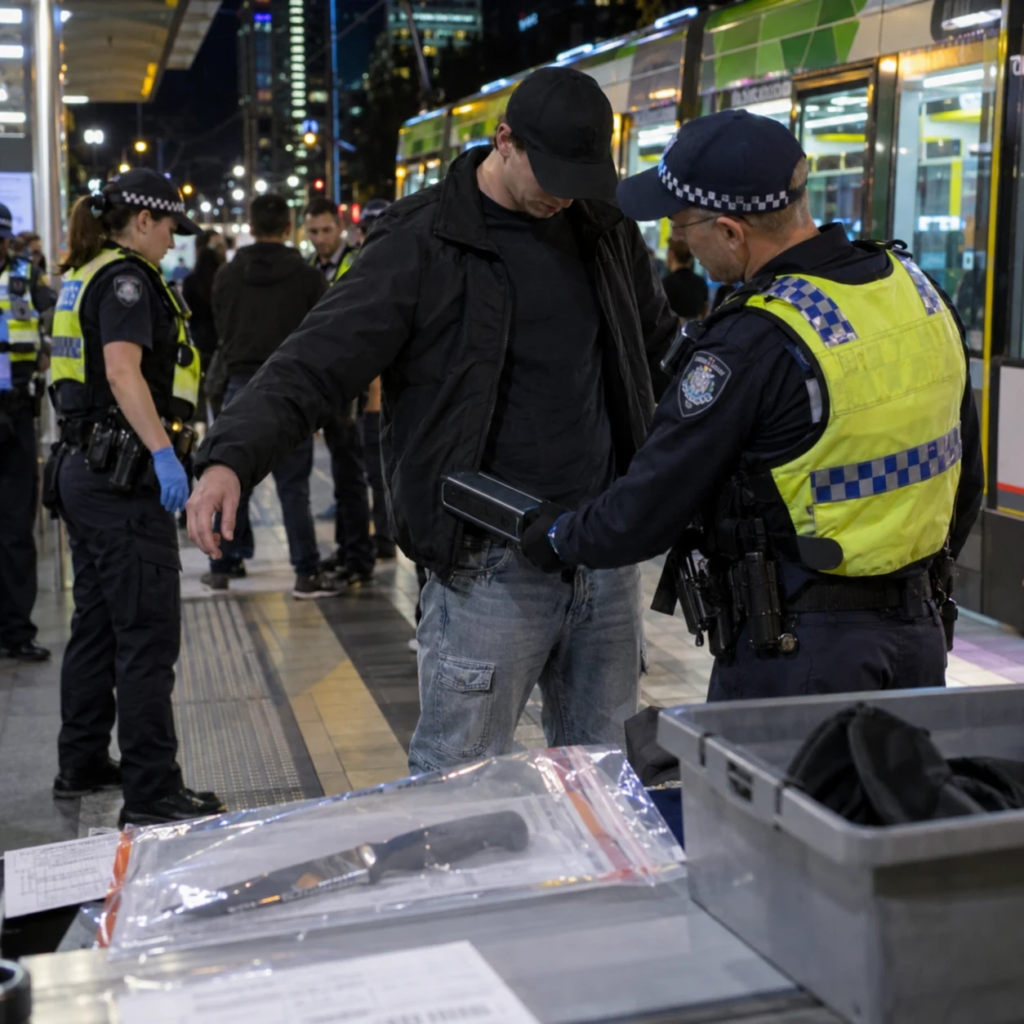
AI-generated editorial illustration.
The Coalition had already backed a similar expansion, meaning the election debate is less about whether police should receive greater wanding powers and more about how broad those powers should be, what safeguards should apply and whether the policy will produce the safety benefits being claimed.
Under Victoria’s current framework, police can conduct suspicionless weapon searches in designated areas subject to legal requirements. Labor’s proposal would substantially widen the operational reach of handheld scanners in public places.
The political case for the change is straightforward.
Knife crime produces intense public concern because a weapon can turn a confrontation into a fatal incident in seconds. Giving police a quick way to detect concealed metal objects can remove weapons before they are used and can also create a visible deterrent in transport hubs, entertainment precincts and other busy locations.
Queensland’s Jack’s Law was introduced after the fatal stabbing of teenager Jack Beasley on the Gold Coast in 2019 and was later expanded. The Queensland government made the framework permanent in 2025, with police able to use handheld scanners under legislated conditions.
Victoria’s proposal borrows from that model, but evidence about the policy’s effect on violent offending remains contested.
A 2022 Griffith University review of Queensland’s initial trial found no evidence at that stage that wanding had deterred people from carrying knives or reduced violent offending. Researchers and civil-liberties advocates argue that finding should make governments cautious about presenting expanded search powers as a proven crime-reduction measure.
Supporters respond that police do remove weapons during scans and that preventing even a small number of serious incidents can justify the intervention.
The difference between those arguments is partly about what counts as success.
If success means finding knives, a wanding operation can be measured by weapons seized.
If success means reducing assaults or homicides across a city, the causal link is harder to establish because violence is influenced by policing, alcohol and drug use, family circumstances, youth services, organised crime, mental health and many other factors.
Criminologist Joel McGregor, quoted by ABC News, has warned that broader search powers also create a risk of racial profiling.
That concern is not simply about whether police explicitly intend to discriminate. When officers have wide discretion to decide whom to approach and scan, patterns can emerge in who is stopped most frequently.
ABC reported that more than one in 10 people searched under Queensland’s regime had been identified as First Nations. Research based on Victorian search data has also found First Nations people and people perceived to be African were searched at higher rates in designated-area operations.
Those figures do not by themselves prove that an individual officer acted with racial bias in a particular search.
They do raise a legitimate policy question about oversight.
Victoria Police has said it has zero tolerance for racial profiling. If the powers expand, that commitment can be tested through data showing who is searched, where searches occur, what proportion finds a weapon or prohibited item and what happens after the encounter.
Transparency becomes particularly important when police do not need the usual level of individual suspicion before using the scanner.
The legal limits also matter.
Earlier this year, the Federal Court found that a broad six-month designation covering Melbourne’s CBD was invalid and had not complied with the relevant rights framework. That decision showed that even where parliament gives police special search powers, the way those powers are activated still has to satisfy legal requirements.
Labor’s election promise will therefore need more than additional equipment. Legislation and operational rules would have to define where the searches can occur, how long authorisations last, what officers can do after a wand indicates metal and what safeguards apply to children and other vulnerable people.
Queensland’s legislation includes human-rights safeguards and operational requirements, but the Victorian parliament would have to decide what parts of that model to adopt or change.
There is also a practical difference between a scanner and a physical search.
A handheld wand can indicate the presence of metal without requiring an officer to immediately conduct a full pat-down. That can make the initial interaction less intrusive than some traditional search methods.
But if a wand alerts, the interaction can escalate to further questioning or a search, which is why the threshold and oversight rules still matter.
The political convergence between Labor and the Coalition could make some form of expanded wanding power likely to remain on the agenda regardless of which major party wins the election.
That does not mean the final laws will be identical.
The detail will determine whether police receive broad statewide discretion or more targeted authority tied to locations, events or intelligence about weapons.
For Victorians, the debate should therefore move beyond the slogan of being “tough on knives”.
The useful questions are measurable: How many searches will be conducted? How many weapons will be found? Who will be searched? Will violent offending fall? What complaints process will exist? And how will parliament know if the powers are working?
Labor’s announcement is an election promise, not an enacted expansion of police powers. Any change would still require implementation through the legal process after the election.
The safety objective has broad political support. The unresolved issue is whether expanding suspicionless searches will deliver that objective in a way that is effective, proportionate and trusted by the communities police are trying to protect.