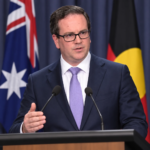
Three One Nation senators have turned their backs during an Acknowledgement of Country in the Australian Senate, staging a highly visible protest against a ceremony their party wants removed from government institutions and public life.
Queensland senator Malcolm Roberts, New South Wales senator Sean Bell and Western Australian senator Tyron Whitten faced away as Liberal senator Slade Brockman delivered the customary Acknowledgement of Country in the chamber on Tuesday, as federal parliament returned for its spring sitting fortnight.
The three senators remained turned away during the acknowledgement before facing forward again when the Lord’s Prayer began.
One Nation leader Pauline Hanson, the party’s fourth senator, was not in the chamber at the time.
The protest was brief, silent and unmistakable.
It also fitted squarely within a broader political campaign being waged by One Nation against the increasingly common use of Acknowledgement of Country and Welcome to Country ceremonies in Australian institutions.
Hanson has called for both practices to be abolished from public schools and government departments and has argued they should not be routinely performed at publicly funded events.
Her senators’ decision to physically turn away from the acknowledgement brought that campaign directly onto the floor of federal parliament.
There is an important difference between a Welcome to Country and an Acknowledgement of Country.
The terms are frequently used interchangeably in political debate, but they refer to different practices.
A Welcome to Country is traditionally delivered by a Traditional Owner, custodian or other appropriately recognised Aboriginal or Torres Strait Islander person connected with the land on which an event is being held.
An Acknowledgement of Country can be delivered by Indigenous or non-Indigenous people and recognises the Traditional Owners or custodians of the land.
The ceremony in the Senate on Tuesday was an Acknowledgement of Country.
That distinction matters because some of the political debate surrounding these practices combines them into a single argument despite their different functions.
For supporters, an acknowledgement is a relatively simple expression of respect towards Australia’s First Peoples and their continuing connection to country.
For Hanson and One Nation, the repeated institutional use of such ceremonies has become symbolic of something very different.
The party argues they encourage division by separating Australians according to ancestry and giving excessive emphasis to racial identity.
That is why the senators’ gesture was not merely an objection to the wording used on one particular morning.
It was a statement against the practice itself.
One Nation has made abolishing the ceremonies part of its political agenda.
Hanson has said that if One Nation wins government it would move to end Welcome to Country and Acknowledgement of Country practices across a range of publicly funded institutions.
Her proposals include public schools and Commonwealth government departments.
The party has also argued against their use at government-funded events and has increasingly incorporated the issue into its broader criticism of Indigenous recognition policies.
Hanson’s position is that Australia should emphasise a single national identity rather than institutional practices she believes divide citizens into Indigenous and non-Indigenous categories.
She has previously argued that Australians do not need to be repeatedly welcomed to their own country.
Supporters of the ceremonies reject that interpretation.
They argue a Welcome to Country is not a suggestion that non-Indigenous Australians are foreigners, but an Indigenous cultural protocol whose modern use recognises the continuing relationship between Traditional Owners and their country.
An Acknowledgement of Country is even further removed from the literal idea of granting somebody permission to be in Australia: it is an acknowledgement rather than a welcome.
The dispute is therefore partly about the ceremonies themselves and partly about what each side believes they represent.
Tuesday’s protest was not unprecedented.
One Nation senators have previously turned their backs during an Indigenous acknowledgement in the federal parliament.
When Australia’s 48th Parliament opened in July 2025, One Nation senators staged a similar protest during proceedings associated with the new parliamentary term.
The action drew criticism from Labor and the Greens and helped establish the party’s opposition to the ceremonies as more than a rhetorical policy position.
The latest incident shows that position has not softened.
It also comes at a very different political moment for One Nation.
The party is now attracting substantially greater national attention, with its polling strength and growing representation making its positions more consequential than they were when Hanson was often treated primarily as a protest voice on the Senate crossbench.
Issues that might once have been dismissed as symbolic One Nation gestures are therefore increasingly being considered in the context of what the party might actually attempt to implement if its electoral support continues to grow.
Hanson recently outlined an agenda for the first 100 days of a hypothetical One Nation government following the next federal election.
That program included dramatic reductions to immigration, changes to climate and energy policy, reductions in the size of government and the abolition of Welcome to Country practices in public institutions.
In other words, what Roberts, Bell and Whitten demonstrated physically in the Senate is connected to a policy One Nation says it would pursue through government.
Hanson entered the chamber later for an entirely different fight.
Although absent for the acknowledgement, the One Nation leader later sought to suspend standing orders to force urgent consideration of her party’s proposed legislation concerning Australian foreign terrorist fighters.
The bill is aimed at creating stronger legal barriers to Australians linked with foreign terrorist organisations returning to the country.
Its political urgency has been driven by reports that 13 Australian men suspected of links to Islamic State could potentially be released from detention in Iraq.
Hanson’s attempt to bring the legislation forward was defeated in the Senate, with Labor and the Greens opposing the procedural move.
The Coalition has shown greater willingness to work with One Nation on the issue, while arguing the proposal needs careful examination for constitutional problems.
That sequence of events meant One Nation used the parliamentary sitting to prosecute two of its most prominent current political themes: opposition to institutional Indigenous recognition practices and a harder national-security position on Australians linked to foreign terrorist organisations.
The two issues are substantively unrelated, but politically they fit within the same One Nation message.
Hanson is positioning her party as willing to challenge practices and policies she says Australia’s major parties have accepted without adequately consulting ordinary voters.
The Acknowledgement of Country debate has become increasingly politically charged.
For many Australian institutions, acknowledgements are now routine.
They appear at conferences, council meetings, sporting events, corporate functions, universities, schools and government ceremonies.
Supporters regard that normalisation as part of reconciliation and a straightforward recognition that Aboriginal and Torres Strait Islander peoples maintained societies and cultures on the continent for tens of thousands of years before European settlement.
Criticism, however, does not come exclusively from One Nation.
Some conservative politicians and commentators argue the ceremonies have become formulaic or excessive. There has also been criticism from some Indigenous Australians who believe repeated or poorly delivered acknowledgements can become tokenistic rather than meaningful.
Those arguments are not identical to Hanson’s.
Questioning whether an acknowledgement is meaningful when repeated at every meeting is different from demanding that governments abolish the practice altogether.
One Nation has chosen the stronger position.
It wants institutional withdrawal.
The politics cannot be separated from the aftermath of the Voice referendum.
Australia rejected the proposed Aboriginal and Torres Strait Islander Voice to Parliament at the 2023 referendum, with the No campaign winning nationally and in every state.
The referendum did not ask Australians to vote on Welcome to Country or Acknowledgement of Country ceremonies.
Nor did its defeat legally affect those practices.
But politically, the result transformed the environment surrounding Indigenous recognition.
Opponents of the Voice interpreted the result as evidence that Australians were uncomfortable with approaches they believed divided citizens according to race.
Supporters argued the referendum concerned a specific constitutional proposal and should not be treated as a public mandate to dismantle broader reconciliation initiatives.
That disagreement has continued well beyond referendum night.
Welcome to Country ceremonies, Indigenous flags, acknowledgements at public events and government spending on Indigenous programs have all become battlegrounds in the post-Voice political debate.
One Nation has placed itself firmly on one side of that divide.
The senators’ decision to turn around for the Lord’s Prayer added another layer of symbolism.
Roberts, Bell and Whitten did not simply remain facing away throughout the opening proceedings.
They reportedly turned back towards the chamber when the Christian prayer began.
That contrast was immediately noticeable.
The Senate’s inclusion of both an Acknowledgement of Country and the Lord’s Prayer reflects two very different traditions within Australian institutional life.
The Lord’s Prayer has itself periodically been the subject of debate, with critics questioning whether a modern, religiously diverse and increasingly secular country should open parliamentary proceedings with a specifically Christian prayer.
Supporters defend it as part of Australia’s parliamentary tradition and history.
The fact that the One Nation senators rejected one ceremony and visibly participated in the proceedings around the other inevitably gives their action a wider cultural meaning.
For supporters, it may represent a defence of the national traditions they believe should take precedence in parliament.
For critics, it will reinforce the argument that One Nation selectively defines which histories and traditions deserve institutional recognition.
The protest also demonstrates how symbolic actions can dominate parliamentary attention.
No legislation was changed when three senators turned around.
No government program was abolished.
No parliamentary vote was decided by the gesture.
Yet within hours it had become national news.
That is precisely why political gestures are used.
A lengthy Senate speech against Acknowledgement of Country might attract relatively little attention outside political circles. Three senators physically turning their backs produces an image that communicates their position immediately.
For One Nation, that visibility is valuable.
For opponents, condemning the gesture can be equally useful because it provides an opportunity to defend Indigenous recognition and portray Hanson’s party as divisive.
That dynamic ensures the culture-war debate sustains itself.
The central disagreement is ultimately about what national unity looks like.
One Nation argues that unity means Australians should meet as equals under a shared national identity without repeated institutional recognition of different ancestral groups.
Supporters of Acknowledgement of Country argue almost the reverse: that genuine national unity requires recognising the unique history and continuing cultures of the continent’s First Peoples rather than pretending those differences do not exist.
Neither side regards the ceremony as merely a collection of words.
That is why three senators turning their chairs or bodies in another direction can become a national political story.
Roberts, Bell and Whitten did not interrupt the acknowledgement. They did not prevent Brockman from delivering it. Their protest was silent.
But it was designed to be seen.
And with Hanson promising to translate that symbolic opposition into government policy if One Nation ever gains the power to do so, the gesture carries a significance beyond Tuesday morning in the Senate.
For now, Acknowledgement of Country remains part of parliamentary practice.
One Nation’s senators have made equally clear that they do not intend to acknowledge it quietly.