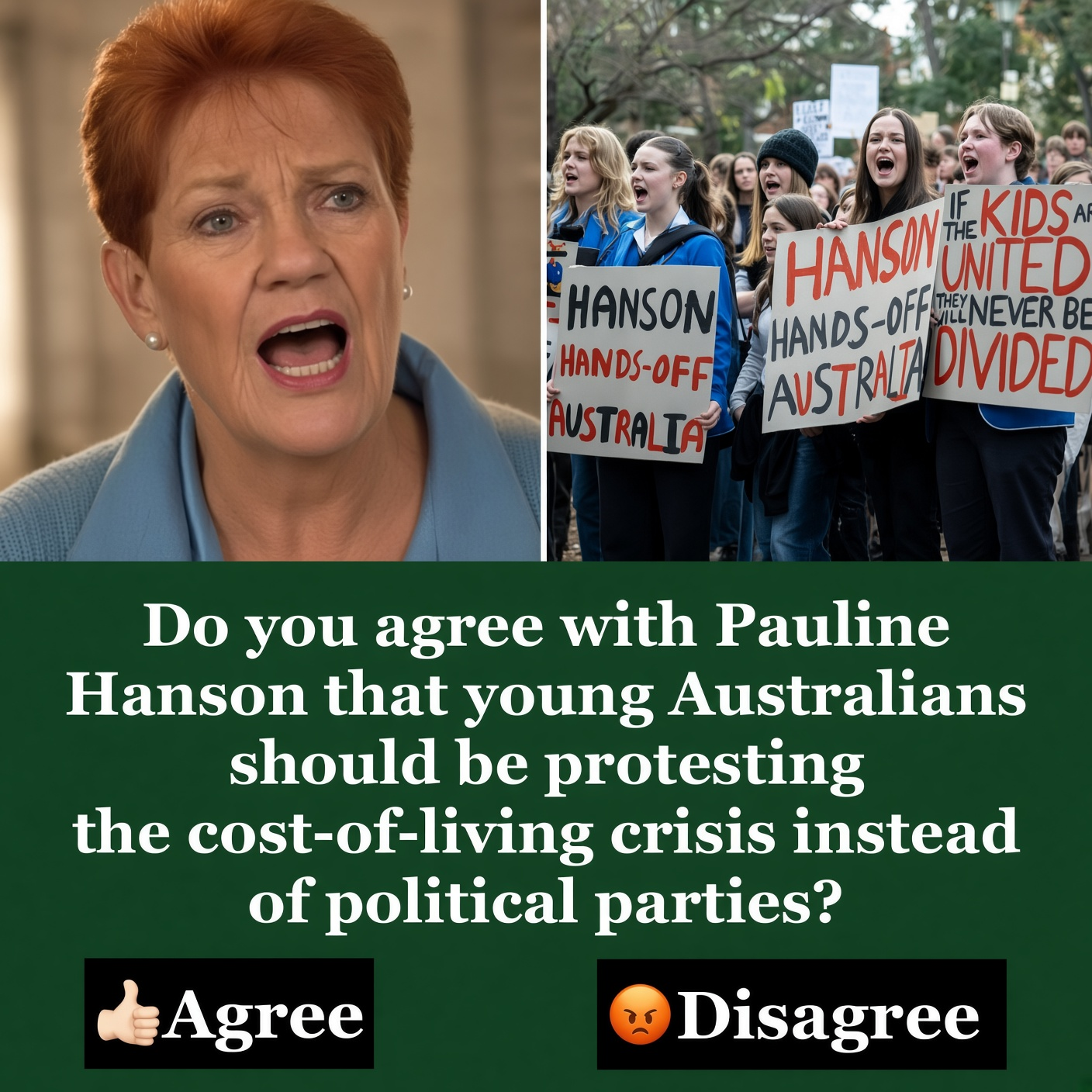
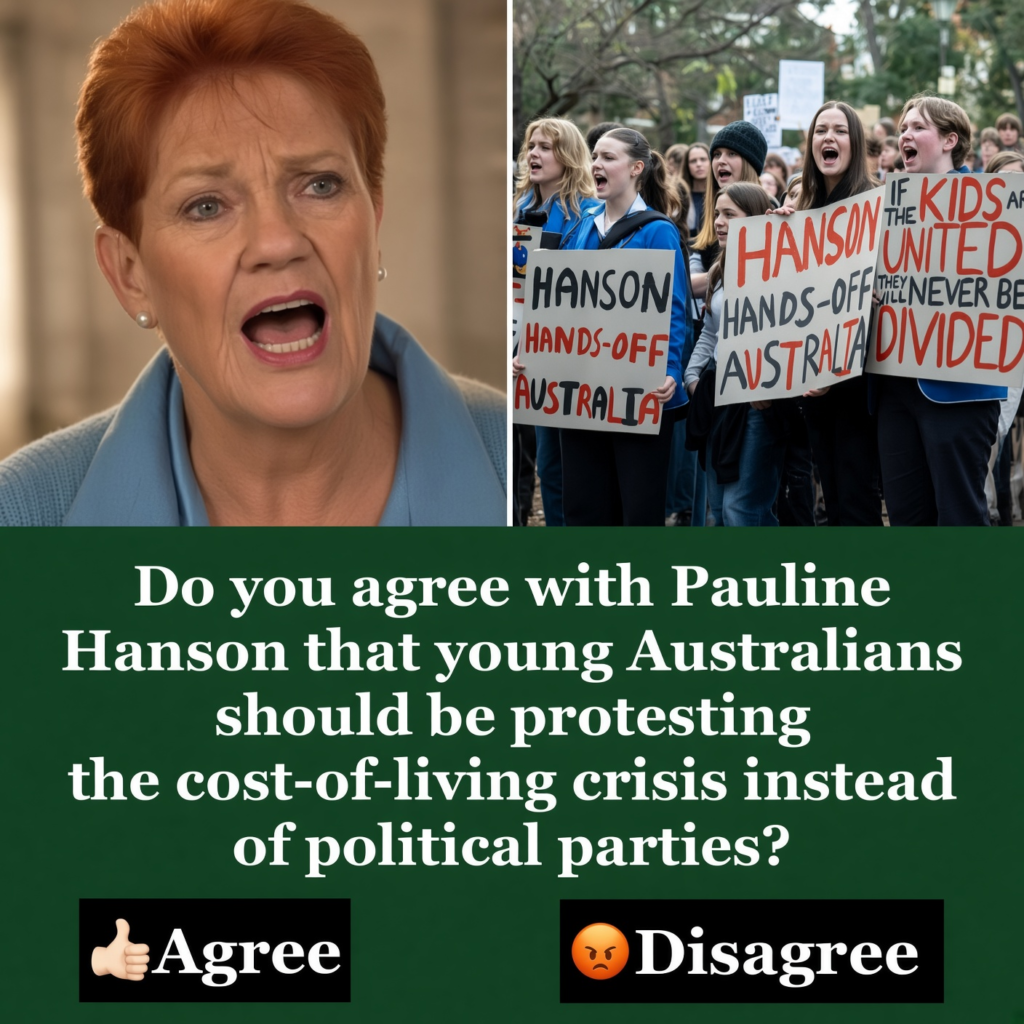
Pauline Hanson has fired back after thousands of school and university students walked out of classes across Australia to protest against her and One Nation, telling young Australians their schools should teach them “how to think, not what to think”.
The One Nation leader issued the pointed response after coordinated demonstrations were held across major Australian cities on Thursday, August 13.
Students gathered in Sydney, Melbourne, Brisbane, Adelaide, Perth and other centres under banners opposing Hanson and what organisers described as the “rise of the far right”.
But Hanson turned the protesters’ message back on them, arguing young Australians should be asking why their families are struggling with the cost of living rather than directing their anger at One Nation.
‘Schools should teach young Australians how to think’
Hanson’s response began with a direct challenge to Australia’s education system.
“Schools should teach young Australians how to think, not what to think,” she said.
She then urged the protesters to focus their attention on economic pressures affecting Australian households.
“If you want to protest something, protest why your parents’ wages are going backwards and the cost of everything is going up,” Hanson said.
The message was an attempt to shift the argument away from accusations directed at One Nation and towards the economic conditions facing younger Australians and their families.
Hanson says One Nation is ‘fighting for you’
The senator then broadened her response into a direct political pitch to the very young people demonstrating against her.
She accused the Labor-Greens political alliance of damaging their future and warned they would inherit what she characterised as a “weaker, poorer and less safe country”.
That description represents Hanson’s political assessment of the government’s record rather than an independently established finding.
She finished with perhaps the most striking line of her response.
“Whether you know it or not, One Nation and I are fighting for you.”
Instead of dismissing the protesters as politically irrelevant, Hanson was effectively arguing that they were protesting against a party she says represents their long-term economic interests.
Thousands had taken to the streets
The comments followed one of the most visible youth-led political demonstrations Australia has seen in recent years.
Thousands of secondary-school and university students participated in coordinated rallies across the country.
In Sydney, protesters gathered around Town Hall.
Melbourne students converged on the State Library of Victoria before marching through the CBD.
Similar demonstrations were held in Brisbane, Adelaide, Perth and other cities.
The rallies were explicitly political, targeting Hanson, One Nation and policies protesters said threatened multiculturalism, workers, women, LGBTQ+ Australians and minority communities.
Students accused One Nation of racism
At the demonstrations, students carried placards and participated in chants directly condemning Hanson and her party.
Some speakers accused One Nation of racism and bigotry.
Others argued that the party’s rising support represented a threat to the kind of Australia they wanted to inherit.
Participants interviewed at the rallies said they believed young Australians had a legitimate reason to speak publicly even when many were not yet old enough to vote.
For those students, leaving school was itself part of the political statement.
They argued that issues involving racism, equality and their future were sufficiently important to justify participating in the demonstrations.
The protests came as One Nation’s support rises
The timing was politically significant.
One Nation has been attracting increased attention and support, turning Hanson into an increasingly important figure in the contest over Australia’s conservative vote.
That rise has alarmed political opponents on the left.
The student rallies were organised not simply as a protest against Hanson’s past statements but as an attempt to resist One Nation’s growing contemporary political influence.
Organisers explicitly connected the demonstrations with what they described as the rise of right-wing politics.
Who organised the walkouts?
The demonstrations were not spontaneous gatherings that suddenly appeared on Thursday afternoon.
They were coordinated in advance.
The National Union of Students was involved in organising the national day of action, alongside student and activist organisations.
Campaigning had encouraged secondary-school and university students to leave classes and attend rallies in major cities.
That organisational structure has become an important part of the subsequent political argument.
One Nation politicians and supporters have argued the students were being influenced by adult political activists and socialist organisations.
Organisers reject the suggestion that young protesters cannot form political views independently.
Some protesters were very young
Reporting from the demonstrations showed that participants ranged from university students to secondary-school pupils.
Some were only in the early years of high school.
That fact intensified the debate over whether political activism should occur during school hours.
There is an important distinction between young Australians having political opinions and schools formally endorsing students leaving class to express them.
Authorities generally defended students’ democratic right to express political views while maintaining that normal attendance requirements still applied.
Jason Clare said high-school students should be in school
Federal Education Minister Jason Clare took a more restrained position than either Hanson or the protest organisers.
He acknowledged Australians’ democratic right to protest.
But he also said high-school students should be at school during school hours.
That distinction allowed the government to defend political expression without endorsing truancy.
State education authorities faced the same issue as students prepared to participate.
Victorian schools did not simply approve the absences
In Victoria, where hundreds of students converged on central Melbourne, education authorities made clear that participation in the rally did not automatically constitute an approved absence.
At least some individual schools explicitly informed families that leaving class to attend the protest was not sanctioned by the school.
Victorian Premier Ben Carroll and Education Minister Gabrielle Williams also emphasised that students should attend school.
That is important context because the existence of a political protest did not suspend ordinary school attendance rules.
Parents could nevertheless make their own decisions about their children’s participation and absences under relevant school procedures.
Greens politicians supported the demonstrations
The walkouts also attracted support from elected Greens politicians.
Greens Senator Mehreen Faruqi publicly encouraged young people to participate ahead of the demonstrations.
In a social-media video, Faruqi attacked One Nation as racist, sexist, anti-worker and divisive and encouraged students interested in joining the protest.
Her involvement became one of the most politically contentious aspects of the walkout.
Critics argued a federal senator should not encourage schoolchildren to miss class for a partisan political demonstration.
Supporters saw her intervention as encouragement for legitimate youth political participation.
The argument quickly became about education itself
Hanson’s response deliberately moved beyond the policies students were protesting.
By declaring that schools should teach young Australians how rather than what to think, she raised the question of ideological influence inside classrooms.
Other One Nation figures went further, accusing sections of the education system of pushing left-wing political ideas.
Those allegations require a distinction between political activism by individual students or teachers and evidence of systematic ideological instruction across Australian schools.
The existence of the protests demonstrates substantial political engagement among participating students.
It does not, by itself, establish that Australian schools systematically instruct students to oppose One Nation.
Students reject the idea they were simply being manipulated
Young people interviewed during the demonstrations offered their own reasons for attending.
Some cited concerns about racism.
Others spoke about LGBTQ+ rights, workers’ rights, environmental policy and multiculturalism.
Some explicitly argued that being unable to vote made public protest more important, not less.
From their perspective, dismissing the demonstrations as indoctrination denied them political agency.
That disagreement has become one of the central fault lines emerging from the rallies.
Can students be politically engaged and still belong in class?
The two propositions are not necessarily mutually exclusive.
Young Australians can hold strong political opinions and have a democratic right to express them.
Schools can simultaneously maintain that students are expected to attend scheduled classes.
The controversy arises when political participation requires students to choose between those obligations.
Thursday’s demonstrations forced that tension into public view.
For organisers, walking out was a meaningful act of protest.
For critics, the same action was simply skipping school for politics.
Hanson wants the conversation redirected to cost of living
Perhaps the most politically calculated part of Hanson’s response was her attempt to redefine what younger Australians should be angry about.
Instead of debating protesters directly on accusations of racism or social division, she pointed to household economics.
Young Australians face serious affordability challenges.
Housing costs, rents and the broader cost of living remain major political issues.
Hanson’s message was that protesters should blame the governments responsible for economic policy rather than the party currently outside government.
That is a political argument, but it is also clearly aimed at expanding One Nation’s appeal beyond its traditional older voter base.
Young voters are increasingly important
Australia’s younger generations will play an increasingly significant role in determining federal and state elections.
Housing affordability has already become one of the defining issues separating younger voters from older Australians.
Climate policy, university costs, employment security and social issues also shape their voting behaviour.
One Nation’s challenge is that many of the students demonstrating on Thursday clearly see Hanson herself as part of the problem rather than the solution.
Her response attempts to reverse that perception.
‘Whether you know it or not’ is the key political message
Hanson’s final sentence was unusually direct.
She did not ask the students to agree with her.
She told them that One Nation was fighting for them regardless of whether they recognised it.
That formulation simultaneously dismisses the protesters’ judgement and courts their eventual support.
It amounts to an argument that young Australians have misunderstood who is responsible for the problems they face.
That is likely to remain central to One Nation’s attempt to convert frustration over housing, wages and living costs into votes.
The protesters have a very different view of their future
The students on the streets were also talking about the future.
But their priorities differed sharply from Hanson’s.
They spoke about multiculturalism, discrimination, environmental protection, gender equality and the rights of minority communities.
Many argued One Nation’s policies threatened rather than protected the Australia they wanted to inherit.
In other words, both sides claim to be defending young Australians’ future while offering fundamentally different definitions of what that future should look like.
That makes the protests more than a one-day confrontation
The rallies will end.
The political argument behind them will not.
Australia is witnessing a broader contest over immigration, multiculturalism, national identity, living standards and the role schools should play in civic education.
One Nation’s growing political profile has brought those questions into sharper focus.
The fact that thousands of young Australians were willing to leave classrooms and demonstrate shows how intensely some of those arguments are now being felt by a generation that will shape future elections.
Hanson’s response shows she has no intention of surrendering that generation to her opponents.
The battle is now over what young Australians should believe — and why
There is an irony in the controversy.
Hanson says students should be taught to think independently.
The protesters say that is precisely what they are doing.
One Nation supporters argue organised political groups are shaping students’ opinions.
Protest organisers argue Hanson is trying to delegitimise young people because she dislikes the conclusions they have reached.
Neither proposition can be established merely by counting how many students marched through Australian cities on Thursday.
But the rallies have created a legitimate debate about political activism, education and the ability of young people to form independent views.
Hanson has made clear she intends to fight that argument
The One Nation leader could have responded to the demonstrations simply by condemning them.
Instead, she addressed the students directly.
She told them to question their education.
She told them to question economic conditions affecting their parents.
And she told them they were protesting against a political movement that, in her view, is actually defending their interests.
“Whether you know it or not, One Nation and I are fighting for you.”
For the students who filled Australia’s streets chanting against her, that claim will be difficult to accept.
For Hanson, convincing at least some of them — or their families — otherwise is now part of a much bigger political contest.