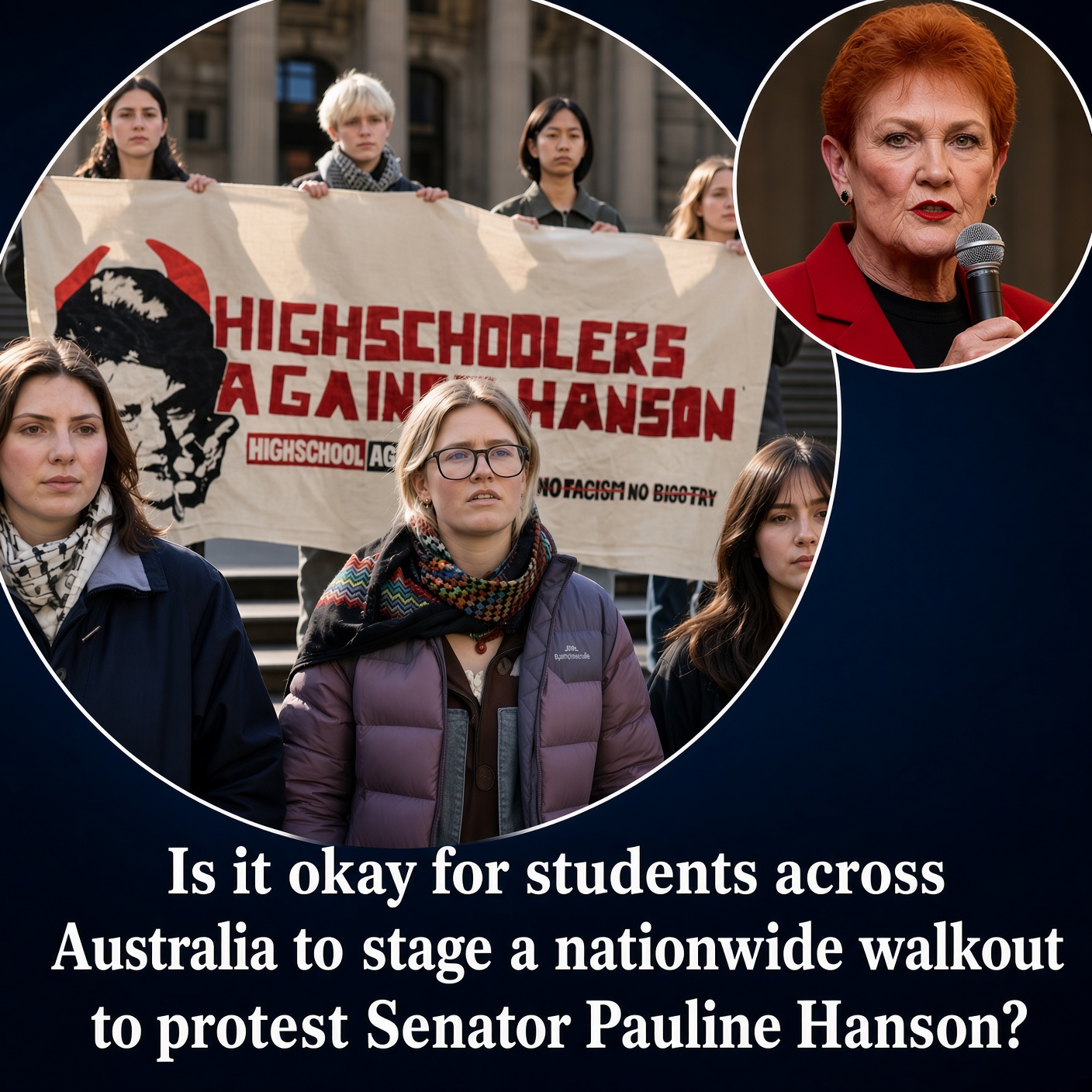
Australian high school students are being urged to walk out of classrooms nationwide on Thursday in a coordinated protest against Pauline Hanson and One Nation, as the party’s growing political influence sparks an increasingly organised campaign of opposition among young activists.
The August 13 action is being promoted by the High School Anti-Capitalists under the banner “Students Say No to Hanson”, with organisers calling on teenagers around the country to leave school and join demonstrations opposing One Nation.
The activist group has accused Hanson’s party of promoting policies it regards as racist, homophobic and hostile to workers, and argues that students should mobilise before One Nation’s recent surge in political support translates into greater electoral power.
The campaign has received backing from the National Union of Students and is being promoted through an unusually detailed organising effort aimed directly at school-aged Australians.
Organisers have distributed a “walkout guide” instructing supporters on how to recruit other students, establish group chats, put up posters, circulate promotional material on social media and build local participation before Thursday.
The material effectively gives teenagers a blueprint for turning opposition to Hanson into organised political activity inside their own schools.
It is important, however, to distinguish the activist campaign from the education system itself.
There is no evidence in the available reporting that Australian schools or education departments are officially organising the walkout.
Rather, students are being encouraged by an outside political activist organisation to leave classes and participate.
Nor is it yet possible to establish how many students will actually take part nationally.
The organisers describe the action as nationwide, but the true scale of participation will only become clear when students are expected to walk out on August 13.
The protest nevertheless represents another sign of the intense political reaction surrounding One Nation as Hanson attempts to turn a dramatic increase in support into electoral gains across Australia.
That reaction has been particularly visible in Victoria.
Only days before the student walkout campaign attracted national attention, protesters gathered outside a One Nation event in Melbourne as Hanson and her party began presenting candidates for the Victorian election.
About 100 demonstrators were reported outside a One Nation fundraiser at the Tower Hotel in Hawthorn, while approximately 150 people attended the event inside.
A substantial police presence was deployed as protesters chanted against Hanson and displayed anti-racism and anti-colonialism signs.
The event proceeded despite the demonstrations.
One Nation used its Victorian campaign activities to introduce candidates and argue that the state needed a fundamental political change after years of Labor government.
The party has promised to campaign heavily on crime, education, government spending, corruption and opposition to Indigenous treaty arrangements.
It has also indicated an ambition to contest seats across Victoria rather than concentrate only on a small number of electorates.
The student walkout is therefore emerging as part of a wider contest over whether One Nation’s rise should be treated as an ordinary democratic shift in voter support or as a political movement requiring active resistance.
The High School Anti-Capitalists firmly embraces the latter position.
Its campaign material uses highly ideological language and presents Hanson as part of a broader right-wing threat that students should organise to defeat.
The group’s accusations against One Nation should be understood as political claims made by activists rather than independent findings about the party.
Organisers describe One Nation as racist, homophobic and anti-worker and argue that Hanson’s increasing popularity represents a danger to migrants, Indigenous Australians, LGBT people and workers.
But their criticism does not stop with One Nation.
The campaign also attacks Labor and the Liberal Party over their records and policies.
Even the Greens, despite occupying a substantially different ideological position from One Nation, have not escaped criticism from the activists, who argue that the party ultimately operates within and supports a capitalist political system.
That broader ideological position is important for understanding who is behind the walkout.
This is not simply a non-partisan student civics campaign opposing one controversial politician.
It is being promoted by an explicitly anti-capitalist activist organisation with a wider political agenda.
Its mobilisation strategy reflects that.
Students are being encouraged not merely to attend a rally but to organise within their schools.
The guide reportedly recommends identifying sympathetic classmates, creating online communication networks and using posters and social media to expand participation.
Such tactics are familiar from previous Australian student protest movements.
School walkouts became a particularly visible form of youth political activism during the School Strike for Climate movement, when students left classrooms to demand stronger government action on climate change.
The Hanson protests differ substantially in political subject matter, but the organising principle is similar: students deliberately interrupt the normal school day to demonstrate that an issue is important enough to justify leaving class.
That inevitably raises questions extending beyond the merits of the political cause itself.
Parents and schools may support students’ right to hold and express political views while taking a different position on whether children should leave scheduled lessons to participate in demonstrations.
Individual schools may also have attendance, supervision and safety obligations that continue regardless of the political nature of a protest.
Those practical questions become more significant when an action is coordinated nationally through social media rather than organised directly by schools.
Students considering participation may face different rules depending on their state, school and age.
The organisers’ decision to target Hanson is also unsurprising given One Nation’s policies in education and culture.
Hanson has recently outlined what she would seek to do during the first 100 days of a One Nation federal government, including removing Welcome to Country and Acknowledgement of Country practices from Commonwealth institutions and seeking to eliminate them from schools.
She has also campaigned for substantially lower immigration, the abandonment of Net Zero policies and major changes to government spending and the NDIS.
Her policies on immigration and Islam have been especially contentious throughout her three decades in Australian politics.
Hanson has recently again argued for tougher restrictions on migration from countries she describes as affected by radical Islam, while One Nation has sought to make lower overall migration one of its defining national policies.
Supporters see those positions as legitimate responses to housing shortages, infrastructure pressure, security concerns and failures of multicultural policy.
Opponents frequently regard them as discriminatory and argue that Hanson uses social divisions for electoral advantage.
The August 13 organisers sit emphatically in the second camp.
Their decision to mobilise high school students also demonstrates how deeply polarised attitudes towards Hanson remain despite — or perhaps because of — One Nation’s increased support.
Hanson has been one of the most divisive figures in Australian politics since her first election to federal parliament in 1996.
For much of that period, opposition to her could be combined with the assumption that One Nation would remain a relatively small minor party.
That assumption has become harder to sustain.
The party’s resurgence has encouraged Hanson to speak increasingly in the language of a prospective government rather than a permanent crossbench movement.
She has publicly said she believes she is capable of becoming prime minister and has begun setting out what a One Nation government would attempt to accomplish in office.
At state level, the party is simultaneously building organisations and recruiting candidates.
Victoria has become one of the most visible fronts in that expansion.
One Nation recently announced a slate of candidates for the Victorian election, including candidates for upper and lower house contests, while promising further policy announcements.
Its campaign launch also produced a separate confrontation over media access.
Hanson excluded journalists from the ABC, The Age and The Guardian from a Melbourne press conference, accusing the outlets of biased and unfair reporting.
Other media organisations were admitted.
Hanson defended the decision as a response to what she regards as persistent hostile coverage and indicated that the exclusion was intended to force journalists and their employers to reconsider how they report on One Nation.
The decision drew criticism from journalists and political opponents who argued elected representatives should not determine access according to whether they approve of an outlet’s coverage.
Employment Minister Amanda Rishworth was among those who argued politicians should be prepared to face difficult questioning rather than exclude journalists they regard as unfriendly.
Hanson’s supporters see the issue differently.
They argue the traditional media has spent decades treating One Nation with hostility and that the party has no obligation to provide privileged access to organisations it believes consistently misrepresent it.
The dispute is part of a much larger change in political communication.
Parties and politicians can now reach millions of voters through their own social-media channels, podcasts and sympathetic independent outlets without relying on traditional broadcasters and newspapers.
Activists opposing them have access to the same infrastructure.
The High School Anti-Capitalists’ walkout campaign is an example of that decentralised political environment.
A relatively small activist organisation can publish a mobilisation guide, distribute graphics and videos online and attempt to coordinate students across multiple states without needing the institutional machinery of a major political party.
That makes the size of an organisation less important than it once was.
It also makes claims of a “national” movement easier to make before actual attendance can be measured.
For that reason, the August 13 turnout will matter.
A large walkout across multiple cities and schools would demonstrate that opposition to Hanson has generated a genuine youth mobilisation capable of extending beyond established activist networks.
A limited turnout would suggest the online campaign was considerably larger than its real-world base.
Either outcome would provide useful evidence about an increasingly important political question: how young Australians are responding to the resurgence of One Nation.
The campaign also creates a difficult strategic choice for Hanson.
She can attack the organisers as radical activists attempting to politicise schoolchildren, potentially reinforcing her argument that left-wing ideology has gained excessive influence in Australian education.
Or she can largely ignore the demonstrations and avoid giving a student protest greater national prominence.
Some conservative politicians are already questioning why students are being encouraged to leave classrooms for an explicitly partisan political protest.
The organisers, meanwhile, are unlikely to be troubled by criticism that their action is political.
Political mobilisation is its stated purpose.
They want students to see One Nation’s growth as something that can be challenged through collective action rather than simply observed through opinion polls and elections.
That is also why the campaign extends beyond Hanson personally.
Its anti-capitalist organisers regard the One Nation surge as one expression of wider economic and political conditions rather than an isolated personality-driven phenomenon.
Whether most participating high school students share that broader ideological analysis is impossible to know before the demonstrations occur.
Some may be committed anti-capitalist activists.
Others may simply oppose Hanson’s policies on race, immigration, Indigenous affairs or LGBT issues.
Still others may participate because classmates are going.
A nationwide school protest can contain all of those motivations at once.
That makes it important not to attribute every statement in the organisers’ material automatically to every student who takes part.
The same principle applies on the other side.
One Nation’s growing electoral support does not mean every voter endorses every statement Hanson has made during her career.
Some supporters are primarily motivated by immigration.
Others cite housing, cost of living, energy policy, distrust of major parties or dissatisfaction with government spending.
The political contest surrounding Hanson is becoming more consequential precisely because both support and opposition now draw people with different motivations.
Thursday’s walkout will provide another test of the strength of that opposition.
Students have been given the organising instructions.
Social-media promotion is under way.
Activists are attempting to recruit classmates and coordinate demonstrations around the country.
What remains unknown is how many young Australians will actually leave their classrooms.
If significant numbers do, Pauline Hanson’s political resurgence will have produced something Australia has not often seen during her 30 years in national politics: a coordinated nationwide school walkout organised specifically to stop One Nation’s momentum.