Labor’s stunning defeat in the Secret Harbour by-election has exposed the depth of voter frustration in one of Western Australia’s traditionally safest Labor areas, with cost-of-living pressures, housing, migration and distrust of the major parties dominating the backlash.
One Nation’s Luke Herdegen surged from a minor-party starting position to win the outer-southern Perth electorate, while Labor suffered a collapse in its primary vote and the Liberals finished a distant third.
For Prime Minister Anthony Albanese and WA Premier Roger Cook, the result creates an uncomfortable question.
Why did voters in territory Labor had dominated for decades become willing to abandon the party — and why did so many choose One Nation rather than the Liberals?
Interviews recorded around the electorate on polling day offered one answer in particularly blunt terms.
“We know that Labor have screwed this country,” one One Nation voter told independent interviewer Jesse Noakes.
That is one voter’s judgement rather than an objective assessment of the government’s record.
But the anger behind it is politically important, particularly when placed alongside the actual election result.
The numbers show a dramatic rejection of the status quo
With 74.5 per cent of votes counted in the ABC’s updated tally, Herdegen had secured 39.1 per cent of first preferences.
That represented a remarkable 30.6 percentage-point increase for One Nation compared with the 2025 state election.
Labor’s Georgia Tree was on just 24.4 per cent, a 22.1-point fall in the party’s primary vote.
The Liberal Party was further behind on 17.3 per cent.
On the two-candidate-preferred count, Herdegen led Tree by 57 to 43 per cent, representing a swing of about 18.6 points away from Labor.
Those distinctions matter because some commentary after the election described the result as a “30.6-point swing against Labor”.
Technically, that is not what the current count shows.
The 30.6-point figure is the increase in One Nation’s primary vote.
Labor’s primary vote declined by 22.1 points, while the two-candidate-preferred movement was smaller again.
Whichever measure is used, however, the political conclusion is unavoidable: the shift was enormous.
A Labor stronghold falls
Secret Harbour itself was created for the 2025 state election largely from the former electorate of Warnbro.
But the broader area had remained in Labor hands under different boundaries and names since 1989.
Former Labor minister Paul Papalia represented the electorate and its predecessors from 2007 until his retirement triggered the by-election.
Labor entered the contest defending an 11.5 per cent margin.
Instead of merely losing some support in a routine mid-term protest, it lost the seat.
And it lost it to a party that had never previously elected a member to Western Australia’s lower house.
That makes the result more than a bad night for WA Labor.
It is evidence that the political destination of dissatisfied working and outer-suburban voters is changing.
Cost of living sits behind much of the anger
The blunt polling-day comments recorded in Secret Harbour fit a much broader national story.
Australian households have endured years of elevated living costs.
Electricity, gas, groceries, insurance, housing and mortgage repayments have all become sources of financial pressure.
Recent analysis of official price data has shown that several essential household costs have risen substantially faster than headline inflation over the past five years.
Electricity prices, for example, have risen sharply over that period, while gas, insurance, rents and new-home costs have also placed pressure on household budgets.
For mortgage holders, interest rates remain another major burden.
The Reserve Bank’s cash rate currently stands at 4.35 per cent after three increases during 2026.
The RBA itself acknowledges those increases have been tough for households with mortgages.
Its August Statement on Monetary Policy says scheduled mortgage payments have increased relative to disposable household income and are now close to their 2024 peak.
That economic environment gives opposition parties a potent message regardless of who is formally responsible for individual policy decisions.
But Albanese did not personally deliver 15 interest-rate rises
One claim circulating after Secret Harbour requires important context.
Critics have repeatedly accused Labor of delivering “15 interest rate rises”.
Opposition Leader Angus Taylor used exactly that formulation in Parliament earlier this month.
The Reserve Bank’s official cash-rate history shows why the political attack resonates, but also why it should not be presented as though the Prime Minister personally ordered those increases.
Australia’s cash rate began rising in May 2022, immediately before Labor took office.
Most of the tightening cycle subsequently occurred during the Albanese government’s term.
The RBA later cut rates three times in 2025 before reversing direction and raising the cash rate three times in 2026, taking it back to 4.35 per cent.
Monetary-policy decisions are made independently by the Reserve Bank’s Monetary Policy Board.
Government fiscal policy can affect demand and inflation and therefore influence the economic environment confronting the RBA, but the cash-rate decision itself belongs to the central bank.
That distinction is essential when assessing responsibility for mortgage pressure.
Energy hardship is also real — but the statistics need care
The claim that one in five Australian households “cannot afford to keep the lights on” similarly overstates the underlying research.
What Energy Consumers Australia research found was that about one in five households were either experiencing or vulnerable to energy hardship.
That is still a serious figure.
Energy hardship can mean households struggling with bills, cutting spending elsewhere, accumulating debt or facing vulnerability because energy costs consume an unusually large share of their income.
The Australian Energy Regulator reported in June that affordability pressures remained high.
More residential customers were carrying energy debt, entering hardship programs and using payment plans than in the previous quarter and the corresponding period a year earlier.
Disconnections and credit-collection activity had also increased.
So while the most dramatic version of the “one in five” claim goes beyond the available evidence, the underlying financial stress is not imaginary.
It is exactly the kind of household pressure capable of reshaping political behaviour in mortgage-heavy outer suburbs such as Secret Harbour.
Migration adds another layer to the backlash
Migration has also become central to One Nation’s appeal.
Australia experienced an extraordinary post-pandemic surge in net overseas migration.
Parliamentary Library figures based on ABS data show net overseas migration of about 538,000 in the year to June 2023, 429,000 in 2024 and 302,000 in 2025.
Those figures reflected unusual post-pandemic conditions, including returning international students and workers and fewer departures than normal.
Migration has since fallen substantially from its peak.
Nevertheless, the cumulative population increase has intensified debate about whether housing construction and infrastructure have kept pace.
One Nation has made lower migration a central part of its pitch to voters.
Labor argues migration is being brought down while maintaining the skilled workforce Australia requires.
The political problem for the government is that voters experiencing high rents or difficulty buying a home may judge the issue through their immediate circumstances rather than the direction of the latest migration figures.
Georgia Tree’s background became an issue
Labor candidate Georgia Tree also faced scrutiny over her professional history.
ABC’s candidate profile confirms Tree previously worked as an adviser to federal Labor MP and Resources Minister Madeleine King.
She later moved into a government-relations role at Woodside Energy.
That career path gave critics an opportunity to portray her as part of the professional political and corporate system rather than a local outsider challenging it.
Polling-day footage circulated by government critic Jesse Noakes pressed Tree over her work at Woodside and whether she had lobbied on gas taxation.
Tree did not provide an answer in the filmed exchange.
That does not establish that she personally lobbied against a particular gas tax.
No such conclusion should be drawn without evidence of her work or lobbying activities.
But politically, the association was enough to generate criticism among some voters interviewed around the electorate.
One described the background as appalling, while another suggested Labor had become trapped by lobbyists.
Again, those are individual voter reactions, not evidence of wrongdoing by Tree.
Woodside’s political contributions require another distinction
Woodside’s relationship with political parties has also become part of the discussion.
An analysis of WA Electoral Commission disclosures published before the by-election identified a $12,100 Woodside contribution to WA Labor in August.
That differs from claims circulating online that the relevant amount was nearly $15,000.
There is also an important terminology issue.
Woodside says it does not donate to campaign funds for political parties, politicians or candidates.
It does, however, pay to attend Australian and Western Australian political-party business engagement events as part of its participation in public-policy discussions.
Those political contributions are disclosed through the relevant electoral authorities.
The distinction does not make political scrutiny illegitimate.
Voters are entitled to examine financial relationships between corporations and political parties.
But describing every disclosed payment as a direct campaign donation to Tree would go beyond the available evidence.
Albanese chooses to confront One Nation
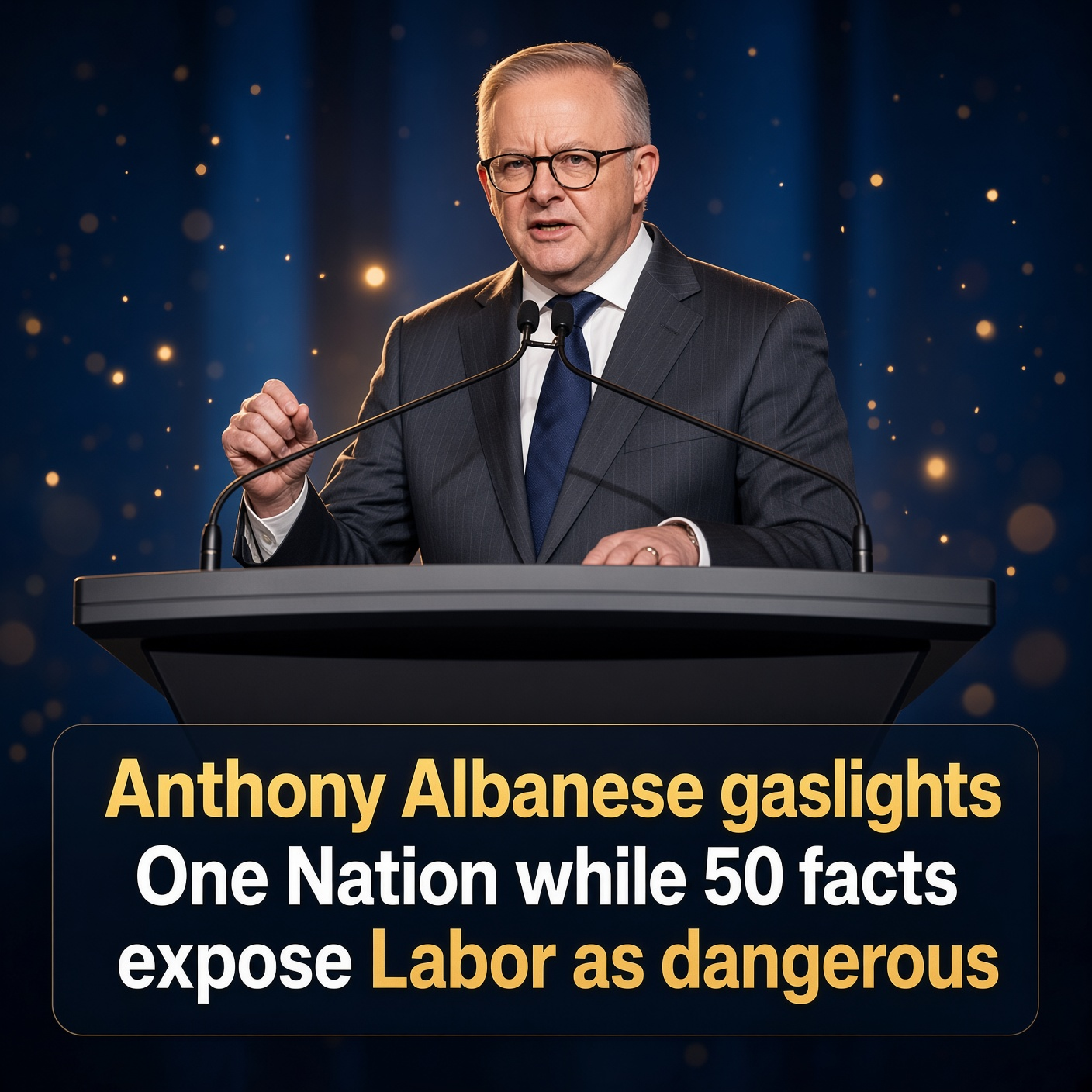
Less than a day after the Secret Harbour result, Albanese addressed the Queensland Labor State Conference.
His speech showed the government has no intention of responding to One Nation’s rise by ignoring it.
“Delegates, this is a crucial time for our movement,” the Prime Minister said.
“Across the world hard right populists are on the march.”
He accused them of “peddling politics that is dangerous, divisive, and downright dishonest”.
“We simply must defeat them. We owe it to history.”
“And we will defeat them.”
Albanese argued parties such as One Nation offered grievance rather than serious answers and accused populists of bending facts, spreading misinformation and turning “Australian against Australian”.
It was a deliberate escalation.
Rather than treating One Nation’s growing support as a temporary protest vote, Labor’s federal leader publicly identified the party as an opponent that had to be defeated.
The danger for Labor is attacking the party without understanding its voters
This is where Secret Harbour creates a strategic dilemma.
Labor can aggressively challenge One Nation’s policies, statements and record.
It can argue that Hanson’s party does not offer workable solutions.
But it cannot afford to treat every One Nation voter as though they share every controversial position associated with the party.
Many are former major-party voters.
Secret Harbour’s demographics help explain why that matters.
The electorate contains many young working families and mortgage holders in Perth’s outer south.
Those voters are particularly exposed to housing costs, interest rates, electricity bills and pressure on household budgets.
Some may be voting enthusiastically for One Nation’s broader ideological platform.
Others may simply be searching for a mechanism to punish Labor and the Liberals.
The electoral consequences are the same.
The Liberals should be just as concerned
Secret Harbour was not merely a rejection of Labor.
The Liberal Party secured only 17.3 per cent of first preferences in the latest ABC count.
That means voters abandoning Labor did not automatically return to the traditional centre-right opposition.
One Nation captured the largest share.
That pattern potentially threatens both sides of Australia’s established political divide.
If economic frustration moves voters directly from Labor to One Nation, Labor loses traditional working-class territory.
If conservative voters choose One Nation instead of the Liberals, the Coalition’s route back to government becomes more complicated.
That is why the by-election has attracted national attention despite being a single state seat.
One by-election cannot explain an entire country
There are nevertheless limits to what can be concluded.
By-elections frequently generate larger swings against governments than general elections.
Voters can register dissatisfaction without changing the government.
Local candidates and local controversies can matter disproportionately.
Secret Harbour’s result therefore cannot simply be projected onto every Labor electorate in Australia.
Nor can a handful of polling-day interviews prove why thousands of people voted the way they did.
The comments captured on camera are useful because they illustrate genuine voter anger.
They are not a scientific exit poll.
The election result itself provides the harder evidence.
Labor’s primary vote collapsed.
One Nation’s surged.
The Liberals finished third.
And a seat Labor entered with an 11.5 per cent margin is changing hands.
The real warning from Secret Harbour
The harshest anti-Labor commentary emerging from the by-election argues that Albanese’s own record explains One Nation’s rise.
That remains a political interpretation rather than a fact capable of being proved by a single result.
But Labor would be taking an equally large risk if it concluded the result could be explained entirely by misinformation, populism or state-specific circumstances.
The financial pressures confronting households are measurable.
Energy hardship is elevated.
Mortgage payments have risen.
Housing remains difficult for many younger Australians to access.
Migration has become a major political concern following the post-pandemic population surge.
And in Secret Harbour, enough voters decided neither Labor nor the Liberals offered the response they wanted.
That is the message Albanese and Cook must confront.
The most important words from polling day may not be the angriest ones captured on camera.
The most important message came from the ballot boxes themselves.
In territory Labor had controlled for decades, voters were prepared to try something different.