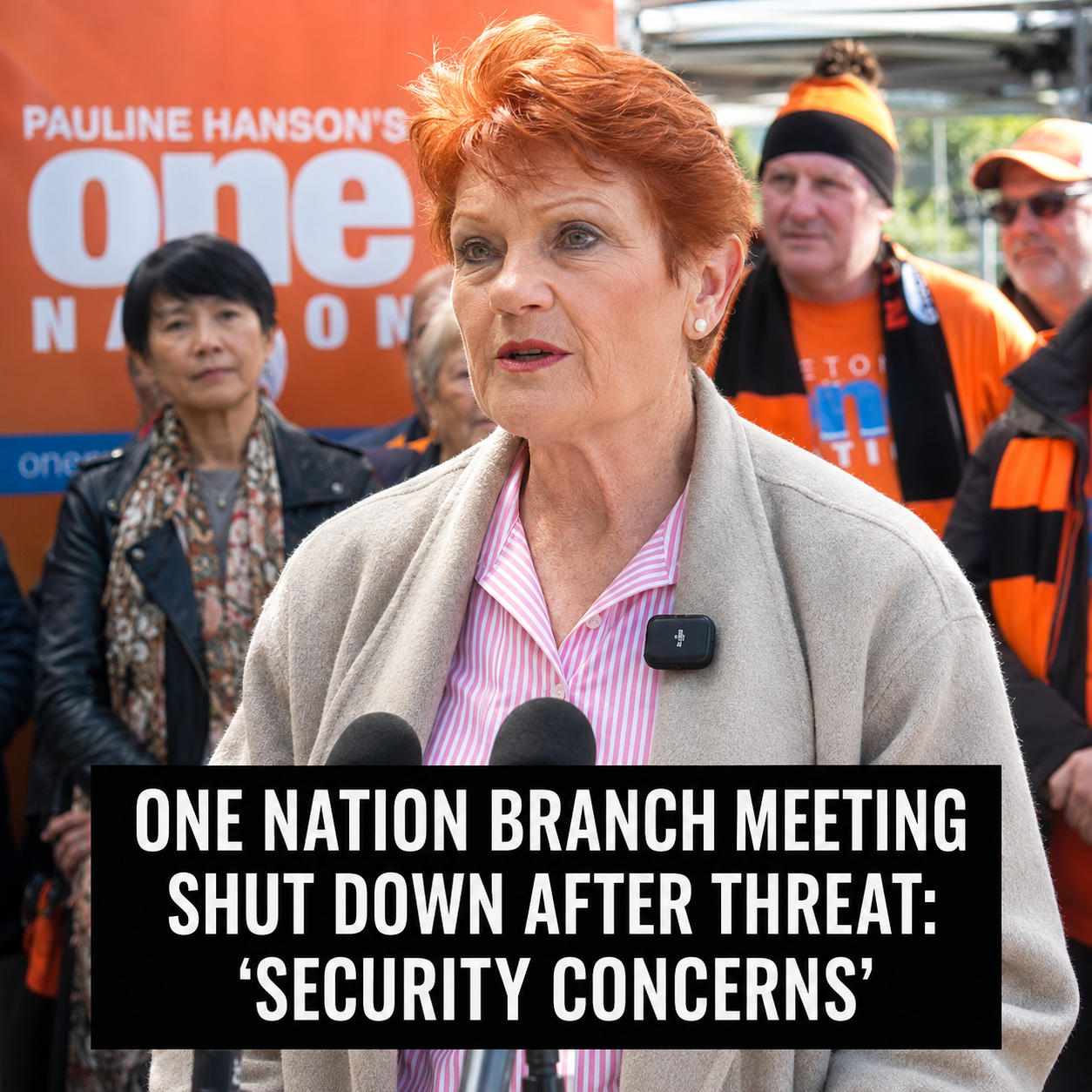
Two One Nation events scheduled for Melbourne’s north-west have been cancelled after the venue was reportedly advised by the Australian Federal Police of a threat and associated security concerns, adding to growing anxiety about the safety of politicians, candidates and campaign workers as Victoria heads towards its November election.
A members’ meeting involving One Nation’s Hawke branch and a separate candidate event had been due to take place at Club Sunbury on Wednesday evening.
One Nation’s public event listing advertised a “Meet the Candidates” gathering from 6.30pm featuring Elita Dabrowski, the party’s candidate for the lower-house seat of Sunbury, and Fiona Lopez, its candidate for the Western Metropolitan region in the Legislative Council.
The event was promoted as an opportunity for voters and supporters to speak directly with the candidates ahead of the Victorian state election on November 28.
But attendees were told at short notice that it would not proceed.
According to an email sent to members and subsequently published by Noticer News, Club Sunbury had received advice from the Australian Federal Police “in relation to a threat and associated security concerns”.
The email said the venue considered that advice and decided the events should be cancelled.
No details about the alleged threat have been publicly released.
There is no publicly available information identifying the person or group allegedly responsible, what form the threat took, whether an arrest or investigation has followed, or whether police believed violence was imminent.
The AFP has not issued a public media statement detailing the matter and Club Sunbury has not publicly explained the threat.
That means claims about the political motivation behind it should be treated cautiously.
In particular, there is currently no evidence establishing that the reported threat came from Antifa, another far-left organisation or any particular ideological movement.
One Nation’s branch communication acknowledged that the circumstances were unclear while arguing the cancellation raised a broader concern about Australians being able to participate safely in democratic politics.
The branch coordinator expressed respect for police but questioned whether law-enforcement agencies had sufficient resources to guarantee people could attend peaceful political meetings without fear.
The communication also sought to reassure members that the cancellation would not deter the party’s campaign.
The incident comes at an unusually heated moment in Australian politics.
Prime Minister Anthony Albanese used Queensland Labor’s state conference at the weekend to launch a forceful attack on the rise of hard-right populist parties.
He described their politics as “dangerous, divisive and downright dishonest”, accused them of bending facts and spreading misinformation, and specifically said parties such as One Nation lacked serious solutions to Australia’s problems.
Albanese said Labor had to defeat those movements politically.
Treasurer Jim Chalmers separately warned about what he described as a “dangerous and divisive” potential alignment between the Liberals, Nationals and One Nation.
Attorney-General Michelle Rowland then intensified the dispute by criticising One Nation over extremist influences.
She said the party had experienced infiltration by extremists and neo-Nazis and accused Hanson of giving platforms to controversial people, while also stating that she did not wish harm on politicians of any political persuasion.
Hanson responded by accusing Labor of using language that could increase threats towards One Nation representatives and supporters.
She argued that describing a democratic political party and its voters as dangerous risked encouraging hostile behaviour.
The cancellation at Sunbury will inevitably be used by One Nation as part of that argument.
But the timing alone does not establish that Labor’s rhetoric caused the reported security threat.
No evidence currently available links Albanese, Chalmers or Rowland’s statements to the person or people allegedly responsible for the Sunbury matter.
There is equally no evidence that any Labor, Greens or other political organisation had any involvement.
Keeping that distinction clear matters because genuine threats against political figures are already an established national-security problem.
Hanson herself has been the subject of an alleged death threat in a separate case that is now before the courts.
A 47-year-old Perth man, Anton Raymond Illich, appeared in court in August accused of making Facebook posts threatening to kill the One Nation leader.
One of the alleged messages stated that he would hunt Hanson down and kill her.
He was charged with two counts of using a carriage service to make a threat.
The allegations remain before the courts.
The AFP had earlier confirmed that it opened an investigation after being notified about an alleged online threat to kill a federal parliamentarian.
Hanson has also said increasing security concerns have changed the way she campaigns and that federal police protection is now present during some of her public activities.
The AFP does not disclose details of individual protection arrangements.
The issue extends beyond One Nation.
AFP Commissioner Krissy Barrett has said threats against parliamentarians have doubled over a three-year period.
A survey of federal politicians and staff published last year found an overwhelming majority had encountered constituents behaving in a violent, threatening or volatile way.
ASIO has repeatedly warned about the growth of politically motivated violence and the increasing risk posed by individuals radicalising rapidly across a variety of ideologies.
That environment makes it especially important to distinguish between strong democratic disagreement and threats or actual violence.
Australia’s political parties routinely organise public meetings, branch gatherings, campaign launches and fundraisers at privately operated venues.
Those venues must balance the right of groups to hold lawful events with responsibilities for the safety of employees, members, patrons and the wider public.
Club Sunbury normally hosts private and community functions and its published function information requires security personnel for night events.
If police provide information suggesting a particular function presents an elevated risk, a venue can decide that cancellation is the safest response even where no offence has yet occurred at the premises.
Without more information from Club Sunbury or the AFP, it is impossible to know what threshold was reached in this case.
The cancelled candidate gathering was part of One Nation’s increasingly ambitious Victorian election campaign.
Dabrowski is a Sunbury local, naturopath and small-business owner who has been endorsed by the party for the Sunbury district.
The seat is currently represented by Labor MP Josh Bull.
Sunbury has been held by Labor since the electorate was created for the 2014 election.
Lopez, an HR manager from Melbourne’s west, is campaigning for a Legislative Council position in Western Metropolitan.
One Nation has been steadily announcing candidates across Victoria and has said it wants to contest every lower-house seat.
The Victorian Electoral Commission says the state election will take place on Saturday, November 28, with all 88 Legislative Assembly seats and all 40 Legislative Council positions up for election.
Formal candidate nominations do not close until November, meaning the names currently promoted by parties are endorsed or announced candidates rather than the final certified ballot.
The Sunbury cancellation therefore comes as One Nation is attempting to transform increased national support into a much larger Victorian campaign organisation.
It is not the first recent episode to raise safety concerns around the party.
In August, a female One Nation staff member in her 60s was reportedly injured during an altercation at Brisbane’s Royal Queensland Show.
One Nation said she was wearing party-branded clothing and walking towards its Ekka stall when she was verbally abused and then allegedly spat on, grabbed and punched.
The party said she suffered a broken rib and significant bruising and required hospital treatment.
The Royal National Agricultural and Industrial Association, which runs the Ekka, said it had been made aware of the alleged incident by police and would assist with inquiries.
There is an important qualification to how that episode has sometimes been described.
One Nation figures linked the alleged attack politically to hostility surrounding recent anti-Hanson protests.
But reporting at the time did not establish that the four alleged attackers were members of a far-left organisation, Antifa or any other political group.
Queensland Police also said at that stage it was aware of the altercation but had not received a formal complaint, while One Nation maintained that the staff member had spoken with officers.
Political affiliation should therefore not be assigned to the alleged attackers without further evidence.
The same principle applies to footage from anti-One Nation demonstrations where individuals have made extreme or offensive remarks.
The fact that somebody attends a protest does not establish membership of an organised extremist group, just as violent comments by an individual protester should not automatically be attributed to every person at the event.
One of the more contentious claims in reporting about recent protests concerns Antifa.
President Donald Trump formally designated Antifa a “domestic terrorist organisation” in the United States by executive order in September 2025 and directed US agencies to investigate and disrupt illegal activity associated with the movement.
The Trump administration has since increased its focus on violent far-left networks and has pressed allies, including Australia, to give greater attention to what US officials describe as far-left terrorism.
That US policy does not make an Australian activist an Antifa member, nor does it automatically give an American executive designation legal force under Australian terrorism law.
Any connection between a particular Australian incident and an organised extremist network still requires evidence.
That evidence is currently absent from the Sunbury case.
What can be established is narrower but still significant.
One Nation had publicly scheduled a campaign event at Club Sunbury for September 2.
The gathering was to feature Dabrowski and Lopez as the party expanded its Victorian election campaign.
A communication sent to members said the venue cancelled after receiving AFP advice concerning a threat and security issues.
Neither the nature nor source of that alleged threat has been publicly identified.
Australia’s broader political-security environment makes such an incident worthy of attention without requiring speculation about the perpetrator.
Threatening candidates, campaign workers or supporters because of their political affiliation is incompatible with democratic participation regardless of whether the target is One Nation, Labor, the Coalition, the Greens or any other political movement.
At the same time, forceful criticism of an opponent remains a normal part of democratic politics and should not automatically be treated as incitement.
Determining where rhetoric ends and criminal intimidation begins requires evidence about the people actually responsible.
For the Sunbury event, that evidence has not yet been made public.
Until the AFP, Club Sunbury or investigators provide further information, the central unresolved question is not whether One Nation faces political hostility — it plainly does — but who made the reported threat, what they threatened to do and whether police can establish a criminal offence.