Anthony Albanese has issued one of his strongest warnings yet about the rise of One Nation, declaring Labor has a responsibility to defeat hard-right populism as Pauline Hanson’s party celebrates a historic breakthrough in Western Australia.
The Prime Minister used a major speech to the Queensland Labor State Conference in Brisbane to accuse populist political movements of exploiting grievances, spreading misinformation and offering voters simplistic answers to difficult national problems.
His language was unusually forceful.
“Across the world hard right populists are on the march,” Albanese told delegates.
He described their politics as “dangerous, divisive, and downright dishonest”.
Then came his rallying cry to Labor.
“We simply must defeat them. We owe it to history.”
“And we will defeat them.”
The declaration came at a particularly uncomfortable moment for the government. Just a day earlier, One Nation had inflicted a stunning defeat on Labor in the Western Australian state electorate of Secret Harbour, securing the party’s first lower-house seat in the state’s history.
The combination of an electoral breakthrough and surging national support has forced a significant change in the way Australia’s major parties talk about Hanson.
One Nation is no longer being treated simply as a protest party that can be expected to fade when an election approaches.
Albanese’s speech made clear that Labor now regards it as a political force that must be confronted directly.
Albanese accuses One Nation of offering grievance without solutions
The Prime Minister’s attack went well beyond the headline declaration about defeating populism.
Albanese accused populist movements of being prepared to “say anything and do anything to win votes”.
He said they would bend facts, spread misinformation and disinformation and “turn Australian against Australian”.
He then singled out One Nation.
“Parties like One Nation have no serious answers to our problems,” Albanese said.
He argued the party’s own divisions and disagreements were becoming increasingly visible and accused it of holding positions that would work against the interests of ordinary employees.
Among the issues he raised were working from home, penalty rates, domestic violence and multiculturalism.
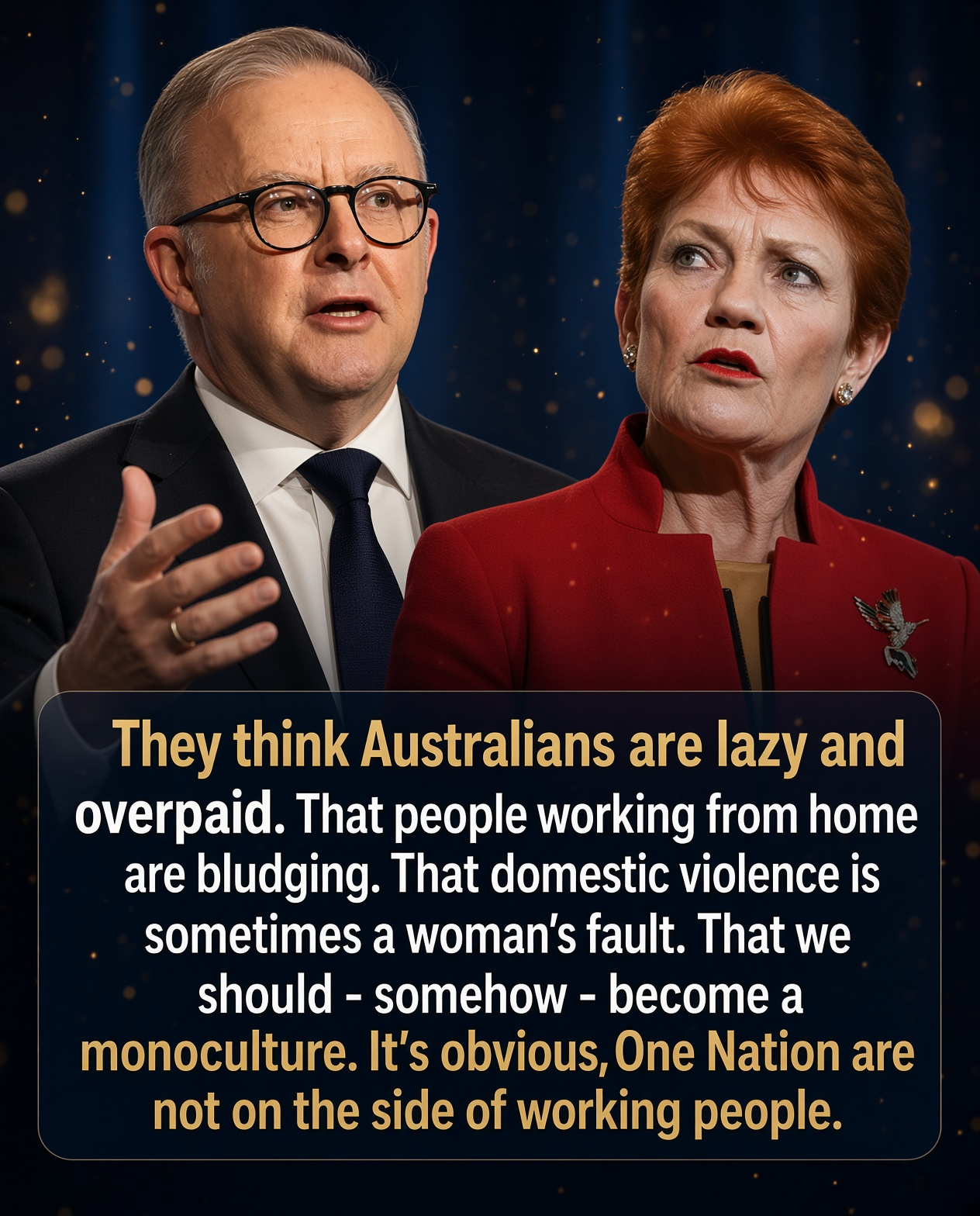
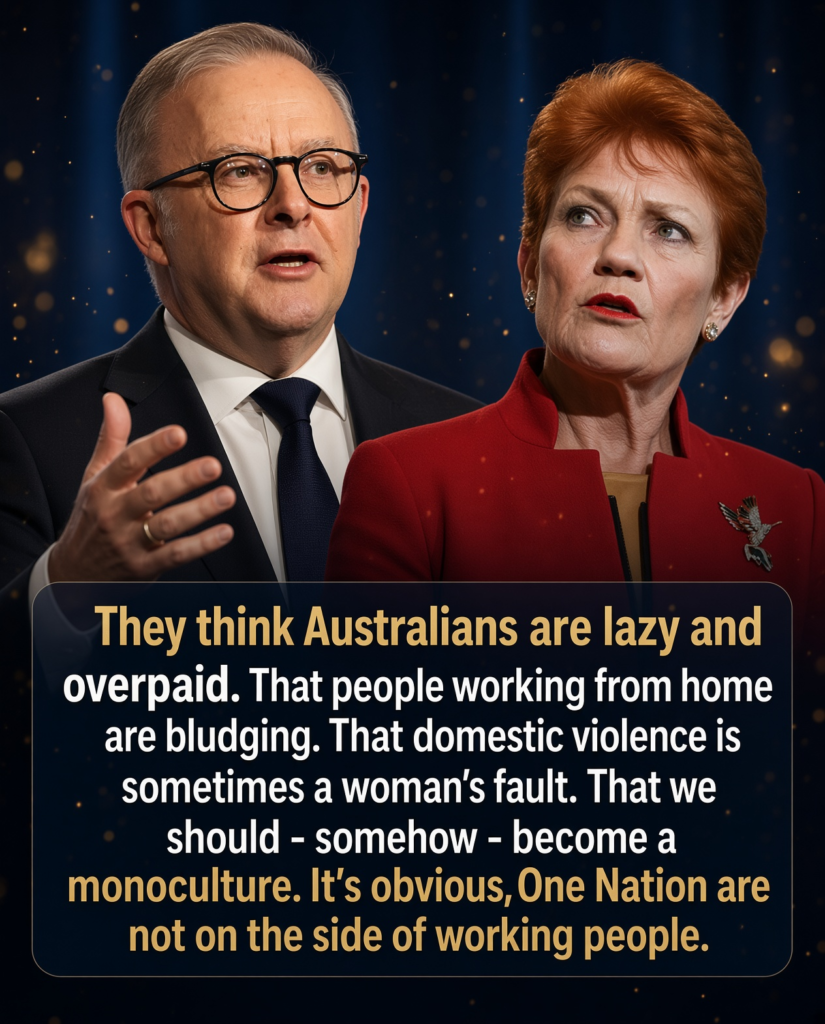
Albanese accused One Nation of regarding Australians as “lazy and overpaid” and people working from home as “bludging”.
He also attacked the party over Hanson’s call for Australia to be a multiracial but monocultural society.
“We unequivocally support multiculturalism because we know it’s part of Australia’s strength,” Albanese said.
“And because we believe every Australian is equal, whether they are Australian by birth or Australian by choice.”
Labor reaches back to One Nation’s 1998 breakthrough
Albanese also turned to history in an attempt to challenge the idea that electoral success necessarily means One Nation is capable of providing stable government.
At the 1998 Queensland state election, One Nation stunned Australian politics by winning 11 seats.
The parliamentary bloc subsequently fractured and the party lost those seats.
Albanese invoked that experience directly.
“Every time they achieve any success, it leads to chaos and division,” he said.
“Remember when they won 11 seats in Queensland in 1998? They lost all of them in record time.”
His argument was that the modern One Nation surge should be judged not simply by the intensity of voter dissatisfaction but by whether the party could operate as a stable governing force.
The Prime Minister then raised the prospect of One Nation and Queensland’s Liberal National Party eventually needing each other to govern.
“How on earth will they govern in coalition with the LNP?” Albanese asked.
“Because they can’t govern without the LNP — and the LNP can’t govern without them.”
He subsequently described the prospect as a “coalition of chaos”.
Secret Harbour makes the argument harder for Labor
Whatever Labor’s historical argument, the immediate electoral evidence confronting the government is uncomfortable.
One Nation’s Luke Herdegen has won the Secret Harbour by-election in Perth’s outer south, delivering the party its first lower-house seat in Western Australia.
The electorate had been regarded as safe Labor territory.
Secret Harbour was formally created for the 2025 state election, largely from the abolished Labor stronghold of Warnbro, while the broader area had been represented by Labor in different electoral configurations since 1989.
Former minister Paul Papalia had represented the seat and its predecessors since 2007.
Labor entered the by-election defending an 11.5-point two-party-preferred margin.
It disappeared.
With 74.5 per cent counted in the ABC’s published update, Herdegen was sitting on 57.0 per cent after preferences against Labor candidate Georgia Tree on 43.0 per cent.
The swing away from Labor was approximately 18.6 percentage points.
On primary votes, One Nation had 39.1 per cent, Labor 24.4 per cent and the Liberals just 17.3 per cent.
The Liberal result is particularly significant.
This was not simply a conventional by-election in which an unpopular government lost support to the established opposition.
Labor’s vote collapsed and One Nation became the principal beneficiary, while the Liberals were pushed into third place.
One Nation says an ‘orange tsunami’ is coming
Herdegen used his victory to argue that the result carried a message far beyond Western Australian state politics.
He declared there were no longer safe Labor seats and described the result as part of an “orange tsunami”.
One Nation supporters believe the victory demonstrates that voters who once viewed Hanson primarily as a protest option are increasingly prepared to elect her candidates to lower houses.
That proposition will require much more electoral evidence before it can be treated as a national trend.
By-elections are unusual contests.
Voters can punish governments without risking an immediate change of government, local candidate factors can be unusually influential, and turnout and campaign intensity can differ significantly from general elections.
Secret Harbour therefore cannot simply be projected across every Labor-held electorate.
But dismissing it would be equally unwise.
A party that previously held no lower-house seat in Western Australia has just taken one from Labor in territory that had been considered exceptionally difficult to lose.
Barnaby Joyce rejects Albanese’s characterisation
One Nation MP Barnaby Joyce responded by accusing the Prime Minister of relying on stereotypes rather than engaging with what the party actually represents.
Joyce said Albanese was producing “tropes, bromides and basically fallacious statements”.
He specifically rejected suggestions that One Nation was racist, homophobic or unconcerned about women experiencing domestic violence.
The former Nationals leader’s move to One Nation has added another dimension to Hanson’s resurgence.
Joyce brings decades of parliamentary experience, ministerial service and an established public profile to a party historically criticised for struggling to retain experienced representatives.
He also gives One Nation a figure capable of directly contesting Labor and Coalition ministers in mainstream political forums.
His response to Albanese was predictably combative.
But underneath the rhetoric sits a more important disagreement.
Labor argues One Nation’s rise is being built on grievances without credible solutions.
One Nation argues those grievances exist because governments have repeatedly failed to listen to voters.
Some of Albanese’s attacks have a factual basis — but require context
Several positions mentioned by Albanese can be traced to public statements from Hanson and One Nation, although some have subsequently been clarified or disputed.
At her National Press Club appearance in June, Hanson said Australia was a “multiracial society” but argued it “must be monocultural”.
That provides a clear basis for Albanese’s criticism of her approach to multiculturalism, although Hanson frames the policy as support for one shared Australian culture rather than opposition to Australians of different racial backgrounds.
Paid parental leave provides an example of why political summaries also need context.
Hanson questioned why businesses should pay women who were not at work during her Press Club appearance.
She subsequently clarified that she supported the government-funded paid parental leave scheme and said her comments had been taken out of context.
That later clarification matters when assessing claims about One Nation’s current policy.
Similar care is required when politicians reduce complex positions to campaign slogans.
The real political battle is over why voters are leaving
The deeper issue behind Albanese’s speech is not whether Labor and One Nation dislike each other’s policies.
They plainly do.
The more consequential question is why an increasing number of Australians are willing to abandon the parties that have traditionally governed the country.
Secret Harbour provides some clues.
The electorate contains large numbers of young working families and mortgage holders in Perth’s rapidly growing outer south.
WA Premier Roger Cook acknowledged after the campaign that Western Australians were doing it tough and were concerned about their lifestyles and futures.
Those concerns are not unique to Western Australia.
Housing affordability, rents, mortgage repayments, infrastructure pressure and the cost of everyday essentials have become powerful political issues across Australia’s outer suburbs.
Migration has increasingly become connected to those debates as voters question whether housing and infrastructure construction can keep pace with population growth.
One Nation has positioned itself aggressively in that space.
Whether its proposed solutions would work is a separate question, but the grievances it is exploiting cannot simply be dismissed as imaginary.
Labor’s answer is ‘hope’, not grievance
Albanese attempted to address that vulnerability towards the end of his conference speech.
His argument was that attacking One Nation alone would not be enough.
Labor, he said, had to offer voters something more compelling.
“The best way to defeat this coalition of chaos is to give Australians real hope of a better future,” he said.
That meant presenting Labor as a party of “progress and optimism and aspiration for everyone”.
This may ultimately be the most important part of the Prime Minister’s message.
If One Nation’s growth is being driven by dissatisfaction with living standards and the established political system, warnings about populism will have limited effect unless voters believe the government is improving their lives.
Labor therefore faces two interconnected tasks.
It must persuade Australians that Hanson’s proposed solutions are flawed.
And it must persuade them that Labor has better ones.
The Coalition faces an equally serious challenge
The Secret Harbour result also demonstrates why the rise of One Nation cannot be understood purely as a Labor problem.
The Liberals finished third in a seat where Labor suffered a huge swing.
That means the traditional opposition failed to capture much of the anti-government sentiment.
If that pattern appears elsewhere, the Coalition faces a strategic dilemma of its own.
Moving closer to Hanson may help recover voters on its right but risks losing moderates.
Attacking One Nation too aggressively risks convincing disaffected conservative voters that the Coalition regards their concerns with contempt.
Waiting for voters to return automatically is increasingly difficult when One Nation is demonstrating an ability to win seats.
Australia’s traditional two-party competition is consequently under pressure from both directions.
One Nation now has to prove it can handle success
The scrutiny facing Hanson will also intensify as her party grows.
One Nation has historically been most effective as a vehicle for political protest.
A party aspiring to become a major parliamentary force needs considerably more.
It needs candidate discipline, detailed policies, administrative capability and credible positions across health, taxation, defence, housing, energy, industrial relations and the budget.
Albanese’s reference to Queensland in 1998 was designed specifically to highlight that weakness.
The question for the modern One Nation is whether it has learned from that history.
Secret Harbour suggests the party has become capable of winning contests it once could not.
It does not yet answer whether One Nation can build a durable national parliamentary organisation.
Albanese has acknowledged the battle has changed
Perhaps the most revealing aspect of Sunday’s speech is simply that it happened.
A prime minister addressing his party faithful chose to devote substantial attention to defeating One Nation.
That is itself recognition of how dramatically the political environment has shifted.
Albanese’s language was designed to rally Labor members around an ideological contest: multiculturalism against monoculturalism, workplace protections against cuts, optimism against grievance and mainstream government against populist disruption.
One Nation will attempt to frame exactly the same contest in reverse — an entrenched establishment defending itself against voters demanding change.
Secret Harbour gives Hanson a tangible victory with which to make that argument.
Labor has history, incumbency and government resources on its side.
One Nation has momentum and voter dissatisfaction.
The Coalition is meanwhile fighting to avoid being squeezed between them.
Albanese says Australians “owe it to history” to defeat the populist movement.
The political challenge for the Prime Minister is that history alone will not decide the next election.
Australians concerned about their mortgages, rents, jobs, housing prospects and living costs will.
Labor’s ability to answer those concerns may ultimately matter far more than how fiercely it attacks Pauline Hanson.