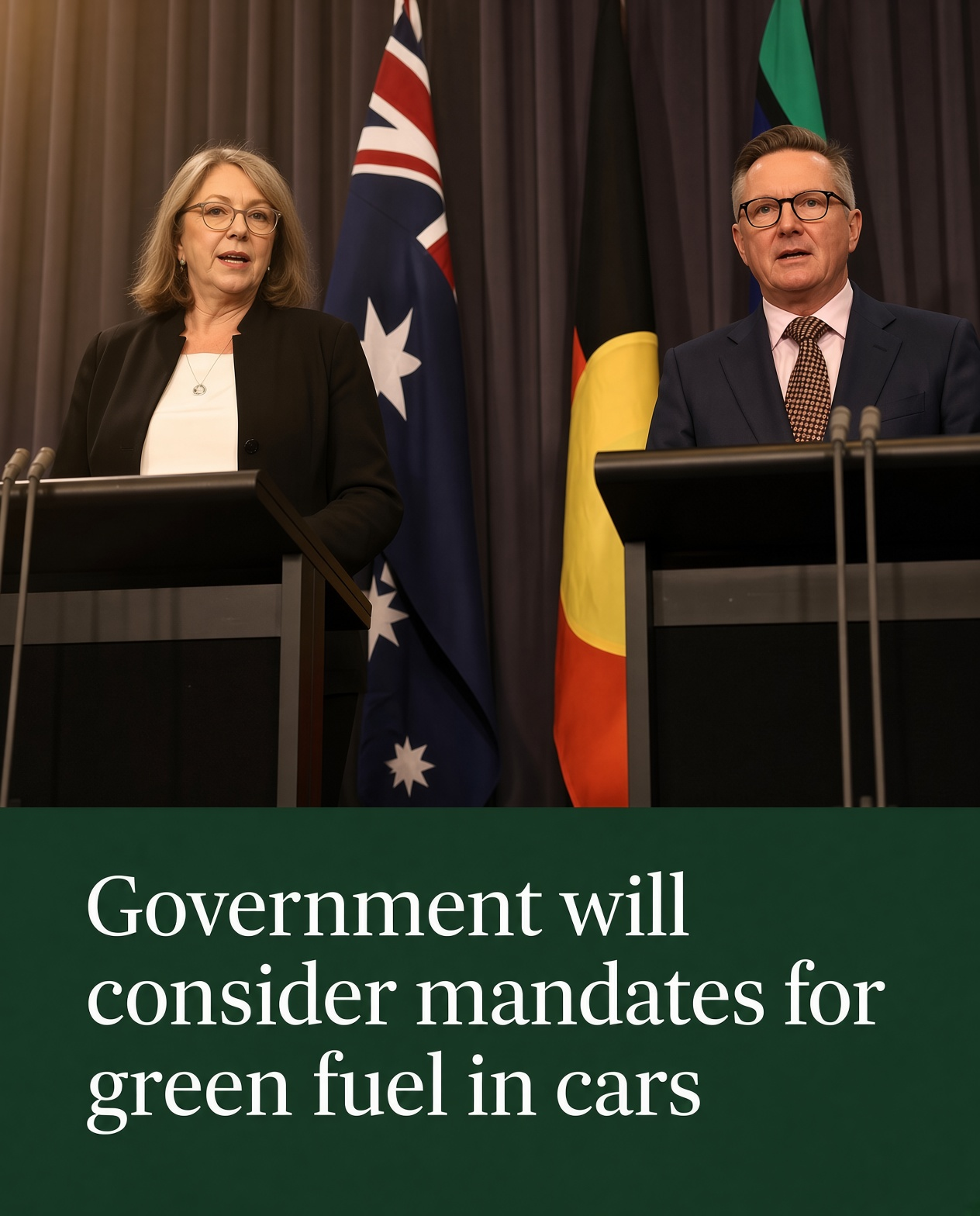
Australian motorists, truck operators and airlines could eventually be required to use fuels containing a minimum share of low-carbon alternatives under plans being considered by the Albanese government.
The proposal would represent a major change to Australia’s fuel market, potentially requiring products such as renewable diesel, biodiesel and sustainable aviation fuel to make up part of the nation’s conventional fuel supply.
But one distinction is crucial.
The government is considering mandates. It has not yet made a final decision on precisely what will be mandated, at what percentage, or when the requirements would begin.
The policy is being developed as Canberra attempts to solve two problems simultaneously: cutting transport emissions and reducing Australia’s exposure to overseas fuel disruptions.
Low-carbon fuel mandates are now firmly on the table
The Albanese government has released discussion material examining how Australia could build a domestic low-carbon liquid fuel industry.
One of the central problems confronting that industry is demand.
Australia possesses agricultural resources, waste streams and renewable-energy potential that could be used to manufacture lower-emissions liquid fuels.
But constructing commercial-scale plants requires enormous capital expenditure.
Investors need confidence that somebody will buy the product once those facilities begin operating.
A mandate is one way of creating that guaranteed market.
What would a mandate actually mean?
The basic concept is straightforward.
Government would require a minimum proportion of eligible low-carbon fuel to be incorporated into, or supplied alongside, conventional fossil fuels.
Instead of allowing the market to determine whether the alternatives are purchased, regulation creates minimum demand.
Exactly how that would work in Australia remains subject to consultation.
The eventual framework could also differ between road transport and aviation because those sectors use different fuels and face very different technological constraints.
Sustainable aviation fuel is a major focus
Aviation is particularly important because long-distance commercial aircraft cannot readily be electrified with current technology.
Sustainable aviation fuel can therefore reduce lifecycle emissions while continuing to use liquid-fuel aircraft.
Transport Minister Catherine King has specifically flagged the possibility of future SAF requirements for Australian aviation, although she stressed this week that the government has made no final decision.
Europe has already moved down this path.
The European Union and United Kingdom introduced 2 per cent SAF obligations, with those requirements scheduled to increase substantially towards the end of the decade.
Renewable diesel could target the hardest vehicles to electrify
Heavy transport presents another challenge.
Passenger vehicles are increasingly moving towards battery-electric technology, but long-haul trucks, mining equipment, some rail operations and other heavy machinery can be considerably harder to electrify.
The government’s low-carbon liquid fuels strategy has consequently focused on hard-to-abate sectors including aviation, heavy road freight, rail, shipping and mining.
Renewable diesel is one of the fuels being promoted for these applications.
This isn’t only about net zero
The government’s strongest argument for the policy may ultimately have less to do with emissions than with fuel security.
Australia remains heavily dependent on liquid fuels.
Government data says liquid fuels account for more than half of Australia’s final energy demand, and conventional fuels are expected to remain important for years even as alternative technologies expand.
At the same time, much of the fuel Australians consume depends on international supply chains.
That vulnerability became dramatically more visible during the global disruptions of 2026.
Australia relies heavily on overseas refineries
Australia produces crude oil and other energy resources, but that does not mean the country is self-sufficient in the petrol and diesel motorists actually put into vehicles.
Large quantities of refined petroleum products arrive from overseas.
The importance of those relationships is evident in the government’s recent fuel-security diplomacy.
Australia and South Korea renewed their energy-security commitments in April, with Canberra describing South Korea as one of Australia’s largest suppliers of refined petroleum products and its largest supplier of diesel.
A disruption affecting Asian refineries or major shipping routes can therefore rapidly become an Australian economic problem.
The 2026 fuel shock changed Canberra’s calculations
Global instability this year forced the government to take extraordinary measures to strengthen domestic fuel supplies.
Canberra temporarily relaxed elements of the Minimum Stockholding Obligation to allow suppliers to move more petrol and diesel into areas where it was urgently required.
The government also legislated to enable additional fuel cargoes and strategic reserves to be secured.
Those interventions highlighted an uncomfortable strategic reality.
Australia can have enormous energy resources beneath its soil and still remain vulnerable when the international supply chain delivering refined fuel is disrupted.
Domestic low-carbon fuel could provide another source
This is where climate policy and national security begin to overlap.
If Australia manufactures substantial quantities of renewable diesel or sustainable aviation fuel domestically, that production does more than reduce lifecycle emissions.
It also represents fuel that does not have to arrive on a tanker from an overseas refinery.
That does not mean low-carbon fuels could quickly replace Australia’s entire imported fuel supply.
But even partial domestic production could diversify the country’s sources.
Farmers could become part of Australia’s fuel industry
The government is also pitching the policy as a potential new agricultural and regional industry.
Low-carbon liquid fuels can be manufactured from a range of feedstocks, including agricultural and forestry residues, used cooking oil, waste and other forms of biomass.
That potentially creates markets for materials that might otherwise have limited economic value.
Agricultural waste could become an industrial feedstock.
Forestry residues could become aviation fuel.
Used cooking oil could ultimately help power trucks or aircraft.
One Australian project is already turning forest waste towards jet fuel
The concept is no longer purely theoretical.
In July, the Albanese government announced $32 million in support for HAMR Energy’s proposed project to transform forestry residues into renewable methanol that could subsequently be converted into sustainable aviation fuel, renewable diesel and other low-carbon liquid fuels.
The funding is being provided through the Australian Renewable Energy Agency.
The project illustrates the kind of domestic industry the government hopes to develop.
But it also demonstrates the problem confronting policymakers.
Producing the fuel is one thing.
Creating a reliable commercial market for it is another.
Canberra has already committed substantial public money
The government has not waited for mandates before supporting the industry.
ARENA’s Future Made in Australia Innovation Fund includes up to $250 million specifically for low-carbon liquid fuels, including sustainable aviation fuel and renewable diesel.
That sits alongside broader government commitments intended to accelerate domestic production.
The underlying strategy is to help projects move through early commercialisation while demand-side measures create a market capable of sustaining them later.
Why not simply let customers choose?
This is where the policy becomes controversial.
If low-carbon fuel were already cheaper than conventional diesel or jet fuel, governments would have little need to mandate its use.
Businesses would purchase it because doing so saved money.
The problem is that emerging low-carbon fuels can be more expensive than the fossil fuels they are intended to replace.
Industry representatives have acknowledged that price difference as one of the reasons companies remain hesitant to invest in Australian production despite government support.
Without guaranteed demand, investors risk spending hundreds of millions of dollars constructing a plant whose output customers may refuse to buy.
A mandate transfers part of that risk
Mandates solve the demand problem by making consumption compulsory.
That provides producers and investors with much greater certainty.
But it also shifts some of the economic risk towards fuel suppliers and ultimately consumers.
If the mandated product costs more than the conventional product it replaces, somebody must absorb the difference.
That could be the producer.
It could be the fuel retailer.
It could be an airline.
Or some portion could eventually reach motorists, freight customers and passengers through higher prices.
Could petrol prices rise?
Potentially — but it is too early to responsibly put a number on it.
The final Australian mandate has not been designed.
The price effect would depend on the mandated percentage, the fuel involved, production costs, government incentives, international prices and how rapidly Australian supply expanded.
A tiny blending obligation would have a different impact from an aggressive mandate.
A mature domestic industry would also have a different cost structure from today’s early-stage market.
Claims that the proposal will definitely add a particular number of cents per litre are therefore premature.
Airfares face the same argument
King has acknowledged that jurisdictions introducing sustainable aviation fuel requirements have experienced some price effects.
She argues the overseas experience suggests those impacts can be relatively small.
Research cited in reporting on the government’s announcement estimates EU ticket-price impacts at about 4 per cent on average by the end of the decade as SAF requirements increase.
That figure should not simply be transferred to Australia.
Australian aviation has different distances, market concentration, fuel logistics and domestic production prospects.
The eventual impact here will depend on the policy Canberra actually adopts.
There is also a food-versus-fuel question
Any large biofuel industry creates another policy challenge.
Where will the feedstock come from?
Using waste cooking oil, forestry residues and genuine agricultural waste can create value from materials that already exist.
But a sufficiently large industry could eventually compete for land, crops or biomass that have alternative uses.
That makes sustainability rules important.
A fuel should not automatically be considered environmentally beneficial merely because its biological feedstock can regrow.
The full lifecycle matters — including land use, farming inputs, processing energy and transport.
Not every ‘biofuel’ delivers the same emissions reduction
This is another reason the government’s terminology matters.
The emerging policy is focused on low-carbon liquid fuels, not simply anything labelled renewable.
Different production pathways can have radically different lifecycle emissions.
A fuel produced from waste using low-emissions energy may deliver substantial savings.
A fuel requiring land clearing, intensive agricultural production and carbon-intensive processing could perform much worse.
Australia will therefore need credible lifecycle accounting if mandates are introduced.
Australia is already adapting its emissions rules for renewable fuels
The federal government has separately consulted on changes to the National Greenhouse and Energy Reporting scheme covering renewable fuels, including co-processed liquid fuels.
Those amendments are intended to apply to reporting for the 2026–27 financial year and later.
That technical work matters because government needs consistent rules for measuring emissions before it can credibly determine which fuels deserve regulatory incentives.
The strategic argument may prove more persuasive than the climate argument
Australia’s energy debate is intensely polarised.
A policy sold exclusively as another net-zero mandate will inevitably face opposition from voters and industries already concerned about energy costs.
Fuel security changes that calculation.
A domestically produced fuel has strategic value even for Australians who are unconvinced by the climate case.
Every litre that can economically be manufactured from Australian waste, agriculture or other domestic resources represents one less litre that must potentially be sourced through a vulnerable international supply chain.
But ‘Australian-made’ does not automatically mean cheaper
Energy security and affordability are not the same thing.
Domestic production may provide greater resilience while still costing more.
That trade-off needs to be explicit.
Australians should be able to judge whether additional fuel security, regional investment and lower emissions justify whatever premium a mandate may impose.
That assessment cannot be made properly until government publishes the final design and detailed cost modelling.
The government hasn’t crossed that bridge yet
For now, Australians are not waking up tomorrow to a new compulsory biofuel blend.
The government is consulting on demand-side measures, and ministers have deliberately left multiple options open.
There is no final national blending percentage.
There is no confirmed commencement date for a broad road-fuel mandate.
And there is not yet enough information to calculate what any final scheme would mean for the price displayed at the local service station.
Those distinctions matter.
What happens next will determine whether the policy succeeds
The government now has to reconcile competing objectives.
It wants investors to build Australian low-carbon fuel plants.
It wants farmers and regional communities to benefit from new supply chains.
It wants aviation, trucking and mining to cut emissions.
And after Australia’s recent fuel-security shocks, it wants fewer strategic eggs sitting in the international-refining basket.
But consumers will reasonably demand another guarantee:
that an industry-development policy does not become an unnecessarily expensive permanent charge at the bowser.
The real debate is only beginning
Low-carbon fuel mandates sit at the intersection of three of Australia’s biggest policy challenges: energy security, cost of living and decarbonisation.
That is what makes the proposal far more consequential than another environmental regulation.
Done well, domestic renewable diesel and sustainable aviation fuel could turn Australian waste and agricultural resources into valuable products, support regional industry and reduce exposure to overseas fuel shocks.
Done poorly, government could force consumers to purchase a more expensive product simply to guarantee demand for projects that would otherwise struggle commercially.
The crucial question is therefore not whether Australia can mandate low-carbon fuel.
It is whether Canberra can build a domestic fuel industry that eventually becomes competitive enough that Australians no longer need a mandate to buy it.