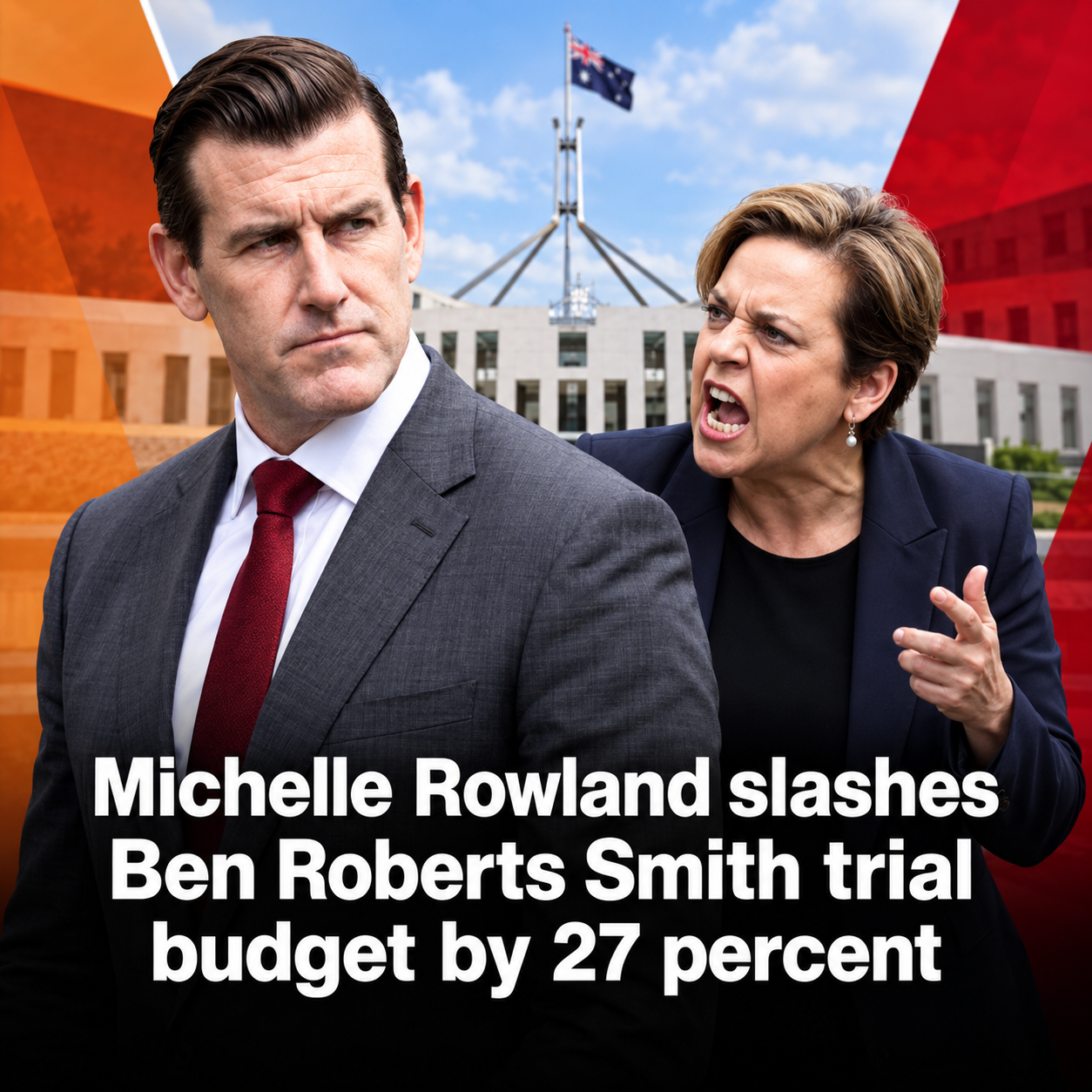
The funding framework available to Ben Roberts-Smith’s defence caps senior counsel at $3,650 a day, significantly below the maximum rate Commonwealth agencies can negotiate for senior barristers under separate government legal-services rules, official documents show.
The disparity has added a new layer to the debate surrounding Australia’s Afghanistan war-crimes investigations as Roberts-Smith, a Victoria Cross recipient and former Special Air Service Regiment soldier, prepares to defend five charges of war crime murder.
Roberts-Smith was arrested on 7 April 2026 following a joint investigation by the Australian Federal Police and the Office of the Special Investigator. Prosecutors allege he was involved in the deaths of five Afghan nationals who were not taking an active part in hostilities during Australian military operations between 2009 and 2012.
He has consistently denied wrongdoing. None of the five criminal charges has been proven, and he remains entitled to the presumption of innocence. Each charge carries a maximum penalty of life imprisonment.
The Commonwealth Director of Public Prosecutions says Roberts-Smith was granted bail on 17 April. His bail conditions have subsequently been varied, including on 1 September when a court also made orders governing sensitive material under the National Security Information Act. His case is next listed at Sydney’s Downing Centre Local Court on 8 September for a brief-service mention.
The defence funding gap
At the centre of the latest controversy is the Afghanistan Inquiry Legal Assistance Scheme, or AILAS, which provides financial assistance for current and former Australian Defence Force members involved in investigations and prosecutions arising from the Afghanistan Inquiry.
The Attorney-General’s Department says the scheme can cover reasonable legal representation costs, including assistance for people defending criminal charges stemming from investigations conducted by the AFP and OSI.
Its published Assessment of Costs document is dated 30 September 2021 and remains the document linked by the department for determining what costs are payable.
Under that schedule, senior counsel can receive a maximum of $3,650 a day including GST, calculated on a six-hour daily cap. Junior counsel is capped at $2,300, while a solicitor at partner, special counsel or consultant level can receive up to $3,300 a day.
By comparison, Commonwealth-wide guidance issued under the Legal Services Directions 2025 allows government entities to negotiate up to $5,000 a day for senior counsel and $3,300 for junior counsel without obtaining special approval from the Office of Legal Services Coordination or the Attorney-General.
That makes the AILAS senior-counsel ceiling 27 per cent below the $5,000 Commonwealth threshold. For junior counsel, the $2,300 AILAS cap is about 30 per cent below the $3,300 threshold.
There is, however, an important distinction. The $5,000 and $3,300 figures are ceilings applying to Commonwealth engagements generally. The Attorney-General’s Department explicitly says those thresholds are not standard rates or automatic starting points, and agencies may negotiate lower fees. The published documents therefore demonstrate a difference between the two funding frameworks, but do not by themselves establish that prosecutors in the Roberts-Smith case are personally being paid the maximum amount.
The Commonwealth guidance also allows greater flexibility around working hours. It says counsel rates are ordinarily negotiated around an expected six-to-eight-hour day and may take longer working days into account where required. AILAS, in contrast, imposes a six-hour daily cap on professional fees for hearings and pre-hearing preparation.
Defence schedule dates back to the Coalition
The AILAS cost schedule was introduced in September 2021, when Scott Morrison’s Coalition was in government. The Morrison government had also established the Office of the Special Investigator following the release of the Brereton Inquiry report into allegations concerning Australian operations in Afghanistan.
The published defence cost schedule has remained dated September 2021 through the subsequent Labor governments.
Meanwhile, the Commonwealth’s broader counsel-rate framework has changed. Guidance published by the Attorney-General’s Department on 2 March 2026 and reissued in July sets the current $5,000 senior-counsel and $3,300 junior-counsel thresholds.
Those thresholds are scheduled to be indexed every two years, with the first increase due from 1 July 2027.
That difference means the gap could widen unless the separate AILAS schedule is also reviewed or updated.
Attorney-General Michelle Rowland has held the portfolio since May 2025. While her department administers the relevant legal-services frameworks, it is important to distinguish that administrative role from the conduct of the criminal case itself. The CDPP is an independent Commonwealth prosecution service.
The Roberts-Smith prosecution is formally brought in the name of the Attorney-General because the Criminal Code requires that procedure for the relevant war-crime offences, but decisions about Commonwealth prosecutions are handled through the independent prosecutorial system.
Other limits built into the defence scheme
The difference in headline barrister rates is not the only restriction contained in the 2021 AILAS document.
The scheme generally funds one senior counsel and one junior counsel unless the department agrees otherwise. More than one solicitor appearing in court also requires prior approval.
Legal research is generally excluded unless the department has approved it in advance and the applicant demonstrates that the work is necessary to resolve a sufficiently complex legal question.
The schedule also excludes uplift fees and limits photocopying to $250 including GST during each six-month grant period.
Administrative legal work — including collation, pagination, indexing, typing, filing court documents and serving documents — is listed at $25 an hour excluding GST, or $27.50 including GST.
The $25 figure has attracted particular attention because Australia’s National Minimum Wage rose to $26.44 an hour on 1 July 2026.
But the two figures should not be treated as legally identical. The AILAS amount is a government reimbursement rate for administrative work claimed under a legal-assistance grant, while the National Minimum Wage regulates what qualifying employees must be paid by their employers. The fact that the GST-exclusive reimbursement figure is $1.44 lower than the National Minimum Wage therefore does not, by itself, establish that an employee is being unlawfully underpaid.
It does, however, illustrate how long the published AILAS cost schedule has remained unchanged while wages and other Commonwealth legal-service rates have moved.
More than $300 million allocated to Afghanistan investigations
The funding debate comes against the backdrop of a lengthy and expensive investigation process.
The OSI and AFP say their joint operation has commenced 53 investigations involving allegations of war crimes by Australian Defence Force members in Afghanistan.
Following Roberts-Smith’s arrest in April, authorities said 39 of those matters were no longer under active investigation because investigators had not obtained sufficient evidence to support referring a war-crime brief to the Commonwealth Director of Public Prosecutions. Ten investigations remained active at that stage.
Two former Australian soldiers have been charged through the process. Roberts-Smith faces five counts, while former Special Forces soldier Oliver Schulz was charged in 2023 with one count of war crime murder and is scheduled to face trial in the NSW Supreme Court in February 2027.
Claims that taxpayers have already spent $318 million investigating Roberts-Smith personally are incorrect.
AAP FactCheck reported in May that the widely circulated $318 million figure covered the much broader Afghanistan war-crimes process, including multiple investigations and the earlier Brereton Inquiry. It reported that budget documents showed $320.5 million had been allocated to the OSI from its establishment through the 2025–26 financial year.
The OSI told AAP that it had actually spent about $231 million between January 2021 and 31 March 2026. An allocation and actual expenditure are not the same thing, and those funds covered dozens of investigations rather than only the case involving Roberts-Smith.
The scale and duration of the process have nevertheless generated significant criticism from parts of the veterans’ community.
RSL Australia publicly criticised continued funding for the OSI during the 2025 federal budget debate, saying the process had gone on too long and involved too much expenditure for what it regarded as limited results. More recently, veterans and RSL representatives have raised concerns about whether accused former soldiers have access to legal resources proportionate to the complexity and seriousness of the cases they face.
Those concerns are likely to intensify as the Roberts-Smith prosecution progresses through a lengthy pre-trial process involving classified evidence, national-security restrictions and witnesses connected to Australian military operations in Afghanistan.
The court has already made extensive orders regulating access to sensitive material. On 1 September, orders were made under the National Security Information legislation, reflecting the unusual complexity of prosecuting allegations arising from covert military operations more than a decade ago.
The central funding issue is therefore narrower — and more clearly documented — than some of the political rhetoric surrounding the case.
The Commonwealth’s own records show that the legal-assistance schedule available to defendants arising from the Afghanistan Inquiry remains based on a 2021 rate structure, while the government’s separate framework for engaging Commonwealth counsel now provides substantially higher maximum thresholds and future indexation.
Whether that difference amounts to unfairness in Roberts-Smith’s particular prosecution is ultimately a matter that cannot be established simply by comparing two published rate tables. But the numerical gap is real, the defence schedule has not kept pace with the newer Commonwealth framework, and the disparity is now attracting scrutiny as one of Australia’s most consequential military prosecutions moves closer to trial.