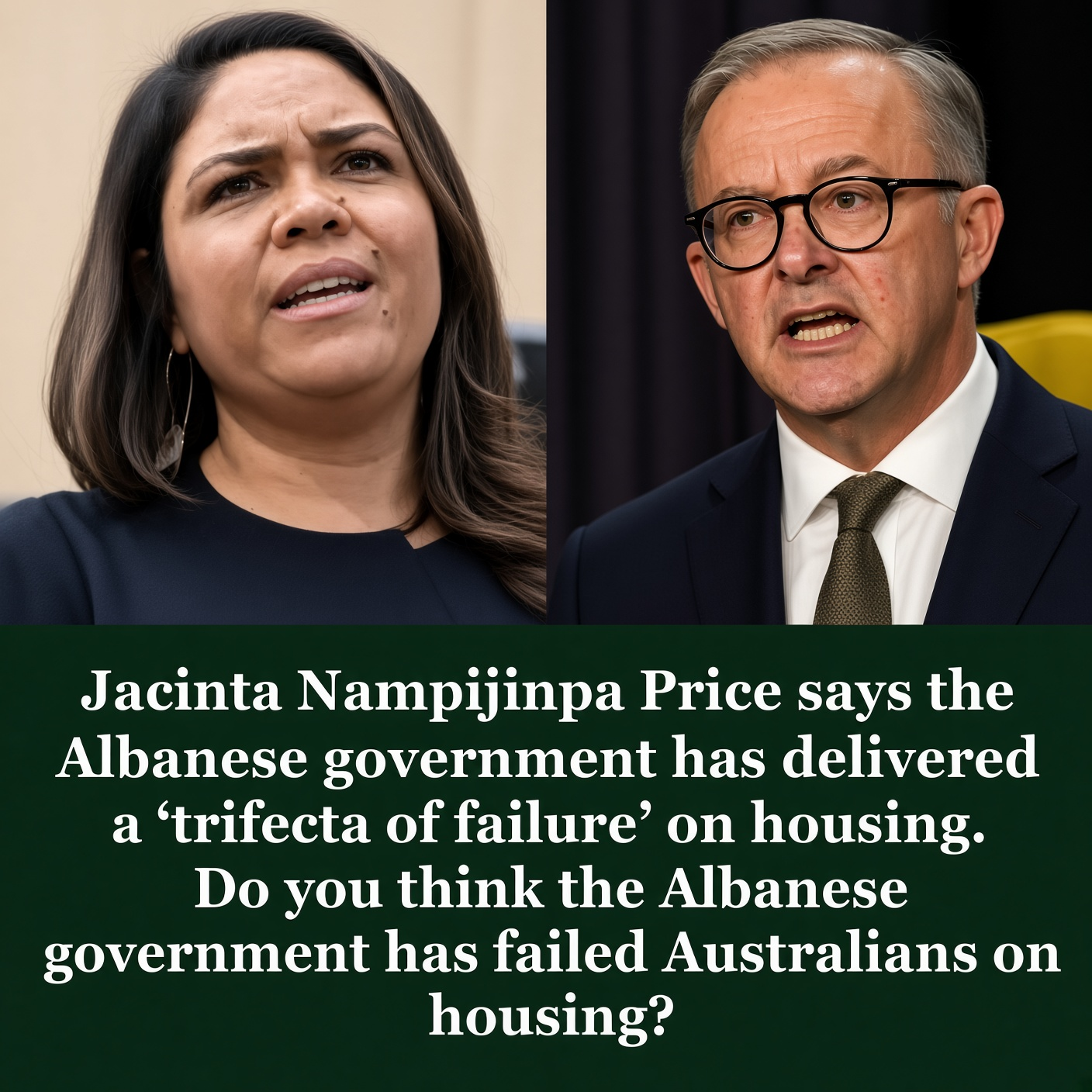
Jacinta Nampijinpa Price has accused the Albanese government of delivering a “trifecta of failure” on housing as fresh evidence shows Australia remains well behind the construction pace required to meet its ambitious 1.2 million-home target.
The Shadow Small Business Minister says Australians are confronting three problems simultaneously: too few new homes, higher rents and deteriorating confidence in the housing market.
“This government has delivered the trifecta of failure in this particular area,” Price told News24.
“They’ve delivered fewer homes, higher rents and also smashed confidence in the market.”
The language is partisan.
But the supply problem underneath it is increasingly difficult for either side of politics to dispute.
Australia is not currently building homes quickly enough to meet the National Housing Accord target — and the government’s own independent housing advisory body expects the deadline to be missed.
The target is 1.2 million homes
National Cabinet agreed in 2023 to an ambitious target of 1.2 million new, well-located homes over five years from July 1, 2024.
That means Australia needs to average approximately 240,000 additional homes every year until June 2029.
The target was designed to confront a fundamental imbalance in Australia’s housing system.
The population has grown rapidly while the country has struggled to produce enough housing in the places where people want and need to live.
The result has been felt across almost every part of the market: renters competing for scarce properties, prospective first-home buyers confronting high prices and developers struggling to make new projects financially viable.
Australia is not on track
The National Housing Supply and Affordability Council’s 2026 assessment provides one of the clearest independent measures of the problem.
NHSAC expects approximately 980,000 homes to be delivered during the five-year Housing Accord period.
That is about 220,000 short of the 1.2 million target.
The council forecasts the full 1.2 million homes will instead be reached around September 2030 — more than a year after the Accord period finishes.
That makes criticism of the government’s housing ambitions substantially more than an opposition talking point.
The target itself is in serious trouble.
Construction is running well below the required pace
Reuters reported last week that Australia’s home-building rate is running approximately 27 per cent below the quarterly level needed to deliver 1.2 million homes by 2029.
Builders are confronting severe labour shortages, rising costs and lengthy construction delays.
Apartment construction is particularly difficult, with a large share of approved developments failing to progress to construction because the numbers simply do not stack up for developers.
That distinction between an approval and a completed home is crucial.
Governments can approve more developments.
Planning systems can release more land.
But a housing target is ultimately achieved only when homes are finished and people can live in them.
Even approvals are behind the required trajectory
The approvals pipeline is also struggling.
About 204,649 homes were approved nationally during the year to June 2026, according to recent reporting based on official figures.
That represented improvement from the previous year but remained substantially below the annual rate required to achieve the Accord target.
Since the target period began, approximately 393,426 homes had been approved by mid-2026, compared with roughly 500,000 that would have been required to remain on pace at that point.
And approval does not guarantee completion.
That makes the eventual construction gap potentially more significant than the approvals numbers alone suggest.
Price says Australians are paying through higher rents
The second element of Price’s “trifecta” is rent.
Her criticism reflects a broader political reality: renters have become one of the groups most exposed to Australia’s housing shortage.
When population growth and household formation outpace additions to rental stock, competition for available properties intensifies.
But supply is not the only factor determining rents.
Interest rates, investor costs, taxation, vacancy rates, household size, location and state tenancy laws can all influence the price tenants ultimately pay.
That makes it too simplistic to attribute every increase in rent solely to Canberra.
The affordability problem extends well beyond renters
Housing stress is now confronting Australians at multiple stages of life.
Renters face high weekly costs.
First-home buyers struggle to accumulate deposits while property prices remain elevated.
Mortgage holders are exposed to interest-rate changes.
Developers face high financing and construction costs.
And builders themselves are dealing with labour and material constraints that limit how quickly additional supply can reach the market.
The housing crisis is therefore not a single problem with a single policy lever.
Why can’t Australia simply build more?
The obvious answer to a housing shortage is more housing.
Delivering it is considerably harder.
Reuters found builders are struggling with shortages of skilled labour while material and labour costs have risen and planning processes continue to delay projects.
Higher financing costs can also turn an approved apartment development into an economically unviable one before construction begins.
This creates a vicious cycle.
Australia needs more homes.
High demand should encourage construction.
Yet the cost of producing those homes can become so high that projects are postponed or abandoned.
The government cannot build 1.2 million homes by itself
There is another important qualification to the political blame game.
The National Housing Accord is not solely a federal government construction program.
The 1.2 million target is a shared commitment involving the Commonwealth, states and territories, with private developers responsible for delivering much of the actual housing stock.
State and local governments control critical planning and zoning processes.
Infrastructure availability can determine whether new suburbs are viable.
Private builders and developers make investment decisions based on costs and expected returns.
And federal policies affect migration, taxation, financing and housing incentives.
Accountability therefore extends across all three levels of government and the private market.
Labor can point to a substantial housing policy agenda
It would also be inaccurate to suggest the Albanese government has simply done nothing about supply.
The federal government established the Housing Australia Future Fund, expanded housing programs and negotiated the National Housing Accord with the states and territories.
The Commonwealth has also offered incentive funding designed to encourage jurisdictions to deliver housing beyond their existing targets and accelerate enabling infrastructure.
The government’s defence is that Australia entered the current period with a housing shortage that took years to develop and cannot be eliminated within a single parliamentary term.
Its vulnerability is that the signature 1.2 million-home target is nevertheless slipping increasingly out of reach.
The Coalition wants migration tied directly to construction
The opposition has identified population growth as the other side of the housing equation.
Under the Coalition policy announced by Opposition Leader Angus Taylor, net overseas migration would be capped according to the number of new homes completed.
Each year, the Housing Minister would report the number of completed homes to Parliament.
That number would then establish the ceiling for net overseas migration in the following year.
The political logic is deliberately simple:
Australia should not add people faster than it adds housing.
Migration has become inseparable from the housing debate
Australia’s post-pandemic population rebound intensified an already severe housing shortage.
Recent analysis cited in the migration debate estimates the mismatch between population growth and housing construction has produced a housing shortfall affecting roughly 380,000 people, with Queensland, Western Australia and New South Wales particularly exposed.
Migration is not the sole cause of Australia’s housing problems.
The country had affordability and supply problems long before the post-pandemic migration surge.
But additional population unquestionably creates additional housing demand.
When supply cannot respond quickly enough, that matters.
The Coalition itself is still arguing over the numbers
There is an important complication in presenting the opposition’s alternative.
The Coalition agrees that migration should be more closely aligned with Australia’s housing capacity, but senior opposition figures have recently disagreed over exactly how far the intake should be reduced.
Shadow Housing Minister Andrew Bragg proposed bringing net overseas migration below 180,000 annually while substantially reducing international student and other visa numbers.
Opposition Leader Angus Taylor subsequently made clear that Bragg’s proposals had not been approved through the Coalition’s formal policy process.
That means individual numerical targets floated by Bragg should not automatically be presented as settled Coalition policy.
Bragg also wants a radical overhaul of building regulation
The Coalition’s housing debate extends beyond migration.
Bragg has proposed dramatically reducing the National Construction Code and making some energy-efficiency and accessibility standards optional.
He argues that reducing regulation would lower construction costs and allow cheaper homes to be built.
The proposal has attracted fierce criticism from housing, disability and energy advocates, who argue cheaper construction could be offset by higher energy bills, poorer accessibility and lower-quality housing over the life of the building.
That debate illustrates the difficult trade-offs facing both major parties.
Everyone wants cheaper homes.
Agreement disappears quickly when the discussion turns to what standards, taxes or regulations should be removed to make them cheaper.
Price also blames Labor for collapsing confidence
The third part of Price’s attack concerns confidence.
This is the least straightforward part of the “trifecta” to measure.
Housing-market confidence can mean different things depending on whether the person being asked is a builder, developer, investor, prospective buyer or homeowner.
High construction costs and financing constraints have clearly damaged development feasibility.
But weaker buyer sentiment can sometimes work in favour of affordability if it reduces price growth.
Conversely, extremely strong buyer confidence in a supply-constrained market can push prices even higher.
“Confidence” therefore requires more precision than homes completed or weekly rents.
The inflation claim also needs qualification
Price linked the government’s housing performance to persistent inflation.
Housing costs are an important component of household expenditure and can contribute to inflationary pressure.
But Australia’s inflation rate is determined by a much wider range of forces, including energy, services, wages, imported costs, consumer demand and monetary conditions.
It would therefore go beyond the available evidence to say Labor’s housing policies alone caused Australia’s inflation problem.
The most damaging number for Labor is 980,000
Political rhetoric can be debated.
The government’s independent housing council’s forecast is harder to dismiss.
Australia promised 1.2 million new homes during the Housing Accord period.
NHSAC’s current central expectation is around 980,000.
That leaves an anticipated gap of roughly 220,000 homes.
And it goes directly to the fundamental criticism facing the government.
Demand for housing is enormous.
Supply remains inadequate.
And the country’s flagship construction target is likely to be missed.
But there is no instant Coalition solution either
Linking migration to completed homes would directly address one source of demand growth.
It would not solve labour shortages in construction.
It would not automatically make apartment projects viable.
It would not remove planning delays.
It would not produce roads, water, electricity and schools around new housing developments.
And depending on how migration reductions were designed, they could potentially reduce the supply of workers needed to build additional homes.
That is the paradox sitting at the centre of Australian housing policy.
Population growth creates housing demand.
But parts of the construction industry also depend on migrant labour.
Australians ultimately need homes, not targets
The National Housing Accord gave governments a headline number against which they could be judged.
That has turned out to be politically consequential.
When the target was announced, 1.2 million homes represented ambition.
As construction falls behind, the same number increasingly measures the size of the shortfall.
Price calls that Labor’s “trifecta of failure”.
Labor can reasonably respond that Australia’s housing shortage is structural, decades in the making and shared across federal, state and local governments.
Both statements can coexist with a more basic reality.
Australia needs substantially more homes than it is currently building.
Until that changes, arguments over migration, rents, planning, investors and government policy will continue.
Because for Australians trying to find a rental or buy their first property, the success of housing policy will not ultimately be measured by a press release, a political slogan or even a five-year target.
It will be measured by whether there is a home they can actually afford.