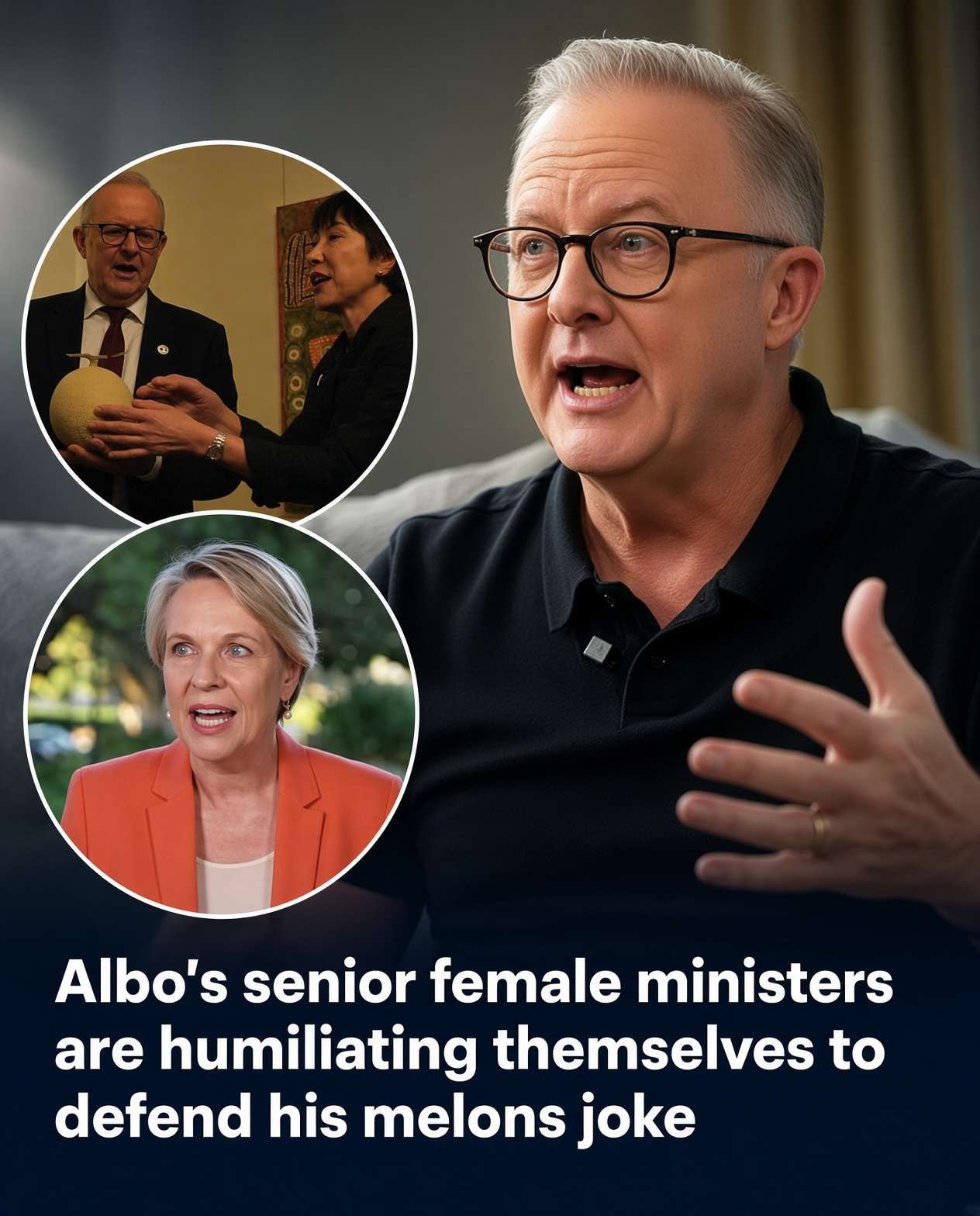
Anthony Albanese’s most senior female colleagues have been drawn into the increasingly bizarre political controversy over his “melons” podcast appearance, with critics accusing Labor of applying one standard to its opponents and another when the Prime Minister himself is under fire.
Finance Minister and Minister for Women Katy Gallagher, Foreign Minister Penny Wong and Social Services Minister Tanya Plibersek have all defended Albanese as the Coalition continues to demand an apology to Japanese Prime Minister Sanae Takaichi.
Their intervention has prompted an especially sharp response from political commentator Peter van Onselen, who argued the senior Labor women were humiliating themselves by defending conduct they would have condemned had it come from a political opponent.
Van Onselen went further, characterising Albanese’s appearance as resembling the “oily bloke at the end of the bar”.
That description is plainly opinion rather than an established fact. But it captures the argument now being prosecuted by Albanese’s critics: not simply that the Prime Minister participated in a crude exchange, but that Labor’s response exposes an inconsistency in the standards it applies to sexism.
For the government, the entire premise is wrong.
Albanese says the hand gestures at the centre of the controversy were not sexual. His ministers say critics have imposed an interpretation on the footage that was never intended. And Japan’s serving ambassador has publicly played down suggestions that the episode has damaged relations between Canberra and Tokyo.
Those competing versions have transformed a few seconds from a comedy podcast into a prolonged argument involving Parliament, senior cabinet ministers, Japanese diplomats and allegations of hypocrisy.
The original exchange is important because some accounts have blurred who actually said what.
Albanese appeared on comedian Nikki Osborne’s Bush Deep podcast in July.
During a discussion about gifts, he spoke about receiving premium Crown Melons from Takaichi, Japan’s first female prime minister.
As he described the melons, Albanese raised his hands in front of his chest in a gesture that critics have interpreted as mimicking breasts.
The exchange then included a reference to Pamela Anderson, whose name has become central to many descriptions of the controversy.
But that distinction needs to be made accurately: it was Osborne who introduced the Pamela Anderson comparison, not Albanese.
Albanese nevertheless participated in the exchange and made the gesture that subsequently attracted criticism.
He has rejected the suggestion that he was making a sexual joke about Takaichi.
The Coalition does not accept that explanation.
Opposition Leader Angus Taylor has repeatedly demanded an apology, while senior opposition figures have described the episode as crude, disrespectful and embarrassing for Australia.
Albanese has been asked directly in Parliament whether he will apologise to Takaichi and has declined to do so, instead rejecting the premise of the questions and emphasising the strength of Australia’s relationship with Japan.
The controversy has become especially uncomfortable for Labor because senior women in the government have been required to defend him.
Gallagher has offered one of the strongest character references.
She described Albanese as an emphatic supporter of women and rejected attempts to define him through the disputed podcast exchange.
Wong has similarly defended the Prime Minister while accusing the opposition of attempting to manufacture a diplomatic dispute.
Plibersek has called the sexual interpretation placed on the gesture unnecessary.
Those responses have created the opening for critics such as van Onselen.
His argument is not simply that the ministers should personally dislike Albanese’s joke.
It is that Labor has spent years insisting that sexist behaviour and language should be taken seriously, particularly when scrutinising Coalition governments, and that its senior women are now bending those standards to protect their own leader.
That is a political argument rather than an objective finding of hypocrisy.
Its strength depends substantially on whether Albanese’s gesture is accepted as sexual in the first place.
If his explanation is accepted — that he was simply illustrating the size or shape of the fruit — then Gallagher, Wong and Plibersek are not defending a sexist joke at all. They are rejecting what they regard as a false interpretation.
If the critics’ interpretation is accepted, their defence becomes much more difficult.
That is why the argument has become so circular.
Almost every subsequent political question depends on what Australians believe they saw in those few seconds of video.
The footage has become more important than Albanese’s explanation.
Political scandals involving body language are unusually difficult because intention cannot necessarily be established by watching a gesture.
Albanese can state what he intended.
His opponents can state what they believe the gesture obviously communicated.
Neither changes the physical movement captured on video.
The Prime Minister’s problem is that viewers do not need a political journalist or opposition MP to describe it for them. They can watch the footage and reach their own conclusion.
That makes categorical denials politically risky.
A politician who acknowledges that something looked inappropriate while denying malicious intent can sometimes close down a controversy quickly.
A politician who insists the interpretation itself is absurd effectively asks voters to choose between his explanation and their own eyes.
Albanese has chosen the latter approach.
He has rejected the allegation and refused demands for an apology to Takaichi.
That decision has helped keep the controversy alive.
It also contrasts with his handling of another controversy from the same podcast.
The Bush Deep appearance had already created trouble for Albanese before the Crown Melon exchange became a major political story.
During a “shag, marry or date” segment involving prominent Australian women, the Prime Minister participated in a conversation that prompted criticism over its tone.
His office subsequently issued an unequivocal apology for comments from the podcast.
The melon controversy has been treated differently.
Albanese has maintained that he did not make the sexual joke being attributed to him and therefore has resisted calls to apologise on that basis.
That distinction is logically defensible: politicians should not be required to apologise for something they genuinely maintain they did not do.
Politically, however, it has meant days of questions that could potentially have ended with a brief expression of regret.
The issue followed him into Question Time this week.
He was asked twice whether he would apologise to Takaichi.
He did not.
Wong faced repeated questions in the Senate over whether she had advised the Prime Minister to apologise and declined to disclose private advice, instead accusing the opposition of attempting to “confect a diplomatic issue”.
That brought senior Labor women even deeper into a controversy they did not create.
The Japanese response complicates the opposition’s case.
If this were straightforwardly a diplomatic crisis, there would be evidence of anger from Tokyo.
So far, the public evidence points in a more complicated direction.
Japan’s ambassador to Australia, Kazuhiro Suzuki, has played down the episode and stressed the strength of the relationship between the two countries.
The Japanese government has acknowledged being aware of media reporting but has shown little public appetite for escalating the matter.
A leaked Japanese diplomatic communication reportedly characterised Australian coverage as sensationalised and indicated officials had received an explanation about the context of the remarks.
Japan’s government has therefore not behaved publicly as though Albanese has caused a serious bilateral rupture.
Takaichi herself has also conspicuously avoided making the controversy a public issue.
As the Australian debate intensified, she continued commenting publicly on domestic matters including disaster recovery, energy and a rocket launch without publicly joining the argument about Albanese and the melons.
That does not mean every Japanese figure believes the incident was harmless.
Former Japanese ambassador to Australia Shingo Yamagami has been sharply critical, arguing that the episode was disrespectful and damaging to the dignity of Japan’s first female prime minister.
His intervention helped propel what had been a relatively contained Australian media controversy into a larger diplomatic story.
But Yamagami is a former ambassador, not the current representative of the Japanese government.
The distinction is essential.
His criticism is significant because of his diplomatic experience and close knowledge of Australia–Japan relations. It should not be presented as an official statement from the current Japanese government.
The argument about Labor’s women is therefore separate from the question of whether Japan is offended.
Gallagher, Wong and Plibersek do not need Tokyo to lodge a diplomatic protest before they can decide whether Albanese’s conduct was appropriate.
Likewise, the absence of an official Japanese complaint does not automatically prove there was nothing objectionable about the exchange.
Those are different tests.
Diplomats have strong incentives to prevent minor controversies from disrupting strategically important relationships.
Australia and Japan are deeply connected through defence, trade, critical minerals and regional security.
Tokyo has little obvious interest in allowing a comedy podcast to dominate that relationship.
That is why Wong’s argument that the opposition is attempting to create a diplomatic crisis has some evidentiary support.
But van Onselen’s criticism operates on another level.
He is asking what Labor itself would say if a male Coalition prime minister had made an identical gesture while discussing a gift from a female foreign leader.
It is a hypothetical question, but an effective political one.
Labor’s history makes the charge of double standards particularly potent.
The party relentlessly attacked the Morrison government over its handling of issues involving women, sexual harassment, workplace culture and the treatment of female staff.
Those debates became particularly intense following Brittany Higgins’ allegation that she had been raped in a ministerial office at Parliament House in 2019.
Bruce Lehrmann, who was accused of the rape, pleaded not guilty and consistently denied the allegation. His criminal trial was abandoned without a verdict after juror misconduct, and prosecutors later discontinued proceedings because of concerns about Higgins’ health.
A subsequent Federal Court civil judgment, applying the lower civil standard of proof, found on the balance of probabilities that Lehrmann raped Higgins. Lehrmann has maintained his denial.
The political consequences extended far beyond the individuals involved.
Labor argued that the Morrison government had a systemic problem with women and that leadership was responsible for workplace culture.
Gallagher and Wong were prominent figures in those broader debates.
That history is why their defence of Albanese is now being scrutinised so intensely by conservative commentators.
The comparison has obvious limits.
A disputed hand gesture on a comedy podcast is not remotely equivalent in seriousness to an allegation of sexual assault.
Conflating them would trivialise the latter.
The relevant comparison is narrower: whether political parties apply their stated standards about respectful treatment of women consistently when the person under scrutiny is one of their own.
That is the terrain on which the current argument should be judged.
Van Onselen’s “oily bloke” description is designed to make that test visceral.
Rather than debating parliamentary procedure or diplomatic protocol, the phrase asks readers to imagine the same behaviour stripped of the prestige of the prime ministership.
Would the gesture look different if performed by an anonymous man making a joke at a pub?
It is deliberately loaded rhetoric.
It is also the kind of framing that makes opinion columns powerful and potentially misleading if repeated as straight news.
Albanese is not objectively an “oily bloke at the end of the bar”. That is van Onselen’s characterisation of how he believes the Prime Minister appeared.
Readers can watch the footage and decide whether they agree.
What can be established is that Albanese discussed the Crown Melons, made gestures at chest height, participated in an exchange in which Osborne introduced a Pamela Anderson reference, and now denies that his behaviour carried the sexual meaning critics attribute to it.
The defence from Labor women may also reflect something more mundane than political loyalty.
They may simply believe Albanese.
Gallagher has worked alongside him at the highest levels of government and says his record demonstrates support for women.
Wong has served as his Foreign Minister throughout his prime ministership and has a direct professional interest in preventing a trivial controversy from being portrayed as a crisis with one of Australia’s closest strategic partners.
Plibersek has rejected the interpretation being placed on the exchange.
None of those positions requires the ministers to believe every joke made on the podcast was wise.
They require only the narrower conclusion that the specific gesture was not what critics say it was.
That possibility is sometimes lost in claims that female ministers are necessarily humiliating themselves by defending a male leader.
Senior female politicians do not lose their agency merely because they reach a conclusion favourable to a male colleague.
Equally, holding powerful women to account for apparent inconsistencies in their public standards is legitimate political scrutiny.
The challenge is avoiding the assumption that either criticism or defence automatically proves bad faith.
The bigger political problem for Albanese is that the story refuses to end.
The government wants to talk about housing, the economy, national security and Australia’s strategic relationship with Japan.
Instead, senior ministers have spent days answering questions about fruit, hand gestures and whether the Prime Minister should telephone Takaichi to apologise.
The Coalition has little incentive to stop.
Every day the story continues is another day Albanese is defending his personal judgment rather than promoting the government’s agenda.
The involvement of Gallagher, Wong and Plibersek makes the attack even more useful because it allows the opposition and conservative commentators to broaden the controversy from Albanese’s conduct to Labor’s credibility on women.
Japan’s muted reaction makes it harder to sustain claims of a genuine diplomatic crisis, but that may not matter politically.
Domestic controversies do not require foreign governments to validate them.
They survive when voters find the underlying image or argument memorable.
Two premium melons, a chest-level gesture and a Pamela Anderson reference have proved exceptionally memorable.
The Monthly’s Karen Middleton has argued that the episode is also becoming a test of Albanese’s political capital: leaders with abundant authority can often absorb mistakes that become much more damaging when their standing is weakening.
That may ultimately be more important than deciding whether every criticism levelled at him this week is fair.
A strong prime minister can sometimes end a silly story by laughing at it.
A weakened one can discover that a silly story becomes a vehicle through which every existing criticism of the government is expressed.
Melongate is now carrying arguments about sexism, ministerial loyalty, diplomatic competence, transparency and political hypocrisy that extend far beyond anything actually said on Bush Deep.
And that is why the female ministers defending Albanese have become part of the story.
The original controversy belongs to the Prime Minister.
Gallagher, Wong and Plibersek did not make the gesture. They did not introduce Pamela Anderson into the conversation. They did not choose to appear on the podcast.
But once they defended Albanese, their own records and rhetoric became available for comparison.
Van Onselen has made the harshest version of that case, arguing they are sacrificing their credibility to protect their leader.
Labor’s answer is that there is no sexist conduct to excuse in the first place.
Japan’s serving diplomatic representatives, meanwhile, appear determined not to allow the episode to overwhelm a strategically important bilateral relationship.
That leaves Australian voters with the question that has driven the saga from the beginning.
Was Albanese simply talking about two unusually large pieces of fruit while a comedian made the risqué joke around him?
Or did Australia’s Prime Minister knowingly join in an obvious sexual gag about the country’s first female Japanese counterpart and then expect everyone to accept that they had misunderstood?
No ministerial talking point can conclusively answer a question about intent.