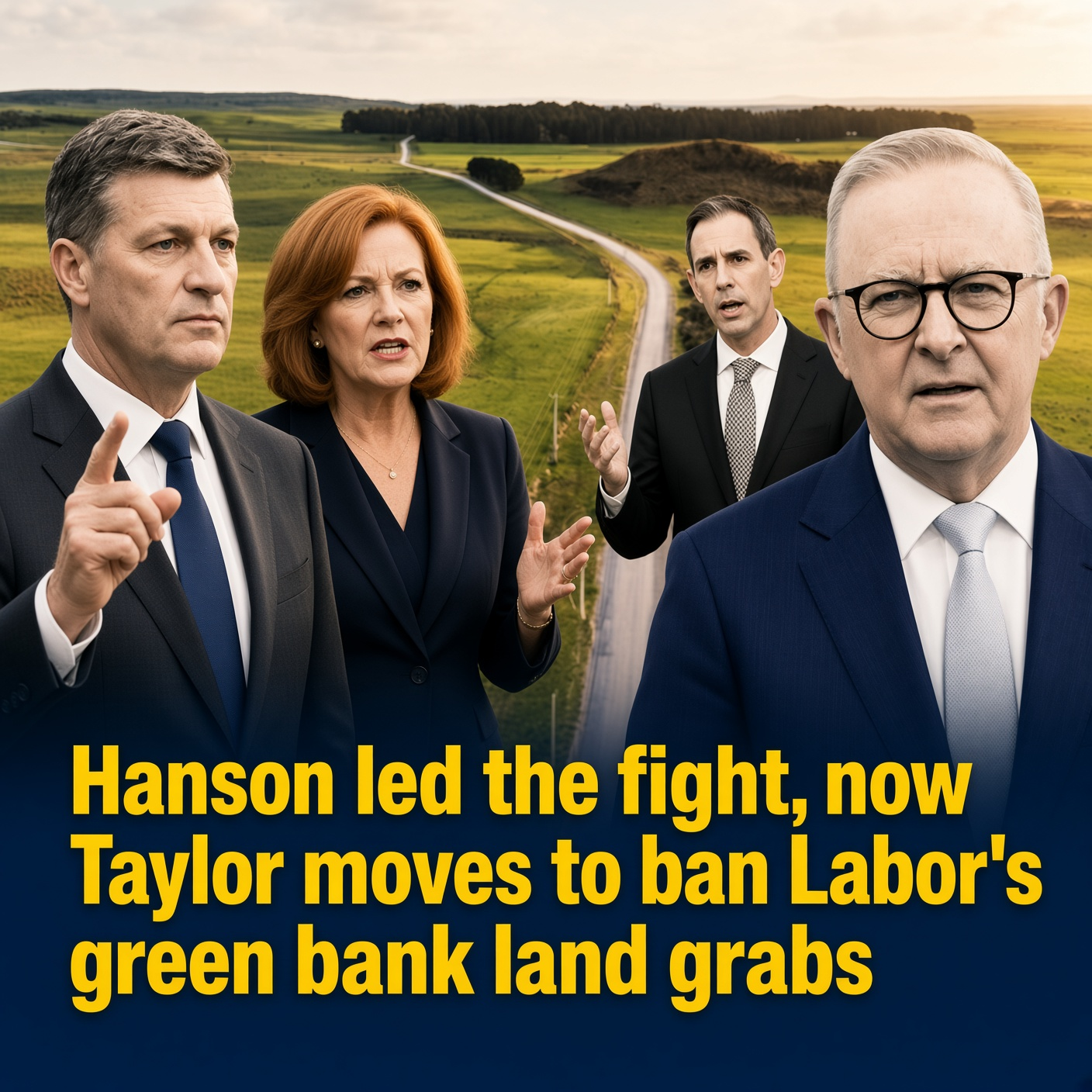
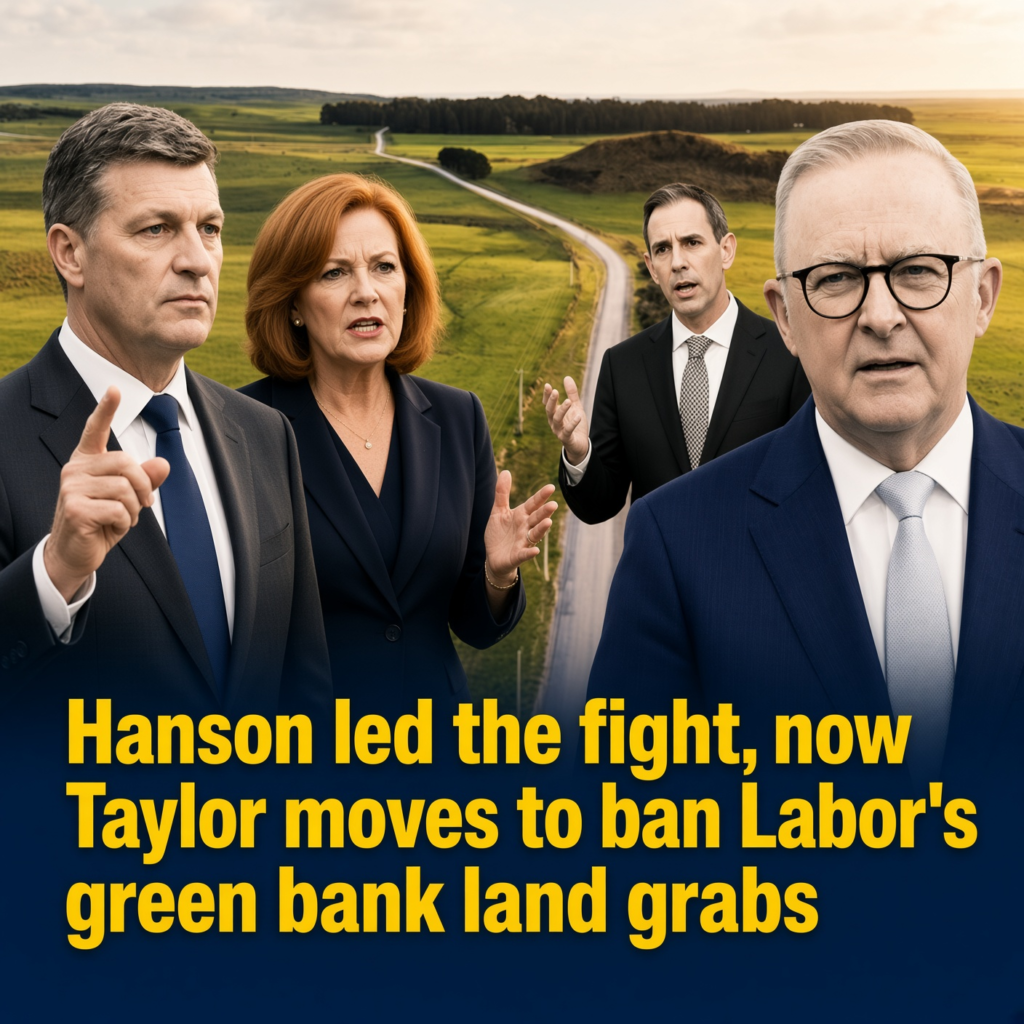
The controversial $142 million sale of Tasmania’s largest farm has triggered a new federal political battle, with Opposition Leader Angus Taylor moving to stop Australia’s green investment bank from financing future farmland purchases for carbon-offset forestry projects.
The Coalition announced on Wednesday that it intends to introduce legislation prohibiting the Clean Energy Finance Corporation from providing funding or financial assistance for the acquisition of Australian agricultural land where the purpose is to grow trees to offset carbon emissions.
The move follows months of anger over Rushy Lagoon, the enormous 21,745-hectare property in Tasmania’s north-east that is being acquired through the Tasmania Natural Asset Trust and managed by UK-based Gresham House.
The CEFC has committed $69 million of public-backed investment towards the $142 million project.
For Taylor, Pauline Hanson and farming groups critical of the transaction, Rushy Lagoon has become the test case for a much bigger question: should a government-backed green investment institution help finance the purchase of productive Australian farmland that will subsequently be partly converted to plantation forestry?
Taylor announces legislation after Rushy Lagoon backlash
The Coalition’s intervention was announced on August 26 as Taylor escalated his attack on the Albanese government’s net-zero policies.
Under the proposed legislation, the CEFC would be prevented from financially supporting entities acquiring agricultural land for projects involving trees grown to generate carbon offsets.
Taylor said the policy was intended to protect Australian food production and prevent government-backed finance from giving investment funds an advantage over farmers competing for agricultural properties.
“Families are already paying too much at the supermarket and the last thing we should be doing is weakening our ability to grow food by turning productive farms into carbon assets,” Taylor said.
He described taxpayer support for investment funds competing for farmland as “extraordinary”.
The legislation has not yet become law. It is an Opposition proposal that will have to pass Parliament.
At the centre of it all is a $142 million Tasmanian farm
Rushy Lagoon is no ordinary rural property.
Covering 21,745 hectares near Cape Portland in Tasmania’s north-east, it has a long history of beef, dairy and sheep production.
The property’s enormous scale and agricultural history have made its change of ownership intensely controversial within Tasmania.
Federal Treasurer Jim Chalmers approved the foreign investment transaction in July after the sale was considered through Australia’s foreign investment framework.
The purchaser is connected to the Tasmania Natural Asset Trust, a forestry and natural-capital investment platform involving Gresham House, Aviva Investors and the government-backed CEFC.
The CEFC is putting in $69 million
The CEFC describes the transaction as a $142 million sustainable forestry and natural-capital project.
Its own commitment is $69 million.
That involvement has become the political flashpoint.
The CEFC is a Commonwealth-owned institution established to mobilise investment into Australia’s transition to lower emissions.
Its Rushy Lagoon investment therefore means public-backed capital is participating directly in the project alongside private investors.
Critics argue that this creates an uneven contest when conventional farmers are trying to buy the same land without comparable government-backed financing.
The CEFC and project proponents reject the characterisation that the investment represents the destruction of productive land, instead presenting it as a combined forestry, agricultural, environmental and carbon project.
What is actually planned for Rushy Lagoon?
Gresham House plans to plant approximately 12 million radiata pine seedlings across about 9,000 hectares over five years.
That represents roughly 41 per cent of the entire Rushy Lagoon property.
A further 1,000 hectares is planned for environmental plantings.
The commercial pine trees are expected to mature over approximately 30 years, after which the softwood would be harvested and milled locally for the construction industry.
The forestry component is also expected to generate Australian Carbon Credit Units.
That distinction matters.
The 9,000 hectares is not being planted solely to generate carbon credits: the stated plan is commercial plantation forestry that also produces carbon credits.
It will not mean the complete end of farming
Another point obscured by some of the political rhetoric is that the entire 21,745-hectare property will not disappear from agricultural production.
Gresham House says cattle grazing will continue at a reduced scale.
The manager has also said it is investigating cropping opportunities and leasing parts of the property for grazing.
Other potential activities include farm accommodation, tourism and mountain biking.
Project proponents argue that this mixed-use model can support agriculture alongside forestry and environmental conservation.
Local critics remain deeply sceptical.
Farmers fear a permanent change to the region
TasFarmers and north-east Tasmanian agricultural communities have been among the strongest opponents of the transaction.
Their concerns extend beyond the number of hectares planted with trees.
Rushy Lagoon has historically supported large numbers of livestock, and farmers argue reducing its agricultural output could have flow-on consequences for processors, transport operators and other regional businesses.
They also fear government-supported carbon and forestry investment could increase competition for agricultural land elsewhere.
That concern is now driving the Coalition’s federal response.
The argument over local bidders
One of the most politically damaging questions surrounding the sale is whether Australian agricultural buyers were effectively priced out.
Critics have challenged suggestions that there was insufficient commercial interest in maintaining Rushy Lagoon primarily as a farm.
Recent reporting indicates traditional agricultural producers participated in the final tender and that some offers came relatively close to the $142 million successful price.
Reports that offers were within approximately 3 per cent of the winning price would put them at roughly $138 million.
That figure should not, however, be confused with independently established evidence of one single $138 million offer from a particular farming family.
The significant point is that agricultural bidders appear to have been much closer to the successful purchase price than some of the earlier political rhetoric around limited buyer interest suggested.
That is where the $69 million becomes politically explosive
The Coalition’s argument is not simply that a foreign-managed investment platform bought a farm.
Australia has permitted foreign investment in agriculture under governments of both political persuasions.
The objection is that the winning project included $69 million from the taxpayer-backed CEFC.
Taylor argues government-supported finance should not be available to help investment vehicles compete against Australian farmers for productive land.
The Nationals have adopted the same position.
Nationals leader Matt Canavan said agricultural land should be producing food rather than being driven into carbon-related investments by government policy.
Pauline Hanson got there before the Coalition’s bill
One Nation leader Pauline Hanson had already turned Rushy Lagoon into a federal political issue before Taylor’s announcement.
Hanson raised the transaction in the Senate and attacked the government’s involvement in the project.
Her central argument closely resembles the case the Coalition is now making: taxpayer-backed finance should not help large investment entities acquire Australian farmland while local farmers are attempting to compete.
She has also demanded greater transparency around the timing of the transaction, government support and what ministers knew about the sale.
The controversy has consequently created an unusual point of alignment between One Nation and the federal Coalition.
Both are now targeting the role of Commonwealth climate policy in agricultural land transactions.
But claims of a Labor ‘cover-up’ remain political allegations
Hanson and other government critics have accused Labor of concealing important details surrounding Rushy Lagoon.
There are legitimate transparency questions now being examined politically, particularly concerning Commonwealth financing, grants, approvals and the timing of the transaction.
But there has been no finding establishing a Labor conspiracy to conceal an unlawful transaction.
Nor has any inquiry concluded that the Commonwealth “stole” Rushy Lagoon from Australian farmers.
Those descriptions belong to the political argument surrounding the sale rather than established findings about it.
Tasmania has now launched an inquiry
The controversy has become serious enough for Tasmania’s parliament to establish a select committee inquiry.
The inquiry will examine the influence of Commonwealth funding and policy mechanisms on the acquisition and use of significant agricultural land.
Its terms specifically include the CEFC, the Australian Carbon Credit Unit scheme and the federal Support Plantation Establishment Program.
It will also examine possible effects on agricultural production, food and fibre industries, employment, regional communities and opportunities for agricultural ownership.
The adequacy of consultation, Commonwealth approvals and oversight will also come under scrutiny.
Labor and the Greens opposed the Tasmanian inquiry
The inquiry passed Tasmania’s House of Assembly with support from the Liberal government, several independents and Shooters, Fishers and Farmers MP Carlo Di Falco.
Labor and the Greens voted against it.
But their reasons are important to understanding the dispute.
Labor resources spokesman Shane Broad characterised the committee as a political “witch hunt”, arguing the sale had already settled and that a state parliamentary committee lacked the power to compel federal officials to appear.
The Tasmanian Greens also acknowledged community concerns but argued that scrutiny should occur federally, where Commonwealth agencies and decisions could be properly examined.
The vote therefore established a state inquiry despite Labor and Greens opposition, but their opposition cannot accurately be described simply as resistance to any investigation of Rushy Lagoon.
There is another disputed $8.8 million
Alongside the CEFC’s $69 million investment, controversy has surrounded an $8.8 million grant associated with plantation establishment.
The Tasmanian government has accused Canberra of committing that support before the property transaction was approved.
The federal Department of Agriculture, Fisheries and Forestry has pushed back against claims about the timing and character of that funding.
The department has said the Tasmania Natural Asset Trust had not received grant funding at the point when the controversy emerged and that the program requires recipients to demonstrate long-term access to the relevant land.
That dispute is another reason the inquiry’s timeline and document trail will matter.
The buyer says the project will create jobs
Gresham House and the Tasmania Natural Asset Trust reject claims the project amounts to abandoning the region.
They estimate approximately 190 jobs will be created over the project’s 30-year life.
The Timber, Furnishing and Textiles Union has also supported the plantation project, arguing additional timber supply will strengthen Tasmania’s forestry and manufacturing industries.
Approximately five million tonnes of timber are expected to be produced over the life of the plantation.
The proponents say this can provide greater resource security for local sawmills.
Farmers dispute those employment numbers
TasFarmers has challenged the projected economic benefits.
Its representatives argue forestry employment could fall substantially once the initial planting phase is completed and question whether the project will ultimately support as many permanent regional jobs as intensive agriculture could.
That disagreement goes to the heart of the Rushy Lagoon argument.
It is not simply farming versus trees.
It is a dispute over which land use produces the greater long-term economic, environmental and community benefit.
There is also an important environmental dimension
Part of Rushy Lagoon intersects with the internationally recognised Floodplain Lower Ringarooma River Ramsar Site.
The CEFC says the project will include conservation areas, wetland restoration, environmental plantings, protective buffers and hydrological safeguards.
Project proponents therefore argue the investment should be viewed partly as environmental restoration rather than simply plantation conversion.
Questions have nevertheless been raised about the environmental consequences of large-scale radiata pine planting, including effects on water and biodiversity.
Those issues have featured in calls for greater scrutiny of the project.
There is an awkward history for Angus Taylor
The politics becomes more complicated when Taylor’s own record in government is considered.
Federal and Tasmanian Labor figures have pointed out that Taylor supported plantation forestry and land-sector investment when he was a minister in the former Coalition government.
Labor Senator Helen Polley has argued that Taylor helped establish policy settings that encouraged plantation investment in northern Tasmania.
She has also pointed to his support for CEFC investment in the land sector during the Coalition’s time in government.
Taylor’s present argument is narrower: regardless of support for forestry or emissions reduction, he says taxpayer-backed institutions should not finance investment funds purchasing agricultural land for carbon-related tree projects.
The Coalition wants to go much further than Rushy Lagoon
The CEFC restriction is only one part of the Opposition’s new announcement.
Taylor’s Coalition is also promising legislation targeting Labor’s broader net-zero policy framework and what it describes as more than $80 billion in net-zero spending.
The Coalition says it will seek to abolish Labor’s net-zero laws and carbon-related measures as part of a broader shift towards lower-cost energy.
That means Rushy Lagoon is rapidly becoming something bigger than a Tasmanian property dispute.
It is being used as a national example in the emerging political fight over climate policy, food security and government spending.
The fundamental policy question is now national
Few dispute that Australia needs both productive agriculture and a viable forestry industry.
There is also broad acceptance that investment capital, including foreign capital, has long played a role in Australian agriculture.
The harder question is what role government-backed finance should play when different land uses are competing for the same property.
If a forestry and carbon project is commercially viable, critics ask, should taxpayers help finance its acquisition of agricultural land?
Supporters can respond that the CEFC exists precisely to unlock investments producing emissions reductions alongside commercial returns.
And if plantation timber supports Australian construction, regional employment and emissions reduction while farming continues elsewhere on the property, they argue the land has not simply been removed from productive use.
Rushy Lagoon has exposed the fault line
For north-east Tasmanian farmers, the debate is much less theoretical.
They have watched one of the state’s most famous agricultural properties change hands while a Commonwealth-owned investment institution committed $69 million to the project.
Thousands of hectares are now earmarked for radiata pine.
The new owners say the result will be timber, carbon abatement, environmental restoration and jobs.
Critics see productive farmland being redirected by government climate incentives.
Both descriptions contain elements of the project, which is precisely why Rushy Lagoon has become such a potent political fight.
Hanson and Taylor now want to change what happens next time
The Rushy Lagoon transaction itself has already proceeded far enough that Taylor’s proposed legislation is primarily about preventing similar deals in the future.
The Tasmanian inquiry will attempt to establish more detail about what happened in this case.
The federal Opposition is drawing a policy conclusion before that process is finished.
It wants the CEFC out of future agricultural land acquisitions for carbon-offset tree projects.
Hanson and One Nation are pushing in substantially the same direction, while demanding further answers about the transaction that triggered the controversy.
Labor and project proponents, meanwhile, continue to defend investment in plantation forestry, carbon abatement and regional economic activity.
A $142 million Tasmanian property sale has therefore become the battlefield for a much larger Australian argument: whether taxpayer-backed climate investment is helping transform regional economies — or pricing farmers out of the land that feeds the country.