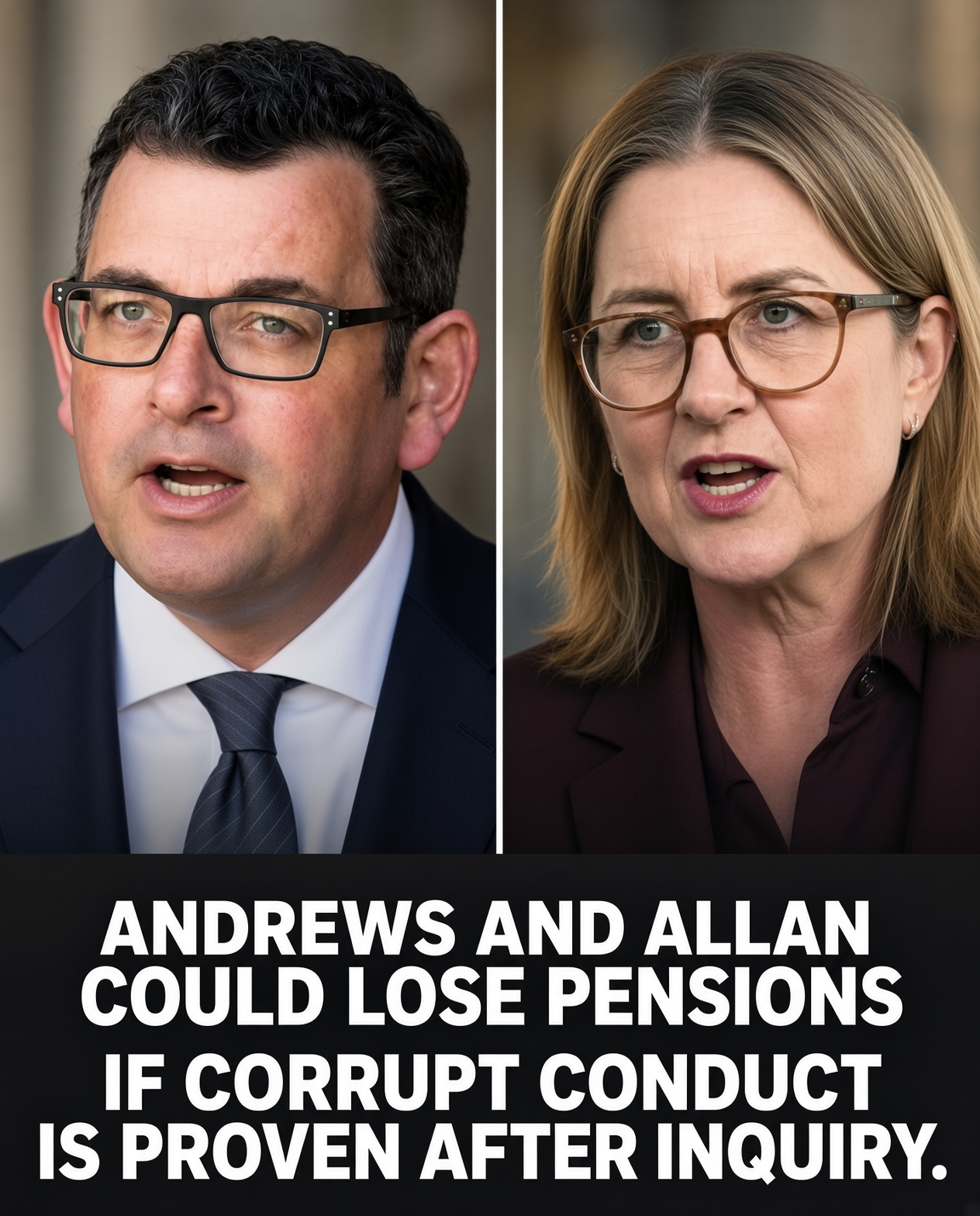
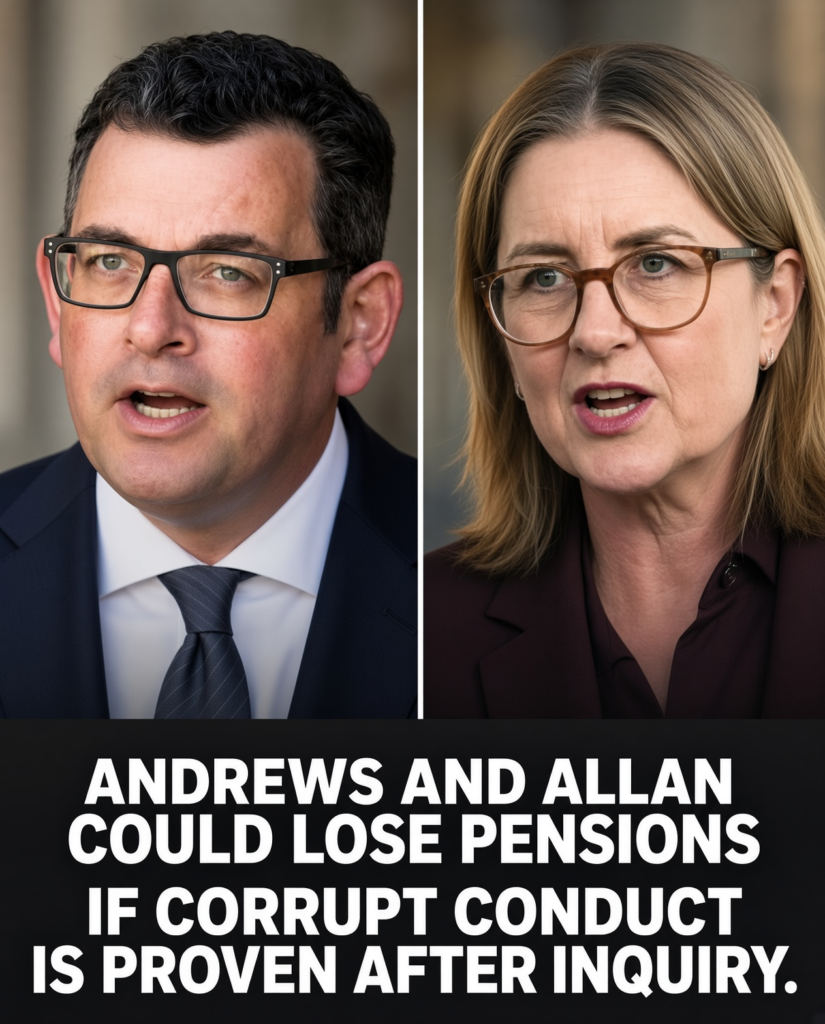
A new political battle has erupted over the parliamentary pensions of former Victorian premiers Daniel Andrews and Jacinta Allan, with calls for the pair to lose retirement benefits reportedly worth more than $300,000 a year if serious corrupt conduct is ultimately established through the state’s coming Big Build royal commission.
The proposal has opened a difficult question for Victoria: should a former politician continue receiving a lucrative taxpayer-backed parliamentary pension if an official inquiry later establishes serious wrongdoing during their time in public office?
At present, the answer may depend less on the seriousness of any hypothetical finding than on the wording of decades-old legislation.
Victorian law does not currently provide a straightforward mechanism for stripping a former MP’s parliamentary pension simply because a royal commission makes an adverse finding against them.
That has prompted the state Opposition to demand action before the Big Build royal commission gets underway.
Shadow attorney-general James Newbury has pressed Premier Ben Carroll over whether the government would support removing pension entitlements from former politicians if corrupt conduct were ultimately established.
Carroll has declined to prejudge the inquiry.
His position is that the royal commission must be allowed to do its work and that any response should follow proper process.
The distinction is critical.
Neither Andrews nor Allan has been found guilty of corruption by the Big Build royal commission.
Indeed, the commission was only announced after Carroll replaced Allan as premier in late July.
The current controversy is therefore about what should happen if serious adverse findings are eventually made — not punishment for findings that already exist.
Why the pensions are attracting attention
The numbers involved ensure the issue will attract political scrutiny.
Andrews and Allan entered Victorian Parliament under historical superannuation arrangements that are no longer available to newly elected MPs.
Those arrangements can provide defined retirement benefits considerably more generous than the accumulation-style superannuation system applying to newer parliamentarians.
Recent reporting places the parliamentary pensions associated with the two former premiers at more than $300,000 annually.
That means the political argument is potentially about millions of dollars in lifetime retirement benefits.
It is important, however, to describe those payments accurately.
They are not the ordinary Age Pension.
They are also not special retirement bonuses newly granted to Andrews or Allan.
They arise from Victoria’s historic parliamentary defined-benefit superannuation arrangements.
The Victorian Independent Remuneration Tribunal has documented how parliamentary superannuation changed over time.
Until late 2004, Victorian MPs could be members of defined-benefit schemes.
Those schemes were then closed to new members and replaced by an accumulation arrangement.
Politicians who were already members of the defined-benefit schemes retained their entitlements.
Both Andrews and Allan entered Parliament before the final closure of those arrangements to new MPs.
The existing law creates the problem
The debate becomes more complicated when the legislation governing those historical benefits is examined.
Victoria’s Parliamentary Salaries, Allowances and Superannuation Act 1968 sets out the circumstances in which a former member’s pension entitlement ceases.
Section 23 is particularly significant.
It provides for cessation in specified circumstances, including where a former member returns to Parliament or where an entitlement is transferred into another complying superannuation fund under the statutory process.
The legislation then expressly states that a former member’s entitlement to receive a pension does not otherwise cease except in accordance with that section.
That language helps explain why the current controversy cannot simply be resolved by a premier or government announcing that a former politician no longer deserves a pension.
The entitlement is statutory.
If Parliament wants to create an additional mechanism allowing forfeiture following particular forms of misconduct, legislative change may be required.
That is precisely the debate now emerging.
The Big Build royal commission changes the political equation
Carroll announced a royal commission into Victoria’s construction sector almost immediately after becoming premier.
Its focus follows years of allegations concerning criminal infiltration, corruption, union conduct and the handling of billions of dollars flowing through taxpayer-funded infrastructure projects.
The Andrews and Allan governments presided over an extraordinary expansion of Victoria’s infrastructure program.
Projects under the Big Build banner transformed transport construction across Melbourne and regional Victoria, but they also involved enormous public expenditure and increasingly intense scrutiny over cost, governance and construction-sector conduct.
Carroll’s decision to establish a royal commission marked a clear break with his predecessors.
He has said political figures will not be protected from scrutiny and has indicated he would himself appear if called to give evidence.
The Opposition wants the inquiry’s scope to be broad.
Liberal leader Jess Wilson has proposed terms of reference designed to examine the conduct of government agencies, unions, contractors and senior political figures.
Her proposed witness list includes Andrews and Allan.
Whether the royal commission ultimately calls either former premier, what evidence they might give and what findings may emerge remain unresolved questions.
That uncertainty is exactly why careful language is essential.
No corruption finding against either former premier
The pension debate risks creating an implication that the outcome of the royal commission has somehow already been determined.
It has not.
A call to strip someone’s pension if corruption is proven is fundamentally different from saying that person has been proven corrupt.
The first is a proposal about consequences.
The second is an assertion of fact requiring evidence and due process.
The Big Build royal commission has not reached a finding that Andrews engaged in corrupt conduct.
Nor has it reached such a finding against Allan.
Future evidence could lead to adverse findings, or it may not.
The commission may identify systemic failures without establishing personal wrongdoing by either former premier.
It may make findings concerning other politicians, public servants, union officials, contractors or businesses.
Its recommendations may ultimately focus more heavily on governance and regulatory reform than individual culpability.
Those possibilities remain open.
Opposition presses Carroll on the consequences
Newbury has nevertheless argued that the government should confront the pension issue now.
During parliamentary questioning, he challenged Carroll over whether former premiers should retain lucrative retirement entitlements if they are ultimately implicated in serious misconduct.
The Opposition’s argument rests partly on public confidence.
If taxpayers fund a parliamentary pension worth hundreds of thousands of dollars each year, it argues, taxpayers should not be forced to continue paying it regardless of what an official inquiry might eventually uncover.
Carroll has resisted committing himself to a hypothetical punishment before the royal commission has established the facts.
That does not necessarily mean the government has ruled out legislative change.
It means the Premier has so far declined to decide what consequences should follow findings that have not yet been made.
The competing approaches capture the political tension surrounding the inquiry.
The Opposition wants accountability mechanisms established in advance.
The government says due process must come first.
Could Parliament change the law?
Parliament can legislate, but altering accrued retirement benefits raises substantially more complicated questions than changing arrangements for future MPs.
The defined-benefit schemes themselves demonstrate the problem.
When Victoria closed the schemes to new parliamentarians, existing members retained their entitlements.
The Victorian Independent Remuneration Tribunal has previously examined parliamentary superannuation arrangements and noted statutory constraints surrounding options that would leave existing or former MPs worse off.
Any proposal to retrospectively extinguish an already accrued pension would therefore require careful legal drafting and scrutiny.
There are several different policy models Parliament could theoretically examine.
One would be forfeiture following conviction for specified serious criminal offences.
Another could involve particular findings by an integrity body or royal commission.
A third might distinguish between pension benefits arising from a member’s own contributions and additional taxpayer-funded benefits.
Each approach would create different legal and fairness questions.
The threshold would also matter enormously.
Should any adverse finding be sufficient?
Should forfeiture require “corrupt conduct” under a statutory definition?
Should a criminal conviction be necessary?
Would misconduct unrelated to the performance of public duties qualify?
Could a former MP appeal before losing an entitlement?
Those questions would have to be answered before a forfeiture regime could operate fairly.
Royal commissions do not conduct criminal trials
There is another important distinction in the phrase “found guilty”.
A royal commission is an extraordinarily powerful investigative body, but it is not a criminal court.
It can investigate conduct, compel evidence within its legal powers, make factual findings and recommend reforms or further action.
Its work may result in evidence being referred to prosecutors or other authorities.
But a royal commission does not itself convict a person of a criminal offence.
That distinction could become important if Victoria eventually legislates to strip parliamentary pensions.
Lawmakers would need to decide whether an adverse royal commission finding alone should trigger forfeiture or whether a subsequent criminal conviction should be required.
Those are very different thresholds.
A criminal prosecution must satisfy the criminal standard of proof and provides an accused person with the procedural protections of a court proceeding.
A royal commission performs a different function.
Conflating the two would risk both legal and editorial confusion.
Andrews remains central to the Big Build era
The reason Andrews is inevitably part of the political discussion is straightforward.
He served as Victorian premier from 2014 until his resignation in 2023, overseeing the creation and enormous expansion of the Big Build infrastructure program.
During that period, Victoria committed tens of billions of dollars to rail crossings, tunnels, roads and other major projects.
Andrews made infrastructure delivery central to Labor’s political identity.
That means an inquiry examining the administration of major taxpayer-funded construction projects inevitably overlaps with the period in which he governed.
Political responsibility for an era, however, is not synonymous with personal corrupt conduct.
The royal commission exists in part to establish where responsibility actually lies.
That task requires evidence rather than assumption.
Allan’s role will also face scrutiny
Allan’s connection to the infrastructure program is similarly substantial.
Long before becoming premier, she held senior infrastructure and transport responsibilities inside the Andrews government.
She later became deputy premier before succeeding Andrews in September 2023.
Her government resisted earlier demands for a royal commission before her removal as Labor leader in July.
Carroll’s decision to establish one immediately after taking office therefore created a stark political contrast.
Allan has now announced that she will not recontest Bendigo East at the November election, bringing her parliamentary career to an end after almost 27 years.
Her imminent departure makes the pension question particularly immediate.
Once she leaves Parliament, the historic defined-benefit arrangements applying to her long political career become directly relevant.
Again, that financial entitlement should not be confused with any finding about her conduct.
The two questions remain legally separate unless Parliament decides to connect them through new legislation.
The debate is bigger than two former premiers
Although Andrews and Allan dominate the headlines, any credible reform should be written as a general integrity rule rather than legislation targeting two named individuals.
That distinction matters.
Good integrity legislation establishes standards that apply consistently regardless of party, personality or political moment.
If a Labor former premier can lose a pension for proven serious corruption, the same rule should apply to a Liberal, National, Greens or independent former MP who satisfies the same legal threshold.
The principle at stake is whether parliamentary retirement benefits should remain unconditional when exceptionally serious misconduct is established.
There are legitimate arguments on both sides.
Supporters of forfeiture can argue that generous taxpayer-backed benefits are connected to public service and should not survive grave abuse of public office.
Opponents of retrospective forfeiture can argue that accrued superannuation rights should not become political prizes that governments can remove after a politician has left office.
Both concerns can be addressed only through clear statutory thresholds and independent processes.
Victoria now faces two separate tests
The first belongs to the royal commission.
It must establish what happened across Victoria’s construction industry and Big Build projects without fear, favour or predetermined conclusions.
That includes identifying systemic failures and individual responsibility where the evidence supports it.
The second belongs to Parliament.
Lawmakers must decide whether the existing pension framework provides appropriate consequences if extraordinarily serious wrongdoing by a former MP is eventually established.
Those questions should not be answered in reverse order.
The pension controversy cannot be used to assume Andrews or Allan will be found corrupt.
Equally, the absence of any current forfeiture mechanism does not prevent Parliament from asking whether the law should change for future cases.
For Victorians, the stakes involve both money and trust.
Defined-benefit parliamentary pensions worth more than $300,000 annually are an increasingly rare privilege inherited from an earlier political era.
The Big Build royal commission, meanwhile, has been established because serious questions have arisen over the integrity of taxpayer-funded construction.
Bringing those two issues together was almost inevitable.
But the most important word in the entire debate remains “if”.
If corrupt conduct is established.
If the findings meet whatever threshold Parliament ultimately considers serious enough.
If legislation can lawfully alter or extinguish the relevant entitlement.
Until those questions are resolved, Andrews and Allan remain former premiers facing political scrutiny — not people already found guilty by a royal commission that has yet to determine its findings.
What Victoria can decide now is whether its laws are ready for whatever that commission ultimately discovers.