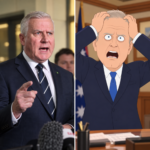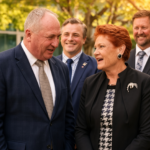

A bitter dispute over Australia’s anti-Pauline Hanson student protests has entered a new phase, with One Nation saying lawyers representing parents have demanded the removal of viral footage showing young protesters outside South Australia’s Parliament House.
The party is refusing to take the video down.
It argues the footage records conduct that occurred openly at a public political demonstration, where protesters were surrounded by cameras and participating in an event specifically designed to attract public attention.
But the legal dispute raises a more complicated question: what happens when young people — including school-aged protesters — become identifiable participants in a political event that spreads far beyond the crowd that witnessed it?
The controversy comes almost two weeks after thousands of high-school and university students walked out of classes across Australia to protest Pauline Hanson and One Nation.
Parents’ lawyers demand video be removed
One Nation says lawyers acting for parents whose children attended the Adelaide protest have issued formal demands over footage from the demonstration.
The disputed video was filmed outside Parliament House during the August 13 student walkout.
According to One Nation, the lawyers want the footage deleted.
The party has publicly rejected that demand.
One Nation’s position is that protesters participated openly in a public political rally, knowingly appearing before cameras and therefore cannot reasonably expect the event itself to disappear from the public record.
At this stage, however, the precise legal arguments contained in the correspondence have not been independently established through publicly available court documents.
Nor is there a published court ruling ordering One Nation to remove the footage.
The original protest was anything but private
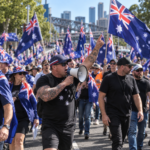
The demonstration was part of a nationally coordinated campaign called “Students Say No to Hanson”.
High-school and university students walked out of classes on August 13 and gathered in cities including Sydney, Melbourne, Brisbane and Adelaide.
The National Union of Students helped organise the nationwide action.
Protesters carried banners and placards, chanted slogans and, at some rallies, displayed effigies of Hanson.
Media organisations were present throughout the demonstrations.
Footage and photographs were subsequently published across television, newspapers and social media.
There was little ambiguity about the political purpose of the event: students wanted their opposition to Hanson and One Nation to be seen and heard.
About 2,000 joined the Adelaide demonstration
The South Australian protest was particularly large.
SA Police estimated approximately 2,000 high-school and university students took part.
The crowd gathered outside Parliament House before marching through central Adelaide, including North Terrace, King William Street and Rundle Mall.
The protest remained part of a broader national mobilisation against One Nation’s growing political support.
Students objected to the party’s positions on immigration, multiculturalism and other social and political issues.
Cory Bernardi went directly into the crowd
South Australian One Nation leader Cory Bernardi attended the Adelaide protest himself.
His presence immediately created a confrontation between the protesters and one of the politicians they were opposing.
Bernardi filmed from within and around the demonstration while students directed chants and insults towards him.
He subsequently posted footage online and attacked the protesters’ behaviour.
Bernardi described participants as “losers” and accused students of being politically manipulated.
His decision to document what was happening transformed parts of the demonstration into viral political content.
Some of the footage sparked outrage
The controversy intensified after video circulated showing some protesters using aggressive language.
Separate media reporting described footage in which protesters appeared to make violent or death-related remarks concerning Hanson.
That language was strongly condemned by One Nation supporters and conservative commentators.
But an important distinction needs to be maintained.
The behaviour of individuals captured in particular clips cannot automatically be attributed to the thousands of students who attended rallies across Australia.
Most participants were engaged in ordinary political protest, carrying signs and chanting opposition to One Nation.
One Nation says the footage should remain online
The party’s response to the legal demands has been uncompromising.
It argues that people who deliberately participate in public demonstrations must accept that their actions can be documented.
That argument is particularly forceful, One Nation says, when participants engage directly with cameras.
The party claims students shown in the footage knew media and political figures were filming and nevertheless continued performing chants and making statements.
Its position is therefore not merely that the video was captured in public.
It argues the visibility was part of the protest itself.
But the involvement of minors complicates the argument
The fact that some protesters were school-aged makes the dispute more sensitive than an ordinary confrontation between adult political activists.
There is an important difference between participating in a public event and understanding how an identifiable video can be redistributed to enormous audiences online.
A teenager might knowingly speak to a camera without appreciating that the clip could subsequently be viewed hundreds of thousands of times, reposted by political organisations and remain searchable for years.
That does not automatically make publication unlawful.
But it helps explain why parents may view the issue very differently from the political organisations publishing the footage.
There is no public court ruling ordering its removal
The legal distinction is important.
A demand letter from a solicitor is not a court judgment.
It can assert legal rights and warn that litigation may follow.
It does not, by itself, establish that the recipient has broken the law.
Based on publicly available information, no court has yet ruled that the disputed One Nation footage must be deleted.
Nor has the full legal correspondence been made publicly available in a form that allows every allegation and legal argument to be independently assessed.
For that reason, claims about precisely what the parents allege must remain attributed to the parties involved.
The dispute follows an extraordinary day of student activism
The August 13 protests were among Australia’s most significant school walkouts in recent years.
Students left classrooms around the country despite calls from political leaders to remain at school.
Federal Education Minister Jason Clare supported young Australians having political opinions but said students should be in classrooms when school was in session.
Victorian Premier Ben Carroll delivered a similar message.
He encouraged students to focus on their education during school hours.
Hanson herself responded directly to the protesters.
Hanson told students One Nation was ‘fighting for you’
Before and during the demonstrations, Hanson urged students not to accept what she described as misinformation about her party.
She told young Australians that One Nation was fighting for their future.
Hanson argued that the issues driving younger Australians’ frustration — particularly housing affordability and cost-of-living pressure — were precisely the issues her party was attempting to address.
The protesters strongly disagreed.
For them, the demonstrations were intended to challenge One Nation’s rise and what organisers described as divisive politics.
Some parents actively supported their children attending
The role of parents cannot be reduced to a single position either.
Some parents openly supported their teenagers joining the demonstrations.
Guardian columnist Philippa Chandler wrote that she gave her teenage daughter permission to attend the Melbourne protest.
Chandler herself had skipped school to protest Hanson in Western Australia 28 years earlier.
For those parents, political participation is part of civic education rather than something incompatible with it.
Others argue political demonstrations should take place outside school hours and that schools have a duty to keep students in class.
Schools also faced difficult questions
The national walkout forced schools to balance political participation against attendance and duty-of-care requirements.
Students leaving school grounds during scheduled classes can be recorded as absent unless appropriate arrangements have been made.
That is particularly significant when participants are minors for whom schools have responsibility during the day.
One Nation figures have questioned whether teachers or individual schools facilitated participation.
Bernardi called for an investigation in South Australia following the Adelaide demonstration.
But there is no basis to say every school encouraged the walkout
This is another point where the political rhetoric can run ahead of the established evidence.
Students from numerous schools participated.
Some had parental permission.
Some educational institutions had to manage absences.
But those facts do not demonstrate that every school, teacher or parent encouraged students to leave class.
Any allegation that particular schools actively organised or promoted participation requires evidence specific to those institutions.
The protests were designed to attract attention
There is nevertheless an unavoidable tension at the centre of the dispute.
Political protests depend upon visibility.
A demonstration nobody sees has limited ability to influence public debate.
Students carried signs designed to be photographed.
They chanted slogans designed to be heard.
Organisers spoke publicly about their objectives.
Journalists attended and recorded the events.
The rallies were promoted through social media.
From One Nation’s perspective, attempts to restrict footage afterwards are inconsistent with the public character of the protest.
Parents may see a distinction between coverage and targeting
The counterargument is that there can be a meaningful difference between being visible in general news coverage and becoming the identifiable focus of viral political content.
A wide shot of thousands of protesters is one thing.
A close-up clip of a particular teenager, distributed to a large hostile audience, may have very different consequences.
The question becomes even more sensitive where minors are involved.
That does not determine the legal dispute.
But it explains why questions about publication, identification and amplification cannot necessarily be answered simply by saying the original event happened in public.
Free political expression cuts in both directions
The students were exercising their ability to protest a political party.
One Nation and Bernardi were exercising their ability to criticise that protest.
Media organisations were reporting an event of obvious public interest.
Parents are now asserting what they believe are the interests or rights of their children.
Those competing interests are why the dispute is more complicated than either “delete the video” or “actions have consequences”.
The political battle is continuing
The controversy also comes as further anti-Hanson student activism is being discussed.
The August 13 demonstrations did not end the broader campaign against One Nation.
Student activists have indicated they intend to continue organising as Hanson’s party builds support.
One Nation, meanwhile, has shown no intention of retreating from confronting those protests publicly.
That means cameras are almost certain to be present again.
A lesson both sides may take from the dispute
The argument over the Adelaide footage reflects a reality of modern political protest that extends well beyond One Nation.
A demonstration is no longer witnessed only by the people standing on the street.
A few seconds filmed on a phone can reach a national audience within hours.
A chant can become a headline.
A confrontation can become a campaign advertisement.
An impulsive remark can remain online indefinitely.
And when school-aged protesters participate, parents can find themselves dealing with consequences they never anticipated.
Young Australians have every right to develop political views and participate in democratic debate. But public political action also exists in an environment where cameras, social media and partisan amplification can turn a moment at a rally into a permanent digital record.
For now, One Nation says the disputed footage is staying online.
Whether the parents challenging its publication take the dispute further — and whether a court is eventually asked to decide it — remains to be seen.