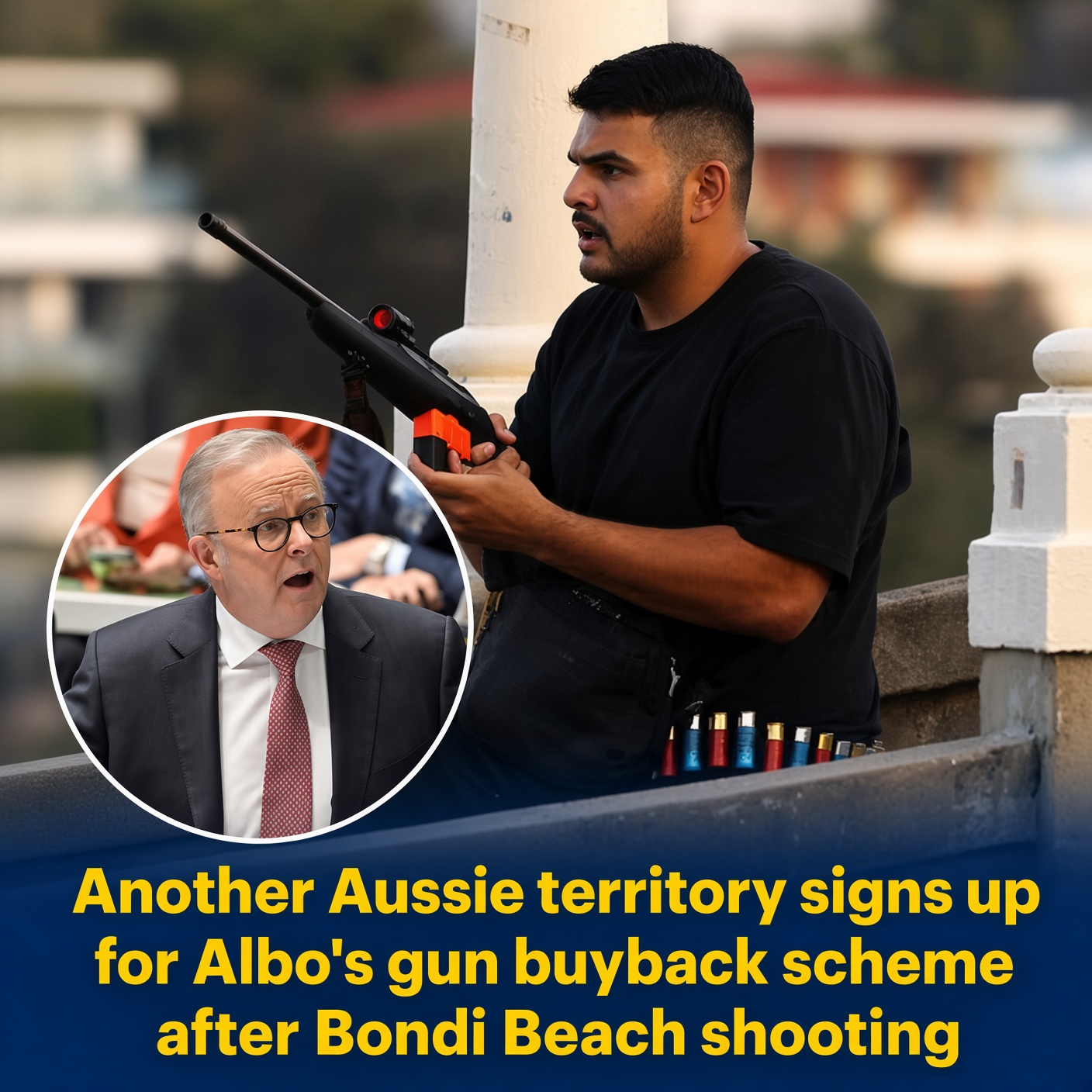
Australia’s national gun buyback has secured its second jurisdiction, with the ACT striking a deal with the Albanese government to remove firearms under reforms introduced in the aftermath of the deadly Bondi Beach terror attack.
The Australian Capital Territory will join New South Wales in the Commonwealth-backed scheme, with the federal government agreeing to carry most of the financial burden.
Under the agreement, Canberra will fund 75 per cent of the ACT’s buyback and associated administrative costs and pay the entire cost of destroying surrendered firearms.
The ACT government will fund the remainder.
But despite being labelled a national gun buyback, the political map remains sharply divided: the ACT is only the second jurisdiction to reach an agreement with the Commonwealth.
ACT becomes the second jurisdiction to sign on
New South Wales was the first jurisdiction to commit to the Commonwealth-backed program, unveiling a sweeping buyback expected to remove hundreds of thousands of firearms.
The ACT has now followed.
Chief Minister Andrew Barr said the territory already had some of the strongest firearms laws in Australia and argued the agreement would further reduce the possibility of weapons falling into the wrong hands.
The ACT had indicated it would participate after the national scheme was announced, but negotiations with the Commonwealth over funding continued until this week.
The deal resolves one of the central questions: who pays.
Commonwealth will pay 75 per cent
The financial arrangement is particularly significant because the cost of participating has become a point of contention between Canberra and several jurisdictions.
Under the ACT agreement, the Commonwealth will fund 75 per cent of both buyback and associated administrative costs.
It will also pay 100 per cent of the cost of destroying the surrendered weapons.
The ACT will cover the remaining 25 per cent of buyback and administration expenses.
That gives other state and territory governments a concrete example of the financial terms Canberra is prepared to offer.
There are about 23,000 guns in the ACT
The territory’s firearms market is small compared with Australia’s larger states, but the numbers are still substantial.
There are about 23,000 registered firearms in the ACT and more than 7,000 licensed firearm owners.
Approximately 14 per cent of those licence holders are expected to be affected by the proposed cap on the number of firearms an individual can possess.
The buyback would provide a mechanism for firearms made surplus by those ownership restrictions to be surrendered for compensation.
But the ACT does not yet have a start date
One detail requires particular caution.
New South Wales has announced that its buyback will begin on November 2.
The ACT has not.
Despite reports suggesting the same date would apply in Canberra, the latest ABC reporting says the ACT and Commonwealth have not yet settled when the territory’s buyback will begin or exactly how much owners will receive for surrendered firearms.
Home Affairs Minister Tony Burke said the governments decided there was no reason to delay announcing the ACT’s participation simply because those details were still being negotiated.
ACT Police Minister Marisa Paterson said the territory would work with the Commonwealth over the coming weeks to finalise the parameters before informing firearm owners and the wider community.
The reforms go beyond buying guns back
The ACT’s response is not limited to compensation for surrendered weapons.
The territory is pursuing wider firearms reforms that include ownership limits and restrictions on particular weapon types.
Reporting indicates most ACT licence holders would be limited to a maximum of 10 firearms, while particular firearms including belt-fed models would be prohibited.
The ACT is also moving towards a digital firearms registry integrated with the National Firearms Register, intended to give law-enforcement agencies better information about firearms and their registered owners.
The entire push began after Bondi
The political origin of the scheme is the December 14, 2025 terrorist attack at Bondi Beach.
Fifteen people were killed after gunmen opened fire during a Hanukkah celebration.
The attack subsequently prompted National Cabinet to pursue tighter firearms regulation alongside measures targeting antisemitism and violent extremism.
Prime Minister Anthony Albanese has argued national firearms reform is an important part of preventing another attack of that kind.
Announcing the ACT agreement, he said governments were working to take guns off the streets and better protect Australians.
The Bondi attack immediately reopened Australia’s gun debate
The attack was particularly significant to the firearms debate because one of the alleged attackers held a firearms licence and legally possessed multiple weapons.
That shifted political attention towards not merely illegal firearms but the number and type of weapons that licensed individuals could lawfully accumulate.
The government’s response has therefore combined a buyback with proposals to restrict ownership and harmonise firearm regulation across jurisdictions.
Supporters argue that reducing the number of high-risk firearms circulating in the community is a practical way to reduce the consequences when weapons reach dangerous individuals.
Opponents argue the response risks imposing major costs on compliant firearm owners without adequately addressing terrorism, organised crime or illegally obtained weapons.
NSW is pursuing the much bigger buyback
New South Wales provides a preview of what a large-scale version of the policy could look like.
The NSW program is due to begin on November 2 and is expected to require roughly 50,000 firearm owners to surrender weapons that fall outside the new rules.
Estimates suggest approximately 274,000 firearms could ultimately be removed.
Compensation will vary according to the firearm being surrendered.
The NSW reforms also impose tighter restrictions on the number and types of firearms people may legally possess.
That has generated a political backlash
The NSW scheme has already become a significant political issue, particularly in regional communities where licensed firearms are widely used for farming, pest control and recreational shooting.
Critics argue that law-abiding firearm owners are being required to surrender legally acquired property because of crimes they did not commit.
One Nation has emerged as one of the strongest political opponents.
The party has argued governments should focus on terrorism, organised crime and illegal firearms rather than imposing additional restrictions on licensed owners.
In NSW, One Nation figures are already positioning opposition to the buyback as an election issue.
The Coalition has also faced pressure over the scheme
The political fault lines are not confined neatly to Labor versus the Coalition.
NSW Opposition Leader Kellie Sloane and sections of the Liberal Party have distanced themselves from the buyback, while criticism has also emerged from regional interests and the firearms industry.
The argument centres partly on effectiveness and partly on proportionality.
Supporters see fewer firearms as an obvious public-safety benefit.
Critics ask whether removing firearms from licensed owners addresses the underlying causes of a terrorist attack.
Australia still does not have a genuinely national buyback
This is where the ACT announcement becomes politically revealing.
The program has been promoted as a national response.
Yet two jurisdictions signing agreements does not amount to nationwide implementation.
Victoria, Queensland, the Northern Territory and Tasmania have not joined the Commonwealth scheme, according to current reporting, while Western Australia is continuing with its own separate buyback arrangements.
The Northern Territory has been particularly resistant.
Both major political sides there have raised objections to the Commonwealth proposal, with opponents arguing responsible Territory firearm owners should not be financially or legally penalised because of an attack in Sydney.
Funding is one reason jurisdictions are hesitating
Who pays for a national policy implemented largely through state and territory firearms systems has been a central source of disagreement.
South Australian authorities, for example, have pushed for the Commonwealth to carry the full financial burden rather than expecting states to contribute.
That argument draws on the precedent of the Howard government’s landmark firearms reforms following the 1996 Port Arthur massacre.
The ACT’s 75-25 arrangement could therefore become important well beyond Canberra.
If the Commonwealth wants more jurisdictions to join, governments elsewhere can now point directly to the terms negotiated by Andrew Barr’s administration.
Port Arthur remains the unavoidable comparison
Every major Australian gun reform is inevitably measured against the changes that followed the Port Arthur massacre.
Thirty-five people were killed in Tasmania in 1996.
The subsequent National Firearms Agreement dramatically tightened firearm regulation across Australia and was accompanied by a buyback that collected more than 650,000 newly prohibited weapons.
The Albanese government describes the current initiative as the most significant national buyback effort since that period.
But there is an important difference.
The political consensus that allowed governments to move together after Port Arthur has been much harder to recreate this time.
The national firearms system still depends on the states
Australia does not operate a single Commonwealth firearms licensing regime.
Firearms regulation remains substantially a state and territory responsibility.
That makes national consistency dependent upon cooperation between nine governments with very different political constituencies and firearm ownership patterns.
A policy that may be relatively straightforward in urban Canberra can generate a dramatically different reaction in rural Queensland, Western Australia or the Northern Territory.
That is why securing individual agreements matters.
The Commonwealth can fund and encourage reform, but it cannot simply turn every state firearms system into an identical national regime overnight.
The debate is also about which guns are being targeted
Political rhetoric around buybacks can obscure an important distinction.
The objective is not simply to purchase random firearms from people willing to sell them.
The scheme is tied to wider legal reforms that can make particular firearms prohibited, reclassified or surplus when owners exceed new possession limits.
That makes it fundamentally different from a voluntary community gun-amnesty program.
For affected owners, surrender may be a consequence of changed law rather than a personal decision that they no longer want the firearm.
That distinction helps explain the strength of opposition within parts of the licensed shooting community.
There is also the illegal-gun question
Critics of the reforms repeatedly point towards firearms outside the legal registration system.
Australia has millions of registered firearms, but determining the number of illicit, unregistered or illegally manufactured weapons is considerably more difficult.
The growth of 3D-printed firearm technology has added another dimension to that problem.
ACT reforms are consequently also targeting 3D-printed firearms rather than relying solely on the buyback.
This matters because a buyback and enforcement against illicit firearms address different risks.
A government can reasonably argue for both.
Equally, opponents can reasonably demand evidence about how much public-safety benefit is achieved for every dollar spent acquiring firearms from already licensed owners.
The Royal Commission has added another layer
The Royal Commission on Antisemitism and Social Cohesion has also examined firearms reform following Bondi.
Its interim report addressed firearm possession, licensing, the National Gun Buyback Scheme and the National Firearms Agreement, while recommending greater harmonisation between federal, state and territory approaches.
That means the debate is no longer simply about whether individual governments support a buyback.
It is increasingly about whether Australia’s fragmented firearms framework can operate consistently enough to deal with modern terrorism and public-safety threats.
The ACT is an easy win for Albanese — the remaining states are harder
Politically, bringing the ACT into the scheme gives the Prime Minister another government standing beside the Commonwealth.
But it does not resolve the central problem.
Australia’s national gun policy is only genuinely national when governments with very different electorates agree to implement it.
NSW is moving aggressively.
The ACT is now on board.
Other jurisdictions remain unconvinced or are pursuing their own approaches.
The next phase of the debate will therefore be fought less over whether Canberra can persuade Canberra, and more over whether the Commonwealth can win over governments representing millions of regional and rural firearm owners.
Two competing definitions of public safety
The dispute ultimately reflects two very different ways of interpreting the lesson from Bondi.
The Albanese government’s argument is that the attack exposed weaknesses in firearms regulation and demonstrated the potential consequences when a dangerous person can gain lawful access to multiple weapons.
From that perspective, tighter ownership caps, reclassification and buybacks are preventative measures.
The opposing argument is that Bondi was fundamentally a terrorist attack and that policy should concentrate on extremist ideology, intelligence failures, border security and illegal weapons rather than imposing new restrictions on the wider licensed firearm community.
Those positions are unlikely to be reconciled simply by another jurisdiction signing an agreement.
The ACT agreement moves the scheme forward — but exposes the unfinished national fight
For Andrew Barr and Anthony Albanese, the announcement is straightforward: another Australian jurisdiction has agreed to remove firearms considered incompatible with the new regulatory regime, with the Commonwealth paying most of the bill.
For affected ACT firearm owners, however, crucial questions remain unanswered.
Exactly which weapons will have to be surrendered?
What compensation will be paid?
When will surrender begin?
And how will the new possession limits work in practice?
Those details are still being finalised.
That makes the ACT agreement an important step for Albanese’s gun reforms, but not the completion of a national scheme.
The bigger test is still ahead.
If Canberra can persuade the remaining states and territories to adopt sufficiently consistent rules, the Bondi attack may produce Australia’s most substantial nationwide firearms overhaul since Port Arthur.
If it cannot, Australia could emerge with something considerably messier: different ownership caps, different prohibited weapons, different compensation arrangements and different buyback policies depending on which side of a state border a licensed firearm owner happens to live.
The ACT has joined. The national argument over Australia’s guns is nowhere near finished.