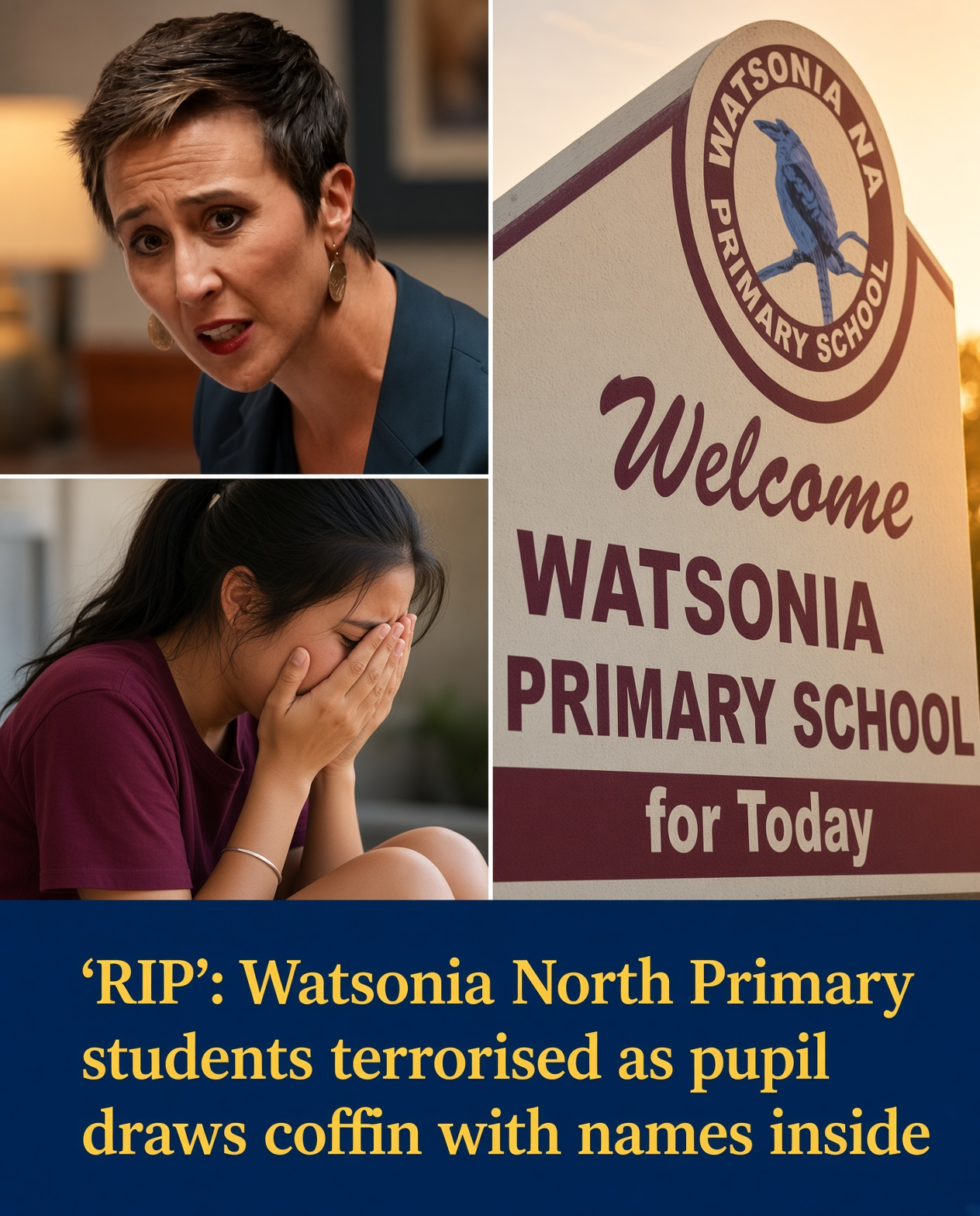
Up to five children at a Melbourne primary school have refused to return to class after a terrifying series of alleged assaults and threats culminated in a coffin being drawn with the names of two students inside it and the letters “RIP”.
Parents at Watsonia North Primary School have taken their concerns directly to Victorian Education Minister Gabrielle Williams, saying their children no longer believe they are safe at school.
Seven parents have written a five-page letter calling for urgent intervention following a string of incidents allegedly involving the same pupil.
Some children have become so frightened that their parents say staying home now feels safer to them than going to class.
Student allegedly slapped in face and left with bloody nose
Among the most serious incidents reported by parents was an alleged physical assault on one student.
The child was reportedly verbally abused before being slapped across the face by a classmate.
The blow allegedly left her with a bloody nose.
According to reporting on the incident, the classmate subsequently said she believed the student “deserved to be hit” and allegedly threatened to do it again.
The episode was not the only allegation of physical aggression raised by families.
Children allegedly whipped with skipping rope
Parents have also reported students being struck with a skipping rope.
Other alleged incidents include children being pushed from monkey bars and subjected to highly abusive language.
The incidents are reported to have involved the same pupil during the current school term.
Taken together, parents say the repeated episodes have left a group of children fearful about what could happen next.
Then came the coffin drawing
The incident that appears to have intensified that fear involved a drawing on a classroom whiteboard.
A coffin was allegedly drawn with the names of two students written inside it.
The letters “RIP” were also written with the image.
For nine-year-old children already worried about alleged physical aggression, parents say the drawing had a profound impact.
Some began questioning whether their classmate might seriously harm them or their friends.
Parents say children have struggled to sleep
The seven parents described the impact in their letter to the Education Minister.
They said the coffin drawing had caused genuine fear among the children regardless of what the pupil who drew it intended.
Parents reported sleep problems as well as escalating anxiety over what might happen at school.
The families say their children are no longer dealing with an ordinary playground disagreement but a situation they perceive as a threat to their safety.
Up to five students stayed home
The consequences have now moved directly into the children’s education.
Up to five students reportedly refused to attend Watsonia North Primary School last week.
Their parents say the children did not believe the arrangements put in place would protect them from further incidents.
That has left families facing an extraordinary choice between sending their children to school despite their fears or keeping them home and disrupting their education.
One parent said they never imagined reaching a point where their nine-year-old felt safer at home than at school.
Seven parents escalate the matter to Education Minister
The families have now gone beyond the school administration.
A five-page letter was sent to Education Minister Gabrielle Williams last week seeking urgent intervention over what the parents described as serious safety and wellbeing concerns.
Williams’ office is understood to have received the correspondence.
The parents told the minister their children were at home instead of in their classrooms because they were genuinely frightened.
The families say the children have lost confidence that the measures proposed by the school can prevent another incident.
Parents say previous safety arrangements failed
A central part of the dispute is not simply what allegedly occurred but how the school responded.
The parents say previous separation and supervision measures were inadequate.
According to their letter, some measures were not sufficiently implemented or enforced and failed rapidly.
The families had reportedly asked for the student at the centre of the allegations to be moved to another class.
They say that request was unsuccessful.
Families criticise reported ‘three metre radius’ solution
Parents told the Herald Sun that one proposed response involved rearranging classroom tables in an attempt to maintain distance between the children.
They characterised the arrangement as a “three metre radius rule”.
The families argue physical separation inside the existing classroom is insufficient given the nature and frequency of the incidents they have reported.
They believe the focus should be on guaranteeing the immediate safety of affected children rather than preserving the existing classroom arrangements.
Children should not have to calculate how to stay safe, parents say
The parents’ letter paints a troubling picture of the emotional burden they believe has been placed on young students.
They argue no nine-year-old should have to spend the school day monitoring another child’s emotions.
Nor, they say, should children be calculating where they can safely sit or play, how to avoid an outburst or whether they may need to run away.
The parents’ central argument is that responsibility for managing safety belongs with the adults and systems responsible for the children.
Department says school is taking ‘appropriate action’
The Victorian Department of Education has responded to the allegations.
A department spokesman said every child deserved to feel safe at school and inappropriate student behaviour was followed by proportionate consequences.
The department said Watsonia North Primary School was taking appropriate action following the incidents.
Support was also being made available to affected students and their families.
However, the department has not publicly detailed what disciplinary action, if any, has been taken against the student at the centre of the allegations.
Privacy rules limit what the department can reveal
There is an important reason for that silence.
The people involved are children.
The Department of Education said it could not disclose further information or reveal the specifics of disciplinary measures because of its responsibility to protect children’s privacy.
That means the public currently has only part of the picture.
The absence of publicly disclosed disciplinary action does not establish that no action has occurred behind the scenes.
The student at the centre of allegations also has privacy rights
The seriousness of the allegations makes careful reporting particularly important.
The child accused of the behaviour is a primary school student and should not be publicly identified.
There may also be circumstances surrounding the child’s behaviour, support needs or school response that cannot lawfully or appropriately be disclosed.
Those considerations do not diminish the reported fear experienced by other children.
They do mean the case cannot responsibly be treated like a disciplinary dispute involving adults.
The school’s stated values include respect and kindness
Watsonia North Primary School describes itself as a community where students and families should feel connected.
Its publicly stated school values are Respect, Persistence and Kindness.
The school says student wellbeing and inclusion are priorities and that individualised support and reasonable adjustments are available for students who need them.
Its wellbeing program also includes strategies around healthy relationships, resilience, stress management and help-seeking.
The school says every child should feel supported
Watsonia North’s own published material says its wellbeing approach aims to ensure students feel safe, supported and ready to learn.
The school has a counsellor working with students experiencing issues including anxiety, emotional regulation, self-esteem and relationships.
It also uses Positive Classroom Management Strategies developed by staff.
These establish behaviour expectations across school settings.
The current controversy therefore presents a direct test of the safety and wellbeing principles the school publicly says it seeks to uphold.
Official data already showed room for improvement on bullying
Watsonia North’s latest annual report provides useful background, although it predates the current incidents.
In the 2025 Attitudes to School Survey, 70 per cent of Year 4–6 students gave positive responses on management of bullying.
The corresponding figure among similar schools was 76.9 per cent.
The Victorian state average was 76.4 per cent.
Watsonia North was therefore below both comparison groups on that measure.
The gap also existed on students’ sense of connection
The same annual report showed 66.9 per cent positive endorsement for students’ sense of connectedness in 2025.
That compared with 76.5 per cent among similar schools and 77.1 per cent across Victoria.
The school’s four-year average was also below the corresponding similar-school and state averages.
Those figures provide context about student perceptions but cannot establish why the current incidents occurred or whether they could have been prevented.
The data must not be used to prejudge this case
Annual survey results describe broad student perceptions across an entire school population.
They do not investigate individual incidents.
They do not tell the public what teachers knew in this particular case or what interventions were attempted.
And because the latest available annual data predates the events now being reported, it cannot measure the school’s response to them.
The figures are a relevant warning sign for context, not proof of institutional wrongdoing.
Schools face competing obligations when serious behaviour occurs
Cases involving violent or threatening behaviour between young children are rarely simple.
A school has an obligation to protect students who report being harmed.
It also retains educational and wellbeing responsibilities towards the child displaying challenging behaviour.
That child may require behavioural intervention, specialist assistance, additional supervision or other supports.
Inclusion cannot mean leaving other students feeling unsafe, but discipline alone may not address the causes of a child’s behaviour either.
The immediate issue is whether children can safely return
For the affected families, the broader debate about behaviour policy is secondary to a much more immediate question.
Can their children return to school without being afraid?
At present, some parents clearly do not believe that question has been satisfactorily answered.
Once children refuse school because they believe attendance puts them at risk, the consequences can quickly spread beyond the original incidents.
Fear begins interfering with education, friendships, sleep and family life.
Keeping children home cannot become the long-term solution
Parents have an understandable instinct to protect a frightened child from an environment they believe is unsafe.
But prolonged school refusal creates another serious problem.
Children can fall behind academically and become increasingly disconnected from their classmates and normal routines.
Anxiety about returning can also become harder to overcome the longer a child remains away.
The burden is therefore on the responsible adults to establish conditions in which affected students can safely and confidently resume their education.
Parents want ministerial intervention
By writing directly to Gabrielle Williams, the families have made clear they no longer regard the matter as something that can be resolved solely within the school.
Their request puts pressure on the Education Minister and department to determine whether the school’s existing measures are sufficient.
It also raises the question of whether additional departmental resources or intervention are required.
The department says appropriate action is already occurring; the parents plainly believe more must be done.
Both propositions now need to be reconciled
Because privacy restrictions prevent the department from disclosing every intervention, there is an unavoidable information gap.
The public cannot see the complete disciplinary or wellbeing response.
But the children’s continued refusal to attend school is itself significant.
Whatever measures have been introduced, several families remain unconvinced that they have restored safety.
A successful response ultimately has to work not only administratively but practically — children need to be able to return to class without believing they are in danger.
The coffin drawing cannot simply be assessed in isolation
A drawing by a primary school child can have many possible meanings, and intent cannot safely be inferred from the image alone.
But context matters.
Parents say the coffin appeared after alleged physical assaults, abusive language and threats.
That sequence explains why the affected children reportedly interpreted it so seriously.
As the parents themselves acknowledged, whatever was intended by the drawing, its effect on the children was profound.
Threat assessment must focus on behaviour as well as intent
A school does not need to assume a nine-year-old genuinely intends lethal violence in order to take a threatening image seriously.
It can examine the pattern of behaviour, the circumstances in which the drawing appeared, previous incidents and the reactions of affected students.
The objective should be proportionate risk management rather than panic.
That means avoiding both extremes: dismissing children’s fear as meaningless and treating an untested allegation as proof of an actual plan to cause grave harm.
The children caught in the middle need support
The five students reported to have stayed home require more than physical separation.
Parents say some are struggling with sleep and fear.
Restoring confidence may therefore require counselling, clear safety arrangements and communication with families about what will happen if another incident occurs.
The Department of Education says support has been made available.
The effectiveness of that support will become clearer if and when the children feel able to return.
The child accused of the behaviour may need intensive support too
Protecting other students and supporting the pupil accused of aggressive behaviour are not mutually exclusive objectives.
Serious behavioural problems in a primary-aged child can require specialised intervention.
The exact circumstances in this case are private and should remain so.
But an effective school response needs to consider what will prevent further incidents, not merely what punishment follows an incident that has already occurred.
The ultimate objective must be safety for every child involved.
What happens next matters more than public outrage
The allegations are disturbing, particularly because they involve children so young.
But the most useful test of the system will be what happens now.
Can the affected students return safely?
Can the school prevent further alleged violence?
Can the pupil at the centre of the concerns receive whatever intervention is necessary?
And can parents regain enough confidence to entrust their children to the school each morning?
Those are the outcomes by which the response should ultimately be judged.
Five empty desks should concern the Education Department
Watsonia North Primary School remains responsible for educating all of its students.
When up to five nine-year-olds are reportedly too frightened to attend, that responsibility has been seriously disrupted.
The department says it is responding and cannot reveal private disciplinary details.
The families say previous measures have failed and want the minister herself to intervene.
The gap between those positions now needs to be closed quickly.
The alleged assaults require appropriate investigation. The threatening behaviour requires a proportionate response. The student at the centre of the allegations requires privacy and appropriate support.
But the most immediate benchmark is considerably simpler.
Children should be able to walk through the gates of their primary school without being afraid that a classmate will hurt them.