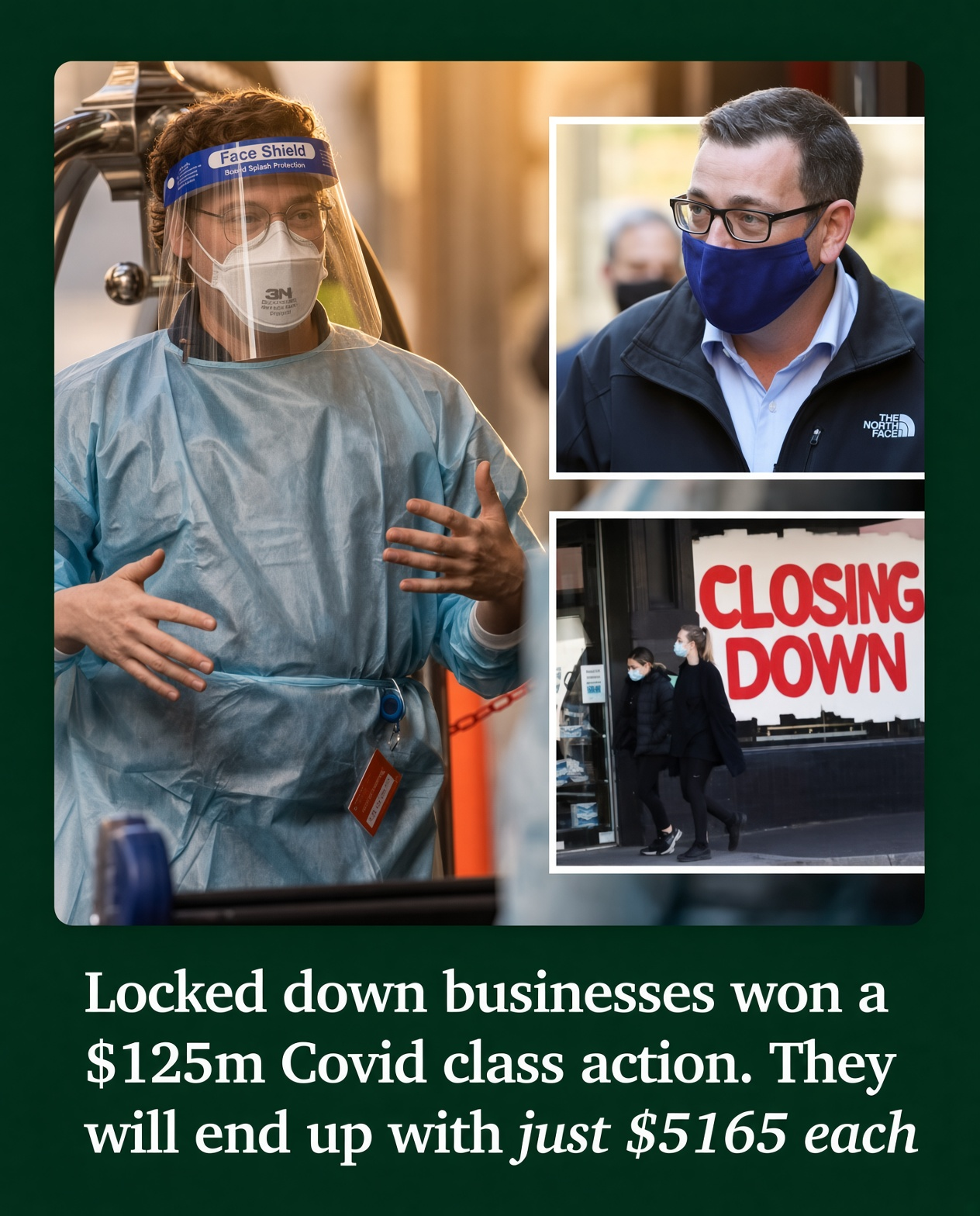
Thousands of Victorian businesses devastated during the state’s 2020 Covid lockdowns could receive an average of little more than $5,000 each from a landmark $125 million class action settlement — while approximately $37.5 million is earmarked for the lawyers who ran the case.
New details emerging from the Supreme Court of Victoria have revealed how the proposed settlement in the Hotel Quarantine Business Losses Class Action could ultimately be divided.
More than 16,800 businesses joined the proceeding after suffering losses during Victoria’s Stage 3 and Stage 4 restrictions between July and October 2020.
The class action alleged failures in Victoria’s hotel quarantine program led to the state’s second Covid wave and the restrictions that followed.
The Victorian government agreed in March to settle the litigation for $125 million, inclusive of costs and interest, without admitting liability or legal fault.
Now comes the difficult question.
How much of that $125 million will actually reach the businesses?
$37.5 million could go to legal costs
The most eye-catching number is $37.5 million.
The law firm Quinn Emanuel has conducted the litigation under a Group Costs Order set at 30 per cent, inclusive of GST.
The order was made by Justice Keogh in November 2023.
Supreme Court documentation explains that if the class action succeeds through either a settlement or judgment, legal fees and disbursements payable to Quinn Emanuel are calculated at 30 per cent of the settlement or damages award, subject to further court order.
Thirty per cent of a $125 million settlement is $37.5 million.
That leaves less than $88 million before the remaining distribution arrangements are taken into account.
Businesses face an average payout of about $5,165
More than 16,800 businesses are involved in the action.
Reporting based on the latest Supreme Court documents puts the pool available for affected businesses at approximately $87 million.
Spread across the group, that produces an average payout of approximately $5,165.
For businesses that suffered months of lost revenue during one of the most economically destructive periods in Victoria’s recent history, the contrast is stark.
A $125 million headline settlement sounds enormous.
For the individual shop, restaurant or other eligible business, the eventual cheque may look considerably less dramatic.
But $5,165 is not what every business will receive
This distinction is critical.
The reported $5,165 figure is an average, not a guaranteed or standard payment.
Businesses are not simply expected to receive identical cheques.
The proposed settlement distribution is based on eligible losses, with payments calculated on a pro-rata basis according to each business’s losses relative to the losses of other eligible group members.
That means some businesses could receive substantially more than $5,165.
Others could receive less.
The ultimate distribution will depend on eligibility, assessed losses and the court-approved settlement administration process.
Why are the lawyers receiving 30 per cent?
The $37.5 million figure will inevitably provoke anger among some business owners.
But the arrangement did not suddenly appear when the parties agreed to settle.
Supreme Court documents show Quinn Emanuel conducted the litigation on a conditional basis.
Its fees would not be payable unless the proceeding achieved a successful result through a court-approved settlement or judgment.
From August 2020 until June 2025, the firm also had a portfolio finance arrangement covering disbursements including barristers, expert witnesses and court fees. Quinn Emanuel subsequently assumed responsibility for those costs itself.
Group members were not required to pay money upfront to participate.
If the case had failed, the firm’s position would have been very different.
The Supreme Court approved the 30 per cent structure
It is therefore potentially misleading to characterise the $37.5 million purely as lawyers independently choosing to “pocket” almost a third of the settlement.
A Group Costs Order is a judicially supervised mechanism available in Victorian class actions.
The Supreme Court made the 30 per cent order in this proceeding in 2023, and the ultimate settlement itself still requires court approval.
That does not mean the size of the deduction is beyond criticism.
It means the criticism should be directed at the economics of the court-approved class action structure rather than suggesting an unexplained $37.5 million fee appeared after settlement.
Class actions can be extraordinarily expensive to run
Major class actions can continue for years and involve senior counsel, solicitors, economists, expert witnesses, discovery, data analysis and enormous volumes of documentary evidence.
They also create financial risks for the representative plaintiff and those funding the litigation.
The Victorian Law Reform Commission has previously noted that class actions impose disproportionate risks and costs on representative plaintiffs and that legal costs are commonly deducted from settlements before group members receive compensation.
The policy argument is straightforward.
Without mechanisms allowing lawyers or litigation funders to recover substantial costs after a successful case, many ordinary people and small businesses could never afford complex litigation against governments or large corporations.
The counterargument is equally obvious when a settlement finally arrives.
The people whose losses created the case can watch a substantial portion of the money disappear before compensation reaches them.
The case dates back to Victoria’s second wave
The proceeding arose from one of the defining episodes of the pandemic in Australia.
Businesses alleged that failures associated with Victoria’s hotel quarantine program caused or contributed to the second Covid outbreak in 2020.
The resulting public health response included Stage 3 and Stage 4 restrictions across Melbourne and regional Victoria.
Retail and hospitality businesses were among those hit particularly hard as customers were prevented from attending physical premises.
The Supreme Court describes the proceeding as being brought on behalf of business owners who suffered economic losses resulting from those restrictions.
The Victorian government did not admit liability
The $125 million settlement should not be interpreted as a court finding that the Victorian government was legally responsible for the businesses’ losses.
No such final judgment was delivered.
The parties reached an in-principle settlement shortly before the matter was due to proceed through trial.
The government did not admit liability or legal fault as part of the agreement.
That distinction matters.
A settlement resolves litigation and the risks facing both sides.
It does not necessarily establish that every allegation made in the proceeding was proved.
The government agreed to settle for $125 million
The agreement was reached on March 16.
Barrister Adam Hochroth SC told the Supreme Court that the parties had reached a $125 million settlement “inclusive of everything, costs, interest”.
The timing was politically significant.
The settlement meant a lengthy and potentially damaging trial would not proceed as scheduled.
Opposition politicians subsequently accused the government of using taxpayer money to avoid having former ministers and senior officials questioned in court.
That is a political allegation, not an established explanation for why the government settled.
Taxpayers ultimately fund the settlement
There is another uncomfortable feature of the case.
The $125 million does not come from former ministers or officials.
It comes from the state.
In practical terms, Victorian taxpayers fund the settlement.
They also fund the government’s defence of the litigation.
That has prompted calls for a full accounting of the state’s legal expenditure associated with the case.
In March, Liberal MP Bev McArthur told Victorian Parliament that the public deserved to know the government’s total legal bill, including expenditure on consultants and expert witnesses.
The lead plaintiff is seeking an additional $250,000
The latest documents contain another potentially controversial element.
5 Boroughs NY Pty Ltd, the restaurant business that served as lead plaintiff, is seeking a special payment of $250,000 from the settlement funds.
According to reporting on the court documents, the business owner says acting as representative plaintiff exposed the restaurant to public ridicule, including an online campaign involving fake negative reviews.
The owner says the hostility contributed to the closure of the Keilor Park restaurant.
The application also refers to a $90,000 loan taken out to avoid liquidation. >
The proposed $250,000 payment has not simply been handed over.
It is part of the settlement arrangements requiring judicial consideration.
Twelve other businesses are seeking $5,000 each
A further 12 business owners who provided financial information used during mediation are seeking special payments of $5,000 each.
Those payments recognise additional work or contribution undertaken by particular group members during the litigation.
Again, they remain subject to the court process.
Businesses can still object
The proposed settlement is not yet the final word.
Eligible businesses have an opportunity to object to the arrangements.
According to the latest reporting, objections can be lodged until September 11.
The Supreme Court is expected to consider the settlement approval application on September 29.
The court’s role is important.
Unlike an ordinary private settlement between two parties, a class action resolution affects thousands of group members who were not individually sitting at the negotiating table.
The court must therefore determine whether the proposed outcome is fair and reasonable for those people.
The $5,165 figure exposes the mathematics of mass litigation
The extraordinary contrast between $125 million and an average of $5,165 demonstrates something easily lost in class action headlines.
Large settlements do not necessarily produce large individual payments.
Start with $125 million.
Remove 30 per cent under the Group Costs Order.
Then distribute the remaining pool across more than 16,800 businesses according to the settlement formula.
The result is inevitably much smaller at the individual level.
That does not establish that the settlement is unfair.
It does explain why some traders may feel deeply disappointed when they compare their pandemic losses with the compensation ultimately available.
For some businesses, no settlement can restore what disappeared
Victoria’s 2020 lockdowns did not merely produce temporary reductions in turnover.
Some businesses exhausted savings.
Some accumulated debt.
Some closed permanently.
Owners lost years of work and, in some cases, businesses they had expected to operate for the rest of their working lives.
No class action can reverse those events.
The litigation can only attempt to convert a complex history of economic loss into a finite pool of money and a legally workable distribution formula.
The settlement also ends a major legal risk for Victoria
The government had its own reason to resolve the dispute.
Litigation of this scale carries enormous uncertainty.
Continuing to trial could have resulted in victory for the state.
It could also have resulted in greater liability, additional legal costs and years of appeals.
A negotiated settlement gives both sides certainty.
That is one of the fundamental reasons civil cases settle.
But because this defendant is the State of Victoria, the decision inevitably carries a political dimension that an ordinary commercial settlement would not.
The court now faces the crucial question
Is the proposed arrangement fair to the businesses whose losses underpin the case?
That is ultimately not a question for the government, the lawyers or political commentators.
It is a question for the Supreme Court.
Victoria’s class action system gives courts an important supervisory role over legal costs, and the Victorian Law Reform Commission has specifically recognised the importance of judicial scrutiny of deductions from class action settlements.
The September hearing therefore matters enormously.
$125 million sounds very different from $5,165
For the government, $125 million resolves an extraordinary piece of pandemic-era litigation without an admission of liability.
For the lawyers, the existing Group Costs Order could produce approximately $37.5 million in fees and disbursements after years of conditional litigation.
For the businesses, roughly $87 million could remain for distribution across more than 16,800 claimants, with the individual amount determined according to eligible losses.
Those are three very different ways of looking at the same settlement.
And for a Victorian trader who watched revenue disappear during the 2020 lockdowns, the number that may matter most is not $125 million.
It is the amount that ultimately arrives in their bank account.