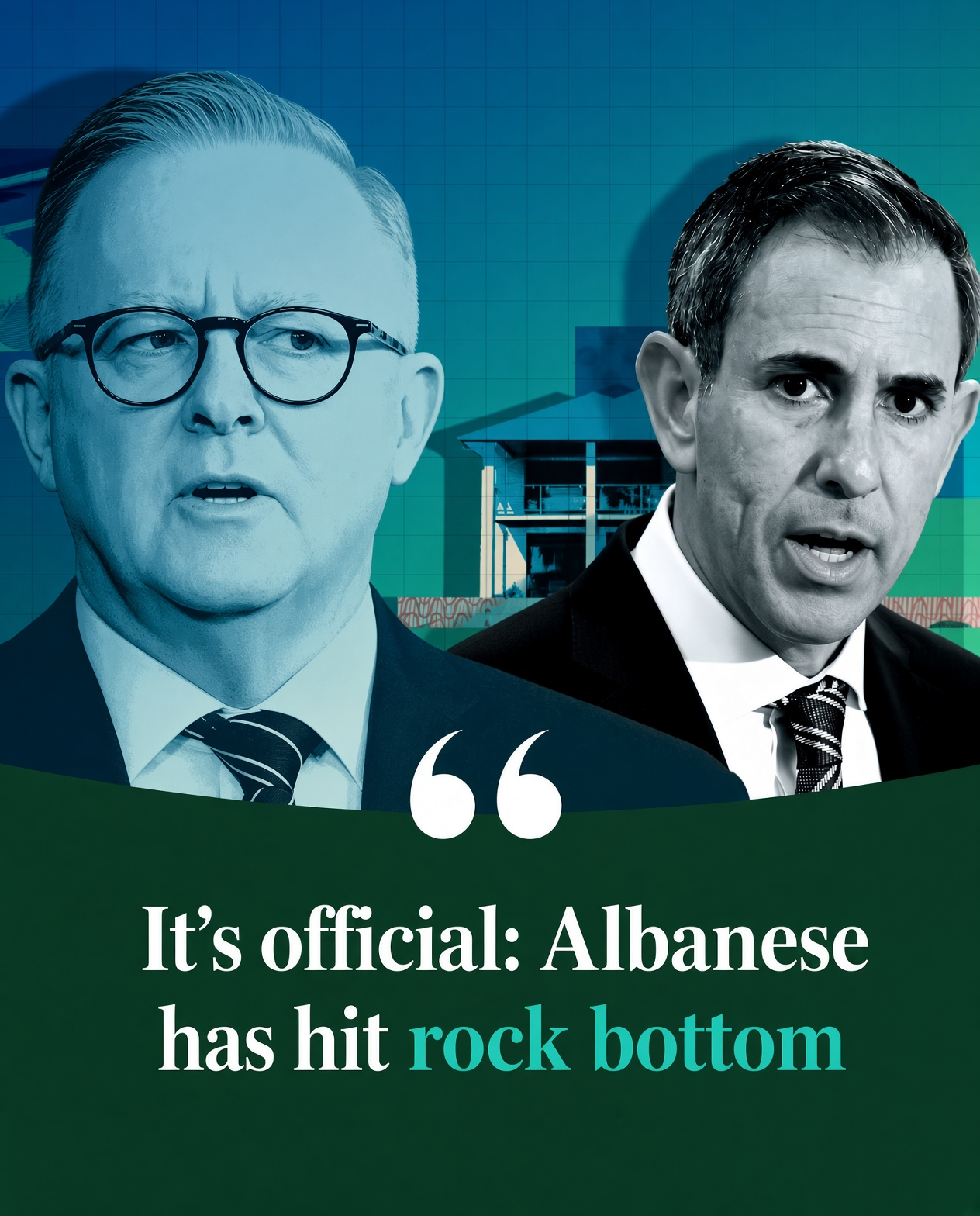
Anthony Albanese has entered one of the most dangerous periods of his prime ministership, with Labor’s primary vote falling to its lowest Newspoll level since the Gillard era and the Prime Minister’s personal approval sinking deep into negative territory.
After years in which Albanese’s political strength rested partly on the weakness and instability of his opponents, voters are delivering an increasingly uncomfortable message to the government.
Labor’s primary support is weak.
Albanese’s personal standing has deteriorated.
One Nation has transformed the electoral landscape.
The Coalition remains historically weak but is attempting to rebuild under Angus Taylor.
And Australians continue to identify cost of living, housing and economic security as central concerns.
None of this means Albanese is finished. But the political environment that carried Labor through the 2025 election has changed dramatically.
Labor falls to 29 per cent
The latest Newspoll provides the clearest measure of Labor’s predicament.
Labor’s primary vote has fallen to 29 per cent — its lowest Newspoll result since June 2013, when Julia Gillard was prime minister.
That is an extraordinary figure for a governing party that secured a commanding election victory little more than a year ago.
Albanese’s personal numbers are also troubling.
His net approval rating has fallen to minus 22.
The result reflects a much broader deterioration in voter satisfaction rather than a single controversy or policy failure.
But Albanese is still preferred prime minister
There is an important qualification to any declaration that the Prime Minister has reached political rock bottom.
Despite Labor’s poor primary vote and Albanese’s negative approval rating, voters have not decisively embraced an alternative national leader.
Newspoll still places Albanese first when Australians are asked who they would prefer as prime minister.
He records 46 per cent support, compared with Pauline Hanson on 31 per cent and Opposition Leader Angus Taylor on 23 per cent.
That distinction matters: voters can be deeply dissatisfied with a prime minister while remaining unconvinced that either major alternative would do a better job.
The old two-party contest is breaking apart
The bigger story may not be Albanese’s individual popularity at all.
Australian politics is increasingly looking like a three-way — or even four-way — competition rather than the traditional Labor-versus-Coalition contest.
Roy Morgan’s polling conducted from August 3 to 9 illustrates the transformation.
One Nation was on 26 per cent of the primary vote.
Labor was on 25.5 per cent.
The Liberal-National Coalition was on 22 per cent.
The Greens were attracting 15.5 per cent.
No major political force was anywhere close to the primary-vote dominance Australians once expected from Labor or the Coalition.
One Nation is no longer a minor polling curiosity
The rise of Pauline Hanson’s party fundamentally changes the political calculations facing Albanese.
One Nation can no longer be treated simply as a protest party taking a handful of percentage points from conservative voters.
It has repeatedly challenged — and in some polls overtaken — both traditional major-party blocs on primary support.
A Roy Morgan poll earlier this month placed One Nation narrowly ahead of Labor nationally.
That means voter dissatisfaction is not flowing neatly from the government to the official opposition.
It is being dispersed across an increasingly fragmented political system.
That is both good and bad news for Labor
For Albanese, the weakness of the Coalition provides some protection.
A government can survive a poor primary vote if its traditional opponent is performing even worse and preference flows allow Labor to assemble winning majorities seat by seat.
But there is a danger in assuming that fragmentation will always work in Labor’s favour.
If One Nation continues building a durable working-class constituency while the Coalition recovers some of its traditional support, Labor could eventually face pressure from multiple directions simultaneously.
The Prime Minister therefore needs more than an opposition that struggles. He needs voters to positively return to Labor.
Cost of living remains the government’s central problem
The political difficulty confronting Albanese is grounded in household economics.
Australians have endured years of elevated living costs.
Housing affordability remains severe.
Mortgage holders have faced higher interest rates.
Renters have experienced substantial pressure.
Energy and grocery bills remain highly visible measures of whether voters believe their standard of living is improving.
Governments can point to aggregate economic indicators, but voters ultimately experience an economy through what remains in their bank accounts after the bills are paid.
Housing has become politically toxic
Housing is particularly dangerous because it reaches several voter groups at once.
Young Australians fear permanent exclusion from home ownership.
Renters face affordability pressure.
Mortgage holders are sensitive to interest rates.
Existing property owners worry about policies affecting the value or tax treatment of their assets.
Population growth and migration have also become inseparable from the housing debate.
Labor therefore faces the difficult task of convincing younger Australians it can make housing more affordable without convincing existing homeowners that government policy will make them poorer.
The property tax fight hurt Labor
The government’s attempts to reform property tax concessions have created another political vulnerability.
Polling earlier this year showed significant voter resistance to elements of Labor’s property tax overhaul.
The debate was especially damaging because opponents framed the changes as another attack on household wealth at a time when Australians were already under financial pressure.
Labor argued its reforms were intended to improve housing affordability and direct support towards younger Australians.
But good policy intentions are politically useless when a government loses control of the explanation.
The budget failed to produce a sustained reset
Federal budgets offer governments an opportunity to change political momentum.
Labor needed its budget to demonstrate that it understood household pressure and had a credible longer-term economic strategy.
Instead, the government’s political difficulties continued.
Questions about taxation, spending, productivity and the future direction of economic policy quickly overwhelmed whatever reset Labor hoped to achieve.
The government increasingly faces a communications problem as well as a policy problem.
Productivity is becoming impossible to avoid
Australia’s productivity performance has become another central economic concern.
Business groups have repeatedly called for regulatory reform, investment incentives and measures capable of generating stronger productivity growth.
Productivity matters politically because sustainable wage growth and improvements in living standards ultimately depend on producing more value for each hour worked.
Without that improvement, governments are left redistributing an economy that is not expanding fast enough per person.
That makes the debate much larger than individual cost-of-living payments or temporary household relief.
Then came ‘Melongate’
Into this already difficult environment came a controversy that had little to do with economic policy.
Albanese’s appearance on comedian Nikki Osborne’s Bush Deep podcast generated sustained criticism after comments involving Japanese Prime Minister Sanae Takaichi and a gift of melons were interpreted as a crude double entendre.
The Prime Minister rejected that interpretation and refused demands that he apologise for the remarks.
The episode became known as “Melongate” and quickly developed into a broader argument about Albanese’s judgement and the dignity expected of a prime minister.
The controversy became much bigger in Australia than Japan
There is an important factual distinction in assessing the episode.
The controversy became a major Australian political and media story.
It does not appear to have produced an equivalent political crisis in Japan.
Commentary examining Japanese coverage found the remarks received little mainstream attention there, while Japanese officials reportedly treated the issue as a non-event.
That does not determine whether Albanese’s comments were appropriate, but it does challenge claims that the episode itself produced a major bilateral diplomatic crisis.
Why did it hurt Albanese anyway?
Political controversies rarely damage leaders purely because of the words involved.
They become dangerous when they reinforce an impression voters already hold.
For critics of Albanese, the podcast provided evidence of poor judgement and an excessive desire to appear informal or relatable.
His refusal to apologise then extended the story.
Questions about what the host had told the Prime Minister’s team before the interview created another round of headlines.
What might have disappeared as an awkward joke instead became a prolonged argument about character.
That is why personal polling matters
Prime ministers can survive unpopular policies.
They can survive bad news cycles.
They can even survive significant electoral setbacks.
What becomes more dangerous is the loss of personal political capital that allows them to persuade voters through difficult periods.
Albanese’s minus-22 Newspoll approval rating suggests that reservoir has become substantially shallower.
Once voters begin interpreting unrelated controversies through a pre-existing negative view of a leader, political recovery becomes harder.
Labor insists it is focused on governing
Senior Labor figures have publicly played down the polling.
The government’s argument is familiar and reasonable: elections are decided on election day, not by individual mid-term opinion polls.
Ministers say their focus remains on delivering the government’s program rather than reacting to weekly political fluctuations.
And there is substantial time before Australians are expected to vote again.
With roughly 21 months until the next scheduled federal election, Albanese has something every struggling leader desperately needs: time.
He is still getting legislation through Parliament
The public drama surrounding Melongate also obscured a more conventional political story.
Albanese continued negotiating legislation through a difficult parliament.
Labor and the Coalition have reached agreements across several policy areas, while the government has also negotiated with crossbench MPs.
Recent parliamentary business has included gambling reform, NDIS measures and changes involving the news media bargaining framework.
Whatever the state of Albanese’s public image, the machinery of government has not stopped functioning.
That could become Labor’s recovery argument
The government’s strongest route back may be deliberately unglamorous.
Rather than trying to manufacture another political personality reset, Albanese can attempt to demonstrate competence through outcomes.
Lower household pressure.
More housing.
Improved real wages.
Economic stability.
Legislation passed.
Public services delivered.
If voters begin feeling materially better off, many of today’s political controversies may fade surprisingly quickly.
But another economic deterioration would be dangerous
The opposite is also true.
If household finances remain under pressure, Albanese cannot expect voters to distinguish every problem neatly between global conditions, Reserve Bank decisions, state governments and federal policy.
Incumbent governments receive credit when conditions improve and blame when they deteriorate.
That political rule is neither sophisticated nor necessarily fair.
It is nevertheless remarkably persistent.
Labor’s electoral future may therefore depend more on Australians’ lived economic experience over the next 12 months than on any parliamentary tactical victory.
Angus Taylor has his own problem
The government’s weakness should theoretically be producing an enormous Coalition advantage.
It is not.
The Coalition’s primary support remains historically poor in several surveys.
Taylor has improved his position in some measures, but he has not yet established himself as the dominant alternative prime minister.
Newspoll’s preferred-prime-minister figures put him behind both Albanese and Hanson.
That means Albanese is vulnerable without yet facing an opponent who has decisively convinced voters he should replace him.
Hanson presents a different challenge
Pauline Hanson’s threat to Labor is not conventional.
One Nation does not need to form majority government to transform the electoral landscape.
It needs to take enough working-class, regional and outer-suburban votes to destabilise traditional electoral coalitions.
Those are precisely the voters whose concerns about living costs, migration, housing, energy and economic security have become increasingly prominent.
If Labor loses working-class voters to One Nation while progressive voters move towards the Greens, its primary-vote base can be squeezed from both sides.
The Greens add pressure from the other direction
The Greens’ 15.5 per cent showing in the recent Roy Morgan poll demonstrates Labor’s other strategic difficulty.
Moving right on migration, law and order or cultural issues can create friction with progressive voters.
Moving left can make it harder to recover socially conservative and economically anxious working-class voters.
The traditional Labor coalition has always contained tensions between those constituencies.
A fragmented four-party political environment makes managing those tensions considerably harder.
Twenty-nine per cent is a warning, not an election result
It would be a mistake to translate today’s polling directly into the outcome of the next federal election.
Australian elections are determined seat by seat.
Preferences matter.
Campaigns matter.
Candidates matter.
Economic conditions can change rapidly.
Opposition parties can make mistakes.
And voters who use mid-term polling to express dissatisfaction do not always vote the same way when government itself is at stake.
Labor’s 29 per cent primary vote is nevertheless an unmistakable warning that a large part of its 2025 electoral coalition is currently looking elsewhere.
The Gillard comparison carries psychological weight
The fact that Labor’s primary vote has reached its lowest Newspoll level since the Gillard era is politically potent because of what happened in 2013.
Labor’s internal instability during those years became synonymous with leadership dysfunction.
There is no equivalent public leadership contest engulfing the Albanese government today.
That difference is substantial.
But once polling begins generating historical comparisons with governments remembered for political collapse, nervousness inside a governing party naturally increases.
Albanese still controls his immediate future
There is no clear evidence of an imminent Labor leadership challenge.
The Prime Minister remains in office with considerable institutional authority.
His government continues legislating.
His opponents remain divided.
And the election is still some distance away.
Declarations that his prime ministership is already doomed therefore run well ahead of the available evidence.
But Albanese’s political margin for error has plainly narrowed.
The next phase is about rebuilding trust
Political recovery cannot come solely from arguing that opponents are worse.
Nor can Labor assume voters will eventually return because One Nation or the Coalition appears risky.
Albanese needs to rebuild a positive case for his government.
That means demonstrating how Australians’ lives will improve through another Labor term rather than simply warning what could happen under someone else.
The Prime Minister’s greatest danger is not that voters suddenly hate him. It is that enough of them stop seeing a compelling reason to keep him.
Rock bottom or a mid-term trough?
That is the question the polling cannot answer.
If Labor’s support begins recovering, today’s numbers may eventually be remembered as the predictable low point of a difficult mid-term period.
If living standards improve and Albanese restores personal authority, the government has ample time to rebuild.
If the deterioration continues, however, August 2026 may be remembered as the point when warning signs became something much more serious.
Albanese has not lost the next election. But for the first time in his current term, the argument that his political position requires a fundamental reset is becoming difficult to dismiss.
The crown is not gone.
It is simply sitting far less comfortably than it once did.