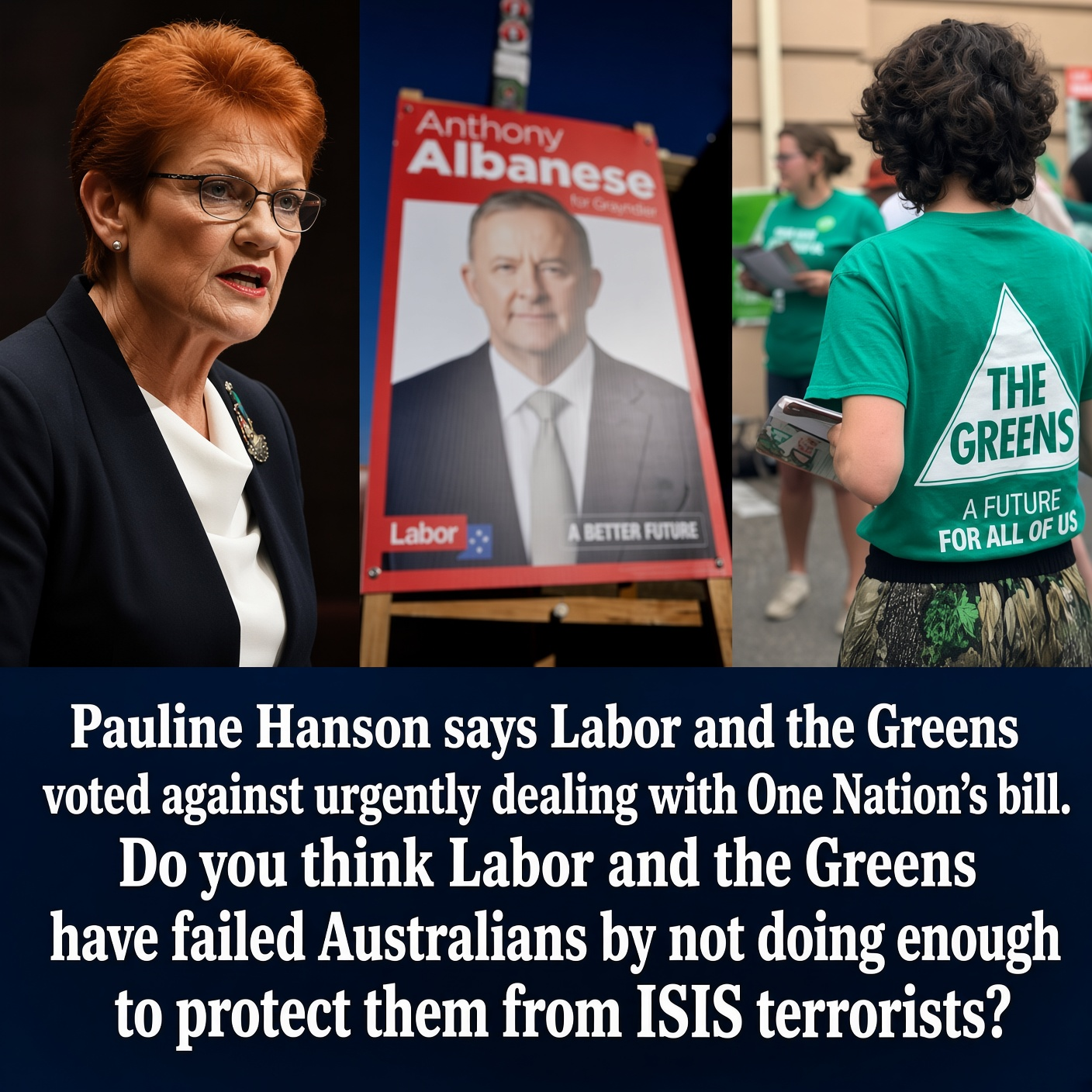
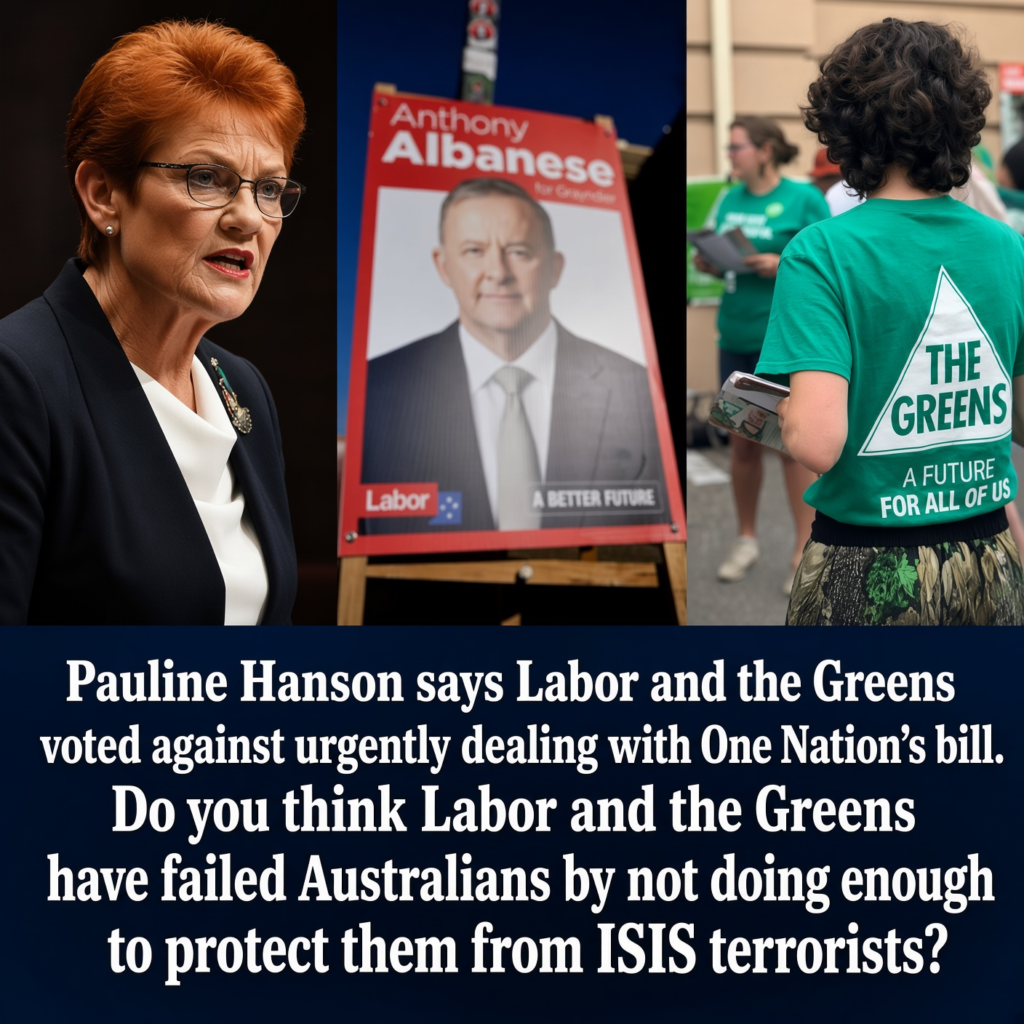
Labor and the Greens have voted against an attempt by Pauline Hanson to force an urgent Senate debate on sweeping legislation designed to make it harder for Australians linked to foreign terrorist organisations to return home.
The Senate rejected One Nation’s bid to suspend standing orders by 35 votes to 24, preventing the party’s Protecting Australians from Foreign Terrorist Fighters Bill 2026 from being immediately brought on for debate.
The vote has intensified an already bitter political argument over what Australia should do about citizens suspected of joining Islamic State overseas, including 13 Australian men detained in Iraq who could potentially be released.
One Nation says Australia should construct every legally available barrier against their return.
The Albanese government says it has no intention of helping the men come back to Australia, but argues Hanson’s proposed solution risks colliding with the Constitution and potentially undermining existing government powers if successfully challenged in the High Court.
The Coalition, meanwhile, has moved closer to One Nation on the issue. Senior opposition figures have backed the objective of keeping suspected foreign fighters out but want the legislation examined by a parliamentary committee and constitutional experts before it proceeds.
The result is an unusual national-security dispute in which the major participants broadly agree that suspected ISIS fighters should not simply be assisted back into Australia, but sharply disagree over what Parliament can lawfully do to prevent their return.
Hanson wanted the Senate to deal with the bill immediately.
One Nation’s legislation was drafted against the backdrop of renewed concern about Australians who travelled to territory controlled by Islamic State and who may retain Australian citizenship.
Hanson argued that the possibility of the 13 men being released from detention in Iraq made the issue too urgent for the normal parliamentary timetable.
Her attempt to suspend standing orders was defeated 35–24.
Greens senator David Shoebridge attacked the proposal as political “dog-whistling” rather than an effective response to terrorism.
Labor also opposed the urgent move.
Acting government leader in the Senate Murray Watt argued that passing legislation vulnerable to a constitutional challenge could create a worse national-security outcome rather than a stronger one.
That distinction is important when describing the vote.
Labor and the Greens voted against Hanson’s attempt to urgently progress the bill. That is not the same proposition as Parliament holding a final vote on every individual counter-terrorism measure contained in it.
The legislation’s ultimate fate remains unresolved.
The bill goes considerably further than its political slogan.
One Nation has presented the legislation as a mechanism to “shut the door” on foreign terrorist fighters.
Its actual provisions involve several parts of Australia’s counter-terrorism and citizenship-management framework.
One of its central proposals is a new foreign terrorist fighter exclusion order.
Rather than giving a minister unlimited discretion to permanently ban a citizen, the proposed system would involve the Federal Court and allow the Home Affairs Minister to seek an exclusion order against a person with relevant terrorist links.
The bill also seeks to make it easier to restrict or cancel passports in relevant circumstances.
It would alter the operation of return permits, including preventing a permit from automatically allowing a person back into Australia while court proceedings over an exclusion order were under way.
Further provisions would tighten bail arrangements for people facing certain terrorism allegations and create offences aimed at people who knowingly assist prohibited returns.
Hanson argues the combination is designed to address weaknesses in existing law while avoiding some of the constitutional problems created by previous attempts to exclude Australian citizens.
Whether it succeeds in doing that is precisely the issue dividing Parliament.
The constitutional problem is fundamental.
An Australian government has substantial power over passports, national security and the movement of people.
But permanently excluding an Australian citizen from Australia raises a much more difficult constitutional question.
Home Affairs Minister Tony Burke has been particularly dismissive of Hanson’s proposal.
He said last month that her approach would last about “30 seconds in the High Court”.
Burke’s argument is not that the government wants suspected ISIS members to return. He has publicly taken the opposite position.
The dispute concerns whether Parliament has the constitutional power to achieve the permanent exclusion Hanson wants.
Australian citizenship carries constitutional protections that are different from the position of a foreign national seeking entry.
The government cannot simply treat an Australian citizen as though they were a tourist whose visa can be cancelled at the border.
That problem has become more complicated following High Court decisions limiting the Commonwealth’s ability to strip citizenship from Australians through executive action.
One Nation says its Federal Court model is designed to address those difficulties.
Labor is unconvinced.
The Coalition wants the proposal tested rather than dismissed.
The opposition’s support has given Hanson’s legislation considerably greater political significance.
Opposition Leader Angus Taylor and Nationals Leader Matt Canavan have signalled support for its objective, while senior Coalition frontbenchers have said they are prepared to work with One Nation.
Shadow home affairs minister Jonno Duniam has argued that the legislation should be sent to a Senate committee so constitutional and national-security experts can examine it.
That approach allows the Coalition to support the principle of stronger exclusion powers without declaring that every clause of Hanson’s bill is legally sound.
It also creates pressure on Labor.
If the government believes the bill is unconstitutional, the opposition’s argument is that it should demonstrate those problems through parliamentary scrutiny and expert evidence rather than simply preventing the proposal from advancing.
One Nation has made a similar demand, calling on the government to release the legal advice underpinning Burke’s criticism.
The government is not generally required to publish confidential legal advice and has resisted demands that it do so.
The immediate concern involves 13 Australian men held in Iraq.
The men are suspected of links to Islamic State and have been detained in Iraq after the collapse of the terrorist organisation’s territorial caliphate.
Among the most prominent names associated with the group is Australian doctor Tareq Kamleh, widely known from Islamic State propaganda as “Dr Jihad”.
Kamleh left Australia in 2015 and appeared in ISIS propaganda after travelling to Syria. Recent reporting indicates he is alive and detained in Baghdad, despite having previously been widely believed dead.
The possibility that Iraqi authorities could release detainees has forced Canberra to confront a question that had for years remained largely theoretical: what happens if Australian citizens suspected of serving Islamic State become free to travel?
Burke has said the Albanese government will provide no assistance to the 13 men.
He has been unusually emphatic, saying the government would “not lift a finger” to help them return.
But refusing assistance is different from possessing a permanent legal power to prevent an Australian citizen from entering Australia if that person independently manages to reach the country.
That gap is the political territory Hanson is targeting.
Australia already has temporary exclusion powers.
The Commonwealth’s existing counter-terrorism framework allows temporary exclusion orders to be imposed in relevant circumstances.
Those measures can prevent an Australian citizen of counter-terrorism interest from returning without a permit and allow authorities to control the timing and conditions of a return.
The system is intended in part to ensure security agencies and police are prepared before a person arrives.
The Albanese government has used existing exclusion mechanisms in relation to Australians linked to Islamic State.
What the current system does not provide is the simple permanent prohibition Hanson is demanding.
That is why the argument cannot be reduced to whether the government is “tough” or “soft” on terrorism.
The central legal question is whether a permanent exclusion regime can survive constitutional scrutiny.
If legislation is passed and subsequently struck down by the High Court, it can have consequences beyond political embarrassment. Depending on the drafting and the judgment, governments can lose powers they had assumed were available or face uncertainty about related parts of the statutory regime.
That is the risk Labor says Parliament should not casually take.
The return of Australian women and children from Syria has intensified distrust of government assurances.
One Nation’s raw political argument relies heavily on what happened earlier this year.
The Albanese government had previously said it would not actively repatriate Australians who remained in Syrian camps after the fall of Islamic State.
In May, however, Australian women and children who had been held in north-eastern Syria made their way back to Australia after leaving the camps.
The circumstances produced a fierce dispute over exactly how much assistance Australian authorities provided.
The government rejected characterisations suggesting it had mounted a conventional repatriation mission, while reporting indicated Australian agencies were involved in preparations and arrangements surrounding their return.
One Nation now cites that episode as the reason Australians should not simply accept assurances that the 13 men in Iraq will receive no help.
There is an important distinction, however.
The women and children in Syria were not legally interchangeable with the 13 male detainees in Iraq, and their individual circumstances differed significantly.
Nor did their arrival mean Australian authorities simply allowed serious allegations to disappear.
Police were waiting.
Three women faced serious charges after returning.
Two women who arrived in Melbourne — Kawsar Ahmad and her daughter Zeinab Ahmad — were charged with crimes against humanity offences involving allegations that they owned and used a Yazidi woman as a slave while living in Syria.
The charges carry maximum penalties of 25 years’ imprisonment.
The allegations have not been proven and the women are entitled to the presumption of innocence.
Another returnee faced terrorism-related allegations.
The prosecutions illustrate one of the government’s counterarguments to permanent exclusion: where Australian citizens are suspected of serious crimes, bringing them within reach of Australian law enforcement can allow them to be investigated, charged, prosecuted and subjected to control orders or other security measures.
Critics respond that prosecution is not guaranteed.
Collecting admissible evidence from a collapsed war zone can be extraordinarily difficult. Intelligence establishing that authorities believe someone was associated with a terrorist organisation is not necessarily evidence that can be presented in an Australian criminal trial.
That evidentiary gap is one reason foreign fighters have posed such a difficult problem for Western governments since the collapse of the ISIS caliphate.
Bail has become another political flashpoint.
One Nation has also pointed to the release on bail of women facing serious allegations linked to Islamic State as evidence that the existing system does not adequately protect the community.
In July, a Melbourne court granted bail to Rayann El Houli, who has been charged with being a member of a terrorist organisation and entering a declared area.
She had spent about two months in custody.
The magistrate concluded strict bail conditions could reduce risks to the community.
El Houli denies the allegations and intends to contest the charges.
The case demonstrates why bail is a particularly difficult subject for political claims.
A person charged with an offence has not been convicted of it. Australian courts make bail decisions by applying legislation and assessing risks including reoffending, interference with witnesses, failure to appear and danger to the community.
A government cannot simply order a court to keep a particular accused person in prison because the allegation is politically explosive.
Parliament can, however, legislate stricter bail tests for categories of offences, subject to constitutional limits.
One Nation’s bill seeks to do exactly that.
The debate therefore involves three separate questions.
The first is political: should Australia do everything legally possible to stop citizens who voluntarily joined ISIS from returning?
There is substantial political support for that proposition across One Nation and the Coalition, and the Albanese government itself clearly has no enthusiasm for facilitating the return of the 13 men.
The second is constitutional: how far can Parliament actually go?
That is where the sharpest disagreement lies.
Hanson says the law can be strengthened and has drafted a Federal Court-based mechanism intended to survive legal challenge.
Burke says the proposal is constitutionally defective.
The Coalition wants that argument tested through committee scrutiny.
The third question is practical: is Australia safer when suspected foreign fighters are permanently kept offshore, or when their return is controlled so police and intelligence agencies can arrest, prosecute, monitor or impose restrictions on them?
There is no universally simple answer.
Leaving citizens overseas can prevent an immediate domestic security risk but may leave their fate dependent on unstable foreign detention systems.
Returning them creates security and monitoring challenges inside Australia but can place them within a functioning legal system.
Those competing risks are precisely why foreign-fighter policy has troubled governments across Europe, North America and Australia for years.
Tuesday’s Senate vote did not resolve any of them.
It resolved a procedural question: whether Hanson’s legislation would be brought forward for urgent debate.
The answer was no.
One Nation will portray the 35–24 vote as Labor and the Greens refusing to urgently strengthen Australia’s defences against foreign terrorist fighters.
Labor will argue that national security is too important for Parliament to rush legislation carrying serious constitutional doubts.
The Greens maintain that Hanson’s proposal is politically inflammatory and that terrorism cases should be dealt with through lawful criminal justice mechanisms rather than populist exclusion policies.
The Coalition has chosen a fourth position: support the objective, examine the bill and try to make it legally robust.
What happens next will depend on whether the legislation receives enough parliamentary support to progress beyond procedural battles and into detailed scrutiny.
But the underlying problem is not going away.
Thirteen Australians suspected of links to one of the world’s most notorious terrorist organisations remain detained in Iraq, and Canberra cannot determine indefinitely what Iraqi authorities will do with them.
If they remain imprisoned, the political urgency may subside.
If they are released, the legal questions Parliament is currently arguing about could become immediate operational problems for Australian authorities.
Hanson’s bill may or may not provide a constitutionally valid answer.
But the question it is forcing Parliament to confront is real: what should Australia do when one of its own citizens is suspected of leaving the country to serve a terrorist organisation — and then wants to come home?