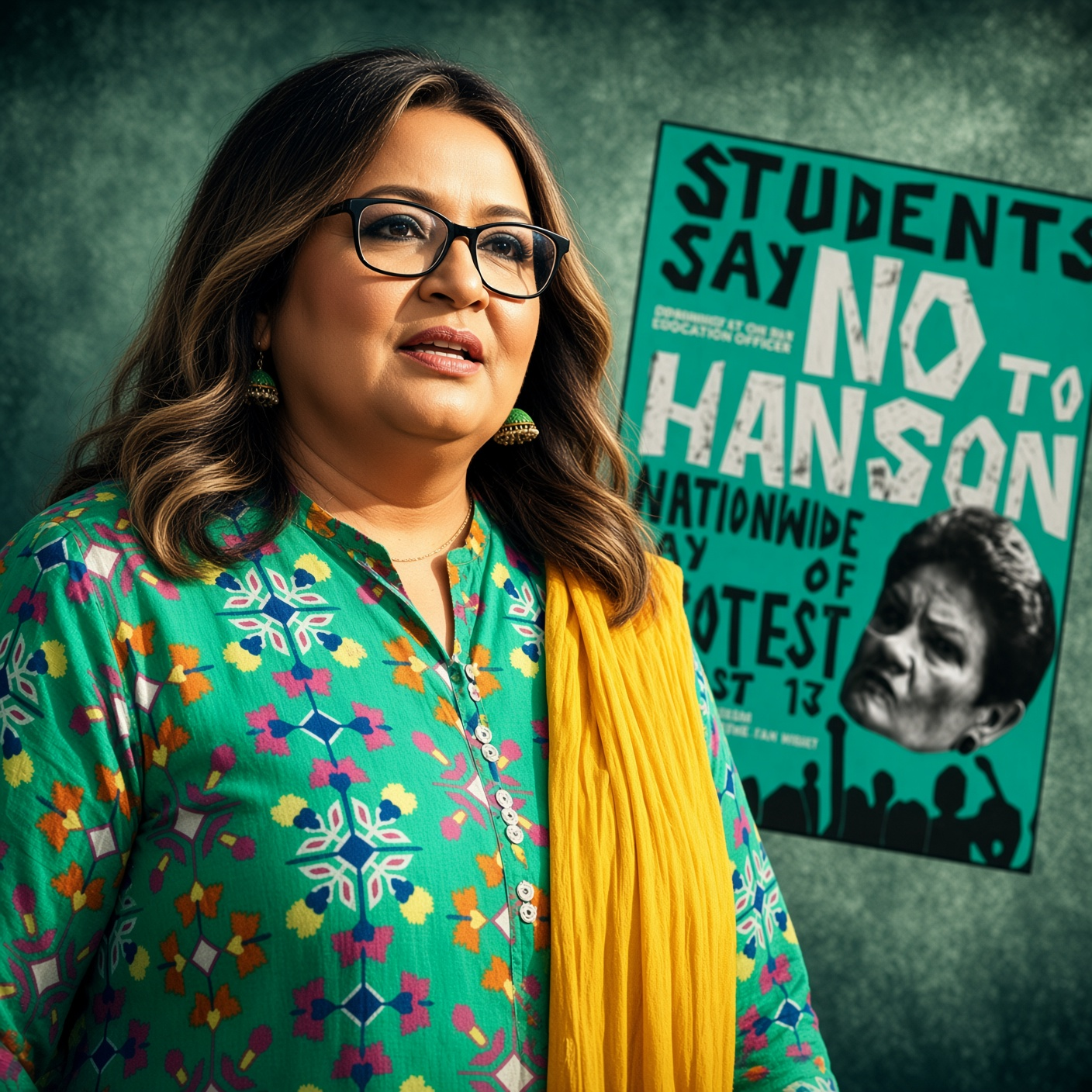
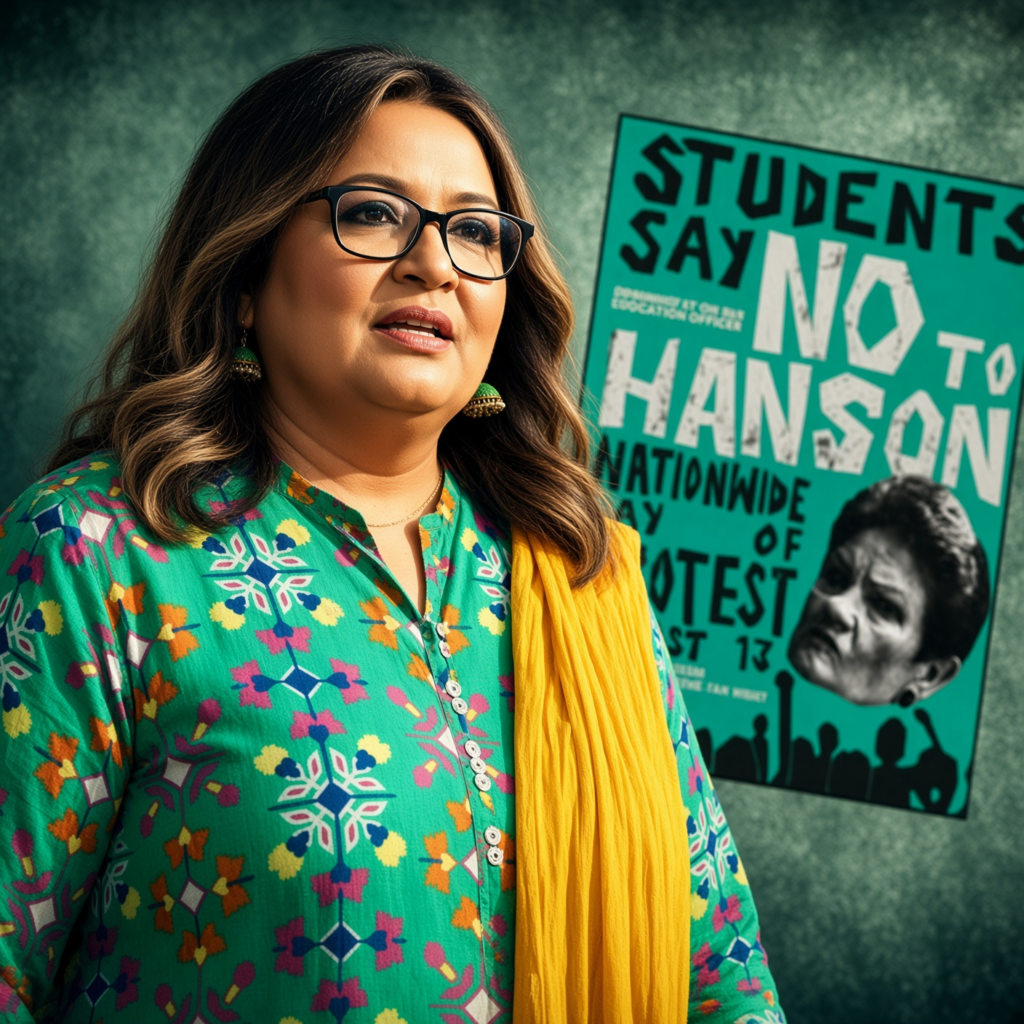
Greens deputy leader Mehreen Faruqi has openly encouraged school students to leave class and join a nationwide protest against Pauline Hanson and One Nation, injecting federal politics into an already contentious student walkout planned across Australia on Thursday.
Faruqi used a social media post on Wednesday to endorse the August 13 demonstrations, which organisers say will bring high school and university students onto the streets to oppose One Nation and what they describe as the “rise of the far right”.
The Greens senator framed her message as a tongue-in-cheek response to students asking permission to miss class.
“And you want my permission? Of course – hope you’ve made a big sign. Have fun!” Faruqi said.
Her intervention is likely to intensify an argument that was already developing over whether school students should be encouraged by politicians and adult activists to abandon classes for political demonstrations.
Faruqi throws support behind August 13 walkout
The nationwide action is scheduled for Thursday, August 13, with demonstrations promoted in cities around Australia.
Organisers have presented the protest as a student-led response to the growing political prominence of Hanson and One Nation.
Promotional material circulating ahead of the event calls on students to oppose racism and the far right, while attacking One Nation over its positions on migration, gender, workers and other political issues.
Faruqi echoed that framing in her own endorsement.
In the social media message, she characterised One Nation as representing “racist, sexist, anti-worker and divisive politics” and encouraged students who shared those views to participate.
Those descriptions are Faruqi’s political assessment of One Nation rather than neutral findings about the party.
What is not in dispute is that a serving federal senator — and the deputy leader of the Australian Greens — has explicitly encouraged students to participate in a protest that requires some school-aged attendees to leave class.
Students Say No to Hanson rallies planned around Australia
The action has been promoted under the banner “Students Say No to Hanson”, with rallies planned in multiple Australian capitals.
Social media promotions list Thursday events in cities including Sydney and Melbourne, with the Melbourne demonstration advertised for 2pm outside the State Library of Victoria.
The campaign has attracted backing from student organisations, including the National Union of Students.
Organisers say Hanson’s renewed political prominence requires students to respond publicly rather than treating One Nation as an ordinary political development.
Their campaign material accuses the party of racism, homophobia and hostility towards workers, while also criticising Labor, the Coalition and even the Greens for what activists regard as an inadequate response to right-wing politics.
That broader ideological agenda has become a major part of the controversy surrounding the walkout.
An ‘anti-capitalist toolkit’ has added to the controversy
The demonstrations are not being organised simply as a conventional civics exercise.
Reporting ahead of Thursday’s walkout has revealed the circulation of a document titled The High School Anticapitalists’ Toolkit, designed to help students organise political activity inside schools.
The material provides advice on recruiting classmates, distributing political material and establishing activist networks.
It urges students to use posters, school lockers, group chats and social media to build participation in walkouts and related campaigns.
The toolkit goes considerably further than opposition to Hanson.
It links the growth of the far right to capitalism itself and promotes a broader anti-capitalist political movement among high school students.
That has allowed critics to argue that children are being recruited into a wider ideological campaign rather than merely exercising an independent right to protest against a political party.
One Nation tells students to stay in school
One Nation has rejected the accusations contained in the campaign material and criticised efforts to encourage schoolchildren to leave their classrooms.
A spokesperson for Hanson urged students to remain at school, learn about political issues and form their own views rather than accepting the descriptions of One Nation contained in activist material.
The spokesperson also rejected claims that Hanson and the party were motivated by hatred towards minority groups.
That response highlights the central disagreement surrounding Thursday’s event.
Organisers see the walkout as political education in practice — young Australians exercising democratic rights on an issue they believe will shape their future.
Critics see adults and organised political groups encouraging children to sacrifice education in support of an ideological campaign.
Faruqi and Hanson have a bitter political history
Faruqi’s involvement carries additional significance because she and Hanson have been engaged in a long-running personal and legal dispute.
In September 2022, after Faruqi criticised the British Empire following the death of Queen Elizabeth II, Hanson responded on social media by telling the Pakistan-born senator to “piss off back to Pakistan”.
Faruqi took legal action under section 18C of the Racial Discrimination Act.
In 2024, the Federal Court found Hanson’s post amounted to unlawful racial discrimination and ordered her to delete it.
Hanson appealed.
Last month, the Full Federal Court unanimously dismissed that appeal, leaving the finding against the One Nation leader intact. Hanson subsequently indicated she could pursue the matter in the High Court.
That judicial history provides relevant context for Faruqi’s strong language about Hanson.
It does not, however, convert every broader political allegation Faruqi makes about One Nation into a judicial finding.
The court ruling was about a specific Hanson post
The distinction is important in reporting the latest dispute.
The Federal Court litigation concerned Hanson’s specific 2022 social media post directed at Faruqi.
The original judgment concluded the post was an “angry personal attack” and found it breached section 18C of the Racial Discrimination Act. The Full Court subsequently rejected Hanson’s attempt to overturn that decision.
That is an established legal outcome.
By contrast, Faruqi’s descriptions this week of One Nation as “sexist”, “anti-worker” and part of a broader far-right movement are political characterisations.
One Nation disputes those descriptions.
This is not the first time Faruqi has backed students skipping class
Faruqi’s position on Thursday’s protest is also consistent with her previous approach to student activism.
In November 2023, hundreds of students left school to attend a pro-Palestinian demonstration in Sydney despite the NSW education minister saying participation was not a valid reason to miss school.
Faruqi publicly praised those students and said she was proud of them.
Her latest endorsement therefore reflects a broader view that school students should be able to engage in direct political action even when demonstrations take place during class time.
Supporters argue teenagers are citizens affected by government decisions even before they become eligible to vote.
Opponents argue elected politicians should not be encouraging children to disregard school attendance requirements simply because they support the cause involved.
The political argument is bigger than one missed school day
The dispute raises a more difficult question than whether missing several hours of class will materially damage an individual student’s education.
Australia has a long history of young people participating in demonstrations, from anti-war campaigns to climate strikes and protests over Indigenous affairs.
Political participation itself can form part of a young person’s civic education.
But a distinction can be drawn between students independently deciding to protest and senior politicians actively encouraging them to leave school for a cause the politician supports.
Faruqi has now placed herself firmly on the latter side of that line.
Her message did not merely defend the students’ right to protest.
It explicitly gave them her rhetorical “permission” to skip class.
One Nation’s resurgence is driving the campaign
The walkout is occurring against the backdrop of a genuine resurgence in One Nation’s political prominence.
Hanson has spent recent months expanding the party’s policy agenda and preparing for upcoming state and federal contests, while opinion polling has generated renewed debate about whether One Nation is becoming a more durable force in Australian politics.
ABC’s recent examination of the party described it as arguably stronger than at any point in decades and considered whether its increased support represents temporary protest voting or a more fundamental political realignment.
That rise is exactly what the student organisers say they want to confront.
Their argument is that waiting until the next election is insufficient and that political opposition to One Nation should also occur through public demonstrations.
Hanson’s critics are also protesting her public events
Thursday’s student action is part of a wider pattern of protests surrounding One Nation.
Demonstrators have targeted party events and fundraisers in recent months, while Hanson has accused sections of the media and political establishment of treating her party unfairly.
At her National Press Club address in June, protesters interrupted proceedings with a banner as Hanson used the speech to outline policies including ending official multiculturalism and substantially reducing immigration.
One Nation’s opponents argue those policies justify a strong anti-racism movement.
The party argues protesters routinely misrepresent its policies and seek to shut down political debate rather than defeat its arguments democratically.
Debate over students and politics will continue after Thursday
Whatever the turnout at the August 13 rallies, the controversy surrounding them is unlikely to end when students return to class.
The involvement of organised activist groups, the circulation of an anti-capitalist organising guide and Faruqi’s explicit endorsement have turned the event into a broader debate about political activism in Australian schools.
Students unquestionably have political views.
Many older high school students will be eligible to vote within a year or two, and issues such as housing, employment, education, climate policy and discrimination directly affect their lives.
The contested question is not whether they should be allowed to hold or express those views.
It is whether elected representatives should encourage them to leave compulsory schooling to do so.
Thursday will test how much support the campaign actually has
Social media promotion can demonstrate enthusiasm among organisers but cannot establish how many students will ultimately participate.
Claims about a nationwide movement will therefore face their first meaningful test when the rallies begin on Thursday.
Events have been promoted across the country and organisers expect both high school and university students to participate.
One Nation, meanwhile, is likely to use the protests to reinforce its argument that political and activist institutions are mobilising against a party whose support is growing.
The Greens will see the same events very differently: as evidence that young Australians are willing to organise against policies they regard as discriminatory and divisive.
Faruqi has removed any doubt about which side of that contest she is on.
One day before students are due to leave classrooms around Australia, one of the country’s most senior Greens politicians has effectively handed them a political late note — and told them to bring a sign.