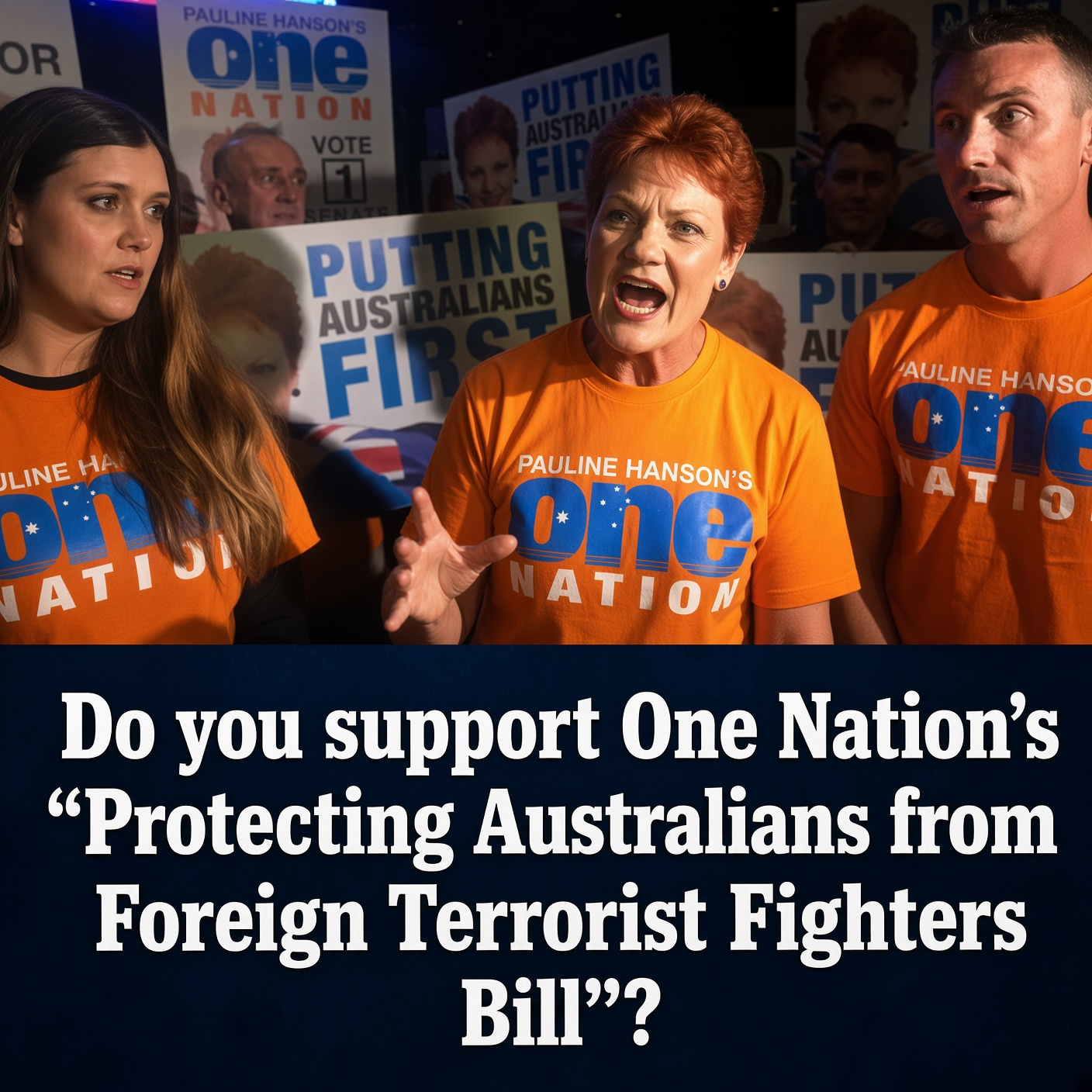
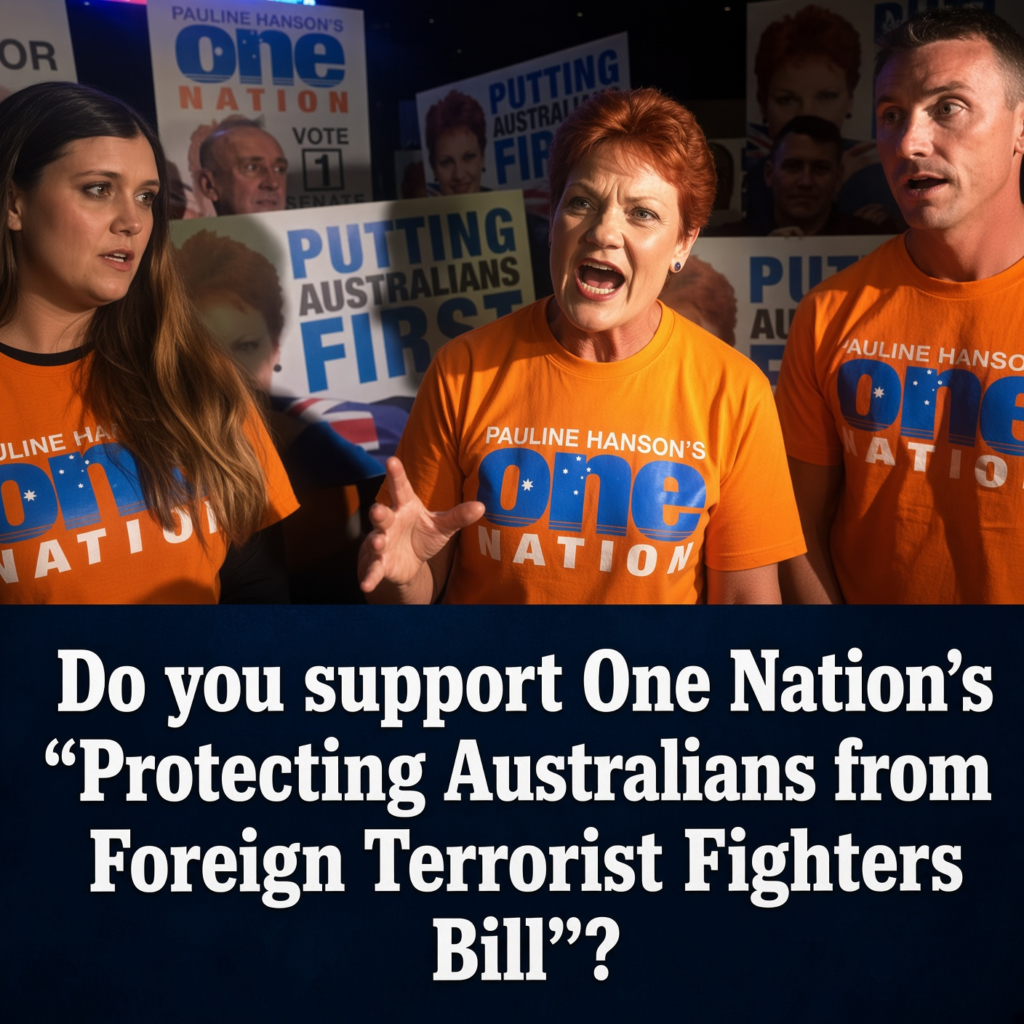
Pauline Hanson has challenged the Albanese government to release the legal advice it says prevents Australia from permanently shutting the door on citizens linked to foreign terrorist organisations, as One Nation intensifies its push for tougher counter-terrorism laws.
The One Nation leader says the safety of Australians must come first and argues the government could go further than existing laws if it had the political will to do so.
Her party is promoting its Protecting Australians from Foreign Terrorist Fighters Bill, which seeks to strengthen passport powers, restrict the return of Australians accused of terrorism-related conduct and create a new court-based exclusion mechanism.
Hanson has framed the issue as a direct challenge to Labor.
If the government can move urgently on other matters it regards as harmful to Australians, including gambling reforms, she argues it should demonstrate the same urgency when dealing with people associated with terrorist organisations.
But the central dispute is not whether Australia already has counter-terrorism powers. It does.
The much harder question is whether Parliament can constitutionally prevent an Australian citizen from returning to Australia permanently while that person remains a citizen.
Hanson demands to see Burke’s legal advice
Home Affairs Minister Tony Burke has argued One Nation’s permanent exclusion proposal would not survive constitutional scrutiny.
Hanson wants him to prove it.
One Nation says that if Burke is relying on legal advice to justify the government’s position, Australians should be allowed to see that advice.
“Australians deserve to see it,” the party said in promoting its legislation.
The demand is politically straightforward but does not mean the government is necessarily obliged to publish confidential legal advice.
Governments of both major political persuasions routinely decline to disclose legal advice, particularly where publication could affect future litigation or reveal privileged legal reasoning.
Nor does the fact that advice remains confidential establish that Burke’s constitutional argument is correct.
The merits of that argument need to be assessed against Australia’s existing laws and previous High Court decisions.
Those precedents explain why the government believes there is a constitutional limit.
What One Nation’s bill would actually do
Hanson’s legislation goes considerably further than simply cancelling passports.
The proposal would create a new “foreign terrorist fighter exclusion order” capable of being issued through the Federal Court.
It would also strengthen passport cancellation and refusal provisions, change the operation of return permits while proceedings are under way, tighten bail arrangements for people facing terrorism charges and introduce criminal penalties for knowingly facilitating an unauthorised return.
The court-based design is significant.
Australian governments have previously encountered serious constitutional problems when ministers were given powers with consequences resembling punishment for terrorism-related conduct.
One Nation is attempting to place the decisive exclusion mechanism in judicial rather than purely executive hands.
Whether that is enough to make permanent exclusion constitutional remains disputed.
Burke says it is not.
Constitutional law experts have also expressed doubts about whether an Australian citizen can effectively be permanently banished from their own country without resolving the underlying question of citizenship.
Hanson’s position is that Parliament should nevertheless test how far it can go rather than accepting the government’s interpretation as the final word.
Australia already has temporary exclusion powers
The debate can create the impression that Australian authorities currently have no ability to stop or control the return of citizens considered terrorism risks.
That is incorrect.
Australia has operated a Temporary Exclusion Order regime since 2019.
The laws were introduced under the former Coalition government specifically to deal with Australians involved in terrorism overseas and other people of counter-terrorism interest.
A TEO can prevent an Australian from legally returning for a specified period of up to two years.
A person subject to an order can return legally through a return permit, allowing authorities to control matters including the timing, route and security arrangements surrounding their arrival.
The original purpose was to give security and law-enforcement agencies time to prepare for the return of foreign fighters rather than having individuals arrive without warning.
The Department of Home Affairs continues to identify TEOs as one of the mechanisms available for managing known foreign fighters and people of counter-terrorism interest.
Interestingly, the latest publicly available statutory report shows no TEOs or return permits were issued during the 2024–25 financial year. That does not establish the powers are ineffective or unnecessary; it shows they were not used during that reporting period.
One Nation argues temporary exclusion is not enough.
Its central contention is that Australians who voluntarily joined or supported a foreign terrorist organisation should not be entitled to return simply because a temporary order eventually expires.
The constitutional problem is citizenship
The political appeal of permanent exclusion is easy to understand.
If someone presents a terrorism threat, keeping that person thousands of kilometres from Australia can appear safer than managing the threat after arrival.
The legal problem is that an Australian citizen is not equivalent to a foreign visa holder.
Australia can refuse visas and impose re-entry restrictions on non-citizens in circumstances provided by migration law. Citizenship carries a fundamentally different legal status.
Home Affairs itself describes Australian citizenship as “full and formal membership of the community of the Commonwealth of Australia”.
Previous attempts to deal with terrorism through citizenship cessation have repeatedly encountered constitutional limits.
The High Court has struck down earlier provisions allowing the executive to terminate citizenship in circumstances involving terrorism-related conduct, forcing Parliament to redesign the system around court involvement.
This history does not automatically prove Hanson’s bill unconstitutional.
Her legislation is different and would need to be assessed according to its own provisions.
But it demonstrates why Burke’s constitutional objection cannot simply be dismissed as an excuse for inaction.
There is a genuine unresolved question about whether the Commonwealth can keep a person permanently outside Australia while continuing to recognise that person as an Australian citizen.
Labor says existing laws reach the limit
The Albanese government’s position is that Australia should use constitutionally valid powers to manage security threats rather than pass legislation likely to be struck down.
Burke has argued the existing framework already approaches the constitutional limit of what can be done to an Australian citizen.
Labor also argues that allowing a citizen to return does not mean authorities simply release that person into the community without scrutiny.
Australians suspected of terrorism offences can be investigated, arrested and prosecuted where sufficient admissible evidence exists.
Authorities can also employ counter-terrorism powers and risk-management mechanisms depending on an individual’s circumstances.
That distinction is important.
“Returning to Australia” and “avoiding legal consequences” are not synonymous.
A citizen may retain a right to return while still facing arrest, criminal prosecution, imprisonment or other lawful restrictions once Australian authorities have jurisdiction over them.
Could existing laws be made tougher?
Even some national security figures who question permanent exclusion believe there may be room to strengthen the existing regime.
Former Home Affairs secretary Mike Pezzullo has suggested a compromise could involve changes to the return-permit process within the TEO framework, providing ministers with greater discretion while remaining short of permanent banishment.
His intervention highlights an important distinction in the debate.
The choice is not necessarily between Hanson’s entire proposal and doing nothing.
Parliament could examine whether passport laws, TEOs, controlled-return arrangements or other counter-terrorism mechanisms can be strengthened without attempting to cross the constitutional line Burke says a permanent ban would breach.
Coalition backs scrutiny of Hanson proposal
The politics shifted further on Wednesday when the Coalition announced support for Hanson’s bill progressing through Parliament.
Coalition figures have indicated they want the legislation examined through a Senate committee process, including detailed scrutiny of whether its provisions can be made constitutionally robust.
The decision does not guarantee Hanson’s bill will become law.
Labor’s cooperation would ultimately be necessary for the legislation to progress through the House of Representatives, and the government has given no indication it will provide that support.
The Greens have also attacked the proposal.
Greens senator David Shoebridge accused One Nation of engaging in political posturing rather than pursuing justice through established legal mechanisms.
Acting Government Leader in the Senate Murray Watt similarly argued the legislation was legally unsound.
On Tuesday, the Senate rejected Hanson’s attempt to suspend standing orders to urgently debate the bill by 35 votes to 24.
That defeat has not ended the campaign.
Hanson is now attempting to shift the burden onto Labor: if the government says her solution is unconstitutional, she wants it to explain publicly what it believes Parliament can legally do instead.
Not everyone linked to Islamic State has the same legal status
The debate also requires careful language about who is being targeted.
Political discussion frequently uses labels such as “ISIS fighters”, “ISIS brides”, “supporters” and “foreign terrorist fighters” interchangeably.
They do not necessarily describe the same conduct.
An Australian who fought for a listed terrorist organisation presents a different factual case from someone accused of providing support, a spouse who travelled into Islamic State-controlled territory or a child taken overseas by their parents.
Criminal liability must ultimately depend on the evidence against the individual rather than a political label.
Hanson’s bill is aimed at people alleged to have engaged in terrorism-related conduct or association, but any court-based system would still need legally defined thresholds and evidence capable of satisfying them.
That requirement is not merely procedural.
Giving a government the power to exclude a citizen indefinitely is an extraordinary measure, making the accuracy and independence of the decision-making process particularly important.
Does keeping someone overseas necessarily make Australia safer?
Hanson presents permanent exclusion as the clearest national-security solution: dangerous people remain outside Australia and therefore cannot threaten Australians at home.
There is another side to that calculation.
A person left in an unstable overseas jurisdiction may be harder for Australian authorities to monitor, prosecute or control.
Bringing a suspect into Australian jurisdiction can give police and intelligence agencies greater capacity to investigate them, while criminal courts can impose substantial prison sentences where offences are proved.
Controlled return arrangements are partly designed around that reality.
The policy question is therefore not simply whether a suspected terrorist should be welcomed home. No major party is proposing that.
The question is which option allows Australian authorities to manage the risk most effectively while remaining within the Constitution.
The legal advice is now part of the political fight
Hanson’s demand that Burke release his legal advice gives One Nation a new way to pursue the issue even if Labor refuses to support the bill.
If the advice remains confidential, Hanson can argue Australians are being asked to accept the government’s constitutional claim without seeing its legal foundation.
If it were released, the advice would inevitably be subjected to intense examination by constitutional lawyers, opposition parties and national-security experts.
But government legal advice is commonly protected by legal professional privilege, and refusing to release it would not be unusual.
The High Court — not the home affairs minister, One Nation or the government’s lawyers — would ultimately determine whether legislation was constitutionally valid if an appropriate challenge reached the court.
That leaves Parliament with a difficult choice.
It can operate cautiously within powers already regarded as constitutionally sustainable, or attempt to legislate closer to the boundary and accept the possibility of a High Court challenge.
Hanson wants the second approach.
Her argument is that national security warrants testing the constitutional limits rather than assuming they have already been reached.
Labor’s argument is that knowingly legislating beyond those limits does not make Australians safer and could create further legal complications.
The Coalition’s support for examining the bill means that disagreement will now receive greater parliamentary scrutiny.
Behind the political rhetoric, however, the central question remains remarkably precise.
Australia unquestionably has powers to prosecute terrorism, cancel or refuse passports in relevant circumstances, temporarily restrict the return of some citizens and control how they come home.
What remains deeply contested is the additional power Hanson wants Parliament to create: the ability to tell an Australian citizen linked to foreign terrorism that the door home is permanently closed.
One Nation says protecting Australians requires exactly that power.
Labor says the Constitution will not permit it.
Hanson now wants the government to show Australians the legal advice behind that answer.