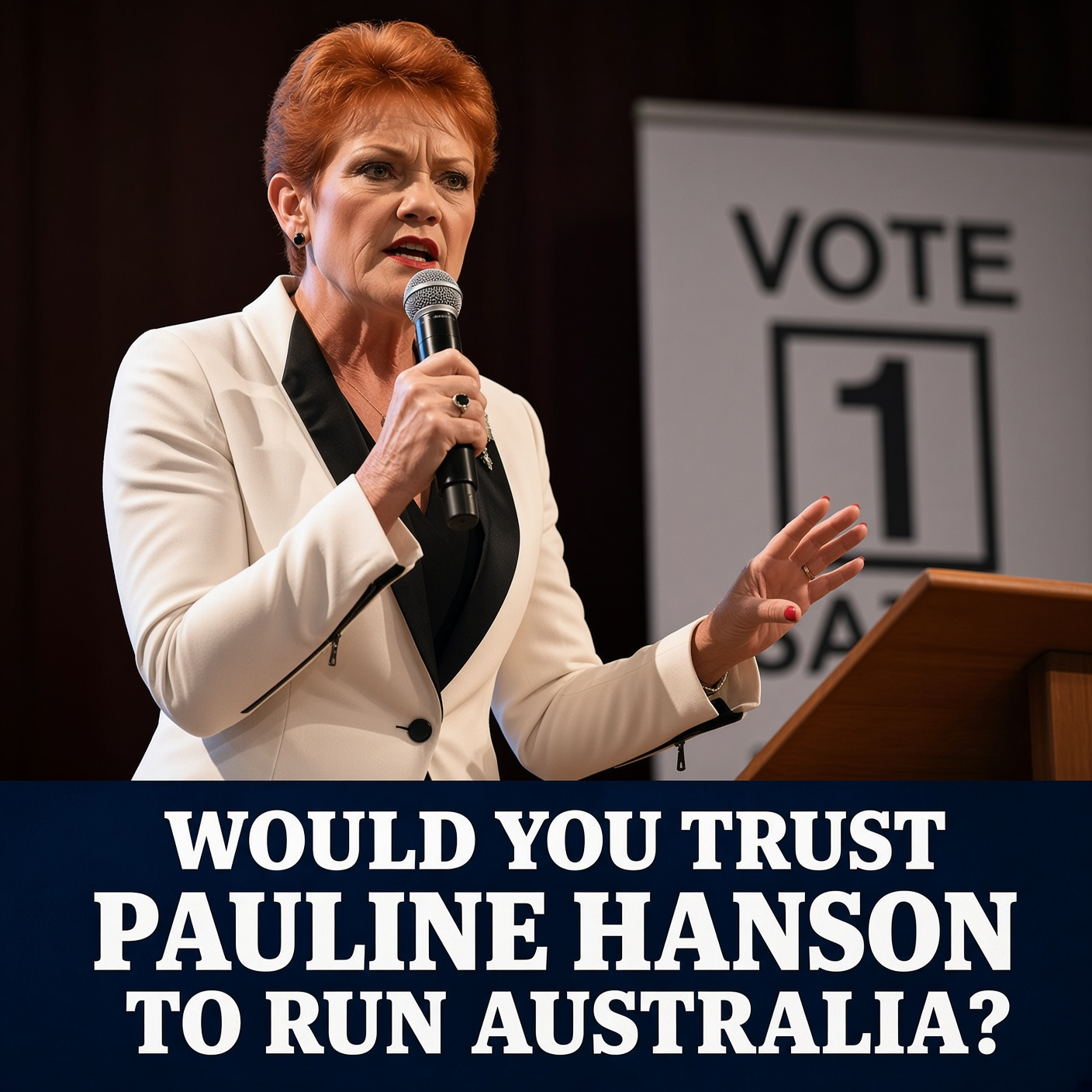
Pauline Hanson has declared she believes she has what it takes to become Australia’s prime minister, using a business breakfast in Perth to present her small-business background as preparation for the country’s top political job while putting immigration, Islam and national identity at the centre of her pitch.
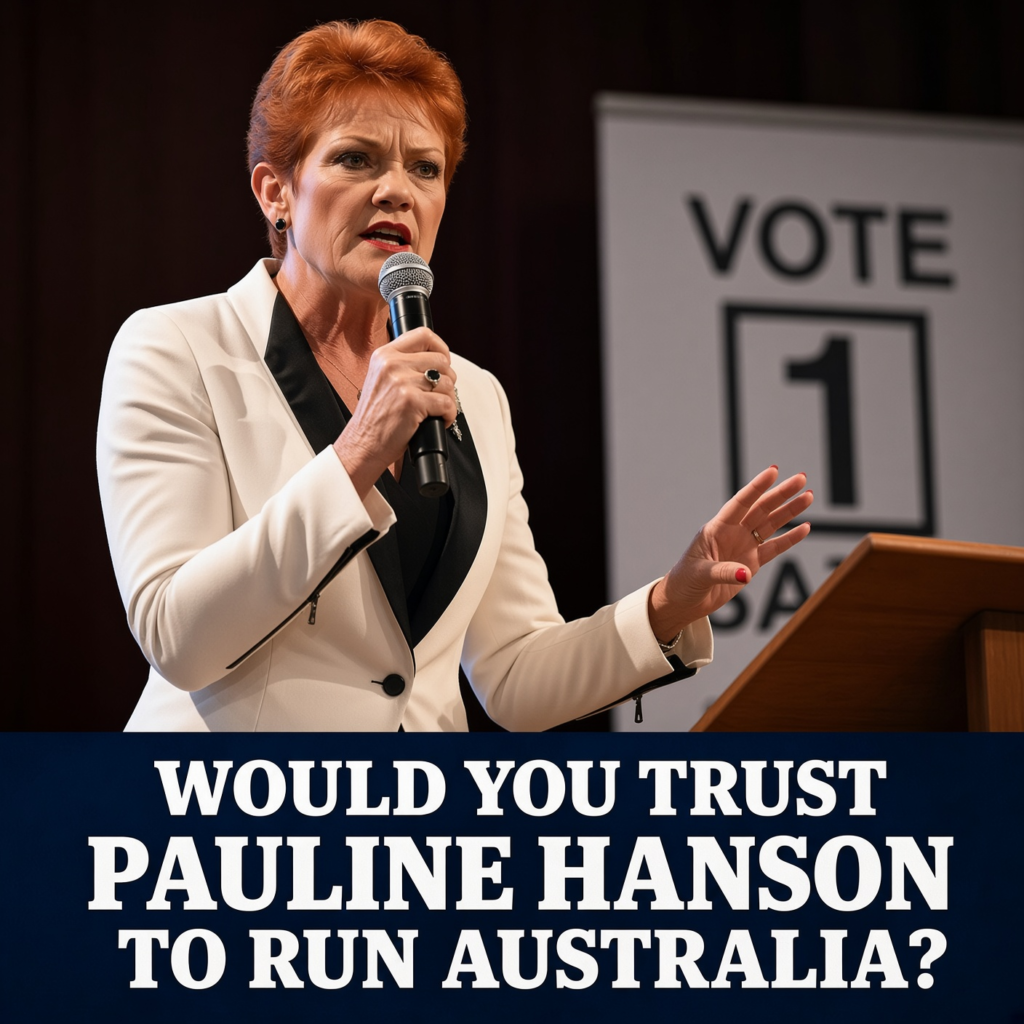
The One Nation leader said she had “no doubt” she could handle the responsibilities of prime minister if Australians gave her party the opportunity to govern.
It was a striking declaration from a politician whose party has spent almost its entire history outside the major-party contest for executive power.
Hanson argued that her experience before entering politics gave her an understanding of Australians and small businesses that many career politicians lacked.
Before becoming one of the country’s most recognisable political figures, Hanson operated a fish-and-chip shop in Queensland and had previously been involved in a plumbing business with her former husband.
She presented that background not as an incidental part of her biography but as a qualification for national leadership.
Running a small business, Hanson argued, meant dealing directly with customers, employees, bills and the consequences of government decisions rather than experiencing the economy primarily through Canberra.
Her argument was characteristically populist: Australia does not necessarily need another prime minister produced by the conventional political system, but someone who understands how ordinary Australians actually live.
“I could do it,” Hanson said when the possibility of becoming prime minister was put to her.
Her declaration comes as One Nation attempts to make a significant transition in Australian politics.
For decades, the party has operated primarily as a vehicle for protest against Labor, the Coalition and policies Hanson believes have been imposed by an increasingly disconnected political establishment.
Its recent rise in support has forced a different question: what would One Nation actually do if it acquired power?
Hanson is increasingly answering it.
She has begun discussing a prospective first 100 days in government, promising major changes to immigration, the NDIS, Net Zero policy and the institutional use of Welcome to Country and Acknowledgement of Country ceremonies.
Her Perth appearance went further by addressing the question of who would lead such a government.
Hanson made clear she sees no inherent reason why that person could not be her.
There remains an enormous distance between strong national polling and forming government under Australia’s electoral system.
Prime ministers are not directly elected by a national popular vote. A government must command the confidence of the House of Representatives, meaning One Nation would need to convert its support into victories across individual lower-house electorates on a scale it has never previously achieved.
But Hanson’s rhetoric illustrates how dramatically the party’s ambitions have expanded.
She is no longer talking only about winning additional Senate seats or holding the balance of power.
She is asking voters to contemplate One Nation as a governing party.
Immigration would sit at the centre of that government.
At the Perth breakfast, Hanson described Muslim migration as the “elephant in the room” and argued Australia should restrict arrivals from countries she considers centres of radical Islam.
She insisted her position was motivated by national security and social cohesion rather than hostility towards individuals solely because of their religion.
“I don’t want people coming to this country from radical Islamic countries,” Hanson said.
The statement immediately created an obvious question: which countries would qualify?
Hanson was pressed on that point during a sometimes heated question-and-answer session.
Her position reflects a longstanding element of One Nation politics.
Hanson has campaigned for years for substantially lower immigration and has repeatedly raised concerns about Islam, integration and whether Australian governments adequately screen people arriving from countries affected by extremism.
But the Perth formulation was narrower than simply declaring that every Muslim should be prevented from entering Australia.
It focused on restricting migration from countries regarded by Hanson as presenting radicalisation or security concerns.
Exactly how a One Nation government would define those countries, what evidence would be used and whether religion itself would become a visa criterion remain important unanswered policy questions.
Australia already conducts character, identity and security checks through its migration and humanitarian systems.
A Hanson government would need to explain what additional legal tests it intended to impose and how they would operate without unlawfully discriminating against applicants.
Hanson also attacked the Albanese government over Palestinians brought to Australia from Gaza.
The issue has become a recurring point of conflict between One Nation and Labor, particularly amid continuing concern over the security screening applied to people leaving the war zone.
Hanson argued that the government had been too willing to admit people from an environment where extremist organisations operate and said Australia should take a much more restrictive approach.
She also criticised demonstrations involving Palestinian flags on Australian streets.
Hanson said she would not have allowed such displays to proceed in the manner seen during protests following the October 7 attacks and the subsequent Gaza war.
That promise raises separate legal questions.
Australian governments do not possess an unrestricted power to prohibit lawful political demonstrations or flags simply because political leaders disagree with their message.
Protest regulation involves state laws, policing powers and protections surrounding political communication.
A prime minister could condemn particular demonstrations or pursue changes to relevant federal laws, but could not simply personally prohibit every Palestinian flag at a protest across the country.
The distinction between Hanson’s political objective and the legal mechanism required to implement it will become increasingly important if One Nation continues presenting itself as a government-in-waiting.
The Perth appearance also forced Hanson to confront another controversy: her recent European trip.
She defended travelling to Britain and meeting controversial activist Tommy Robinson, arguing politicians should be prepared to speak with people outside the conventional political establishment.
Robinson, whose real name is Stephen Yaxley-Lennon, has been one of Britain’s most prominent anti-Islam activists and has a lengthy history of controversy and criminal convictions.
Hanson interviewed him while in the United Kingdom.
She defended that decision as part of an effort to understand what she believes Australia can learn from Britain’s experience with immigration and social cohesion.
Hanson said Australians were tired of political leaders who only spoke to people who agreed with them.
She portrayed her British visit as an opportunity to examine the consequences of government decisions on migration, public spending and energy policy rather than relying solely on official accounts.
The interview with Robinson nevertheless attracted considerable criticism.
During the discussion, Hanson revisited immigration and the history of the White Australia policy, prompting accusations that she was romanticising a racially discriminatory period in Australian policy.
Those remarks followed her back to Perth.
Asked at the breakfast whether she supported returning to the White Australia policy, Hanson resisted the characterisation and became involved in a heated exchange over what she had actually said.
The controversy illustrates a persistent problem for One Nation as it tries to broaden its appeal.
The party wants immigration to be debated primarily in terms of numbers, security, housing, infrastructure and cultural integration.
But Hanson’s own history means her statements about race and Islam inevitably attract scrutiny extending far beyond those policy questions.
That scrutiny will intensify rather than diminish if she seriously presents herself as a potential prime minister.
Prime ministers are responsible not merely for domestic policy but for Australia’s diplomatic relationships, national security apparatus and representation abroad.
A Hanson government would therefore have to translate political rhetoric about “radical Islamic countries” into diplomatic and immigration policies capable of operating across relationships with Muslim-majority nations throughout Southeast Asia, the Middle East and beyond.
Indonesia, Australia’s enormous northern neighbour, is the world’s largest Muslim-majority country and one of Canberra’s most important strategic partners.
Malaysia is another major regional partner.
Gulf states are important trading and investment relationships.
That does not prevent Australia from imposing strict security requirements on migrants from countries where terrorism is a concern.
But it demonstrates why defining policy through broad religious or geographical categories can become much more complicated once a party moves from campaigning to governing.
Hanson’s Perth speech was significant precisely because she appeared willing to embrace that transition.
She repeatedly returned to her belief that conventional politicians do not understand the consequences of their decisions for ordinary people.
Her small-business experience is central to that political identity.
Hanson left school as a teenager and spent much of her working life outside professional politics before entering federal parliament in 1996.
She worked in family businesses, helped operate a plumbing and construction enterprise and later ran a fish-and-chip shop in Ipswich.
That shop became one of the defining symbols of her first political rise.
Critics have long used it to question whether she possessed the sophistication required for national office.
Hanson turns the same biography into the opposite argument.
She says dealing with suppliers, wages, customers and everyday financial pressures provides exactly the sort of practical experience Canberra needs.
It is a message with obvious resonance during a cost-of-living crisis.
Small businesses have faced rising wages, electricity bills, insurance premiums, rents and borrowing costs while households have struggled with many of the same pressures.
One Nation is attempting to connect that frustration with its broader argument against high immigration, government expenditure and Net Zero policies.
Hanson’s pitch is that Canberra has made life unnecessarily expensive because decision-makers are insulated from the consequences of their policies.
Whether her own economic prescriptions would produce better outcomes is a separate question and one that would receive much more detailed scrutiny if One Nation moved closer to government.
But the political proposition is clear.
Hanson wants voters to regard her lack of a conventional political résumé as an asset rather than a weakness.
The same outsider narrative shapes her defence of Gina Rinehart.
Hanson used the Perth event to praise the mining billionaire and reject criticism of their increasingly close relationship.
She argued Rinehart should be recognised for the jobs, taxes, royalties and investment generated through her mining interests, particularly in Western Australia.
Hanson described her as intelligent, successful and patriotic.
She also rejected the suggestion that friendship with Australia’s richest person was incompatible with One Nation’s appeal to ordinary Australians.
In Hanson’s telling, Rinehart is not part of an elite exploiting the country but an Australian entrepreneur whose businesses create wealth for it.
The relationship has nevertheless become one of the most scrutinised alliances in Australian politics.
Rinehart has provided substantial support to Hanson and One Nation, including assistance with travel and a campaign aircraft.
The mining magnate has also hosted Hanson socially and discussed political issues with her.
Those links created immediate questions when Hanson returned from her latest European trip.
At the Perth breakfast, she was repeatedly asked who had paid.
Hanson’s initial defence concentrated on one point: Australian taxpayers had not funded it.
She said the trip had not cost taxpayers “one cent”.
Subsequent disclosures have provided a more complete picture.
One Nation has acknowledged that party funds paid for Hanson’s luxury London accommodation after a proposed arrangement with Channel Seven’s Spotlight program collapsed.
Hanson stayed at the five-star Conrad London St James, where reported rates were around $900 a night.
The party says those expenses did not come from money raised through its “Fire the Liar” crowdfunding campaign and were instead covered through investment income associated with party funds.
Hanson has also confirmed that Rinehart paid for flights taking her from London to Italy, where she attended a Dolce & Gabbana fashion event in Sicily at the billionaire’s invitation.
Hanson said she paid for her own Italian accommodation and meals.
That means her claim that the European trip did not cost taxpayers money can coexist with the fact that other people and organisations helped finance parts of it.
“Not taxpayer-funded” is not the same thing as “entirely self-funded”.
There is no contradiction between those two facts.
The political argument concerns whether party and donor support for luxury overseas travel is consistent with One Nation’s anti-establishment identity.
Hanson sees no reason to apologise.
She argues political parties legitimately spend money on political activities and that Rinehart is entitled to support politicians and causes she believes in.
Her opponents argue the relationship complicates One Nation’s claim to represent ordinary Australians against powerful elites.
That dispute will become increasingly important if Hanson’s prime ministerial ambitions are to be taken seriously.
A minor-party senator can defend accepting assistance from a wealthy supporter principally as a disclosure and political-optics issue.
A prospective prime minister faces broader questions about access, influence and whether major donors receive privileged opportunities to shape policy.
Hanson has acknowledged speaking with Rinehart about policy.
She does not regard that as improper.
Politicians routinely speak with businesses, unions, advocacy groups, charities and donors about government policy.
The accountability question is whether those relationships are properly disclosed and whether public policy is made in the national interest rather than to reward private benefactors.
No evidence from the Perth event established that Rinehart had purchased a particular policy outcome from One Nation.
But the scale and visibility of her support guarantee that questions about influence will follow Hanson as the party grows.
The same growth explains why Hanson’s declaration about becoming prime minister cannot simply be dismissed as another provocative soundbite.
One Nation still faces enormous structural barriers to forming government.
It needs candidates capable of winning individual House seats, local organisations strong enough to support them, sufficient campaign funding and a preference strategy that can survive Australia’s electoral system.
National polling support alone cannot install Hanson in The Lodge.
Nor would a large Senate presence allow her to become prime minister without commanding the lower house.
But Australian politics has changed sufficiently for One Nation to begin behaving differently.
The party is opening branches, recruiting candidates, raising significant money and increasingly presenting detailed positions on what it would do with executive power.
Hanson’s rhetoric has changed accordingly.
She is no longer simply telling Australians what Labor and the Coalition are doing wrong.
She is telling them why she believes she could replace them.
Her case rests heavily on the biography that first made her an unconventional political figure three decades ago: the small-business owner who believes practical experience matters more than credentials accumulated inside political institutions.
Her critics will see that as manifestly inadequate preparation for leading a G20 economy, managing national security and conducting Australian diplomacy.
Her supporters are likely to see precisely the opposite — proof that she comes from outside a political class they no longer trust.
That is the gamble behind Hanson’s increasingly explicit prime ministerial pitch.
Immigration restrictions, tougher national-security policies, lower government spending and a rejection of political conventions remain at its centre.
So does the politician herself.
After 30 years in Australian public life, Pauline Hanson is no longer asking merely to influence the government.
She is asking voters to consider whether she should lead it.