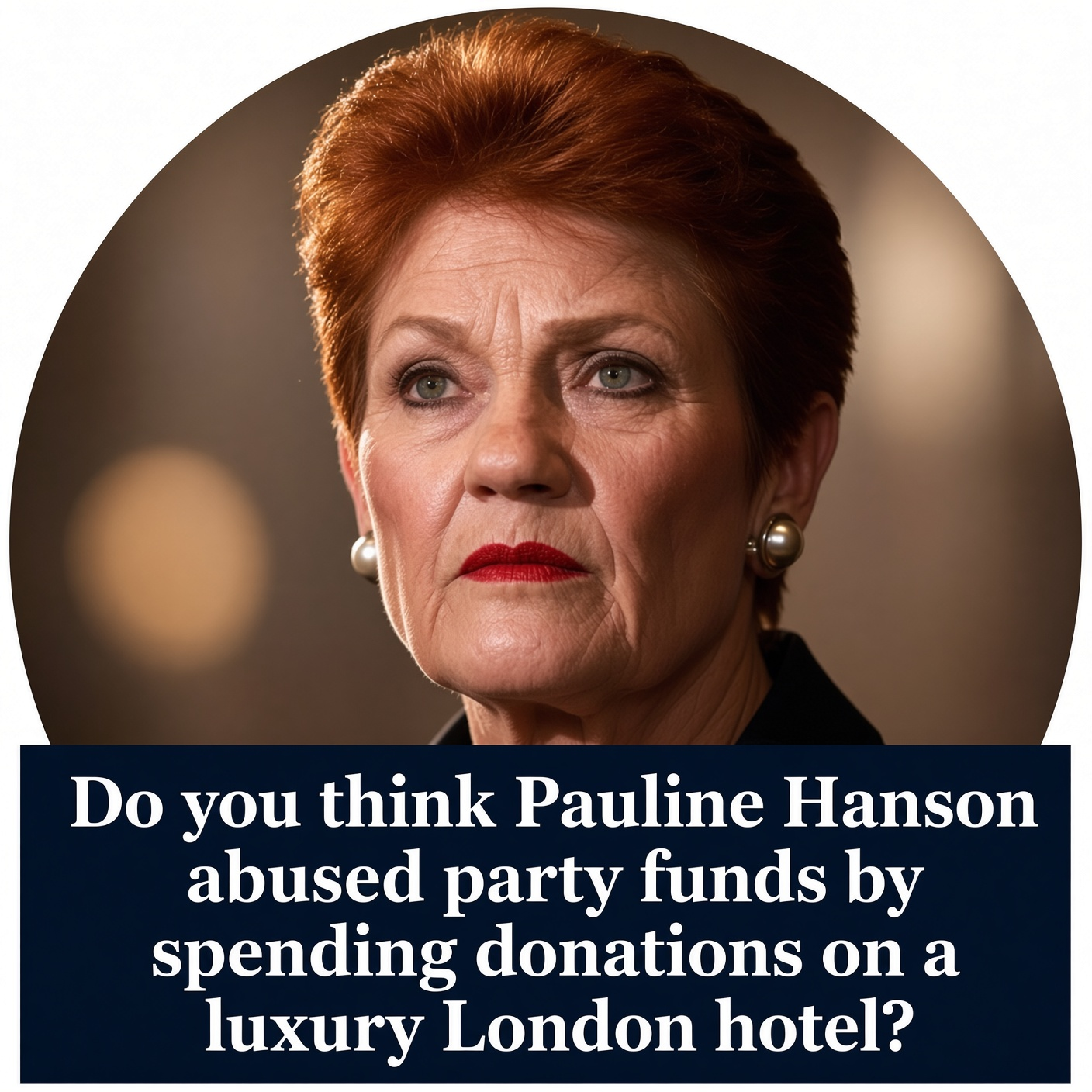
Pauline Hanson has defended One Nation’s use of party funds to pay for a luxury London hotel during her European trip, rejecting claims that an expensive room was left sitting empty while she travelled to Italy to meet mining billionaire Gina Rinehart.
The One Nation leader has confirmed her party paid for accommodation at the five-star Conrad London St James, where reported room costs were about $900 a night, after an arrangement for Channel Seven’s Spotlight program to cover costs fell apart.
Hanson insists taxpayers did not fund the accommodation and says money raised through One Nation’s high-profile “Fire the Liar” fundraising campaign was not used for the trip.
Instead, the party says the expenses were covered using investment income generated from party funds including membership fees and political donations.
The distinction has become central to Hanson’s defence as scrutiny intensifies over exactly how the European trip was financed and what political purpose the spending served.
Hanson has also strongly disputed reports that One Nation continued paying for her London room while she was away in Italy.
She says the booking was cancelled for the relevant period and has pointed to Expedia invoices as evidence supporting her account.
“Nothing but fake news,” Hanson said as she attacked reporting about the trip.
She also turned her criticism towards Spotlight, describing the program as “shady from day one” and arguing that One Nation was left carrying costs after the original television arrangement collapsed.
The controversy is therefore no longer simply about the price of a hotel room. It has become an argument over political-party money, donor expectations, Hanson’s relationship with wealthy supporters and the boundary between legitimate political travel and luxury overseas activity.
The European trip had originally been conceived very differently.
Reporting about leaked Channel Seven documents indicates Spotlight developed plans to film Hanson overseas, including a highly contentious proposal involving the al-Roj refugee camp in north-eastern Syria.
The camp holds families connected with Islamic State fighters and has been the subject of years of debate in Australia over whether Australian women and children detained there should be repatriated.
A leaked risk assessment reportedly detailed significant security and political dangers associated with taking Hanson into the region.
Hanson ultimately did not visit the camp.
The relationship between One Nation and Spotlight subsequently deteriorated, with Hanson’s side maintaining that the broadcaster withdrew its financial support and left the party to cover costs that had originally been expected to form part of the television production.
That explanation is important because it provides One Nation’s justification for why party money became involved.
Hanson’s London activities were not entirely private.
While in Britain, she interviewed controversial British activist Tommy Robinson and attended a conservative political conference.
She had also intended to meet Nigel Farage, although that meeting did not proceed.
Hanson’s interview with Robinson generated controversy of its own.
During their discussion, she blamed the dismantling of the White Australia policy for some of the country’s contemporary immigration problems and spoke approvingly about aspects of Australia’s earlier approach to migration.
The ABC reported on the interview in July, bringing significant domestic attention to comments Hanson made during the overseas trip.
Those activities give One Nation grounds to argue the journey contained a clear political and media component rather than being merely a European holiday.
But Hanson’s separate trip to Italy has complicated that argument.
While travelling in Europe she joined Rinehart in Sicily, where she attended a Dolce & Gabbana fashion show.
Hanson has confirmed Rinehart covered connecting flights associated with that part of the trip, while saying she paid her own accommodation and meals in Italy.
She stayed at the luxury Grand Hotel San Pietro during the Italian visit.
It was the overlap between the London booking and the Italian detour that produced some of the most damaging claims.
Reports alleged the Conrad London St James room remained booked and empty for five nights while Hanson was in Italy.
Hanson flatly denies that account.
She says the London accommodation was cancelled during her absence and has relied on booking documentation to challenge the reporting.
That factual dispute matters.
There is a considerable difference between a political party paying for accommodation required during an overseas political trip and paying thousands of dollars for a luxury room that nobody was using.
Hanson’s position is that the latter did not occur.
One Nation has simultaneously sought to answer another politically sensitive question: whether supporters who donated to its “Fire the Liar” campaign effectively paid for Hanson’s European accommodation.
The campaign has become one of the party’s most visible fundraising operations.
It was built around opposition to Anthony Albanese and Labor and has raised millions of dollars for One Nation’s future campaigning.
According to the party, that money was not used to pay Hanson’s European expenses.
One Nation says the “Fire the Liar” funds have been placed in a term deposit and preserved for future electoral campaigning against Labor.
The party instead says Hanson’s travel expenses came from interest earned on investments funded through other political donations and membership revenue.
That distinction does not mean the London accommodation was privately funded.
Hanson has acknowledged that One Nation money paid for it.
It means the party disputes the more specific allegation that money contributed to the “Fire the Liar” campaign was drawn down to finance her stay.
It is also important to distinguish party funds from taxpayer-funded parliamentary travel.
Hanson says no taxpayer money was used for the London accommodation.
Political parties can receive money from several sources, including membership fees, private donations, fundraising and, in particular circumstances, public election funding.
How party money is subsequently spent can still attract legitimate scrutiny even when the expense is not charged directly to taxpayers.
That is particularly true when politicians aggressively solicit relatively small donations from ordinary supporters while their leaders undertake expensive overseas travel.
Coalition figures have seized on precisely that political vulnerability.
Shadow Treasurer Tim Wilson attacked Hanson over the reports, arguing the episode was inconsistent with the anti-establishment political identity she presents to voters.
Wilson said the luxury accommodation created an image of the “global elite” and described it as a betrayal of the people Hanson claims to represent.
The criticism goes to the heart of the political risk for One Nation.
Hanson has built much of her appeal by presenting herself as an opponent of political elites and as a representative of Australians who believe the major parties have become disconnected from ordinary life.
A five-star London hotel costing about $900 a night creates an obvious line of attack against that image.
Whether the expense was permissible under party rules is therefore only part of the issue.
The political question is whether One Nation supporters believe it was an appropriate use of party resources.
One Nation senator Sean Bell has defended the spending.
He argued that overseas activity undertaken by party representatives should be assessed according to whether it advances One Nation’s political objectives and delivers value to supporters.
Bell said donors should receive “bang for their buck”, effectively presenting the trip as an investment in the party’s political reach rather than a personal luxury.
That defence highlights a broader reality about political-party expenditure.
Parties routinely spend money on activities that do not resemble conventional election advertising.
They fund staff, travel, events, research, media production, fundraising, campaign infrastructure and political networking.
International travel can form part of those activities where politicians meet ideological allies, participate in conferences or generate media content relevant to their domestic political agenda.
The harder question is where legitimate political activity ends and personal benefit begins.
Hanson’s itinerary contained elements of both political engagement and high-end social activity.
Her interview with Robinson was unmistakably political.
A proposed meeting with Farage would also have had a clear political dimension.
The Dolce & Gabbana fashion show with Rinehart sits less comfortably within that description.
Hanson’s friendship with Rinehart makes the Italian component particularly sensitive.
Australia’s richest person has become one of One Nation’s most important high-profile supporters and has provided significant assistance to Hanson and the party.
Earlier in 2026, Rinehart provided One Nation with a Cirrus G7 aircraft valued at about $1 million for campaigning.
Hanson enthusiastically described the aircraft as “sexy”.
The donation attracted considerable attention because it demonstrated the scale of Rinehart’s backing for a party that simultaneously markets itself as a grassroots alternative to the established political system.
Rinehart and Hanson have also travelled together previously, and their relationship extends beyond a conventional donor-politician interaction.
That makes Hanson’s Italian visit politically relevant even where Rinehart rather than One Nation covered particular expenses.
For critics, the relationship creates an apparent contradiction between One Nation’s populist messaging and its leader’s access to one of the wealthiest people in the country.
For One Nation, there is no contradiction.
The party regards Rinehart as a supporter whose views on energy, regulation, investment and national economic policy align with many of its own priorities.
Hanson has openly acknowledged discussing policy with the mining magnate.
The current hotel controversy has brought those relationships back into focus at an awkward moment.
One Nation is enjoying extraordinary political momentum and attempting to transform itself from a minor-party protest vehicle into a credible national alternative to Labor and the Coalition.
That transformation brings greater scrutiny of its finances, organisation and leadership.
A party polling at historically high levels can no longer expect its internal spending decisions to attract the limited attention they might have received when it occupied a smaller position in Australian politics.
Supporters, opponents and regulators will increasingly examine how it raises money, where that money goes and how closely spending aligns with the purposes presented to donors.
The “Fire the Liar” campaign makes those questions particularly important.
Fundraising appeals work by creating a direct relationship between a political cause and a supporter’s contribution.
A person donating a modest amount to defeat Labor may reasonably assume that money will be directed towards electoral campaigning.
One Nation says that is exactly what will happen with those funds.
Its explanation that the money remains in a term deposit is therefore central to rebutting suggestions that the campaign financed Hanson’s luxury accommodation.
But money inside a political organisation is fungible in a broader economic sense, which means scrutiny can extend beyond whether a particular dollar can be traced directly from one fundraising campaign to one hotel invoice.
Voters may instead ask whether the party’s overall resources are being deployed efficiently and consistently with the political case used to attract donations.
That is a question of political judgment rather than proof of wrongdoing.
No evidence presented in the current reporting establishes that Hanson illegally used One Nation funds merely by having the party pay the London accommodation.
Nor does the fact that the Conrad is an expensive hotel establish that the expenditure breached electoral law.
The controversy concerns accountability and political optics as much as legality.
There is also a continuing factual dispute over the accommodation itself.
Reports that a room was left vacant for five nights have been challenged directly by Hanson and One Nation, which say booking records demonstrate otherwise.
Unless that documentary dispute is resolved independently, the allegation should not be presented as established fact.
What is established is that One Nation paid for Hanson’s London hotel after the anticipated Spotlight funding arrangement collapsed.
What is also established is that Hanson travelled separately to Italy, spent time with Rinehart and attended the Dolce & Gabbana event.
The argument is over how those pieces fit together and what they say about the appropriate use of party resources.
The collapse of the Spotlight project adds another layer.
Reporting on leaked correspondence and planning documents indicates Seven had contemplated a far more ambitious television project than a routine interview in London.
The proposed Syria component carried obvious security risks.
Once Hanson refused to proceed with that element and the relationship deteriorated, One Nation says the party was left with expenses arising from travel originally organised in connection with the television production.
If that account is accepted, the decision to use party money for at least part of the remaining political itinerary becomes easier to understand.
It does not automatically settle whether a $900-a-night hotel represented value for money.
That is where Bell’s “bang for their buck” defence will ultimately be tested by One Nation supporters themselves.
Hanson has shown little inclination to apologise.
Instead, she has attacked the reporting, produced her explanation for the London booking and insisted that supporters’ campaign money was protected.
That response is consistent with her broader political style.
Hanson routinely turns controversies involving mainstream media organisations into arguments about whether those outlets can be trusted, a strategy that resonates with supporters already sceptical of traditional institutions.
But dismissing the controversy as media hostility does not remove the underlying accountability question.
One Nation is asking Australians to trust it with substantially greater political power and is raising significant sums from supporters to pursue that objective.
Greater political power inevitably produces greater expectations of transparency.
Hanson’s explanation is now on the record: Channel Seven was originally expected to pay, Spotlight pulled out, One Nation covered the London costs, the “Fire the Liar” money was not touched, and the allegedly empty five-night booking did not exist.
Her opponents have an equally clear argument: a politician who campaigns against elites should expect scrutiny when her party pays for five-star accommodation while she travels through Europe with billionaire friends.
Neither argument changes the central established fact.
One Nation paid for Pauline Hanson’s luxury London accommodation.
The question that remains is not whether the party picked up the bill, but whether its members and donors believe the political value of the trip justified the price.