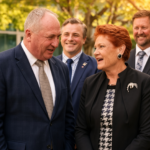
Pauline Hanson and Barnaby Joyce stayed overnight at Gina Rinehart’s Brisbane mansion after a One Nation fundraising event at the property, adding a fresh transparency question to the party’s increasingly visible relationship with Australia’s richest person.
Guardian Australia reported that the stay took place on the night of 12 April, after a fundraiser at Rinehart’s riverside home in Hawthorne. The following morning, Joyce appeared live on Channel Seven’s Sunrise from a room that appeared to be inside the property before he and Hanson later flew from Brisbane to Sydney on a flight provided by Hancock Prospecting.
That flight was subsequently declared in parliamentary interests records. What is less clear is how the overnight accommodation should be treated. Guardian Australia reported that it could not identify a corresponding declaration for the stay at Rinehart’s home, which the publication values at about $20 million.
The absence of an accommodation entry does not, on its own, prove that either politician breached parliamentary rules. Both the Senate and House of Representatives require certain gifts, sponsored travel and hospitality to be disclosed, but the rules also recognise that private social relationships can complicate where the line is drawn. In the Senate’s published guidance, free or concessional accommodation can amount to hospitality, while hospitality provided in a purely social way by friends or colleagues is excluded.
Flights associated with the trip were declared, but the accommodation is where the disclosure question becomes more complicated. The distinction matters because the parliamentary registers are designed to give voters visibility over benefits that could create, or appear to create, a conflict with an elected representative’s public duties. They are not intended to record every ordinary interaction between politicians and their friends.
For senators, sponsored travel or hospitality worth more than $300 is registrable. The Senate’s explanatory notes say hospitality includes free or discounted accommodation supplied by a person, organisation, business, interest group or foreign government. The same guidance says hospitality provided in a purely social way by friends or colleagues does not need to be included.
House of Representatives rules also require members to register sponsored travel or hospitality valued above $300, along with other interests that could foreseeably give rise to an actual or apparent conflict with public duties.
Joyce’s register records a 13 April flight from Brisbane to Sydney provided by Hancock Prospecting, noting that it came at no cost to the taxpayer. Hanson’s register also records a 13 April Brisbane-to-Sydney flight provided by Hancock Prospecting. Those entries establish that the travel itself was treated as registrable hospitality or sponsored travel.
The accommodation is more difficult to assess from the public record alone. The stay followed a fundraising event for One Nation at the same property, which gives the episode an obvious political context. At the same time, both Hanson and Joyce have publicly described Rinehart as a friend, and long-standing friendships can fall within the social hospitality exception depending on the circumstances.
That is why the strongest conclusion supported by the available information is narrower than some of the political rhetoric around the story. There is a legitimate question about how the overnight stay fits within the disclosure regime, but no formal finding cited in the reporting establishes that the accommodation amounted to a breach.
Joyce has defended the relationship with Rinehart on personal grounds. Guardian Australia reported that he described her as a long-term friend rather than someone providing him with commercial accommodation. That explanation goes directly to the issue the rules themselves raise: whether a benefit is political or sponsored hospitality, or simply something offered in a genuinely private social relationship.
The context, however, is what makes the matter difficult to dismiss as an ordinary sleepover between friends. The accommodation followed a political fundraiser, the politicians travelled the next day on a company-provided flight, and Rinehart has become a significant public supporter of Hanson and figures around One Nation.
The Brisbane stay is not the first time the relationship between Hanson, Joyce and Rinehart has attracted attention.
Hanson has previously travelled on aircraft connected with Rinehart and her companies. In late 2025 she travelled to the United States on Rinehart’s private jet and stayed at Rinehart’s Palm Beach property in Florida. Hanson later lodged a declaration recording return flights from Brisbane to Florida provided by Hancock Prospecting and hospitality from Rinehart.
Other flights have also been added to parliamentary registers after scrutiny. In January this year, Hanson and Joyce travelled on Rinehart’s Gulfstream aircraft while visiting flood-affected communities in Queensland. Both politicians argued that privately provided travel could save taxpayers money, while critics said the benefits should still be clearly disclosed so the public could understand the relationship.
The issue is therefore not simply whether a billionaire is allowed to be friends with politicians. There is no rule preventing that. Nor is there anything inherently improper about a politician accepting hospitality that is properly disclosed or that falls within a recognised personal exception.
The public-interest question is whether the cumulative relationship — private travel, political fundraising, accommodation, access and public support — is being disclosed in a way that allows voters to see where personal friendship ends and political assistance begins.
That question has become more important as Rinehart’s support for One Nation has become more visible. Guardian Australia has previously reported on fundraising events connected with the mining magnate and on travel supplied to Hanson and Joyce. Hanson herself has spoken positively about Rinehart’s backing, while Joyce has long had a public relationship with the billionaire.
Rinehart is not merely a wealthy private citizen with no political profile. Through Hancock Prospecting and her personal advocacy, she has been an outspoken participant in national debates over mining, energy, regulation and economic policy. Her political relationships therefore attract scrutiny in the same way that major union, corporate or activist relationships with politicians can attract scrutiny.
Labor senator Murray Watt used the latest reporting to criticise what he described as a lack of transparency around One Nation’s financial and political relationships. That criticism is political, not a formal ruling on the registers, and should be treated as such. Hancock Prospecting has said donations will be disclosed in accordance with applicable laws and reporting requirements.
There is also an important distinction between donations to a political party and benefits provided to an individual parliamentarian. Electoral disclosure laws govern donations and other support to parties. Parliamentary interests rules govern gifts, travel, hospitality and other interests relevant to individual senators and members. The same relationship can engage both systems, but the legal questions are not identical.
That distinction still leaves a broader transparency test. Parliamentary disclosure systems inevitably rely on judgment. The rules cannot list every possible dinner, lift, hotel room, private flight or overnight stay that might arise during a politician’s career. Instead, they set categories and thresholds, then place responsibility on senators and members to determine what should be registered.
The Senate has repeatedly said that individual senators are responsible for interpreting the interests resolutions and deciding which interests fall within them. It also allows senators to declare matters that may not strictly fit a listed category if they believe the public should know about them.
That approach creates flexibility, but it also means public confidence depends heavily on politicians choosing disclosure when circumstances are ambiguous. A benefit does not need to be illegal to be politically significant. Something can fall into a grey area under the rules while still being relevant to voters assessing influence, access and potential conflicts.
The Rinehart stay sits squarely in that grey area. If the accommodation was genuinely provided as private social hospitality between friends, the Senate guidance provides a clear basis for treating it differently from ordinary sponsored accommodation. If the stay was materially connected to a political fundraiser and a broader pattern of political support, the argument for disclosure becomes stronger.
Those are questions that cannot be settled simply by pointing to the estimated value of the house. A night in a $20 million mansion sounds politically dramatic, but the register is concerned with the nature of the benefit and the circumstances in which it was provided, not the headline value of the property alone.
Nor should the fact that the associated flight was declared automatically determine the status of the accommodation. Different parts of the same trip can be treated separately. A parliamentarian may declare sponsored transport while regarding an overnight stay as personal hospitality, although that distinction is open to public and political scrutiny.
For One Nation, the story is potentially more significant because it feeds into a broader argument about the party’s image. Hanson has spent decades presenting herself as an outsider willing to challenge political and corporate elites. Her opponents are likely to use Rinehart’s support to argue that the party now enjoys relationships with some of the most powerful business interests in the country.
Supporters will make the opposite case: that receiving private support does not make a politician controlled by the person providing it, and that transparent declarations allow voters to judge those relationships for themselves.
That is precisely why the registers matter. They do not exist to declare someone guilty of corruption. They exist to put potentially relevant interests on the public record so that journalists, political opponents and voters can make informed judgments.
At this stage, the key facts are straightforward. Guardian Australia says Hanson and Joyce stayed at Rinehart’s Brisbane property after a One Nation fundraiser. Parliamentary records show that the next day’s Hancock Prospecting-funded flights were declared. The publication says it could not find a matching declaration for the accommodation. Parliament’s rules require certain sponsored hospitality above $300 to be registered, while Senate guidance also excludes hospitality provided purely socially by friends or colleagues.
What remains unresolved is which side of that line the Brisbane stay falls on. Unless parliamentary authorities, the politicians involved or updated registers provide further clarification, the issue is likely to remain one of transparency and judgment rather than a settled finding of wrongdoing.