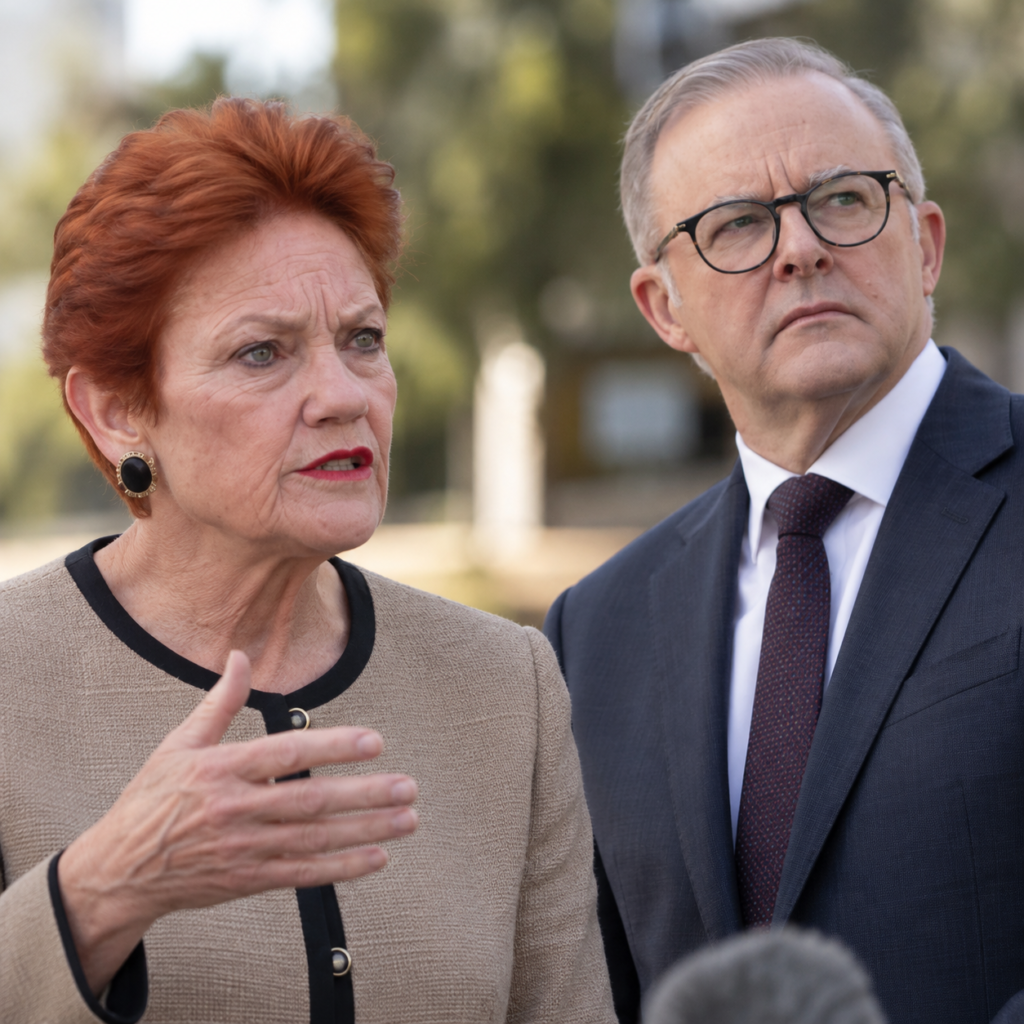
Anthony Albanese has delivered an unusually personal rebuke of Pauline Hanson, declaring his late mother was “way out of Pauline Hanson’s league” after the One Nation leader criticised her for spending decades in public housing.
The Prime Minister said he was “stunned” by Hanson’s remarks and accused her of displaying “nastiness” and “spitefulness” by bringing his mother, Maryanne Ellery, into an argument over social housing.
“If Pauline Hanson wants to criticise me, then that’s fine,” Albanese told reporters on Sunday.
“But my mother was way out of Pauline Hanson’s league. Way out of it.”
His response followed the resurfacing of a February interview in which Hanson attacked Albanese’s repeated references to growing up in public housing and questioned why his mother had remained in the system for decades.
Hanson argued that housing commission homes should be a temporary safety net rather than somewhere people remain for 30 or 40 years.
People should receive a “hand up”, she said, before making way for another household in need.
She also described Albanese’s frequent references to his working-class childhood as “pathetic”.
The Prime Minister strongly rejected the suggestion that he had ever been ashamed of, or complained about, his upbringing.
“I’m proud to be a houso, and I’m proud of the community in which I grew up,” he said.
He returned to a theme he used during the last federal election campaign: that kindness should not be mistaken for weakness.
“Tell you what’s weakness — it’s nastiness. Nastiness. And spitefulness.”
Albanese then gave an extended account of his mother’s life, drawing a sharp contrast between her character and the politics he accused Hanson of practising.
“She never complained. She never denigrated anyone. She respected everyone, and I grew up in a community that looked after each other,” he said.
He described Maryanne as “compassionate, not uncaring”, “generous, not mean” and “kind, not nasty”.
The comments were strikingly personal by the standards of an ordinary political press conference.
For Albanese, however, his mother’s story has always been inseparable from his own.
He was raised by Maryanne in public housing in Camperdown in Sydney’s inner west.
She was a single mother at a time when having a child outside marriage carried far greater social stigma than it does today.
Albanese has previously described how, as a child, he was initially told his Italian father had died in a car accident rather than being told the circumstances in which his parents met and separated.
Maryanne devoted herself to raising her son.
Albanese said she worked cleaning offices overnight before worsening rheumatoid arthritis eventually made regular work impossible.
The illness became profoundly disabling.
On Sunday, Albanese recalled that his mother reached a point where she could not properly use a knife and fork and struggled to walk downstairs.
She became an invalid pensioner and depended on public housing for long-term security.
“She had a tough life,” Albanese said.
Yet he said her attitude remained that “there’s always someone worse off than yourself”.
Maryanne died in 2002 at the age of 65.
Albanese has said she spent all 65 years of her life in the same public housing property in which she had been born.
That fact became central to Hanson’s criticism.
For Hanson, it illustrated what she believes is wrong with a system in which a scarce public asset can remain occupied by one household for decades while others wait for help.
For Albanese, it demonstrates precisely why social housing exists.
His mother was not someone who had become wealthy and simply refused to surrender a subsidised home.
By his longstanding account, she lived with severe disability, limited income and little realistic capacity to secure equivalent housing on the private market.
Those competing interpretations explain why a legitimate argument over housing policy has become such an intensely personal political fight.
There is no question that NSW has a serious shortage of social housing.
As of July 31, there were 70,244 applicant households on the NSW Housing Register.
Of those, 13,776 were priority-approved applicants and 56,468 were on the general list.
That shortage inevitably raises difficult questions about who receives a home, how long they remain there and when government should reassess their eligibility.
But the current NSW system is more complicated than the choice between lifetime housing and an arbitrary deadline.
Most new Homes NSW tenants are offered fixed-term leases of two, five or 10 years.
Before a lease expires, officials review whether the household remains eligible for public housing.
Factors include income, household circumstances, age and medical or disability needs.
If a tenant remains eligible, a further lease can be offered.
If they are no longer eligible, they can ultimately be required to leave.
There are also older continuous tenancies created under previous arrangements.
Homes NSW policy specifically recognises that tenants housed before July 2005 can retain continuous-tenancy rights in certain circumstances.
Maryanne’s tenancy began decades before the modern fixed-term system.
Judging the administration of her home as though today’s review framework operated throughout her lifetime would therefore be historically misleading.
The policy question Hanson raises is nevertheless real.
With more than 70,000 NSW households waiting for social housing, governments have a responsibility to make sure heavily subsidised homes continue to serve people with genuine need.
Current policy already attempts to do that through eligibility reviews.
What Hanson has not established is that Maryanne Albanese would have failed such a needs-based test.
Her severe disability and dependence on a pension would have been highly relevant considerations in any modern assessment.
That distinction has shaped the political reaction.
Trade Minister Don Farrell said criticism of Albanese should not extend to a mother who died more than two decades ago.
“Attacking somebody’s mother, I think, is appalling,” Farrell said.
He accused One Nation of bringing a “bitterness” into Australian politics that he regarded as un-Australian and said Hanson should apologise.
The criticism has not been confined to Labor.
Liberal frontbencher Andrew Hastie, who is already engaged in a bitter dispute with Hanson over a One Nation cartoon that repeatedly labelled him a “traitor”, said political families should be off limits.
“I don’t think you should be talking about the late mother of anyone in this game,” Hastie said.
“I know the Prime Minister loves his mum. I love my mum.”
His conclusion was simple: “Mums, you leave out of politics.”
Hastie said the episode reinforced his view that Hanson was not fit to become prime minister.
It was a notable intervention from a politician who is otherwise one of Albanese’s most direct ideological opponents.
Hastie has spent recent days attacking the Prime Minister and Labor on national security, immigration and economic policy.
But he drew a distinction between attacking Albanese’s political record and attacking the circumstances of the woman who raised him.
Energy Minister Chris Bowen has made a similar argument, previously accusing Hanson of crossing a basic line of decency by criticising somebody who had been dead for more than two decades and could not respond.
Barnaby Joyce has taken a different view.
Joyce has defended Hanson by arguing that her essential point concerns the allocation of public housing rather than Maryanne’s personal character.
He says politicians should be able to ask whether a system intended to help those in need should allow people to remain in the same property indefinitely.
But Joyce has also acknowledged he did not know the full circumstances of Albanese’s mother.
That concession matters.
Public housing eligibility has always depended not merely on how many years a person has occupied a home but on why they need it.
Disability, poverty, age and the absence of reasonable alternatives can all transform a lengthy tenancy from an example of system failure into an example of the system doing exactly what it was created to do.
For Albanese, his mother’s experience belongs firmly in the second category.
The story has long been central to his political identity.
He has repeatedly said growing up in council housing taught him that public institutions could provide stability without determining how far a child could go in life.
His rise from a two-person household dependent on a disability pension to the prime ministership has become one of Labor’s most frequently used narratives about social mobility.
That undoubtedly makes it politically useful.
It also makes it fair for opponents to scrutinise policies Albanese connects to that story.
But criticism of a political narrative is different from implying that his disabled mother personally remained in public housing for too long.
That was the distinction Albanese sought to draw on Sunday.
He did not present his mother as somebody demanding sympathy.
He presented her as somebody who endured circumstances she did not choose without becoming resentful of others.
“She never complained,” he said.
That line also answered another part of Hanson’s attack: the suggestion that Albanese constantly complains about where he came from.
His argument is the opposite.
He says he invokes his public housing background because he is proud of it.
“I’m proud to be a houso,” he said.
The confrontation comes at a politically significant moment.
One Nation is applying increasing pressure to both major parties over immigration, housing affordability and cost-of-living concerns.
Hanson’s argument that scarce public housing should turn over more quickly is likely to appeal to Australians facing years on waiting lists or struggling in the private rental market.
But attacking the individual circumstances of a disabled single mother carries an obvious political risk.
One Nation has sought to cast itself as the party willing to defend working-class Australians who feel abandoned by the political establishment.
Long-term social housing tenants, disability pensioners and single-parent households are themselves among the groups most exposed to economic insecurity.
The result is a tension Hanson will need to resolve if she continues pursuing the argument.
She can make the case for stricter social-housing eligibility reviews without arguing that every long tenancy represents unfairness.
The latter claim would ignore the reason social housing exists in the first place: some people remain in genuine need for many years.
Albanese has made clear that, in his view, his mother was one of them.
He also made clear that attacks on her will produce a very different response from attacks on him.
Politicians routinely describe opponents as incompetent, dishonest or unfit for office.
Albanese is accustomed to that.
On Sunday, however, the argument was no longer merely about Labor and One Nation.
It was about a woman who cleaned offices at night, raised a son alone, lived with crippling arthritis and died more than two decades before he became prime minister.
Hanson believes her housing history illustrates a policy failure.
Albanese believes it illustrates the dignity and security public housing can provide to somebody with nowhere else to go.
And in delivering his answer, he made one boundary unmistakable.