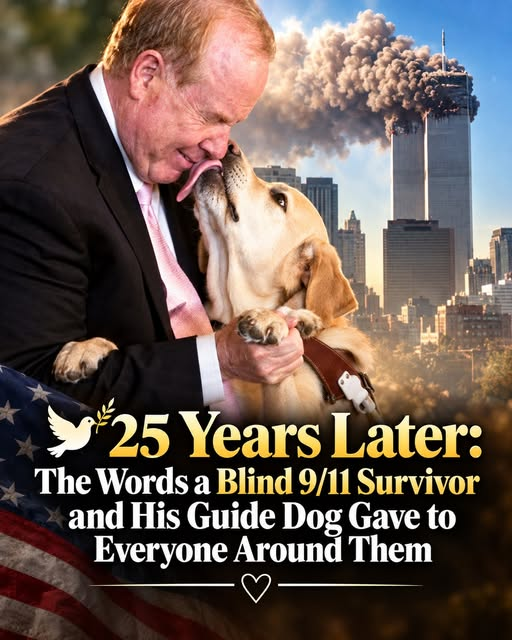
NEW YORK — Nearly 100 stories above Lower Manhattan, the North Tower of the World Trade Center suddenly shuddered and began to sway. Michael Hingson, blind since birth, was standing in the doorway of his office on the 78th floor when he heard what sounded like a muffled explosion and felt the building move beneath him. Across the room, his colleague David Frank grabbed onto a desk as both men briefly feared the tower was about to fall. “David and I actually said goodbye to each other,” Hingson recalled, “because we thought we were going to take a 78-floor plunge to the street.”
While fear spread through the office, Hingson’s yellow Labrador guide dog, Roselle, had been sleeping beneath his desk. As the building began to steady itself, Frank spotted fire and smoke above them and shouted that they needed to leave immediately. It was the morning of September 11, 2001, and American Airlines Flight 11 had just crashed into the North Tower at 8:46 a.m. At that moment, Hingson and the others around him still had no idea of the enormous tragedy unfolding across New York City.
Hingson, then a regional sales manager for a computer-storage company, had been preparing with Frank to lead a seminar that morning. He quickly called his wife, Karen, at their home in Westfield, New Jersey, told her there had been an emergency and then checked the office to make sure no colleagues had been left behind. Once they knew the area was clear, Hingson, Frank and Roselle entered the stairwell and began the long journey toward the ground. Roughly 15 floors above them, the tower was already being consumed by the aftermath of the crash.
The stairwell quickly filled with people, making it difficult for Roselle to guide Hingson in the way she normally would. Sometimes she walked beside him and helped him navigate obstacles, but when the space became too tight, she stayed close to his heel while Hingson held the railing and continued downward. He trusted her completely, but Hingson has always been careful about how he describes their relationship. “The dogs don’t lead,” he explained. “They guide.”
As they descended, Hingson repeatedly spoke to Roselle in the same calm voice she had heard countless times before. “Good dog, Roselle. You’re doing a great job,” he told her, knowing she could sense the fear of hundreds of people packed into the stairwell. Hingson believed that if he remained calm, Roselle would understand that they simply needed to keep doing what they had been trained to do. In the middle of one of the most frightening situations imaginable, their years of trust suddenly mattered more than ever.
About 10 floors into the evacuation, a woman behind them stopped and said she could no longer breathe or continue. Rather than simply moving on, Hingson turned back to help her, and for a moment several strangers came together in what he later described as a group hug on the stairs. Roselle offered comfort in her own way, licking the frightened woman before everyone resumed their descent. It was a small moment of compassion unfolding inside a building where no one yet knew how much time remained.
By approximately the 50th floor, the pressure was beginning to overwhelm Frank. “Mike, we’re going to die,” Hingson remembered him saying. “We’re not going to make it out of here.” Hingson refused to let the fear take control and answered with the words that would become one of the defining memories of their escape: “Stop it, David. If Roselle and I can go down these stairs, so can you.”
Something changed after that exchange. Frank moved about a floor ahead and began calling back descriptions of what he could see, giving Hingson information about what awaited them below. Hingson later believed Frank’s calm voice may also have helped other evacuees within earshot keep moving instead of surrendering to panic. Floor after floor, the three continued toward the ground while thousands of people elsewhere in the complex were also desperately trying to escape.
Then they began passing firefighters heading in the opposite direction. While civilians moved downward toward safety, first responders climbed toward the smoke and destruction above, and Hingson estimates that roughly 50 firefighters passed his group during the descent. When people asked whether they could help, the firefighters told them to keep going down and get outside while emergency crews handled what was happening upstairs. By the end of that day, 343 New York City firefighters would be among those killed.
After descending dozens of floors, Hingson finally reached the lobby, where an FBI agent directed him, Roselle and Frank away from the World Trade Center complex. They crossed Broadway, and for a brief moment it seemed that the worst part of their ordeal might finally be behind them. Then a police officer suddenly screamed for everyone to run because the South Tower was coming down. Hingson could not see the collapse approaching, but he would never forget the sound, describing it as a terrifying combination of “a freight train and a waterfall.”
Everyone around them began running, and for a moment Hingson wondered how they could have escaped one tower only to potentially be buried by another. Then he recalled hearing a thought clearly in his mind: Don’t worry about what you can’t control. Focus on running with Roselle, and the rest will take care of itself. Hingson concentrated on his dog as they moved through the chaos until Roselle suddenly stopped at the top of a flight of stairs. She guided him downward into a subway station, where they found temporary shelter beneath the streets.
When police eventually told them it was safe to emerge, Hingson, Roselle and Frank returned above ground to a scene almost impossible to comprehend. Frank looked toward where the South Tower should have been and told Hingson that all he could see were enormous pillars of smoke rising hundreds of feet into the sky. The tower was gone, but their ordeal was still not over. About 10 minutes later, the North Tower — the building where Hingson had worked and from which they had just escaped — collapsed too.
Hingson and those around him hunkered down as the roar and debris swept through Lower Manhattan. When the noise finally subsided enough for them to stand again, Frank looked around at a skyline that had been transformed within minutes. “Oh my God, Mike, there’s no World Trade Center anymore,” Hingson remembered him saying. “It’s gone.”
Hours later, Hingson finally returned home to New Jersey with Roselle. The Labrador who had remained beside him through 78 floors of evacuation, packed stairwells, frightened strangers and collapsing towers walked into the house, found her favorite toy and began to play. There was no celebration and, at least from Roselle’s perspective, seemingly no reason to continue thinking about what had happened. “For her, it was over,” Hingson recalled. “Nothing threatened her. She was fine.”
In the years after September 11, Hingson moved to California and worked for Guide Dogs for the Blind while speaking to audiences about trust, teamwork and the ability to control fear during a crisis. His 2011 memoir, Thunder Dog, became a New York Times bestseller, while his later book, Live Like a Guide Dog, was published in 2024. Roselle herself was honored with the Award for Canine Excellence in the service dog category in 2002. She died in June 2011 at the age of 14.
Hingson now lives in Victorville, California, with Alamo, his ninth guide dog, but the lessons of that morning with Roselle have never left him. Their survival was not simply the story of a dog leading a blind man out of a burning skyscraper; for Hingson, it was about years of trust allowing them to function as a team when fear threatened to overwhelm everyone around them. “Don’t worry about what you can’t control,” he says. “Focus on the things that you can because if you worry about everything, all you’re going to do is drive yourself crazy.”
Twenty-five years later, that may be the most powerful lesson Hingson carries from the 78 floors he descended beside Roselle. The world around them had descended into unimaginable chaos, but their trust in each other remained intact until they reached safety. “If we allow ourselves to be blinded by fear,” Hingson says, “all we’re going to do is make it harder for ourselves to live.”