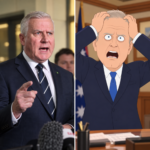
Pauline Hanson has demanded an apology and retraction from Attorney-General Michelle Rowland after accusing the senior Labor minister of “victim-blaming” her over threats of violence directed at the One Nation leader.

The extraordinary dispute has intensified an already bitter argument over the language Australian politicians use about their opponents at a time when police and security agencies are recording increasing threats against elected representatives.
Hanson argues Labor has gone beyond robust political criticism by portraying One Nation as dangerous and linking it with extremist movements.
Rowland says politicians across the spectrum face a genuine security threat but argues Hanson should also examine the rhetoric, associations and standards surrounding her own party.
Neither side has produced evidence establishing that the other’s political statements caused a particular act or threat of violence.
That distinction is important because the argument now sits at the intersection of two separate issues: the right of politicians to strongly criticise political opponents, and the obligation to condemn threats against those opponents without qualification.
What Rowland actually said
The confrontation developed after Prime Minister Anthony Albanese addressed the Queensland Labor State Conference on August 30.
Albanese warned that “hard-right populists” were advancing internationally and accused them of promoting politics he described as dangerous, divisive and dishonest.
He said such movements would bend facts, spread misinformation and turn Australians against each other before adding that parties such as One Nation had no serious answers to the country’s problems.
Hanson responded by accusing the Prime Minister of crossing a line.
She argued that describing political opponents as dangerous could encourage unstable or hostile people to see them as legitimate targets.
Hanson also said the threat environment had become serious enough that she required Australian Federal Police protection while attending public events.
Rowland was then asked directly whether she considered One Nation dangerous.
At a press conference, she said she believed some elements associated with the party were dangerous where they were “recruiting or otherwise giving a platform to extremist views, including neo-Nazi views”.
She also accused One Nation of trading on political division at a time when social cohesion was especially important.
The following morning, Rowland was asked about Hanson saying she felt unsafe.
The Attorney-General began by acknowledging the broader threat.
She said it had become dangerous to be a politician in Australia and particularly dangerous to be a high-profile woman.
She pointed to online algorithms amplifying hate and extremism against politicians on different sides of politics.
But Rowland then turned the argument back on Hanson.
She suggested Hanson examine what her party, ideology and behaviour were doing and whether they were contributing to the environment she was complaining about.
Rowland referred to Hanson’s engagement with controversial figures, including convicted individuals, and alleged that One Nation had been infiltrated by extremists and neo-Nazis.
She stressed that she did not wish physical harm on Hanson or any other politician.
Hanson calls the comments victim-blaming
Hanson responded by demanding Rowland withdraw the remarks.
She accused Australia’s first law officer of appearing to excuse threats against One Nation representatives and supporters.
“Millions of Australians support One Nation. They are not extremists. They are not dangerous,” Hanson said in her response.
She argued that people should be free to vote for One Nation without being treated as morally suspect or as legitimate targets for hostility.
Hanson’s complaint goes beyond a personal demand for an apology.
Her broader argument is that governments have a special responsibility to separate condemnation of a political party’s policies from language that could be interpreted as demonising its voters.
Labor rejects that characterisation.
Its position is that challenging extremist associations or inflammatory rhetoric is part of ordinary democratic accountability and cannot reasonably be equated with encouraging physical violence.
The neo-Nazi claim needs careful qualification
One part of Rowland’s argument requires particular care.
The Attorney-General said Hanson had admitted having a party infiltrated by extremists and neo-Nazis.
Publicly available remarks from Hanson show a more qualified position.
When questioned earlier this year about people with neo-Nazi views supporting One Nation, Hanson acknowledged that fringe supporters could exist but denied they were members of her team or represented the party.
She said she could not control every person who chose to support her policies.
That is materially different from an admission that One Nation as an organisation has knowingly recruited neo-Nazis or accepted them into its formal structure.
Rowland’s criticism should therefore be reported as her allegation and political assessment rather than as an independently established fact about current One Nation membership.
At the same time, Hanson’s associations are legitimate subjects for scrutiny.
She has appeared in an interview with British far-right activist Tommy Robinson, a controversial figure with a history of criminal convictions.
During that interview, Hanson discussed Australia’s immigration history and the end of the White Australia policy, remarks that later attracted significant criticism.
She subsequently denied advocating a return to the White Australia policy.
Whether appearing with controversial figures amounts to “giving a platform” to extremism is ultimately a political judgement. The appearance itself is a matter of record.
The threats against Hanson are not hypothetical
Whatever the political disagreement over responsibility, Hanson has faced genuine threats.
A 47-year-old Perth man appeared in court in August accused of threatening to kill the One Nation leader through Facebook posts.
The man, Anton Raymond Illich, faces charges including using a carriage service to make a threat to kill.
A court heard one alleged post threatened to hunt Hanson down and kill her.
He remains before the courts, and the allegations against him have not yet been finally determined.
The case is important because it demonstrates why political leaders cannot treat threats against opponents as merely rhetorical complaints.
Violent threats against any democratically elected representative undermine more than the safety of one politician.
They can discourage candidates from standing for office, prevent MPs from meeting constituents and narrow the space in which legitimate democratic disagreement can occur.
The threat environment reaches across political lines
Hanson is far from the only politician facing heightened security concerns.
The Australian Federal Police has recorded rising levels of harassment, threats and offensive communications directed at federal parliamentarians and electorate offices.
The AFP recently confirmed the number of reported threats and offensive communications against MPs had increased by more than 10 per cent over the previous year.
Prime Minister Albanese has himself been the subject of multiple alleged violent threats now before the courts.
Politicians from the Coalition, Labor, Greens and crossbench have also reported harassment, intimidation and threats.
Women in public life frequently face an additional layer of sexualised abuse.
Australia’s security agencies have been warning for several years that politically motivated violence is becoming a more serious concern.
ASIO raised the national terrorism threat level to probable in 2024 and warned that more Australians were embracing extremist ideologies and becoming willing to consider violence as a political tool.
That context makes the current political fight unusually sensitive.
It also makes simplistic claims of causation particularly dangerous.
There is no evidence Albanese’s speech caused the threats
Hanson is entitled to argue that senior ministers should consider the possible effect of their language.
But saying Labor’s rhetoric “incited” specific threats requires evidence that has not been established.
Some of the threats against Hanson predate Albanese’s August 30 speech.
The Perth criminal case, for example, concerns alleged conduct from July.
Political violence expert Josh Roose has argued that accusing Albanese’s conference speech of being an incitement to violence goes too far.
The Prime Minister’s language was hostile and deliberately political, but calling an opponent dangerous or divisive is not in itself an instruction or encouragement to attack them.
The same evidentiary standard must apply in the other direction.
Rowland cannot demonstrate that threats facing Australian politicians are caused by Hanson’s conduct simply because she considers some of her rhetoric inflammatory or objects to the people she interviews.
Political speech may contribute to a broader climate without being the direct cause of a criminal threat.
Those are different propositions and should not be collapsed into one.
Both sides are fighting over where democratic criticism ends
The dispute exposes an increasingly difficult problem in Australian politics.
Politicians have every right to make moral arguments about their opponents.
Labor is entitled to say it considers One Nation divisive, wrong or dangerous to social cohesion.
One Nation is equally entitled to accuse Labor of damaging the country, misleading voters or pursuing dangerous policies.
Democracy does not require politicians to sanitise disagreements until every party sounds the same.
But there is also a responsibility to make one boundary unmistakable: political opponents are defeated through elections, parliamentary debate and lawful democratic action, never through intimidation or violence.
That principle should not change depending on who receives the threat.
A death threat against Pauline Hanson is no more acceptable because a person thinks her immigration policies are offensive.
A threat against Anthony Albanese is no more acceptable because a person believes Labor has damaged the economy.
A politician’s rhetoric, history or ideology may be relevant to political criticism. None provides justification for violence.
One Nation’s rise makes the language more consequential
The argument is unfolding as One Nation enjoys some of the strongest political support in its history.
Recent polling has placed the party at or around 30 per cent of the national primary vote, ahead of both Labor and the Coalition in some surveys.
One Nation has also recently converted that momentum into an electoral victory in Western Australia, winning the previously Labor-held state seat of Secret Harbour.
That growth helps explain why Labor is directing considerably more political fire towards Hanson than it did when One Nation was polling in single digits.
It also explains why Hanson is framing the attacks not simply as criticism of herself but as criticism of millions of voters considering supporting her party.
The distinction matters.
A government can attack a party’s policies without suggesting every voter who supports that party shares the worst characteristics attributed to its most controversial associates.
Likewise, One Nation cannot avoid scrutiny of its candidates, rhetoric or associations by claiming every criticism is an attack on its voters.
An apology remains unlikely
There is no indication Rowland has accepted Hanson’s demand for a retraction.
The Attorney-General’s public position remains that One Nation should examine the political environment it helps create, while Hanson maintains that such language amounts to blaming people who are already receiving threats.
The stronger lesson from the dispute is not that either side must stop criticising the other.
It is that Australia is entering a period in which political hostility and genuine security threats are increasingly occurring at the same time.
That makes precision more important, not less.
Extremist associations can be investigated and challenged.
Divisive rhetoric can be criticised.
Politicians can accuse each other of damaging the country.
But threats of violence must be condemned without qualification, while claims that somebody’s words caused violence should require evidence rather than assumption.
Hanson and Rowland disagree profoundly about where responsibility lies for the increasingly hostile political climate.
On one point there should be little room for disagreement: Australians must be able to campaign, vote and argue fiercely about politics without fearing violence because of the party they support.