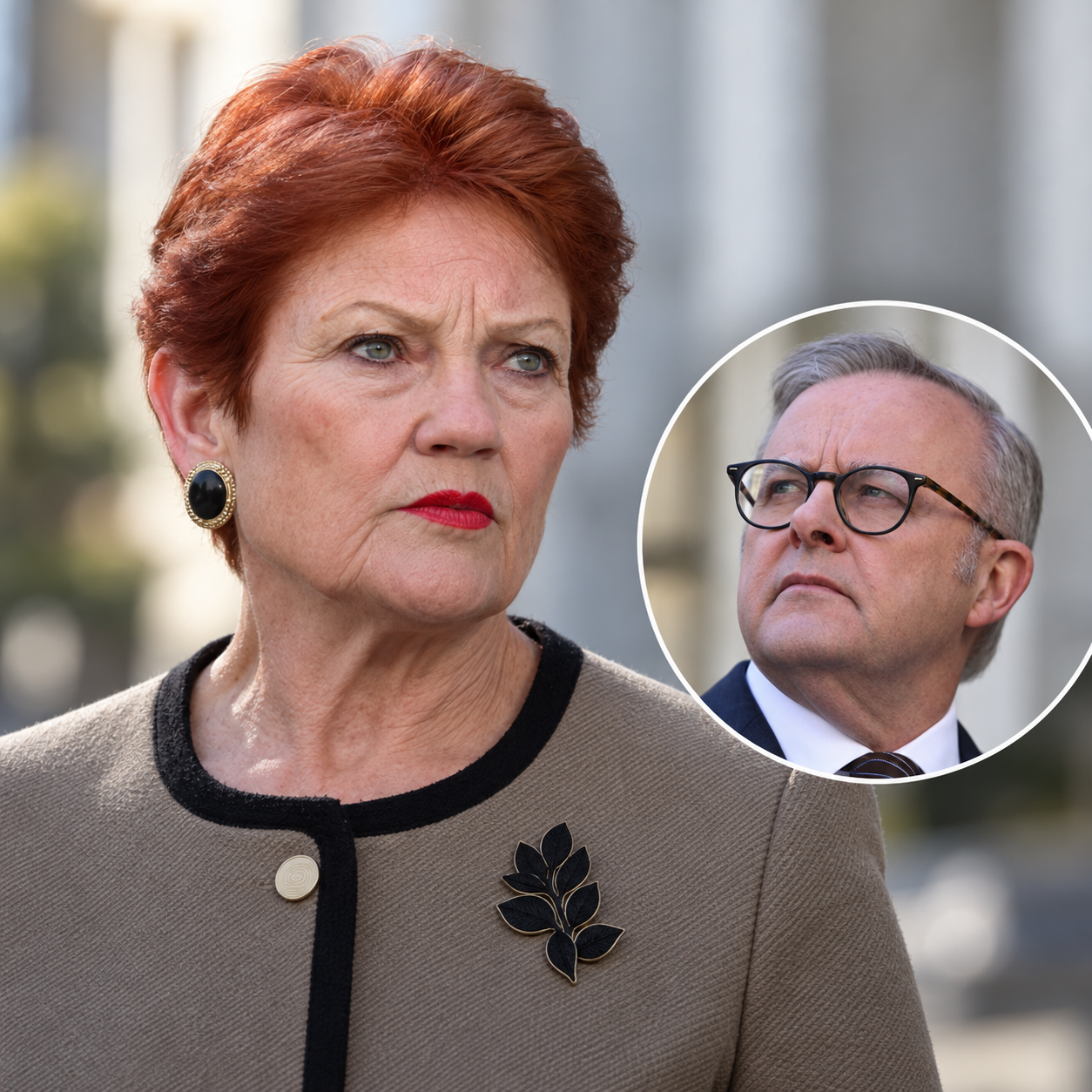
One Nation has surged to the top of a major national opinion poll, overtaking Labor by four percentage points and leaving the Coalition languishing in third place as Australia’s political landscape continues to shift.
The latest YouGov/News24 Pulse poll puts Pauline Hanson’s One Nation on 30 per cent of the primary vote, up four points from the previous survey.
Labor has fallen three points to 26 per cent, while the Coalition has dropped from 21 per cent to 18 per cent.
The Greens remain on 12 per cent, with independents on 7 per cent and other parties and candidates also on 7 per cent.
The national poll was conducted between 1 and 8 September among 1,510 voters, making it the first YouGov wave conducted entirely after One Nation’s emphatic victory over Labor in the Western Australian state seat of Secret Harbour.
The result gives One Nation its strongest lead over Labor recorded in the current YouGov series and matches the party’s previous peak of 30 per cent reached in late June.
For Labor, 26 per cent is its equal-lowest primary result of the current parliamentary term.
One Nation is first on primary vote — but Labor still leads after preferences
The headline number is politically significant, but it needs to be separated from the question of who would actually be most likely to form government.
Australia’s federal electoral system does not award government to the party recording the highest national first-preference vote.
House of Representatives contests are decided seat by seat through preferential voting, with candidates eliminated and preferences distributed until one candidate has a majority.
On YouGov’s respondent-allocated two-party preferred measures, Labor continues to lead both of its principal rivals.
Against One Nation, Labor leads 53 per cent to 47 per cent.
Against the Coalition, Labor leads 52 per cent to 48 per cent.
That means the same poll showing One Nation comfortably ahead on primary support still has Labor ahead in both hypothetical final contests.
The distinction is crucial when interpreting claims that One Nation has become Australia’s “most popular political party”.
It is correct to say One Nation is the largest party by primary vote in this particular poll.
It is not correct to say YouGov shows One Nation leading Labor on the measure most analogous to an election contest after preferences.
A four-point surge after Secret Harbour
The timing of the poll will strengthen One Nation’s argument that its historic Secret Harbour by-election victory was more than a local protest.
Luke Herdegen captured the previously safe Labor seat in Western Australia’s southern Perth suburbs after recording approximately 39 per cent of the primary vote and finishing with more than 57 per cent after preferences.
One Nation took the seat from Labor with a swing of almost 19 percentage points.
The result was particularly significant because Secret Harbour is not a traditional rural One Nation stronghold.
It contains outer-suburban communities, young working families and mortgage holders — exactly the voters both Labor and the Coalition need to compete for at federal elections.
Barnaby Joyce subsequently argued that perceptions of One Nation had “dynamically changed”, saying voters were increasingly treating the party as a serious political choice rather than simply a vehicle for protest.
The latest YouGov result gives that argument additional weight.
One Nation has not merely retained the support recorded before the by-election. It has gained four more percentage points in the first full YouGov survey conducted afterwards.
The Coalition’s 18 per cent is the other major story
One Nation’s rise is only half of the political transformation recorded in the poll.
The Coalition has fallen to 18 per cent of first preferences.
That is only one percentage point above its record low in the YouGov series and leaves the Liberal-National bloc 12 points behind One Nation.
YouGov director of public data Paul Smith said a result of that scale, if translated into an election result, could leave the Coalition with fewer than 11 members in the House of Representatives.
He joked that such a parliamentary party would be smaller than a cricket team.
That should not be interpreted as a literal seat forecast from a simple national primary-vote figure.
Seat outcomes depend on geography, candidate strength, preference flows and how support is distributed across individual electorates.
But the comparison illustrates the scale of the Coalition’s current problem.
Historically, when voters became dissatisfied with a Labor government, the Coalition could expect to capture a large proportion of that support.
The current polling suggests that mechanism has broken down.
Labor is losing primary support, but the Coalition is not benefiting.
Instead, One Nation is absorbing much of the dissatisfaction.
Albanese still leads Hanson as preferred prime minister
The leadership numbers provide another warning against treating the primary-vote result as a direct prediction of who Australians want running the country.
Anthony Albanese continues to lead Pauline Hanson in a head-to-head preferred prime minister contest.
The Prime Minister leads Hanson by 51 per cent to 40 per cent, with 9 per cent unsure.
That margin has narrowed from 52–37 in the previous survey, meaning Hanson has gained ground, but Albanese still holds an 11-point advantage.
Against Opposition Leader Angus Taylor, Albanese leads by a much smaller margin of 43 per cent to 39 per cent, with 18 per cent unsure.
The previous result was 44–37.
Albanese’s personal approval rating is also weak.
YouGov records 36 per cent satisfied with his performance and 59 per cent dissatisfied, giving him a net rating of minus 23.
Taylor is on 36 per cent satisfied and 48 per cent dissatisfied.
The numbers underline the unusual nature of the present contest: the Prime Minister remains preferred over both opposition leaders even while his party has fallen behind One Nation on first preferences.
One Nation also leads on immigration
The YouGov survey contains another result likely to concern both major parties.
Asked which party would be best at managing immigration, 36 per cent nominated One Nation.
Labor and the Coalition were each selected by just 18 per cent.
Immigration has become one of the most politically potent issues of the current term, tied closely to housing shortages, rents, infrastructure pressure and the cost of living.
One Nation has made lower immigration one of its defining positions for decades, while both Labor and the Coalition are under pressure to demonstrate that migration settings are compatible with Australia’s housing and services capacity.
The 36 per cent figure suggests One Nation has established a substantial issue advantage among voters who regard immigration management as a priority.
Another poll tells a slightly different story
One Nation’s strength is now visible across multiple polling houses, but the exact ranking still varies.
Roy Morgan’s most recent federal poll, conducted from 31 August to 6 September with 1,541 voters, recorded Labor on 27 per cent and One Nation on 26.5 per cent.
The Coalition was on 21.5 per cent and the Greens on 14.5 per cent.
That means Labor remained narrowly ahead of One Nation by half a percentage point in Morgan at almost exactly the same time YouGov was recording a four-point One Nation lead.
Morgan also had Labor leading One Nation 53.5 per cent to 46.5 per cent after respondent preferences.
The disagreement between pollsters does not mean either survey is necessarily wrong.
Opinion polls are estimates derived from samples and are affected by methodology, weighting, question structure and random sampling variation.
The more important common finding is that One Nation is now competing around the same level as Labor nationally while the Coalition trails well behind both.
Polling averages show a much tighter contest than one headline poll
A broader polling aggregate provides another useful perspective.
An independent Australian federal polling tracker updated this week places Labor at approximately 27.5 per cent of primary support and One Nation at 27.2 per cent.
The Coalition sits at roughly 21.1 per cent and the Greens at 12.8 per cent.
Those figures combine recent results from multiple polling houses rather than relying on a single survey.
They show that One Nation’s rise is real, but they also demonstrate why it is premature to declare the party conclusively ahead of Labor nationwide.
The aggregate has the two parties virtually tied.
What has changed beyond dispute is the position of the Coalition.
Australia’s traditional centre-right governing bloc is currently polling well below both Labor and One Nation across several major surveys.
One Nation’s challenge is converting votes into seats
The next hurdle for Hanson is far more difficult than winning opinion polls.
One Nation must convert national support into individual House of Representatives seats.
A party polling 30 per cent nationally could theoretically win dozens of electorates if that support is efficiently distributed across competitive seats.
The same party could win far fewer if its vote is spread evenly while Labor and Coalition candidates benefit from preference flows.
This is why seat projections become especially unreliable when a major third party emerges.
The traditional “uniform swing” models used to estimate Labor-versus-Coalition elections were not designed for a political environment in which One Nation could attract close to one-third of first preferences.
Secret Harbour provides an important real-world example that One Nation can win under preferential voting when its primary support is high enough.
But one state by-election is not the same as contesting more than 150 federal electorates simultaneously.
Candidate quality, campaign organisation, preference recommendations and local demographics will all matter.
Labor’s problem is no longer only the Coalition
The latest poll also changes Labor’s strategic challenge.
For most of Australia’s modern political history, a governing Labor Party primarily had to defend itself against a Liberal-National opposition.
That assumption is becoming less reliable.
Labor is now losing working-class and outer-suburban voters to One Nation at the same time as it faces pressure from the Greens and independents in inner metropolitan seats.
If that pattern persists, Labor may be forced to fight on two very different fronts.
In progressive urban electorates it could face competition over climate, housing and social policy.
In outer suburbs and regional Australia it could face One Nation campaigns focused on immigration, cost of living, energy, crime and distrust of political institutions.
The Secret Harbour result showed how damaging that second threat can become when Labor’s vote collapses and One Nation rather than the Liberals becomes the principal beneficiary.
For the Coalition, the threat may be existential
The Coalition’s dilemma is arguably even more serious.
One Nation is competing directly for voters who once formed the Liberal and National parties’ conservative base.
That creates difficult choices over policy and preference strategy.
Moving towards One Nation on immigration, energy or cultural issues could help recover some voters while alienating moderates in metropolitan electorates.
Rejecting One Nation more aggressively could make it harder to win back conservative voters who now regard Hanson’s party as their first choice.
The latest polling suggests the Coalition cannot simply wait for Labor’s popularity to fall.
Labor has fallen three points in YouGov and the Coalition has fallen with it.
One Nation is the party that has gained.
Is One Nation now Australia’s most popular party?
According to the latest YouGov/News24 Pulse primary-vote question, yes.
One Nation leads with 30 per cent, ahead of Labor on 26 per cent, the Coalition on 18 per cent and the Greens on 12 per cent.
That is a real and politically significant result.
But the broader answer requires qualification.
Roy Morgan still has Labor marginally ahead. Polling averages put Labor and One Nation virtually level. Labor continues to beat One Nation after preferences in the latest YouGov survey, and Albanese remains clearly preferred over Hanson as prime minister.
The strongest conclusion is therefore not that One Nation has definitively replaced Labor as Australia’s dominant political party.
It is that Australia’s old two-party hierarchy has been disrupted.
One Nation is now capable of leading national polls, winning previously safe metropolitan seats and competing with Labor for first place in aggregated primary support.
The Coalition, meanwhile, is increasingly fighting not merely to return to government but to avoid being displaced as the principal force on the Australian right.
If the numbers remain anywhere near these levels as the 2028 election approaches, the next federal campaign may look unlike any Australia has seen in generations.