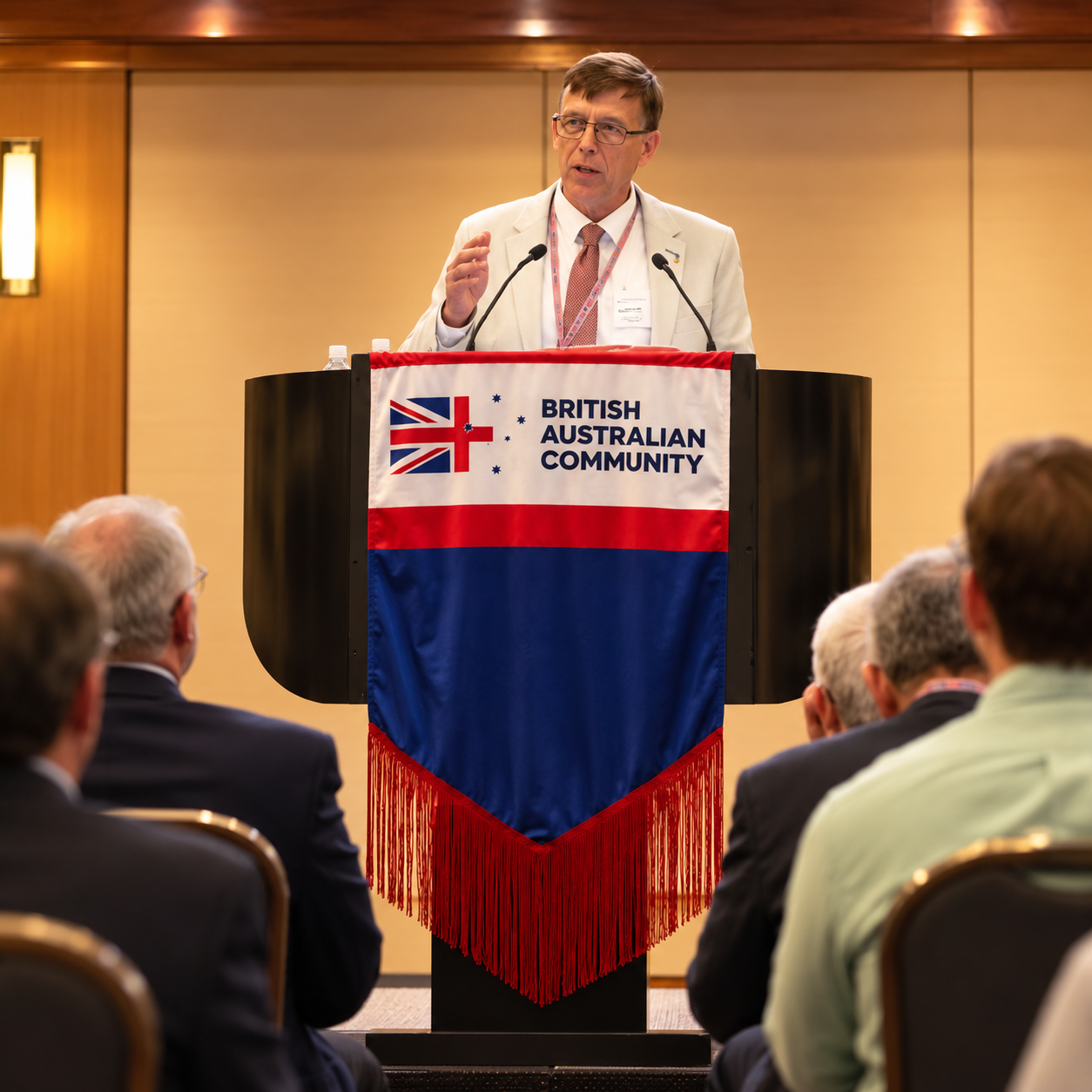
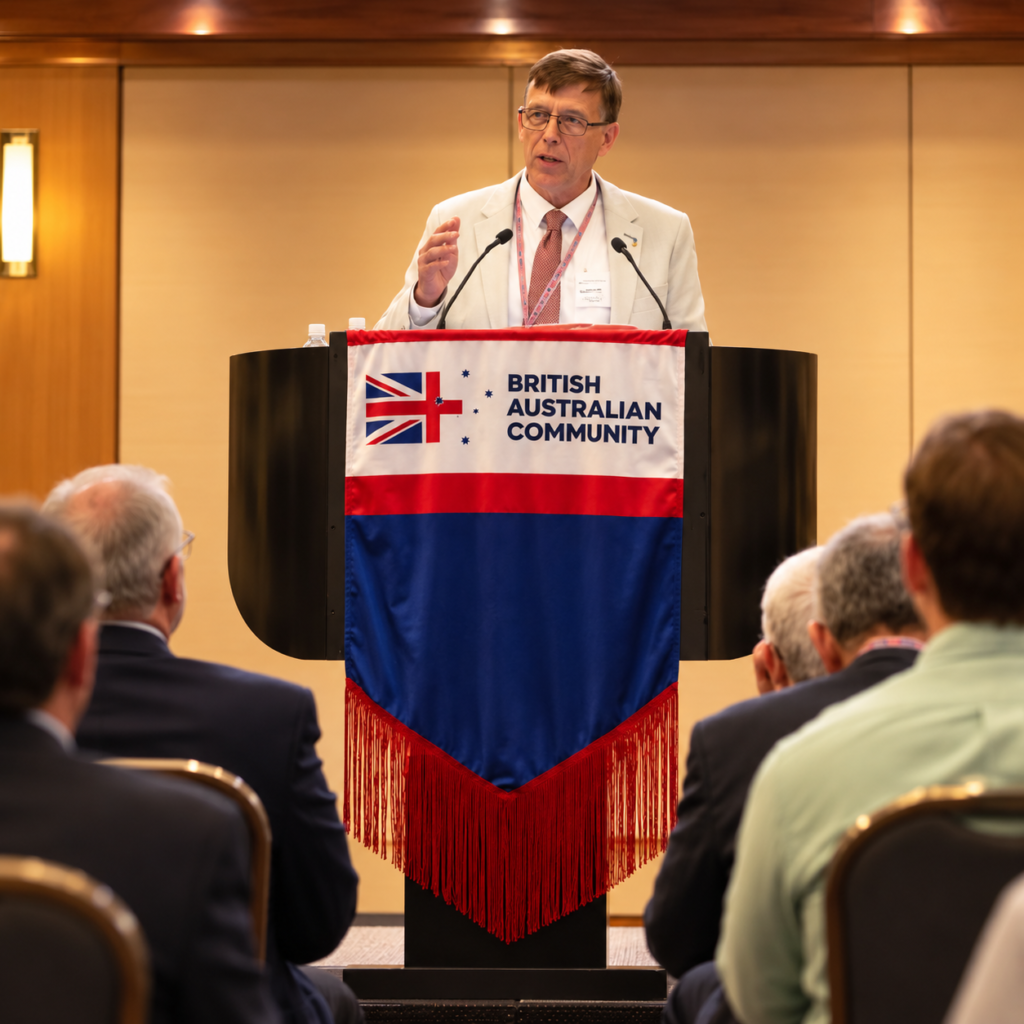
An Anglo-Celtic advocacy organisation has urged the High Court to strike down Australia’s new prohibited hate-group laws, warning that powers now being used against White Australia could one day be directed at other political or ethnic associations.
The British Australian Community, or BAC, intervened in the public debate as the Full Court began hearing a constitutional challenge brought by White Australia and its national president, Thomas Sewell.
BAC president Harry Richardson described the Commonwealth regime as a “political weapon” and argued that a representative democracy should be cautious about giving executive government the power to effectively prevent an organisation from continuing to operate.
Richardson used much stronger political language as well, comparing the legislation with something expected in a “totalitarian banana republic”.
That description is BAC’s opinion, not a legal finding.
But the constitutional question underneath the rhetoric is genuine and is now before Australia’s highest court: how far can the Commonwealth go in prohibiting an organisation before the power becomes incompatible with the Constitution?
BAC warns the power could extend beyond White Australia
The British Australian Community describes itself as an organisation representing Australians whose ancestry comes from the British Isles and says its mission includes defending Anglo-Celtic cultural interests and responding to discrimination against that community.
Its intervention does not make BAC a party to the High Court case.
Instead, Richardson is using the White Australia litigation to argue that constitutional rules should be judged according to how powers could operate against any organisation in the future, not merely according to public attitudes towards the organisation currently targeted.
He said Australia already has criminal laws dealing with terrorism, violence and incitement, and questioned why an additional executive proscription regime was necessary.
His concern is that once an organisation is listed, ordinary activities that would otherwise be lawful — remaining a member, recruiting, funding or supporting the organisation — can themselves become serious criminal offences.
Richardson argues that such a system could discourage political organisation even where people have not personally committed violence or another criminal offence.
Whether that argument is constitutionally decisive is the question for the High Court, not BAC.
What the law actually allows
Part 5.3B of the Commonwealth Criminal Code was created by the Combatting Antisemitism, Hate and Extremism legislation passed in January.
The scheme provides a mechanism for organisations to be declared prohibited hate groups.
It is correct that the government does not need to wait for a criminal court to convict a member of a hate crime before a group can be listed.
The legislation allows the relevant minister to act where statutory criteria concerning hate-crime conduct, preparation, assistance or advocacy are satisfied on reasonable grounds.
But the power is not expressed as a general authority to ban any organisation with which the government disagrees.
The Director-General of Security must provide relevant advice recommending that the organisation be considered for listing.
The AFP Minister must then be satisfied on reasonable grounds that the statutory requirements have been met and that prohibition is reasonably necessary to protect the Australian community, or part of it, from specified forms of harm.
The Attorney-General must agree in writing, the federal Opposition Leader must be briefed and the organisation is formally specified through regulation by the Governor-General.
The Parliamentary Joint Committee on Intelligence and Security also has a review function.
Those safeguards are central to the Commonwealth’s defence of the legislation.
White Australia argues they are still insufficient.
The consequences of listing are severe
Once an organisation becomes a prohibited hate group, Division 114B activates criminal offences covering defined forms of involvement.
Knowingly and intentionally remaining a member can carry a maximum sentence of seven years.
Directing activities, recruiting people, certain training conduct and some forms of funding or material support can attract maximum penalties ranging as high as 15 years.
That does not mean every person who previously associated with an organisation automatically becomes a criminal on the day it is listed.
The membership offence requires knowledge that the organisation is prohibited and intentional continued membership.
The Criminal Code also provides an exception where a person takes all reasonable steps to leave the organisation as soon as practicable after becoming aware of the prohibition.
Nor is merely holding an unpopular political opinion, by itself, an offence under the listing provisions.
The constitutional controversy arises because the executive listing changes the legal status of participation in the organisation before any individual prosecution takes place.
White Australia says that is precisely the problem
White Australia was formally listed on 15 May, with the prohibition taking effect the following day.
The Commonwealth describes the organisation as a nationalist and racist extremist group formerly known as the National Socialist Network and European Australia Movement.
Government material says the decision relied on classified and unclassified information concerning racist propaganda, advocacy and violent conduct.
White Australia disputes the constitutional validity of the legal mechanism rather than merely asking the Court to reassess whether ministers made a politically wise decision.
Its lawyers have challenged Part 5.3B on three grounds.
First, they argue the Commonwealth Parliament lacks sufficient constitutional legislative power to enact the regime.
Second, they say the legislation impermissibly burdens the implied freedom of political communication.
Third, they contend that giving the executive power to make the findings that result in organisational prohibition infringes the constitutional separation of judicial power.
The Commonwealth rejects each argument.
The Communist Party precedent
One of the most important cases hanging over the hearing dates from 1951.
In Australian Communist Party v Commonwealth, the High Court struck down legislation introduced by the Menzies government to dissolve the Communist Party.
The modern plaintiffs rely heavily on that decision.
The comparison does not mean White Australia and the Communist Party are legally or politically identical.
The constitutional principle concerns whether Parliament and the executive can establish the very facts needed to bring their own actions within Commonwealth legislative power.
White Australia’s lawyers argue the prohibited hate-group framework repeats that difficulty because executive officials decide whether the organisation has engaged in the conduct used to justify prohibition.
The Commonwealth says the 2026 regime is fundamentally different because Parliament has established statutory criteria, requires intelligence advice and makes ministerial satisfaction legally reviewable.
That difference could prove critical to the outcome.
Free political communication is also at stake
The second major question is Australia’s implied freedom of political communication.
Australia has no general constitutional free-speech right equivalent to the First Amendment in the United States.
Instead, the High Court has recognised limits on government power where legislation burdens communication necessary for Australia’s system of representative and responsible government.
A political organisation seeking candidates, members, donations and public support is plainly participating in political communication.
White Australia argues that prohibiting the organisation and criminalising important forms of participation imposes an extreme burden on that process.
The Commonwealth responds that the Constitution does not give political organisations immunity from valid laws protecting the community from serious harm.
The key question is therefore proportionality: whether the burden created by Part 5.3B is justified by its legitimate protective purpose and whether Parliament has gone further than constitutionally necessary.
Why BAC fears a future precedent
Richardson’s argument concentrates less on whether White Australia deserves political sympathy and more on what happens if the High Court approves the structure of the power.
Once constitutional validity is established, the same legal framework remains available to future governments.
BAC fears an administration with more authoritarian instincts could attempt to interpret broad concepts such as harm, advocacy and political violence aggressively against organisations it regarded as inconvenient.
That is a hypothetical concern rather than evidence of present misuse.
But constitutional limits are often designed precisely for situations in which the identity of future office-holders cannot be predicted.
Legal scholar Anne Twomey has made a related point in her analysis of the case, arguing that its long-term importance lies in defining the boundaries of legislative and executive authority rather than deciding whether White Australia itself deserves to continue operating.
A rule created in a case involving an unpopular organisation can later apply to organisations with very different beliefs.
The legislation did receive significant parliamentary support
The prohibited hate-group scheme was enacted rapidly following the December 2025 Bondi terrorist attack and the wider political response to antisemitism and violent extremism.
The Criminal and Migration Laws Bill passed both houses of Parliament on 20 January.
The final package reflected negotiations between Labor and the Liberal opposition.
The Liberal Party supported the amended legislation after changes were made, including amendments intended to tighten the focus of the hate-group provisions.
The Coalition was not completely united, however.
The Nationals opposed the final hate-law package, and Liberal senator Alex Antic also broke with his colleagues on aspects of the legislation.
That history makes the current political argument more complicated than a simple Labor-versus-opposition fight.
Some of the strongest criticism of the new regime has come from politicians and civil-liberties advocates on the right who believe the Commonwealth response went too far, while the legislation itself became law with substantial bipartisan support.
The High Court is not deciding whether it likes White Australia
That distinction remains essential as the case attracts increasingly charged political commentary.
White Australia’s ideology and history can be relevant to the factual basis of its listing.
They cannot determine whether Parliament possesses a constitutional power it does not otherwise have.
Conversely, political participation does not make an organisation immune from generally applicable criminal laws merely because it calls itself a party.
The High Court must separate those issues.
Its official description of the case identifies the questions as legislative power, political communication and Chapter III — not whether the justices approve of White Australia’s political program.
On the first day of oral argument, White Australia’s lawyers characterised the legislation as authoritarian and described the total prohibition model as using a “sledgehammer on a nut”.
The Commonwealth argued that White Australia was not simply an innocent political organisation caught by an abstract law, pointing to conduct and rhetoric the government says justified its listing.
A ruling will set boundaries for governments that do not yet exist
BAC’s most dramatic prediction is that Australia would become a democracy “in name only” if the law survives.
That conclusion is political advocacy, not a legal assessment that can presently be established as fact.
Even if the High Court upholds Part 5.3B, the statute would still contain threshold criteria, parliamentary mechanisms and avenues for judicial supervision.
But an upheld law would undoubtedly confirm that the Commonwealth has substantial power to prohibit qualifying organisations and attach major criminal consequences to continuing involvement with them.
If the Court instead invalidates part or all of the scheme, Parliament may have to introduce narrower thresholds, stronger judicial safeguards or a fundamentally different process for dealing with extremist organisations that do not fall within existing terrorism laws.
Either result will reach beyond White Australia.
The judgment will help define how Australia’s constitutional system balances community protection against the danger of concentrating too much power in the executive.
That is the strongest version of BAC’s argument stripped of its rhetoric.
The immediate litigant may be politically marginal and widely condemned, but the constitutional rule produced by the case will belong to every Australian government — and every Australian political organisation — long after the current dispute has ended.