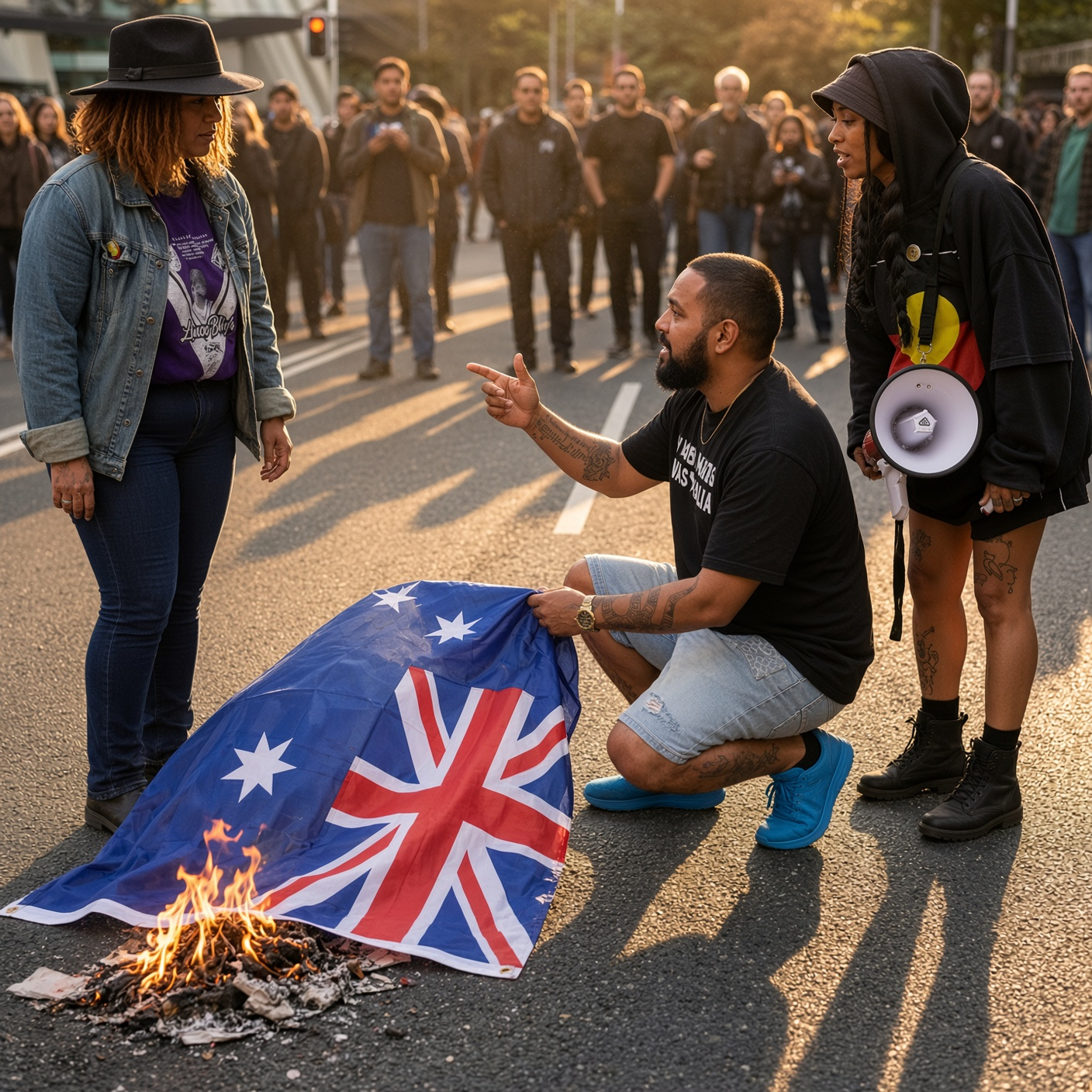
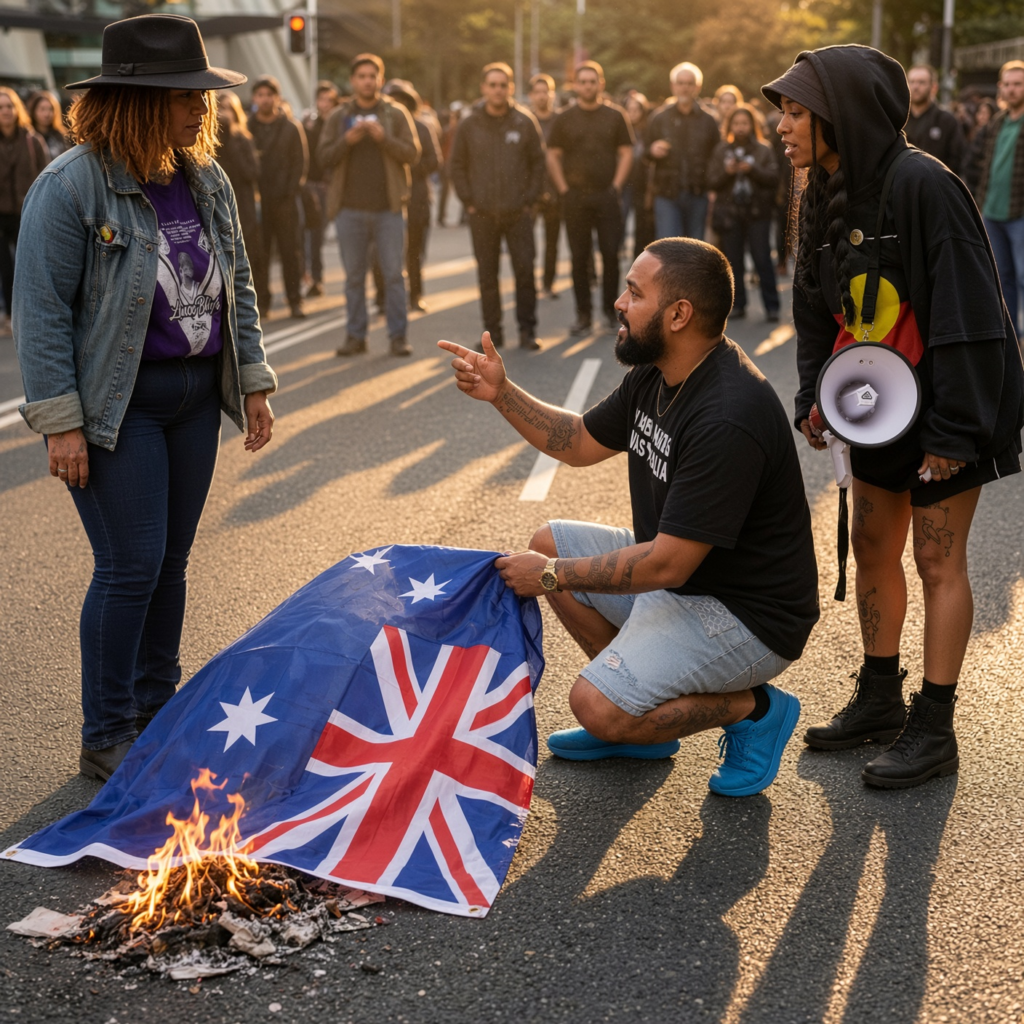
The Coalition has pledged to make serious public desecration of the Australian National Flag a federal criminal offence, with offenders potentially facing up to 12 months in prison under a new push to strengthen legal protection for one of the country’s most recognisable national symbols.
Opposition Leader Angus Taylor says Australians should be able to take pride in the flag without repeatedly watching it being burned at political demonstrations and then being told the act is simply another form of protest.
The proposed offence would form part of the Coalition’s planned Australian National Symbols and Heritage Protection Bill, announced on September 6.
Importantly, the proposal is more specific than a blanket rule making every act involving the burning or mistreatment of a flag punishable by prison.
According to the Coalition’s published policy, the federal offence would apply to serious public desecration of the Australian National Flag where a person is reckless as to whether their actions could incite hatred or violence, threaten public order or cause a public disturbance.
Reports outlining the policy say the maximum penalty would be 12 months’ imprisonment.
The distinction is significant because the debate now emerging in Canberra is not simply about whether burning a flag is offensive. It is about whether an act involving a national symbol should cross into federal criminal law when it is performed publicly in circumstances carrying broader risks to order or safety.
Taylor has framed the policy as an issue of national pride.
“Our flag represents the country we love,” he said when announcing the broader package protecting Australian national symbols and memorials.
He argued that Australians should not be expected to accept the deliberate destruction of the national flag as an unavoidable consequence of free political expression.
The Coalition’s position follows several highly publicised incidents in which Australian flags have been burned during demonstrations.
On January 26 this year, an Australian flag was set alight during an Invasion Day protest at Queens Gardens in Brisbane.
The protest took place alongside separate Australia Day events and attracted thousands of participants. Police were required to keep opposing groups apart during parts of the day, although authorities said the gatherings were largely peaceful overall.
The flag-burning incident drew immediate criticism from politicians including Pauline Hanson and renewed calls for federal legislation specifically protecting the national flag.
Similar scenes have previously occurred in Melbourne.
During a major protest in the Victorian capital in August 2025, a small group remaining after the principal demonstration burned an Australian flag. No arrest was reported specifically for the flag burning itself.
Australian flags were also photographed being burned during confrontations between anti-immigration demonstrators and counter-protesters in Melbourne in October 2025, when police were forced to separate opposing groups and several officers were injured during broader disorder.
Those incidents have strengthened arguments from supporters of criminalisation that Australia’s existing legal framework leaves a gap between behaviour that many Australians consider profoundly offensive and conduct that actually constitutes an offence.
At present, there is no general Commonwealth offence making desecration of the Australian National Flag illegal simply because the flag has been burned, damaged or dishonoured.
The Albanese government confirmed that position earlier this year in an official response to a parliamentary petition calling for the criminalisation of flag destruction and defacement.
The government said the Australian National Flag was the country’s foremost national symbol and acknowledged that most Australians deplored its desecration.
However, it also confirmed that the Flags Act 1953 itself contains no penalties for desecrating the national flag or other official Australian flags.
That does not mean people can engage in any conduct involving a flag without legal consequences.
Depending on the circumstances, existing state and territory laws can still apply. A person who damages somebody else’s property, starts a dangerous fire, assaults another person, obstructs police or commits a public-order offence may face charges regardless of whether a flag is involved.
The difference under the Coalition plan is that serious public desecration of the Australian National Flag could become an offence in its own right under Commonwealth law.
That change would create a significant political and legal debate over freedom of expression.
Australia does not have an unrestricted constitutional right to free speech equivalent to the First Amendment in the United States.
However, the High Court has recognised an implied freedom of political communication arising from Australia’s system of representative government.
The Attorney-General’s Department explains that political communication can be restricted by law, but restrictions must be compatible with Australia’s representative and responsible system of government and appropriately directed towards a legitimate objective.
That is likely to become highly relevant if legislation restricting flag burning reaches Parliament and is eventually challenged in court.
Burning a national flag can be intended to communicate an intensely political message. A law criminalising that conduct must therefore navigate the difference between regulating dangerous or disorderly behaviour and suppressing a form of political expression simply because it is offensive.
The Coalition has attempted to address that issue by placing additional conditions around the proposed offence rather than announcing an absolute ban.
Its policy specifically refers to serious public desecration combined with recklessness about hatred, violence, public order or public disturbance.
Shadow Attorney-General Michaelia Cash has argued that freedom of speech is fundamental but should not be interpreted as an unrestricted freedom to destroy national symbols or heritage.
Labor has taken a different view.
Assistant minister Matt Thistlethwaite has described the Coalition’s flag proposal as unnecessarily restrictive and argued that existing laws can already deal with behaviour that creates danger or incites violence.
He has also questioned the political timing of the announcement, suggesting the Coalition is attempting to recover voters who have shifted towards Pauline Hanson’s One Nation.
Taylor rejects that explanation and says the proposal reflects core Coalition values rather than an attempt to imitate another political party.
One Nation has long advocated tougher legal protection for the Australian flag, meaning the issue has now become part of a wider competition among conservative parties over national identity and patriotism.
The current proposal is also far from Australia’s first attempt to criminalise flag desecration.
Parliamentary records show repeated attempts over several decades to create federal offences protecting the flag, with none so far becoming law.
In 2006, Liberal MP Bronwyn Bishop introduced the Protection of the Australian National Flag (Desecration of the Flag) Bill, which sought to amend the Criminal Code and establish offences relating to unlawful destruction or desecration of the national flag.
The bill did not proceed.
Then-prime minister John Howard opposed criminalisation despite personally condemning flag burning. He argued that creating a specific offence risked turning people engaging in offensive behaviour into political martyrs.
That historical position now provides an interesting contrast with the present Coalition leadership.
Two more flag protection bills were introduced to the House of Representatives on February 9 this year, before Taylor announced the Coalition’s new policy.
Nationals MP Pat Conaghan introduced the Flags Amendment (Protection of Australian National Flags) Bill 2026, designed to prohibit burning, destruction, desecration or other serious dishonouring of the Australian National Flag or Australian Red Ensign.
Independent MP Rebekha Sharkie introduced a separate Criminal Code Amendment (Flag Protection) Bill 2026.
Her proposal goes further in the flags it covers, seeking to create an offence for intentionally or recklessly burning or desecrating the Australian National Flag, Australian Aboriginal Flag or Torres Strait Islander Flag.
Both private members’ bills remain before the House of Representatives.
The existence of those competing proposals demonstrates that the debate does not fall neatly along party lines.
Support for stronger protection of national flags can be found among Liberal, National and independent MPs, although the precise scope of the proposed offences differs.
What is new is the decision by the federal Coalition leadership to make flag protection part of its formal political platform.
For supporters of the proposal, the argument centres on respect.
The Australian National Flag has represented the Commonwealth since shortly after Federation and is flown at government buildings, military ceremonies, sporting events, schools, community events and commemorations across the country.
Supporters of criminalisation argue that deliberately burning it in public is not comparable with simply criticising the government, protesting against a law or carrying a political sign.
They see the act as an attack on a symbol intended to belong collectively to Australians, including people with sharply different political opinions.
Opponents counter that the very reason flag burning is provocative is because it communicates a powerful political message, and that criminal law should not be used simply to protect people from being offended.
They also point out that protesters who create fires, threaten others, damage property or engage in violence can already be prosecuted under existing laws.
The central question is therefore where Parliament should draw the line.
The Coalition’s proposed test attempts to draw it around serious public conduct carrying a risk of hatred, violence or disorder, rather than around every disrespectful use of the flag.
But the exact legal wording will matter enormously.
The Coalition has announced the policy and said it will introduce legislation, but the final bill has not yet passed Parliament and the proposed offence is not current Australian law.
Until legislation is introduced, debated, potentially amended and passed by both houses, Australians who burn the national flag cannot be jailed merely because Taylor has announced the policy.
Existing state, territory and Commonwealth offences may still apply to associated conduct, but there is currently no general federal crime of desecrating the Australian National Flag under the Flags Act.
If the Coalition succeeds in changing that, it would mark a major departure from the position Australia has maintained despite decades of political attempts to legislate against flag burning.
It would also force Parliament to confront a question that repeatedly resurfaces whenever footage of a burning Australian flag appears from a protest: whether the national symbol should be protected primarily by social condemnation, or by the criminal law.
The Liberals have now made their answer clear.
They want serious public desecration capable of inflaming hatred, violence or disorder to carry the possibility of prison.