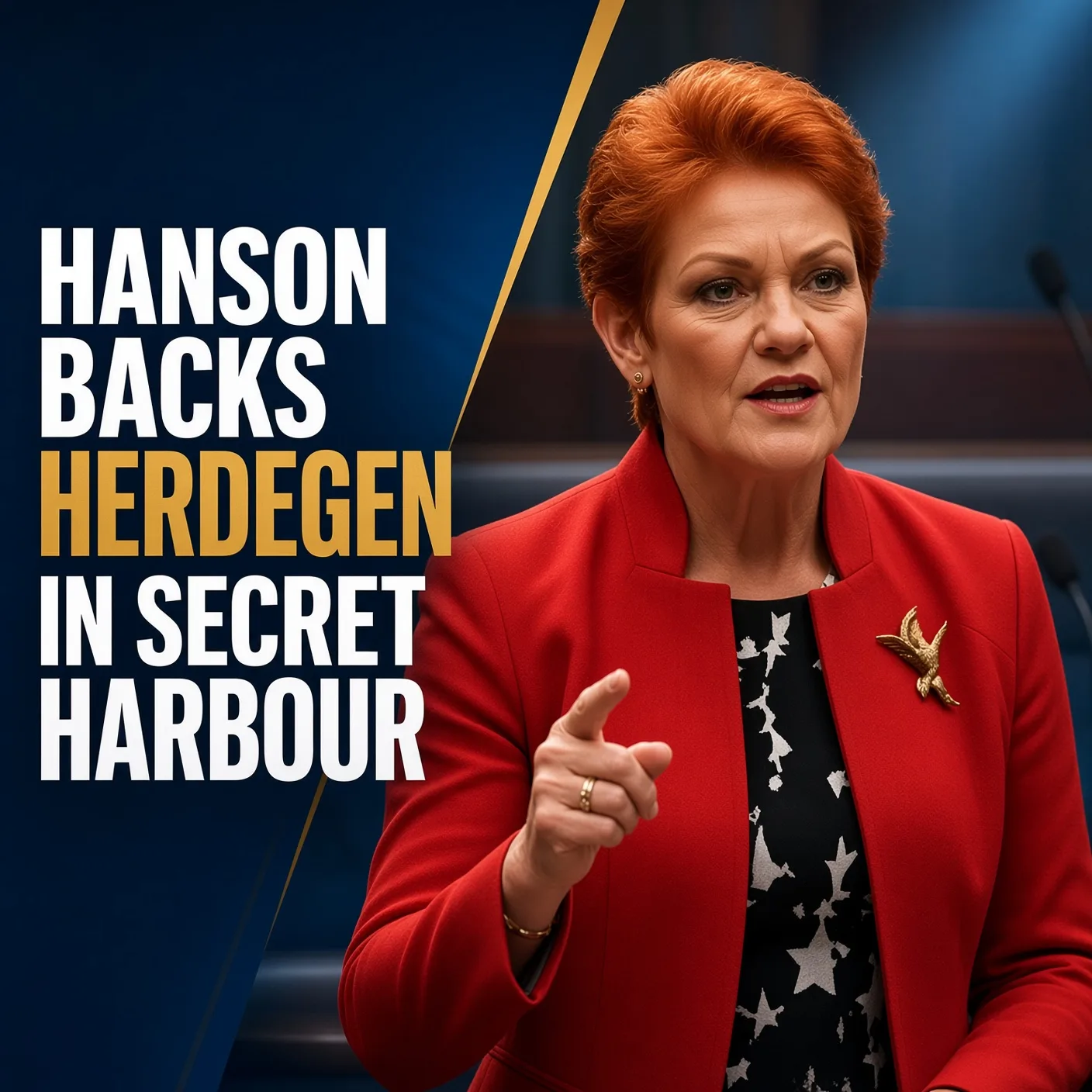
One Nation’s gamble on a 39-year-old Rockingham gym owner has paid off spectacularly, with Luke Herdegen capturing the previously safe Labor seat of Secret Harbour and giving Pauline Hanson’s party its first lower-house seat in Western Australian history.
The result represents a dramatic reversal in an electorate Labor entered the by-election holding on an 11.5 per cent margin and raises a larger question for both major parties: whether the political shift visible in Perth’s rapidly growing southern suburbs can spread into neighbouring state and federal seats.
For the Liberal Party, that question has particular significance because parts of Secret Harbour fall within Canning, the federal electorate held by senior Liberal MP Andrew Hastie.
One Nation has already established a branch in Canning and made clear it intends to challenge Hastie at the next federal election.
The Secret Harbour result does not mean Canning will automatically follow. State and federal elections operate under different circumstances, and Hastie has a personal profile and incumbency advantage that cannot be replicated from the state contest.
But One Nation’s performance demonstrates that voters in this part of Western Australia are prepared to abandon both major parties in substantial numbers.
Herdegen turns an unlikely candidacy into a historic victory
Herdegen was not an established political figure when One Nation selected him.
He lives in Rockingham, just outside the electorate, and runs several Anytime Fitness franchises across Perth’s southern suburbs, including a gym serving the Secret Harbour community.
Before building his business, Herdegen worked in a range of jobs including as an electrical trade assistant, concreter, traffic controller, marketing consultant and personal trainer.
He has also competed in weightlifting, winning a national title in 2023.
One Nation presented that background as evidence that its candidate understood the pressures confronting small businesses and working households.
During the campaign, Herdegen focused heavily on cost of living, housing and what he described as the declining ability of ordinary Australians to get ahead through work.
The message found an audience.
With almost three-quarters of ballots counted in the ABC’s latest published figures, Herdegen had secured 39.0 per cent of first preferences.
Labor’s Georgia Tree was on 24.4 per cent, while Liberal candidate Ryan Robertson was third on 17.4 per cent.
After preferences, Herdegen was leading Tree by 57.1 per cent to 42.9 per cent.
That represents an 18.7-point two-candidate-preferred swing away from Labor based on the count published by the ABC.
The scale of the primary-vote movement was even more striking.
One Nation’s first-preference support rose by 30.6 percentage points compared with the 2025 state election.
A Labor fortress was already showing cracks
The scale of One Nation’s victory is easier to understand when placed against the electoral history of the area.
Secret Harbour is technically a relatively new electorate, having been created through the redistribution that renamed and substantially reshaped the former district of Warnbro.
But the broader area has been represented by Labor under different electorate names and boundaries for decades.
Paul Papalia first entered parliament by winning the Peel by-election in 2007 before representing Warnbro from 2008.
When the boundaries were redrawn ahead of the 2025 state election, the renamed Secret Harbour electorate had a notional Labor margin of 31.3 per cent.
That appeared formidable.
The actual 2025 election told a different story.
Papalia retained the seat, but Labor’s post-election margin collapsed to 11.5 per cent.
That was still enough to classify Secret Harbour as safe Labor territory on conventional electoral measures, but the result showed that the area’s old political loyalties were weakening.
One Nation itself received less than 9 per cent of the vote in the electorate at that election.
Little more than a year later, it has won the seat.
Papalia’s departure opened the contest
The by-election was triggered by Papalia’s retirement after almost two decades in state parliament.
His departure removed a long-serving incumbent with substantial local recognition and forced Labor to introduce a new candidate to voters in an electorate already moving sharply against the party.
Labor selected Georgia Tree.
The 34-year-old had previously worked as an adviser to federal Resources Minister Madeleine King before moving into a government relations role at oil and gas producer Woodside Energy.
Tree emphasised her connections to the area during the campaign, including growing up in Warnbro and her family’s working-class background.
She also campaigned on traditional Labor themes including Medicare, apprenticeships, TAFE and infrastructure.
But her candidacy attracted criticism because she was living outside the electorate.
The contest consequently became about much more than replacing Papalia.
It developed into a test of whether Labor could hold an outer-suburban electorate facing intense housing, mortgage and cost-of-living pressures while One Nation’s national support was rising.
Labor knew the danger was real
WA Premier Roger Cook did not treat Secret Harbour as an ordinary by-election.
During the campaign he repeatedly described the contest as a “fight for our lives”.
By polling day, Cook was publicly acknowledging that Labor could lose.
That reflected the growing evidence that Herdegen was running a competitive campaign despite Labor’s historical dominance of the area.
One Nation devoted significant resources and political attention to the seat.
WA party leader Rod Caddies campaigned closely with Herdegen, while Hanson personally appeared alongside the candidate and used her national platform to promote the campaign.
The party also relied heavily on volunteers and donations from supporters.
Hanson later credited those volunteers, candidates and donations from ordinary Australians with helping produce the result.
The campaign demonstrated an increasingly organised One Nation operation in Western Australia rather than a minor party simply relying on Hanson’s national profile.
Sixteen candidates competed for the seat
Secret Harbour also produced an unusually crowded ballot.
The WA Electoral Commission confirmed 16 candidates contested the by-election, compared with seven candidates at the 2025 state election.
Alongside Labor, One Nation and the Liberals were candidates from the Greens, Legalise Cannabis WA, Shooters, Fishers and Farmers, Australian Christians, the Animal Justice Party, Libertarians and WA First, as well as several independents.
Despite that fragmented field, One Nation emerged with by far the largest first-preference vote.
The Liberals’ third-place finish is particularly significant.
The by-election was not simply a story of Labor voters moving against the government.
It also exposed the Liberal Party’s difficulty in establishing itself as the automatic alternative to Labor in an electorate with a substantial conservative and protest vote.
The Liberal preference strategy becomes part of the story
WA Liberal leader Basil Zempilas had taken a less confrontational approach towards One Nation than some senior federal Liberals.
The Liberal how-to-vote card placed One Nation third, after Australian Christians.
After the result, Hanson publicly thanked Zempilas and praised his approach.
She argued that the parties shared common ground on a number of conservative policies.
Zempilas rejected suggestions the Liberals had effectively surrendered the contest, saying the party wanted to increase its primary vote but was realistic about its prospects in a by-election in a seat it had never held.
The strategy, however, stands in stark contrast to the approach advocated by Andrew Hastie.
Hastie warned Liberals against treating One Nation as an ally
Even before votes were cast, Hastie was warning his party that One Nation’s rise should be treated as a direct electoral threat.
Parts of Secret Harbour are located inside his federal electorate of Canning.
Hastie has argued that the Liberals cannot assume votes for One Nation will eventually return to the Coalition through preferences.
During the by-election campaign, he said the Liberal Party should be fighting for every vote rather than accepting the idea that a One Nation victory was somehow beneficial to the broader conservative side of politics.
“I don’t accept this idea that a win for One Nation is a win for the Liberal Party,” Hastie told ABC’s 7.30 before polling day.
He said the Liberals were “fighting for our lives” and warned that voters would respond to whichever party appeared strongest.
The Secret Harbour result gives those comments considerably greater weight.
The Liberal candidate did not come close to reaching the final preference contest.
Instead, One Nation became the principal challenger to Labor and then defeated it.
Canning is already in One Nation’s sights
Hastie’s concern is not theoretical.
One Nation has already established a branch in Canning as part of its plan to expand its organisational presence ahead of the next federal election.
The electorate is particularly attractive because of the political characteristics of communities south of Perth.
Canning contains a mixture of rapidly expanding outer-suburban areas and regional communities.
Issues such as housing affordability, mortgages, infrastructure, migration, energy costs and cost-of-living pressures have become increasingly prominent.
Those are also issues One Nation is using to target voters who previously supported either Labor or the Coalition.
Hanson and Hastie have also developed an increasingly hostile political relationship.
Hastie has accused One Nation figures of conducting a personal campaign against him, while Hanson has made clear that the party intends to challenge his hold on Canning.
The Secret Harbour result therefore gives One Nation something it did not previously have: evidence of a successful campaign in communities overlapping with and immediately adjacent to Hastie’s federal territory.
But Secret Harbour is not a prediction of Canning
There are strong reasons to be cautious about extrapolating one state by-election into a future federal result.
By-elections frequently produce unusually large swings.
The government was defending the seat without its long-serving incumbent.
Sixteen candidates divided the primary vote.
Local issues played a significant role.
And Herdegen’s campaign had its own candidate-specific characteristics.
Canning would present One Nation with a different opponent.
Hastie is a nationally recognised Liberal MP and former special forces officer who has represented the electorate since 2015.
A federal election would also be fought over a wider range of national issues and under different political circumstances.
There is consequently no basis for assuming that the 39 per cent primary vote One Nation achieved in Secret Harbour would transfer directly into Canning.
What the result does establish is that a large pool of voters in Perth’s south is willing to consider One Nation as something more than a protest preference.
They have now elected one of its candidates to parliament.
Outer-suburban Australia is becoming a major battleground
The deeper significance of Secret Harbour extends beyond Hanson, Herdegen or Hastie.
The electorate represents the type of community increasingly being watched by political strategists across Australia.
It contains many younger families and mortgage holders living on the metropolitan fringe, where rapid population growth can place pressure on roads, schools, hospitals and other infrastructure.
Housing costs and household budgets are particularly sensitive political issues.
For decades, Australia’s political geography was often described relatively simply: Labor dominated many working-class areas while the Coalition performed strongly among wealthier suburban and regional voters.
That alignment is becoming less reliable.
One Nation is attempting to build support among working-class and outer-suburban voters who believe neither major party is responding adequately to cost-of-living pressures, housing shortages, migration or concerns about economic security.
Secret Harbour provided the party with an opportunity to test whether that strategy could translate into an actual parliamentary seat.
It did.
Herdegen immediately raises One Nation’s ambitions
After his victory, Herdegen described the result as a message that would send “shockwaves around the country”.
He declared that no seat was safe from what he called the “orange tsunami”.
Within days, he was talking openly about One Nation’s prospects in other Labor-held electorates and even the possibility of the party challenging for government in Western Australia in 2029.
Premier Cook dismissed those ambitions as premature.
That scepticism is understandable.
One Nation has won one WA lower-house seat, not government.
Building the organisation, candidate base and statewide support required to compete across dozens of electorates is vastly more difficult than concentrating resources on one high-profile by-election.
But Secret Harbour has changed the starting point of that discussion.
Before August 29, One Nation’s growing polling numbers in Western Australia were theoretical.
After August 29, the party had converted them into a seat.
A warning to both major parties
Labor has the most obvious reason to study the result.
It lost a seat that had been regarded as safe territory and suffered a huge decline in its primary vote.
But the Liberals cannot regard Labor’s defeat as an uncomplicated victory for the right.
They finished third.
That is why Hastie’s warnings about One Nation matter.
If voters moving away from Labor increasingly choose One Nation rather than the Liberal Party, the traditional two-party competition changes fundamentally.
And if disillusioned Liberal voters also move towards Hanson, Coalition incumbents can find themselves under pressure at the same time.
Secret Harbour does not prove that Canning will fall to One Nation.
It does, however, demonstrate that Hanson’s party now has the organisational capacity, voter support and political momentum to win in an area once regarded as firmly controlled by a major party.
Luke Herdegen began the campaign as a gym owner attempting to pull off an upset in Labor heartland.
He will enter the WA Legislative Assembly as One Nation’s first lower-house MP in the state’s history.
For Labor, the result is a warning about the fragility of supposedly safe outer-suburban seats.
For the Liberals, the fact that One Nation won while their candidate finished a distant third presents an equally uncomfortable message.
And for Andrew Hastie, whose Canning electorate sits directly in the path of One Nation’s expansion strategy, the political fight Hanson has been promising is no longer hypothetical.