One Nation has secured a historic breakthrough in Western Australia after Luke Herdegen won the Secret Harbour by-election, delivering the party its first seat in the state’s Legislative Assembly and inflicting a major defeat on Labor in what had been considered one of its safest territories.
The result represents an extraordinary reversal from the 2025 state election and has immediately intensified debate about whether Pauline Hanson’s party is beginning to build a durable electoral base among outer-suburban and working-class voters who have traditionally supported one of Australia’s two major political blocs.
Early figures on election night showed One Nation on 35.8 per cent of first preferences, Labor on 25 per cent and the Liberals on 17.4 per cent. But those figures moved as counting continued.
By the ABC’s updated count on 1 September, with 74.6 per cent of votes included, Herdegen’s first-preference support had climbed to 39.0 per cent. Labor candidate Georgia Tree was on 24.4 per cent, while Liberal candidate Ryan Robertson remained on 17.4 per cent.
After preferences, Herdegen was leading Tree 57.1 per cent to 42.9 per cent, a margin of 3,742 votes and an 18.7 percentage-point swing away from Labor on the two-candidate preferred count.
For One Nation, the scale of the primary vote was almost as important as the seat itself. The party had won just 8.4 per cent of first preferences in Secret Harbour at the 2025 WA election. Within roughly 18 months, that support had increased by more than 30 percentage points.
Labor’s movement was in the opposite direction.
Former minister Paul Papalia won 46.6 per cent of the primary vote in 2025 and ultimately defeated the Liberal candidate by 61.5 per cent to 38.5 per cent after preferences. The post-election Labor margin was 11.5 per cent.
That made Secret Harbour a seat few would ordinarily have expected Labor to lose in a single by-election cycle.
The electorate had previously been known as Warnbro before boundary and name changes took effect at the 2025 state election. Papalia had represented the area and its predecessor electorates since entering parliament in 2007.
His resignation in July created the vacancy that triggered the by-election. Papalia said he was leaving politics to care for an immediate family member suffering from a serious illness.
The contest that followed quickly became much more than a routine replacement election.
Secret Harbour, on Perth’s southern coastal fringe, contains communities including Secret Harbour, Golden Bay, Karnup, Lakelands, Madora Bay and Singleton, as well as parts of Port Kennedy. It is an area dominated by working families, mortgage holders and commuters, where cost-of-living pressures, housing, transport and local services featured heavily during the campaign.
Those conditions gave One Nation an opportunity to test whether the strong polling and electoral momentum it had developed elsewhere in Australia could be converted into support in a metropolitan Labor seat.
It did so decisively.
Senator Hanson celebrated the result as evidence that voters who once regarded Labor and the Coalition as their only realistic options were increasingly prepared to look elsewhere.
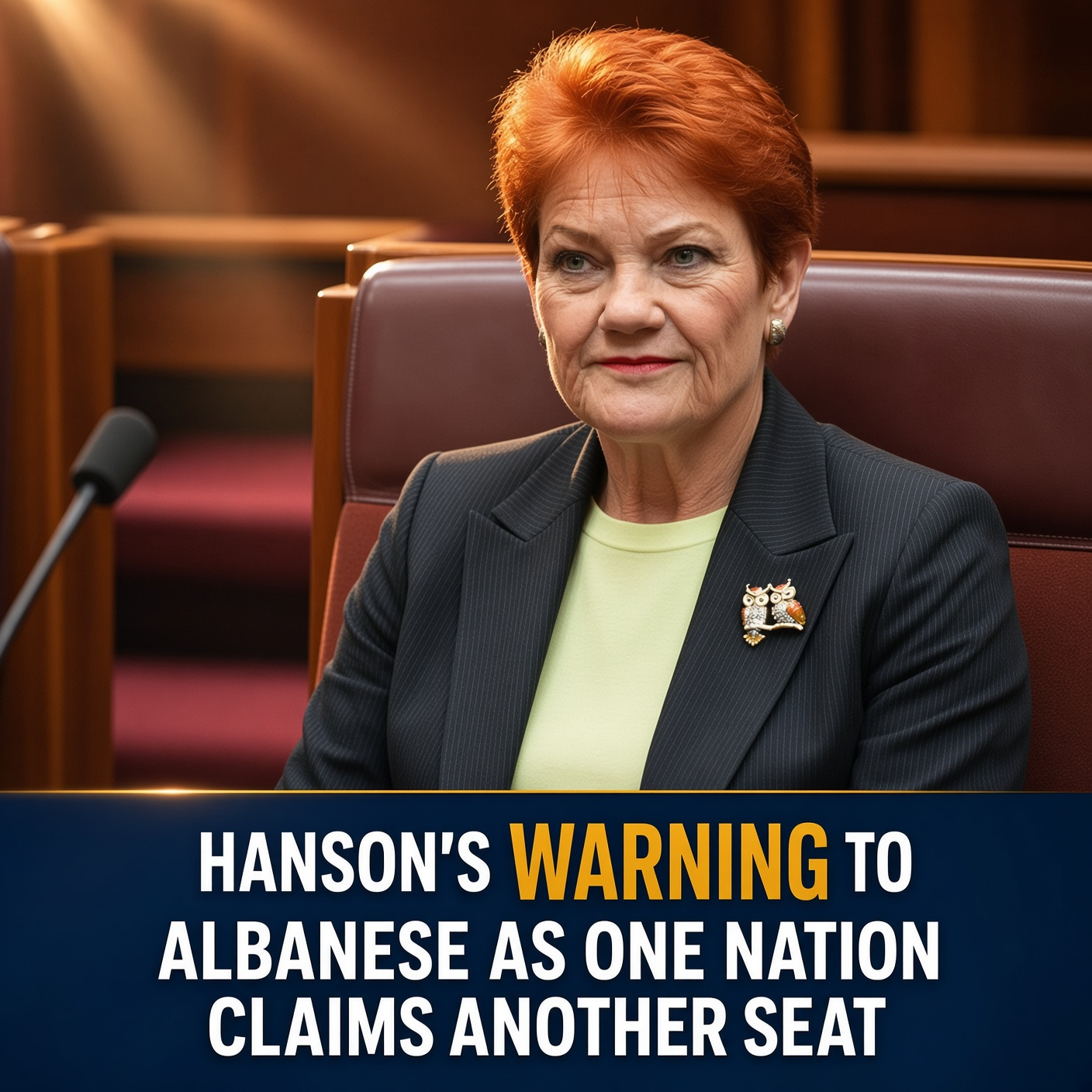
“Tonight’s result should be a warning to Labor, we’re coming for more of your seats,” Hanson said after the scale of the swing became clear.
She praised Herdegen’s campaign and argued that One Nation had succeeded by recruiting local candidates, mobilising volunteers and focusing on economic pressures affecting ordinary households.
Hanson also sought to frame the victory in national terms, making clear that she sees the WA result as part of a wider effort to challenge Prime Minister Anthony Albanese and the major parties heading towards the next federal election in 2028.
Herdegen, a gym business owner who moved to the Rockingham area in 2023, described the victory as a message from voters who believed they had been ignored.
“The people have had enough. They definitely felt neglected,” he said after the result.
He later declared the surrounding region to be new electoral territory for One Nation and suggested nearby Labor-held seats such as Kwinana, Rockingham and Baldivis could now face stronger challenges.
Whether those predictions are realised remains uncertain, but the Secret Harbour numbers are difficult for Labor strategists to dismiss.
In 2025, Labor was almost 22 percentage points higher on primary support than it was in the by-election. One Nation, by contrast, moved from a minor fourth-place presence to a commanding first-place finish in a field of 16 candidates.
The Liberals also have difficult questions to answer.
Robertson’s 17.4 per cent primary result left the party a distant third. The Liberals had polled 25 per cent in Secret Harbour at the 2025 state election, meaning their own first-preference vote also fell significantly while One Nation surged.
That result complicates any attempt to portray One Nation’s growth simply as a transfer of dissatisfied Labor voters. The party appears capable, at least in this electorate, of drawing support from across the traditional political divide as well as from voters who may previously have supported minor parties or independents.
The scale of the Liberal result is particularly significant because much of Secret Harbour sits within the federal electorate of Canning, represented by senior Liberal MP Andrew Hastie.
It means both major parties now have reasons to examine what happened in Perth’s outer south rather than treating the result purely as somebody else’s problem.
WA Premier Roger Cook acknowledged the message after Labor’s defeat.
“The voters of Secret Harbour have spoken and we will listen,” he said.
Cook argued that by-elections were difficult for incumbent governments but accepted that Labor had a responsibility to understand why voters had turned away from it so strongly.
The loss does not threaten the Cook government’s ability to govern. Labor won 46 of the 59 Legislative Assembly seats at the 2025 election and continues to hold a dominant parliamentary position even after losing Secret Harbour.
Politically, however, the symbolism is considerably larger than the change of a single seat.
One Nation had never previously won a lower house seat in Western Australia. Its success comes during a year in which the party has repeatedly demonstrated that its support can translate into seats rather than simply higher opinion-poll numbers.
At the South Australian election earlier in 2026, One Nation won four seats in the state’s House of Assembly and three positions in the upper house. Its lower-house primary vote reached 22.9 per cent across the seats it contested, producing what was then the party’s strongest state election result in decades.
In May, David Farley won the federal Farrer by-election for One Nation in another major breakthrough. The Australian Electoral Commission later formally declared Farley elected with 57.6 per cent after preferences.
Farrer was especially important because it marked the first time a candidate standing as One Nation had been elected to the federal House of Representatives.
Secret Harbour adds a different dimension to that momentum.
Farrer had been a Coalition-held federal electorate. One Nation’s South Australian gains had largely come from conservative or independent territory. Secret Harbour demonstrated that the party could also take a seat directly from Labor in an outer-metropolitan area.
That distinction is why the result is being watched closely in Canberra as well as Perth.
It would nevertheless be a mistake to assume that a state by-election automatically predicts the outcome of the 2028 federal election.
By-elections frequently produce larger swings against governments than general elections. Local candidate factors, dissatisfaction with state services, the absence of a sitting member and the ability of voters to lodge a protest without changing the government can all contribute to unusually volatile results.
Secret Harbour also followed the departure of a long-serving local member, removing the personal vote Papalia had built over nearly two decades in parliament.
But the size of the One Nation primary vote makes the result harder to write off as a routine protest.
Winning almost four votes in every 10 in a 16-candidate field gave Herdegen a level of first-preference support that many candidates from the major parties would regard as formidable in contemporary Australian politics.
The result also came as national polling showed One Nation enjoying substantially stronger support than it had historically attracted, increasing pressure on both Labor and the Coalition to explain how they intend to win back voters who feel economically or politically disconnected from them.
Prime Minister Anthony Albanese responded to the broader rise of One Nation in the days after the by-election by sharpening his criticism of what he described as hard-right populism, telling Labor supporters that movements he regarded as divisive and dishonest had to be defeated.
Hanson has responded by portraying such attacks as evidence that the major parties are worried about One Nation’s growing electoral reach.
That argument is likely to become increasingly prominent as Australia moves towards the next federal campaign.
For Labor, Secret Harbour is a reminder that even seats carrying apparently comfortable margins can become competitive when voters are sufficiently dissatisfied. For the Liberals, the result presents an equally uncomfortable question about whether One Nation is replacing them as the preferred opposition to Labor among sections of the conservative and outer-suburban electorate.
For One Nation, the challenge now is different: proving Secret Harbour was not simply an exceptional by-election result.
The party will need to demonstrate that it can retain support when elections are fought across an entire state or country, field credible candidates across dozens of electorates and convert higher primary votes into repeated lower-house victories under Australia’s preferential voting system.
The formal electoral process in Secret Harbour has continued beyond election night, with the WA Electoral Commission receiving eligible postal votes until 9am on 3 September and completing the remaining count and preference processes afterwards.
But the political outcome has not been in doubt: Luke Herdegen has delivered One Nation its first Western Australian lower-house victory and transformed what began as a local by-election into one of the most closely examined electoral results of 2026.
Hanson’s warning that Labor should expect One Nation to come after more of its seats may ultimately prove ambitious. What Secret Harbour has established, however, is that the threat can no longer be dismissed simply because a seat has historically been considered safe.