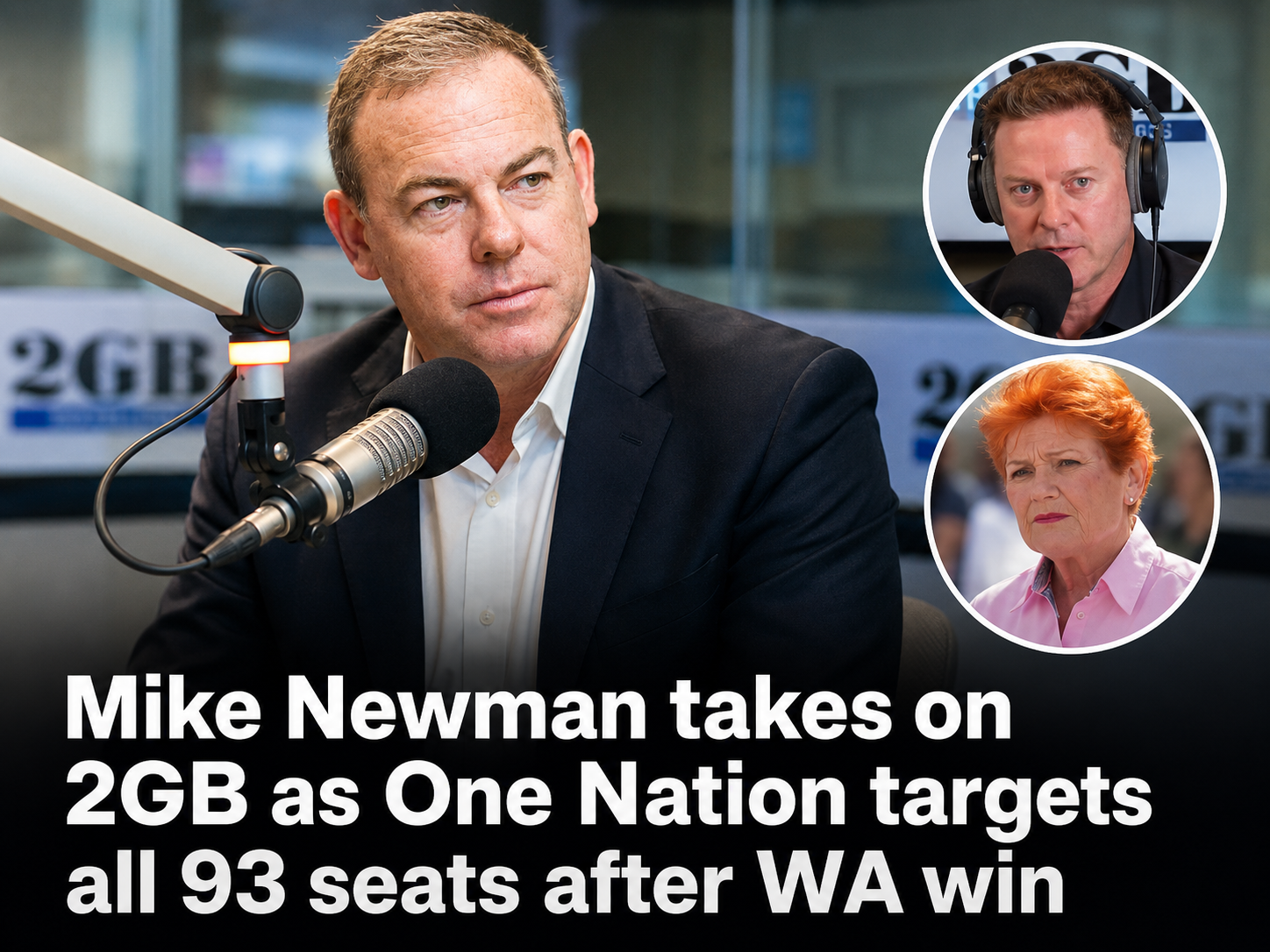
One Nation’s new NSW leader Mike Newman has declared the party intends to contest every lower-house seat at next year’s state election, using mounting pressure over housing, business costs and the proposed overhaul of emergency-services funding to build a statewide challenge to Premier Chris Minns.
Newman, the former NSW Senior Trade and Investment Commissioner for North Asia, has wasted little time expanding the party’s ambitions since Pauline Hanson installed him as state leader.
He will personally contest Cessnock in the Hunter, while coal miner and cattle farmer Stuart Bonds has been announced as One Nation’s lead Legislative Council candidate.
But Newman says the campaign will go considerably further.
Speaking on Sydney radio, he said One Nation intended to run across all 93 Legislative Assembly electorates as well as contest the upper house.
“We’re going for all 93 seats in New South Wales and upper house as well,” Newman said.
“We’re here to win. We’re not here to just sort of become the next opposition.”
The ambition is consistent with comments Newman made immediately after his appointment, when asked which electorates One Nation would target and responded: “Every single one.”
Actually putting candidates on every ballot will require a substantial organisational build-out before the March 13, 2027 election.
Newman told 2GB that more than 400 people had already expressed interest in standing for the party and said candidate vetting would now be a major task.
That figure is a claim from One Nation rather than a list of 400 endorsed candidates. The party has so far publicly announced only a fraction of the team it would require for a full statewide campaign.
Newman said he wanted candidates who genuinely identified with the organisation rather than people simply looking for a political opportunity.
“I want to build a team around me that bleeds orange,” he said.
The scale of the proposed expansion reflects One Nation’s rapidly improving political position.
In Western Australia, Luke Herdegen has been declared the winner of the Secret Harbour by-election by election analysts after Labor candidate Georgia Tree conceded, giving One Nation its first lower-house seat in that state.
The formal WA count is still continuing ahead of the postal-vote deadline, but the result is no longer in serious doubt.
With about three-quarters of votes counted by Tuesday, Herdegen had approximately 39 per cent of first preferences and was leading Labor by about 57 per cent to 43 per cent after preferences.
The One Nation primary vote had risen by more than 30 percentage points from the previous state election.
Newman has seized on the result as evidence that supposedly safe Labor or Coalition seats should no longer be treated as untouchable.
That argument will be tested severely in Cessnock.
The Hunter electorate has been held almost continuously by Labor since 1927 and Clayton Barr retained it comfortably in 2023. One Nation nevertheless finished ahead of the Nationals on primary votes at that election, giving the party an organisational foothold before Newman’s arrival.
His campaign is being constructed around economics rather than immigration alone.
Newman has promised to abolish payroll tax for regional businesses and halve it in metropolitan NSW, reduce regulation, restrain public-service growth and introduce private-sector-style performance measures for senior bureaucrats.
He is also campaigning for greater use of coal and nuclear power and against the state’s renewable energy zones.
His latest attack on the Minns government has focused on the Emergency Services Levy.
NSW currently finances most of its emergency-services system through a levy imposed on insurers, with the cost ultimately incorporated into home, contents and business insurance premiums.
The Minns government has argued for years that the arrangement is unfair because people and businesses without property insurance avoid much of the levy even though they still benefit from Fire and Rescue NSW, the Rural Fire Service and the State Emergency Service.
It wants to replace the existing model with a broader property-based system.
Newman argues that changing where the charge appears does not necessarily change who ultimately pays it.
He told 2GB that if commercial or industrial property owners faced a new levy, some would attempt to recover that additional cost through higher rents or prices.
That is a legitimate issue for the reform process, but it is too early to describe a particular commercial-property charge as settled government policy.
NSW Treasury released an options paper in May outlining five possible replacement models.
The models are based around combinations of fixed charges and land values, and the government says its three objectives are to reduce insurance costs, protect pensioners and vulnerable households, and create a revenue-neutral system capable of sustainably funding emergency services.
A Legislative Assembly select committee is currently examining those options.
Public hearings are scheduled for September 8 and 9, and the committee is required to report to parliament by November 18.
The government has explicitly said it is waiting for that report before determining its preferred model.
The current Emergency Services Levy therefore remains in operation.
The question of who ultimately bears a replacement property charge will be one of the most contentious elements of the inquiry.
A landlord may seek to pass some costs to tenants, and businesses may attempt to recover higher operating costs through prices, but the actual economic incidence would depend on the final design, lease arrangements, market conditions and available concessions.
There is also another side to the reform.
The Insurance Council has long argued that the existing levy significantly inflates NSW insurance premiums and discourages some households from obtaining adequate cover.
Removing it from insurance could therefore lower premiums even while shifting the cost of emergency services elsewhere.
That makes the political argument more complicated than simply describing the proposal as a new tax.
Housing provides Newman with a more immediate pressure point.
NSW is committed to delivering 377,000 new homes between July 2024 and June 2029 under its share of the National Housing Accord.
The latest independent assessment indicates the state is far off that trajectory.
The National Housing Supply and Affordability Council’s August quarterly report found NSW had completed about 21 per cent of its Accord target and forecast the state would not reach the full number until around March 2032.
That forecast had deteriorated from June 2031 in the council’s previous assessment.
Rolling annual NSW dwelling completions were also down about 1 per cent, even though approvals had increased.
The construction industry itself remains under considerable stress.
Figures based on ASIC insolvency data show 1,540 NSW construction businesses entered external administration during 2025–26.
The number is extremely high by historical standards, but the direction matters: it was actually 1.7 per cent lower than the 1,567 recorded in 2024–25.
In other words, describing 1,540 firms as evidence that the sector remains under severe pressure is justified. Describing the figure as a new record increase is not.
Master Builders NSW says escalating costs, labour shortages, supply-chain disruption, interest rates and weak project margins have all contributed to the industry’s difficulties.
Those problems do not have a single political cause, but they present an obvious vulnerability for any government promising substantially more housing.
The economic backdrop is also becoming less favourable.
The 2026–27 NSW Budget forecasts real gross state product growth of only 1 per cent this financial year and another 1 per cent in 2027–28.
Treasury attributes the slowdown to factors including higher interest rates, elevated fuel prices and global uncertainty weighing on household consumption and business activity.
Newman uses those numbers to argue that NSW needs lower taxation and less regulation.
The harder question will be how One Nation pays for its own commitments.
Abolishing regional payroll tax and cutting the metropolitan rate would remove a substantial source of state revenue. Newman says savings can instead be generated through audits of government programs, tighter control of bureaucracy and eliminating expenditure that fails to produce adequate value.
Detailed costings have not yet been released.
The same distinction applies to One Nation’s fundraising strength.
Newman referred in his radio interview to the party’s “Fire the Liar” fundraising campaign against Anthony Albanese.
One Nation itself announced in July that the campaign had raised $5 million from almost 79,000 supporters, with an average donation of $63.50.
That demonstrates considerable grassroots fundraising capacity.
It should not, however, be treated as a $5 million NSW election account.
Newman acknowledged the money sits on the federal side of the party.
NSW electoral law requires state-election expenditure by a political party to be paid from its NSW state campaign account, and donations or proceeds held in an account exclusively for federal election purposes cannot simply be transferred into the state account.
One Nation will therefore need to finance its NSW campaign within the state’s separate donation, campaign-account and expenditure rules.
For 2026–27, political donations to a registered NSW party are generally capped at $8,500 per donor, subject to specific exemptions provided by electoral law.
That makes recruiting hundreds of candidates only one part of the organisational challenge.
The party must vet those candidates, establish campaigns, comply with NSW electoral funding rules and turn statewide opinion-poll support into victories under the state’s optional preferential voting system.
Newman’s own background is central to One Nation’s attempt to present itself as capable of doing that.
He spent decades in finance and investment roles in Japan and previously represented NSW in North Asia as a senior trade commissioner.
Since taking the leadership, he has positioned himself as an economic manager rather than a conventional career politician.
He has also shown a willingness to acknowledge Minns personally while attacking the government around him, describing the Premier favourably before accusing his ministerial team of lacking sufficient calibre.
That creates a different style of contest from the national confrontation between Hanson and Albanese.
At federal level, Labor has increasingly attacked One Nation as a dangerous populist force.
In NSW, Newman is trying to force the argument onto taxation, regulation, housing supply, energy and whether the state economy is delivering enough for households and businesses.
The emergency-services levy will provide an early test.
If the Minns government ultimately designs a new property charge that clearly lowers insurance costs without placing disproportionate burdens on renters, businesses or vulnerable households, Newman’s criticism may become harder to sustain.
If the final scheme creates obvious winners and losers or pushes substantial costs onto property-intensive businesses, One Nation will have a ready-made election issue.
For now, the reform is still being designed.
One Nation’s statewide campaign is also still being built.
What is no longer in doubt is the scale of Newman’s ambition: from a party with no current NSW lower-house representation, he is preparing to put One Nation in front of voters across the entire state.
Secret Harbour has given the party evidence that enormous electoral margins can collapse.
NSW will determine whether that was an exceptional by-election revolt — or the beginning of something much larger.