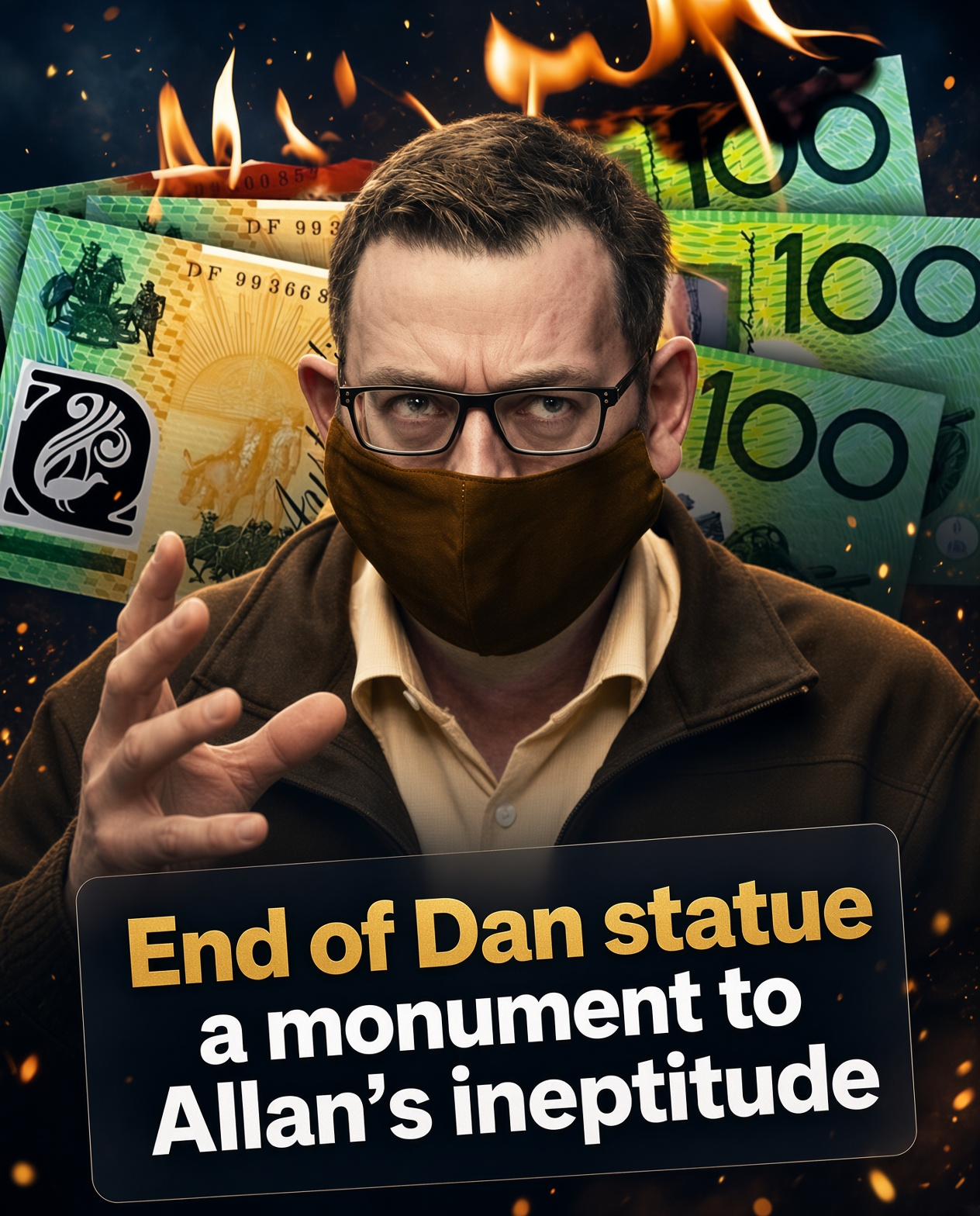
COMMENTARY: Daniel Andrews will not be getting his taxpayer-funded statue at Treasury Place after all.
For Victorians who regarded the $134,304 monument as an extraordinary use of public money during a cost-of-living squeeze and a period of enormous state debt, Premier Ben Carroll’s decision will be welcome.
But cancelling the Andrews tribute does not make the original decision disappear.
In fact, the controversy raises a more uncomfortable question for Victorian Labor: why was the statue commissioned in the first place?
The project was approved under Jacinta Allan’s government as the automatic consequence of a decades-old policy recognising Victorian premiers who served more than 3,000 days.
Andrews qualified after serving 3,219 days as premier between December 2014 and September 2023.
The rule itself was not created by Labor.
It originated with former Liberal premier Jeff Kennett in 1999.
That distinction matters because criticism suggesting Labor invented a special scheme solely to immortalise Andrews would be wrong.
But Labor did choose to continue the policy.
And it chose to commission the Andrews statue in March 2026 at a contracted cost of $134,304.
That was a political decision for which the government remains responsible.
Carroll has now killed the automatic statue rule
The new Premier has taken a markedly different approach.
Carroll announced on Saturday that an independent and bipartisan panel would review how Victoria commemorates former senior public officials.
More importantly, he ended the Kennett-era policy that automatically entitled long-serving premiers to statues at Treasury Place.
“I respect your money,” Carroll said.
“That means being careful and deliberate about how government spends it.”
His government said the automatic statue policy was “no longer consistent with community expectations about how governments should spend money”.
Then came the line that effectively ended the Andrews project.
“We are grateful to former Premiers for their service,” Carroll said.
“But gratitude does not require a taxpayer-funded statue.”
It is difficult to argue with that principle.
What is more difficult for Labor is explaining why it took until August 2026 to reach it.
The $134,304 has not simply disappeared
There is also an important detail behind the word “cancelled”.
The Andrews statue itself will no longer proceed as the planned monument at Treasury Place.
But the underlying contract has not been cancelled.
The government says terminating it could impose additional costs on taxpayers.
Instead, the independent panel will recommend another subject and location for the commissioned work.
That means the controversy is not quite as straightforward as taxpayers getting their $134,304 back.
The money was committed under an existing contract.
What changes is who — or what — the commissioned sculpture ultimately represents.
The situation became more awkward on Sunday when Carroll was questioned about how far work on the Andrews statue had already progressed.
Sources cited by the Herald Sun suggested the sculpture was close to finished.
Asked whether work had commenced, Carroll said he was not aware of the project’s status.
He similarly could not specify how much had already been spent.
That leaves a legitimate public-interest question.
If taxpayers have already funded substantial work on one sculpture, how much additional expense will be involved in producing something different?
The government’s stated objective is to avoid unnecessary costs.
Victorians are entitled to see the final numbers.
James Campbell’s criticism captures the political problem
Herald Sun commentator James Campbell put the backlash in particularly blunt terms.
He argued it was difficult to imagine a more effective way of provoking the public than commissioning a statue of the premier associated with Victoria’s lengthy COVID-era restrictions and deteriorating state finances.
The second part of that judgement — that Andrews “ruined” Victoria’s finances — is commentary rather than an objective fiscal finding.
But Campbell’s broader political point is easy to understand.
Andrews remains one of the most consequential and polarising figures in modern Victorian politics.
To his supporters, he was a three-time election winner who drove major infrastructure construction, removed level crossings, expanded public services and led the state through an extraordinary health emergency.
To his critics, he became the face of prolonged COVID restrictions, government secrecy, infrastructure cost blowouts and rapidly increasing debt.
A publicly funded statue was therefore never going to be viewed as a politically neutral administrative exercise.
It was always going to reopen arguments about his record.
The COVID years made a monument uniquely combustible
Andrews’ handling of the pandemic remains central to the strength of opposition to the statue.
Melbourne endured a series of prolonged lockdowns as the state government attempted to suppress COVID-19.
Businesses closed.
Students were kept away from classrooms.
Families faced restrictions on movement and gatherings.
Residents lived under curfews during parts of the pandemic.
Those policies continue to divide Victorians years later.
Supporters argue the government was responding to a once-in-a-century public-health emergency without the benefit of hindsight.
Critics argue some restrictions were excessive and inflicted enormous social and economic damage.
There were also serious government failures.
Victoria’s hotel quarantine program became the subject of intense scrutiny after infections escaped into the community.
The Victorian Ombudsman separately found that the government’s July 2020 detention of residents in public housing towers without notice breached their human rights.
Whatever judgement an individual Victorian makes about Andrews’ pandemic leadership, commissioning a permanent public monument to him only a few years after leaving office was guaranteed to be contentious.
Andrews himself had hardly demanded a statue
There is another irony.
When Andrews passed the 3,000-day threshold in 2023, he publicly downplayed the significance of the milestone.
He described it as something created by Kennett and said there was “no magic” to reaching the particular number of days.
That makes the eventual controversy even more avoidable.
The government did not need to invent a new honour.
Andrews was not publicly campaigning for one.
The project proceeded because an old government policy said it should.
That is precisely the kind of automatic expenditure governments should be willing to reconsider before signing a contract rather than afterwards.
Victoria’s debt makes every symbolic expense harder to defend
The $134,304 price of a sculpture is obviously tiny compared with Victoria’s overall budget.
Cancelling every statue in Melbourne would not solve the state’s fiscal challenges.
But that misses the political point.
Governments regularly tell households that difficult budget choices are necessary.
When public finances are under strain, symbolic spending receives greater scrutiny because it demonstrates what government regards as worth paying for.
And Victoria’s debt position is substantial.
The 2026–27 Victorian Budget forecasts general government sector net debt of $175.6 billion this financial year.
It is forecast to increase to $183.2 billion in 2027–28 and $191.1 billion in 2028–29.
By 2029–30, the government’s own budget forecasts net debt reaching $199.3 billion.
That is the origin of the increasingly common claim that Victoria is approaching $200 billion in debt.
It is important to state the figure accurately.
Victoria is not currently carrying $200 billion in general government net debt.
The budget forecasts it will approach that level by the end of the forward estimates.
That is still an enormous number.
The interest bill matters more than the statue
The real fiscal problem is not a six-figure sculpture.
It is the cost of servicing a rapidly growing debt burden.
As borrowing rises, an increasing amount of revenue must be devoted to interest rather than services or infrastructure.
That is money unavailable for hospitals, schools, transport, policing or tax relief.
It also reduces the government’s flexibility when the next economic downturn or unexpected emergency arrives.
This is why relatively small spending controversies can become politically potent.
A household facing rising bills does not assess government spending only by asking whether a particular expense is large enough to alter the state budget.
It also asks what the spending says about priorities.
That is where the Andrews statue became politically toxic.
Labor inherited the statue rule — but chose to use it
Carroll has attempted to shift some responsibility back to Kennett, calling the automatic statue policy a bad Liberal-era idea.
Historically, he is correct that Kennett created it.
Four former premiers — Henry Bolte, Albert Dunstan, Rupert Hamer and John Cain Jr — were commemorated under the program.
But blaming a policy created in 1999 has obvious limits after more than a decade of Labor government.
Governments inherit thousands of rules, programs and traditions from their predecessors.
They are not compelled to preserve all of them forever.
Labor had ample opportunity to review the automatic statue entitlement before Andrews reached the threshold.
It could have changed the rule before commissioning began.
It did not.
The Allan government instead entered into the $134,304 contract.
Carroll is now undoing that decision.
That sequence makes his emphasis on respecting taxpayers’ money politically powerful — but also invites questions about why the same judgement was not exercised earlier.
Public opposition was overwhelming
The government also cannot claim the controversy emerged unexpectedly.
A Freshwater Strategy poll published earlier in August found 74 per cent of surveyed Victorians wanted the statue plan cancelled.
Only 19 per cent supported proceeding with the taxpayer-funded project.
Opposition Leader Jess Wilson had already promised to scrap the Andrews statue if the Coalition won the November election.
With Carroll attempting to establish a distinct political identity after replacing Jacinta Allan as premier, retaining such an unpopular project would have given the opposition an easy campaign weapon.
His decision therefore makes political as well as fiscal sense.
It removes one of the simplest symbols the Coalition could use to argue Labor has become detached from household concerns.
Carroll is trying to establish a different Labor government
The decision also fits a broader effort by the new Premier to demonstrate a change of direction.
Carroll has repeatedly emphasised that his leadership will not simply reproduce the governments of Andrews and Allan.
Ending the automatic statue policy gives him a highly visible way to demonstrate that difference.
The timing matters.
Victoria goes to the polls on November 28.
Labor will enter that election after a long period in government and facing criticism over debt, infrastructure spending, crime, health services and cost-of-living pressures.
Carroll needs to persuade voters that replacing the premier represents more than changing the name on the office door.
The Andrews statue offered an unusually straightforward opportunity to prove it.
He took it.
Calling the government ‘corrupt’ requires evidence
There is, however, a line political commentary should not cross without evidence.
The raw criticism describes the Victorian Labor government as “corrupt”.
That is a serious allegation.
The decision to commission an unpopular statue does not itself establish corruption.
Nor does high government debt.
There have been numerous controversies involving Victorian Labor over its long period in office, and integrity bodies have scrutinised government and party conduct on various matters.
But describing an entire government as corrupt as an established fact requires evidence considerably stronger than disagreement over spending decisions.
The stronger criticism here does not need that label.
The government can legitimately be questioned about judgement, priorities, accountability and its handling of taxpayer money.
The statue controversy provides ample material for that argument on its own.
The contract now deserves complete transparency
Carroll’s decision should therefore be the beginning of the accountability process, not the end.
Victorians should be told how much of the $134,304 has already been paid.
They should be told how much work has been completed.
They should know whether changing the commissioned subject creates additional costs.
And when the independent panel recommends a replacement, the government should explain why that subject deserves public funding.
If the purpose of the policy change is respecting taxpayer money, transparency around the existing contract is essential.
Otherwise Victoria risks ending one statue controversy only to create another.
The larger lesson is about government judgement
It would be easy to dismiss the entire affair as a noisy argument about $134,304 in a state budget measured in tens of billions.
That would underestimate why the story resonated.
Public spending is not judged solely by scale.
It is judged by context.
Victoria is approaching a forecast $200 billion in net debt.
Families are dealing with cost-of-living pressure.
The government is asking voters to trust it with difficult financial choices.
And against that backdrop, it commissioned a taxpayer-funded statue of one of the most polarising political figures in the state’s recent history.
Carroll has now concluded that automatic monuments to former premiers are no longer appropriate.
That is a defensible decision.
But it inevitably invites the question his government would probably prefer voters not to ask.
If the idea is so clearly inconsistent with community expectations today, why did Labor sign the contract only months ago?
The Andrews statue will no longer stand at Treasury Place.
The political judgement that commissioned it cannot be removed quite so easily.