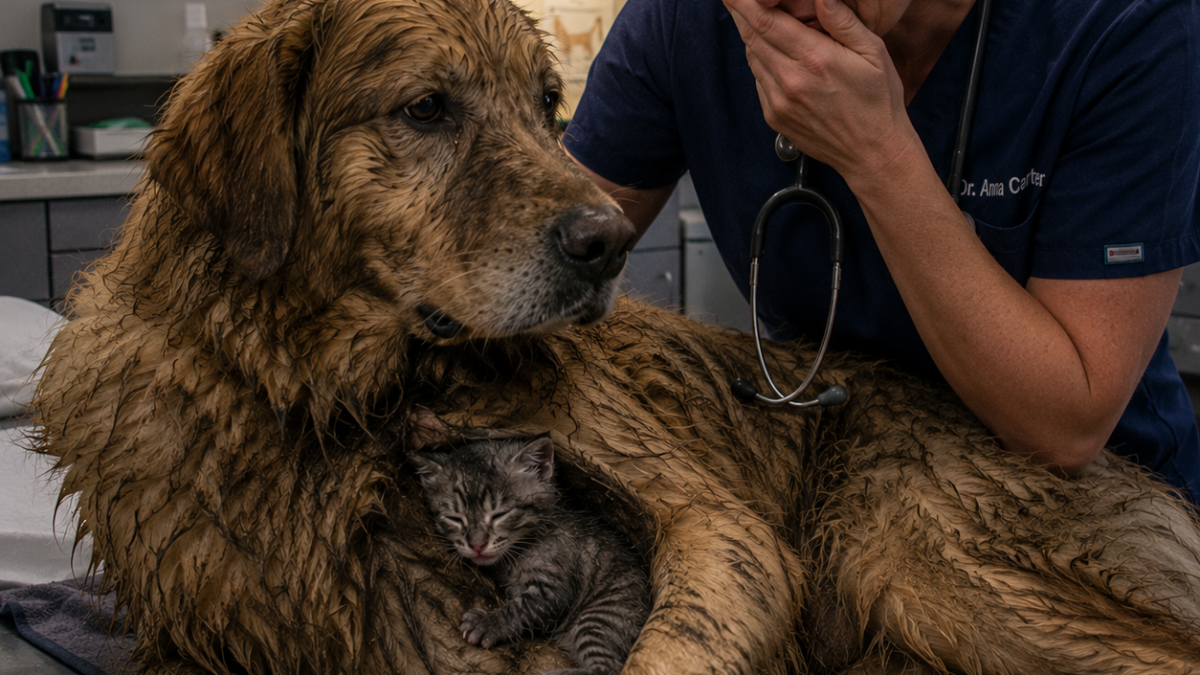
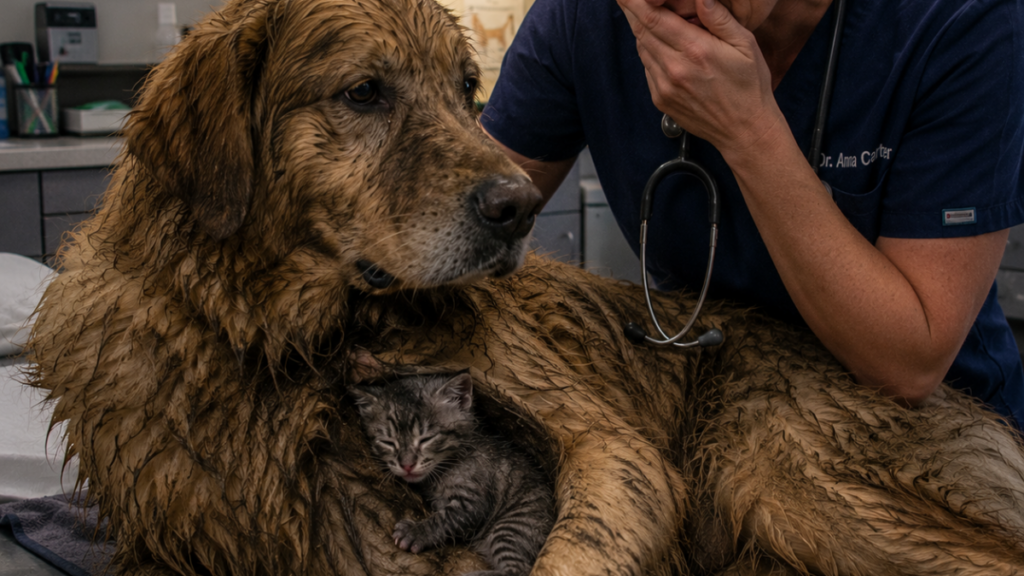
ax slept for almost six hours.
The kitten did not.
Ellie fed the tiny gray bundle every two hours while Anna monitored Max’s temperature, hydration, lungs, and bloodwork.
Daniel stayed.
Nobody asked him to.
He simply remained in the plastic chair beside the recovery kennel, damp hiking boots drying beneath him.
At one point Anna walked past with a cup of coffee.
“You know you can go home.”
Daniel looked through the kennel door.
Max was asleep with his muzzle resting near the fleece-lined box where the kitten lay.
“Yeah.”
Anna waited.
Daniel added:
“I’m not going to.”
She nodded.
She understood that kind of decision.
The kitten was approximately ten days old.
Female.
Underweight but not critically so.
No obvious injuries.
Anna doubted Max had been caring for her for long.
“A newborn kitten needs milk,” Daniel said.
“Exactly.”
“So he couldn’t have kept her alive for days.”
“Probably not.”
“How long?”
“Maybe hours. Possibly a day if she had nursed shortly before he found her.”
Daniel looked at Max.
“So there’s probably a mother cat somewhere.”
Anna nodded.
“And maybe littermates.”
“That’s what worries me.”
Daniel glanced at the bags containing the debris from Max’s fur.
Blue insulation.
Wood shavings.
Burrs.
A small piece of dried moss.
“You really think those tell you where he came from?”
“Not exactly.”
Anna held up the fragment of insulation with tweezers.
“But they tell us something about the kind of environment he was in recently.”
“House?”
“Barn.”
“Shed.”
“Cabin.”
“Crawlspace.”
“The wood shavings suggest unfinished lumber or animal bedding.”
“What about the burrs?”
Anna showed him a photograph on her phone.
“Beggar-ticks.”
“Never heard of them.”
“They grow heavily in damp open ground.”
“Plenty of that around here.”
“Yes.”
“So not much help.”
“No.”
She smiled.
“Not by themselves.”
That was the pattern of the next several days.
Nothing meant much alone.
Everything meant something in combination.
Sheriff Mark Evans returned that afternoon carrying Ava Whitmore’s old missing-person file.
He had not been sheriff when Ava disappeared.
Back then he was a deputy.
But he remembered the search.
Everybody in Willow Creek did.
Ava had been thirty-seven.
Reporter for the Willow Creek Chronicle.
Divorced.
No children.
Lived alone in a small farmhouse outside Briar Ridge.
Her older brother Thomas lived two towns away.
She loved animals.
Especially Max.
On October 18, five years earlier, Ava left the newspaper office at 6:12 p.m.
Her car was found the next morning beside an old forest access road.
Driver’s door unlocked.
Purse inside.
Phone missing.
Max missing.
No obvious blood.
No signs of struggle.
Search teams covered miles.
Nothing.
Two years later hunters found partial human remains nearly nine miles north.
Dental records confirmed Ava.
The medical examiner could not determine a precise cause of death because of decomposition and animal activity.
No evidence proved homicide.
No evidence ruled out accident.
The case remained open.
Daniel flipped through photographs.
“Why was her car there?”
“Unknown.”
“What was she doing in the forest?”
“Unknown.”
“Was she hiking?”
“Possibly.”
“Reporting?”
“Possibly.”
Mark smiled without humor.
“You’re discovering why unsolved cases stay unsolved.”
Anna glanced toward Max.
“Was there ever evidence he was with her?”
“Dog hair in the car.”
“His?”
“No DNA test was done.”
“But likely.”
“Likely.”
Daniel rubbed his jaw.
“What about witnesses?”
“One person thought they saw Ava’s car near the old forestry road around seven.”
“Anyone else?”
“Nothing reliable.”
“Enemies?”
Mark sighed.
“She was a reporter.”
“That’s not an answer.”
“It actually is.”
Ava had covered zoning disputes.
County contracts.
A school-board scandal.
A nursing-home closure.
A developer accused of dumping fill into a wetland.
A mayoral campaign.
Several people had been angry with her.
But anger was not murder.
The original investigation examined threats.
None led anywhere.
Anna looked through the old case summary.
“What was she working on when she disappeared?”
Mark hesitated.
“A land-development story.”
Daniel looked up.
“What kind?”
“Old timber parcels being purchased through shell companies.”
“Illegal?”
“Not necessarily.”
“Then why investigate it?”
“Because Ava thought the owners were hiding environmental liabilities.”
“What liabilities?”
“Contaminated dumping sites.”
Anna frowned.
“That sounds bigger than a normal zoning story.”
“It might have been.”
“Was the story published?”
“No.”
“Why?”
Mark looked at her.
“Ava disappeared before she finished it.”
That sentence changed the temperature of the room.
Daniel noticed Max wake.
The dog lifted his head.
Mark said Ava’s name again.
“Ava.”
Max’s ears rose.
Daniel crouched.
“You know that?”
Max stared at him.
Then toward the clinic door.
Anna watched.
“Try Max.”
Daniel said it.
“Max.”
The dog blinked.
No excitement.
No obvious recognition.
Ellie walked in carrying the kitten.
“Ava.”
Max stood.
Not well.
But stood.
His tail moved once.
Everyone froze.
Ellie looked confused.
“What did I do?”
Daniel whispered:
“He knows her name.”
Anna shook her head gently.
“Maybe.”
Daniel gave her a look.
She smiled.
“Dogs react to tone, familiar sounds, context. We document it. We don’t turn it into testimony.”
Mark nodded.
“Good.”
Daniel muttered:
“You two are exhausting.”
Max remained standing.
Then walked three steps toward the door.
His legs were weak, but his intention was unmistakable.
Daniel opened the recovery room door.
Max entered the hallway.
Stopped.
Looked back.
Then walked again.
Toward the clinic entrance.
“He wants outside,” Ellie said.
“Maybe.”
Daniel looked at Anna.
“Don’t start.”
They fitted Max with a harness.
Daniel took him into the fenced relief yard.
Max urinated.
Then lifted his nose.
Wind came from the north.
He stood there a long time.
Still.
Listening.
Then he began pulling.
Not toward Daniel’s truck.
Toward the wooded ridge behind the clinic.
“Easy.”
Daniel held the leash.
Max pulled harder.
Anna stepped outside.
“He’s weak.”
“I know.”
“Bring him back.”
Max resisted.
Not aggressively.
He simply planted himself and stared north.
Daniel followed his gaze.
“What’s up there?”
Anna shrugged.
“Forest.”
Mark, standing behind them, answered differently.
“Briar Ridge.”
Ava’s old farmhouse lay north.
So did the access road where her car had been found.
So did the area where her remains were eventually recovered.
Daniel looked down at Max.
“You trying to go home?”
Max pulled once.
Anna stopped them.
“No.”
Daniel frowned.
“No?”
“He is dehydrated, underweight, and recovering.”
“So?”
“So we do not take a dog who has barely eaten in days on a mystery expedition because he pulled north.”
Daniel knew she was right.
He disliked it anyway.
The next morning Thomas Whitmore arrived.
Ava’s brother.
Fifty-four.
Tall.
Gray hair.
School-bus mechanic.
He had not seen Max in five years.
When Anna opened the recovery-room door, Thomas stopped.
His face collapsed.
“Max?”
The dog looked at him.
No movement.
Thomas stepped closer.
“Hey, buddy.”
Max stood.
His tail began moving.
Slowly.
Thomas dropped to his knees.
“Max.”
The dog crossed the room.
Not running.
But walking with purpose.
Thomas wrapped both arms around him.
Then began crying.
Max pressed his face beneath Thomas’s chin.
Anna turned away.
Daniel did too.
Some reunions deserved privacy even when they happened in a room full of people.
After several minutes Thomas looked at the kitten.
“That his?”
Ellie laughed.
“We’re pretty confident Max is not the biological mother.”
Thomas smiled through tears.
“I mean the kitten he found.”
“Yes.”
“He always loved small animals.”
“Ava had cats?”
“Constantly.”
Thomas wiped his face.
“Max used to carry kittens around by the scruff when Ava fostered litters.”
Anna looked at him.
“That could explain why he picked this one up.”
Thomas nodded.
“If he heard it crying, he wouldn’t leave it.”
Daniel sat across from him.
“Where do you think he’s been?”
Thomas shook his head.
“I spent two years asking that.”
“You looked for him?”
“Every shelter.”
“Every online group.”
“Posters.”
“Reward.”
“After Ava was found?”
“Still looked.”
His voice broke.
“I thought maybe if Max came home…”
He stopped.
Daniel understood.
Maybe Max would bring part of Ava with him.
Maybe the dog represented an unanswered sentence Thomas had never stopped reading.
Anna showed him the debris from Max’s fur.
“Does any of this mean anything?”
Thomas looked at the blue insulation.
“No.”
Wood shavings.
“No.”
Then the burrs.
He frowned.
“These stick to everything near Ava’s old place.”
Anna leaned forward.
“You still own it?”
“No.”
“Who does?”
“I do technically.”
They all looked at him.
Thomas corrected:
“I mean I inherited it. It’s empty.”
“Empty for five years?”
“Mostly.”
“Mostly?”
“There’s a detached barn.”
“Condition?”
“Bad.”
“Blue insulation?”
Thomas thought.
“The farmhouse had yellow fiberglass.”
“Barn?”
“None.”
“Any other buildings?”
“Old pump house.”
He looked uncertain.
“And a hunting cabin farther into the acreage.”
Daniel sat up.
“Blue insulation?”
Thomas stared at him.
“I haven’t been inside that cabin since Ava disappeared.”
That afternoon the sheriff joined Thomas, Daniel, and an animal-control officer at the property.
Anna stayed at the clinic with Max.
She refused to use the dog as a tracking tool while he was still recovering.
Daniel argued.
Lost.
The farmhouse stood empty behind waist-high weeds.
Windows boarded.
Porch sagging.
Nothing suggested recent habitation.
The barn held old farm equipment and raccoon droppings.
No cats.
No fresh dog bedding.
Then they hiked toward the cabin.
Half mile into the woods, Daniel saw beggar-ticks covering a low clearing.
He stopped.
“Those burrs.”
Mark nodded.
“Same plant.”
Not proof.
But direction.
The cabin appeared behind a stand of oak.
Small.
Weathered.
Roof partly collapsed.
Blue foam insulation visible where exterior boards had fallen away.
Daniel’s heart accelerated.
“Here.”
Mark held up one hand.
“Don’t enter yet.”
They photographed the exterior.
No obvious human footprints because recent rain had churned the ground.
But near the porch they found tracks.
Dog.
Cat.
Raccoon.
Deer.
Inside, the cabin smelled of damp wood and animals.
A pile of cedar shavings lay beneath a broken shelf.
Blue insulation fragments scattered nearby.
Then Daniel heard it.
A faint cry.
“Mew.”
He froze.
Again.
“Mew.”
Thomas moved toward the back wall.
Mark stopped him.
“Slow.”
Behind an overturned storage crate, a thin calico cat stared at them.
Her body crouched protectively.
Beneath her:
Three kittens.
Alive.
Thomas covered his mouth.
“Oh.”
Daniel whispered:
“That’s the mother.”
Maybe.
They called animal control.
The calico was weak but mobile.
The kittens appeared roughly the same age as the gray kitten at the clinic.
One missing from a litter of four.
That fit.
The calico hissed as responders approached.
She was trapped humanely rather than grabbed.
The kittens were collected.
No dramatic resistance.
No hidden murder evidence.
Just an old cabin sheltering a cat family.
But Daniel found something else.
A dog bed.
Not commercial.
A depression worn into old blankets near the fireplace.
Golden fur clung to them.
Food bowls nearby.
One metal.
One chipped ceramic.
And beside them, a plastic storage tub with a broken lid.
Inside:
Empty dog-food bags.
Different brands.
Different years.
Some expiration dates recent.
Thomas looked confused.
“Someone has been feeding him.”
Mark crouched beside the bags.
“Looks like it.”
“Who?”
No answer.
They searched farther.
Behind the cabin hung a five-gallon bucket with a lid.
Inside were sealed dry-food portions.
A handwritten date marked the top.
Three days earlier.
Someone had been coming regularly.
Max had not survived five years entirely alone.
He had been living here.
Or at least returning here.
The mystery shifted again.
The sheriff installed a trail camera.
They removed the animals but left the food station mostly undisturbed.
Then waited.
The first person appeared the next morning.
Eighty-one-year-old Ruth Bell.
Widow.
Retired librarian.
She walked into the clearing carrying two grocery bags.
Mark knew her.
Everybody knew Ruth.
She ran the church book sale.
Made pecan pie.
Complained about property taxes.
Not exactly the mysterious figure Daniel expected.
When Mark approached, Ruth nearly hit him with the food bag.
“You scared ten years off me.”
“Mrs. Bell.”
“Sheriff.”
“What are you doing here?”
“Feeding Henry.”
Mark blinked.
“Who?”
“The dog.”
Daniel had come with him.
“You mean Max?”
Ruth stiffened.
“His name is Henry.”
There it was.
Five years.
Another name.
Another life.
Ruth sat on the cabin porch and told the story.
She first saw the dog four years and eight months earlier.
Winter.
Three months after Ava disappeared.
He appeared behind her house, thirty miles north of Willow Creek.
Thin.
No collar.
Would not approach.
Ruth began leaving food.
For weeks.
Eventually he came closer.
Then one morning he followed her into the garage.
She called him Henry because her late husband had always wanted a Golden Retriever named Henry.
“Why didn’t you take him to a vet?”
Daniel asked.
Ruth looked ashamed.
“I tried.”
“What happened?”
“He panicked when I put a leash on him.”
“Then?”
“I stopped trying.”
“That was five years ago.”
“Almost.”
“Didn’t you think someone might be looking?”
Ruth’s eyes dropped.
“Yes.”
“Then why not call animal control?”
Her answer was painfully human.
“Because I got attached.”
Silence.
She continued.
“At first I told myself I would when he trusted me.”
“Then he trusted me.”
“And I told myself he was scared for a reason.”
“Then months passed.”
“And I became embarrassed.”
“Then a year.”
“Then I knew if I admitted how long I’d had him, people would think I stole him.”
Daniel softened.
“Did he live with you?”
“For about two years.”
“Then why the cabin?”
Ruth rubbed her hands.
“My daughter moved in after my stroke.”
“She has severe asthma.”
“The dog made it worse.”
“So you put him out here?”
Her eyes flashed.
“No.”
Not indignation for herself.
For him.
“I tried to rehome him.”
“He escaped.”
“Twice.”
“Then he began coming here.”
“Why here?”
“My husband used this cabin before he died.”
“I used to bring Henry on walks.”
“He chose it.”
“Wouldn’t stay in another foster home.”
“So I fed him here.”
“For three years?”
“Yes.”
Every other day.
Sometimes daily in winter.
Ruth repaired the roof partly.
Left blankets.
Water.
Flea medication hidden in food when she could manage it.
Not ideal care.
Not veterinary care.
But care.
Daniel sat quietly.
“You never scanned him.”
“No.”
“Did anyone tell you he might have a chip?”
“Yes.”
“Why didn’t you?”
Ruth began crying.
“Because I was selfish.”
That answer ended the interrogation more effectively than excuses would have.
Mark asked:
“Did he ever disappear for long periods?”
“Sometimes.”
“A few days.”
“Once two weeks.”
“Where did he go?”
“I don’t know.”
“Recently?”
Ruth nodded.
“He started leaving more after the calico showed up.”
“The kitten’s mother?”
“Probably.”
“I was feeding her too.”
“Then yesterday?”
“Henry was gone.”
“I thought he’d return.”
Daniel looked toward the empty cabin.
“So Max found one of the kittens away from the nest.”
Ruth wiped her face.
“Wouldn’t surprise me.”
“He carried baby rabbits to me once.”
“Alive?”
“Unfortunately.”
Daniel laughed.
The larger question remained.
How did Max get from Ava’s disappearance location to Ruth’s property?
And why?
Ruth’s story covered most of five years.
Not the beginning.
Mark returned to the old missing-person case.
Now they had something they never had before:
A known location where Max appeared three months after Ava disappeared.
Ruth’s house.
Thirty miles northeast.
Why there?
Dogs can travel thirty miles.
That alone was not astonishing.
But Ruth remembered something.
“The first week he kept leaving.”
“Where?”
“South.”
“How do you know?”
“He’d disappear down the old rail trail.”
“Then come back from the same direction.”
Mark pulled up a map.
The rail trail ran southwest.
Toward the forest where Ava’s remains were later found.
Thomas stared.
“He was going back.”
Nobody could prove it.
But it was plausible.
For months after Ava disappeared, Max may have moved between food near Ruth’s house and the place he last knew Ava.
That possibility broke Thomas.
He walked outside.
Daniel followed.
Thomas stood beside the sheriff’s truck crying.
“He waited for her.”
Daniel did not say yes.
He had learned from Anna.
Maybe.
But he put one hand on Thomas’s shoulder.
“That dog remembered something.”
That was enough.
At the clinic, the calico reunited with the gray kitten.
Anna supervised carefully.
The mother sniffed the kitten.
Licked her immediately.
Then pulled her close beside the other three.
Ellie cried.
Daniel filmed it for Ruth.
Max watched from his kennel.
His tail thumped.
“Think he knows?” Ellie asked.
Anna smiled.
“Maybe.”
Ellie groaned.
“You’re impossible.”
Max’s bloodwork improved.
He gained weight.
His coat slowly dried and softened.
When Anna combed him again, she found more evidence of the cabin.
Cedar fibers.
Blue insulation dust.
Cat hair.
And something unexpected.
Human hair.
Long gray strands.
Probably Ruth’s.
That discovery was far less sensational than the kitten.
But emotionally, it answered part of the title’s mystery.
Max had not been alone.
His fur carried the people and animals he had lived beside.
A life written in debris.
Daniel began visiting daily.
So did Thomas.
Ruth came once after Mark explained everything.
She walked into the clinic trembling.
Max heard her voice from the recovery room.
“Henry?”
He erupted.
For the first time since Daniel found him, the old dog barked.
Once.
Twice.
Then scratched at the kennel.
Anna opened it.
Max ran.
Not gracefully.
Not strongly.
But fast enough.
He slammed into Ruth’s knees.
She nearly fell.
Daniel caught her.
Ruth dropped into a chair.
Max climbed halfway into her lap.
Tail beating.
Whining.
Licking her face.
Thomas watched.
The pain on his face was unmistakable.
Ruth saw it.
“Oh.”
She looked down at Max.
Then at Thomas.
“I’m sorry.”
Thomas nodded.
No words.
Ruth continued:
“I loved him.”
“I can see that.”
“I should’ve found you.”
“Yes.”
“I was afraid they’d take him.”
Thomas looked toward Max.
“They should have.”
Ruth cried harder.
“I know.”
Thomas went quiet.
Then something shifted.
Not forgiveness.
Not yet.
Perspective.
“Did he have a good life with you?”
Ruth answered immediately.
“Yes.”
“Was he warm?”
“Yes.”
“Fed?”
“Yes.”
“Did he sleep inside before the cabin?”
“At the foot of my bed.”
Thomas closed his eyes.
That image mattered.
Max had not spent five years starving through forest winters.
For two years he had slept in an old woman’s house.
For three more she had kept a cabin stocked because the dog refused to stay anywhere else.
Was it responsible?
No.
Was it cruel?
Also no.
Humans liked simple categories.
Love complicated them.
Thomas sat beside Ruth.
“His name was Max.”
She nodded.
“I know now.”
“I’m not asking you to stop calling him Henry.”
Ruth looked surprised.
Thomas scratched the dog’s back.
“He’s apparently had a whole life none of us knew about.”
Daniel smiled.
“Two names might be the least confusing part.”
The kitten was named Cedar.
Ellie won that argument.
The calico mother became Maple.
The other kittens were adopted through a local foster program after weaning.
Ruth adopted Maple.
Anna raised an eyebrow when she heard.
Ruth said:
“I’m getting her scanned first.”
That made Anna laugh.
Cedar went to Ellie.
Nobody was surprised.
The mystery surrounding Ava remained.
Mark did not abandon it simply because Max’s recent years had been explained.
He revisited her reporting notes.
The original source story tried to make them evidence of a massive dangerous conspiracy.
Reality turned out narrower.
Still serious.
Ava had investigated illegal dumping connected to a development company.
Construction debris.
Old solvents.
Contaminated soil moved from an industrial property onto cheap forestland.
Some transactions were hidden through shell companies.
But there was no army of assassins.
No corrupt national network.
No people chasing veterinarians through the woods.
There had been financial misconduct.
Environmental violations.
And possibly pressure placed on Ava.
Whether that caused her death remained unknown.
Then Mark found something overlooked.
Ava’s phone records.
The night she disappeared, she had called a local source at 6:37 p.m.
Man named Raymond Keller.
Former equipment operator for the development contractor.
Keller died four years later.
But his widow still lived nearby.
Mark interviewed her.
She remembered Ava.
“My husband met her that night.”
“Where?”
“At an old clearing off Forest Road Nine.”
“Why?”
“He was going to show her a dumping site.”
Mark’s pulse accelerated.
“Did he?”
“He came home around ten.”
“Was Ava with him?”
“No.”
“What did he say?”
“That she left before him.”
“Alone?”
“With the dog.”
“Anything happen?”
“Keller said Ava slipped.”
Mark went still.
“What?”
Mrs. Keller looked confused.
“Near a ravine.”
“Was she injured?”
“He said she twisted her ankle.”
“Then why did she leave?”
“She insisted.”
“Did Raymond help her?”
“He offered.”
“She refused.”
“Why didn’t he tell police?”
Mrs. Keller’s face changed.
“He was scared.”
“Of what?”
“Losing his job.”
Raymond had been participating in illegal dumping.
He feared admitting he was Ava’s source would expose him.
So when Ava disappeared, he stayed silent.
That omission may have cost investigators the correct search area in the critical first days.
Mark returned to Forest Road Nine.
Using old aerial maps and Keller’s work records, they identified the dumping clearing.
Less than two miles from where Ava’s remains had eventually been found.
Terrain between them was steep.
Rocky.
Cut by seasonal drainage channels.
The working theory became tragically ordinary.
Ava met Keller.
Documented the dumping site.
Possibly injured her ankle.
Left near dusk with Max.
Tried to return toward her vehicle.
Became disoriented or took a shortcut.
Fell or suffered a medical emergency in difficult terrain.
Max stayed.
Eventually left seeking food.
Returned.
Left again.
Searchers missed the exact area because Keller concealed the meeting location.
No murder required.
No shadowy organization.
Just illegal behavior.
Fear.
A lie by omission.
And wilderness.
Could somebody have harmed Ava?
Still possible.
The medical examiner could not rule it out.
But investigators finally had a plausible route explaining why she was found where she was.
Then another piece surfaced.
Thomas had kept boxes from Ava’s house.
Among them was an old digital camera.
Battery dead.
Memory card still inside.
One set of photographs was dated the evening she disappeared.
Trucks.
Barrels.
Excavated pits.
Then a final image.
Max standing beside Ava’s car.
Timestamp 7:14 p.m.
Forest Road Nine.
A second photograph thirty minutes later showed a rocky trail.
Blurry.
Ava may have been walking.
No people visible.
Nothing after that.
The photographs proved Ava had gone where Keller said.
They did not prove how she died.
But for Thomas, they gave shape to the final evening.
That mattered.
The environmental investigation reopened.
The development company no longer existed, but successor entities still held liability.
State regulators sampled old dumping areas.
Several exceeded allowable contamination levels.
Cleanup orders followed.
Financial penalties.
Civil settlements.
Some criminal limitations had expired.
The world did not deliver perfect delayed justice.
But Ava’s reporting was finally published.
The Willow Creek Chronicle ran a long investigation using her notes, photographs, and later regulatory findings.
Headline:
AVA WHITMORE WAS RIGHT ABOUT FOREST ROAD NINE.
Thomas kept three printed copies.
One for himself.
One for the newspaper archive.
One beside Max’s bed.
The question of where Max would live became unexpectedly difficult.
Legally, Thomas had the strongest family claim through Ava’s estate.
Emotionally, Ruth had cared for him nearly five years.
Daniel loved him after five days.
The clinic staff had opinions.
Max had opinions too.
Nobody asked him with words.
They watched.
When Thomas visited, Max was affectionate.
When Daniel arrived, tail wag.
When Ruth entered?
Joy.
Unmistakable.
Thomas saw it.
One afternoon he told Anna:
“I can’t take him from her.”
Anna looked surprised.
“He was Ava’s.”
“I know.”
“And you’ve been searching.”
“I know.”
“Then why?”
Thomas looked through the window.
Ruth sat outside beneath a maple tree.
Max asleep with his head on her shoe.
Thomas swallowed.
“I wanted Max back because I thought it would give me Ava back.”
Anna said nothing.
“It won’t.”
“No.”
“He’s thirteen now.”
“Approximately.”
“He has arthritis.”
“Yes.”
“He knows Ruth’s house.”
“Yes.”
“Her routines.”
“Yes.”
Thomas smiled sadly.
“He loves her.”
Anna nodded.
“Clearly.”
Thomas signed ownership transfer.
With conditions.
Veterinary follow-ups.
No unsupervised cabin living.
Microchip updated with both Ruth and Thomas as contacts.
Ruth cried so hard she could barely hold the pen.
“You’re sure?”
“No.”
Thomas laughed through tears.
“But I think it’s right.”
Ruth looked at Max.
“I stole five years from you.”
Thomas’s expression hardened briefly.
Then softened.
“You kept him alive for five years.”
“Both things can be true.”
Ruth nodded.
“Yes.”
That became the foundation of their strange friendship.
Thomas began visiting Ruth every Sunday.
At first for Max.
Then for coffee.
Ruth told him stories.
How Max—Henry—refused thunderstorms unless classical music played.
How he once brought a live chicken into the kitchen.
How he slept outside the bathroom whenever Ruth was ill.
How after her stroke he stopped leaving her side for nearly two weeks.
Thomas told her about Ava.
How she adopted Max from a rescue at four months.
How she named him after their grandfather.
How he stole socks.
How Ava used to say he could tell when someone was lying.
Ruth laughed.
“That explains why he ignored the mailman.”
Two lives became one biography.
Max and Henry.
Nobody needed to choose.
Daniel visited too.
He and Ruth argued about hiking.
“You found him in terrible weather.”
“It wasn’t terrible.”
“It had rained for three days.”
“I’m a firefighter.”
“Retired.”
“That doesn’t make rain wetter.”
Ruth liked him.
Anna eventually admitted she did too.
The kitten Cedar grew at Ellie’s apartment.
She became an obnoxiously confident gray cat.
At six months Ellie brought her to visit Max.
Cedar walked directly to him.
Sniffed his nose.
Then climbed onto his bed.
Max sighed.
Daniel said:
“He remembers.”
Anna answered:
“Maybe.”
Everyone shouted:
“ANNA.”
She laughed.
Max aged gently.
His years outdoors left consequences.
Arthritis.
Worn teeth.
Old skin infections.
One damaged toenail.
But his heart remained strong.
Kidneys good.
Liver good.
He gained seventeen pounds over six months.
His coat became golden again.
Not perfect.
One patch near his chest never grew evenly because of old scarring.
Ruth brushed him every evening.
She kept every strange object the brush collected for the first month.
Leaves.
Seed heads.
One burr.
Daniel teased her.
“You expecting another kitten?”
“Wouldn’t surprise me.”
No more kittens appeared.
The astonishing discovery remained singular.
But Anna often thought about what the kitten represented.
Max had lived through disappearance.
Loss.
Strangers.
Two names.
Forest winters.
A cabin.
Then one day he heard a newborn animal crying.
Whatever history he carried, he responded to that sound by picking up something smaller than himself and keeping it warm.
That was not evidence of magical morality.
Dogs carry objects.
Some show nurturing behavior.
Some retrieve small animals gently.
But it still moved Anna.
Because bodies remember habits.
Ava had fostered kittens.
Max had watched her care for them.
Years later, in a cabin Ava never saw, he encountered another helpless kitten.
Maybe something learned long ago surfaced.
Pick it up.
Keep it close.
Bring it somewhere safe.
Nobody could prove that.
Maybe.
Anna smiled whenever she thought the word now.
Maybe was not always frustrating.
Sometimes maybe was where tenderness lived without pretending certainty.
Two years after Max returned, Sheriff Mark formally updated Ava’s case.
Not closed.
Reclassified with no confirmed evidence of foul play based on newly discovered location history and witness information.
Thomas struggled with that.
He wanted a definitive answer.
Accident.
Murder.
Exposure.
Fall.
Anything.
Mark told him:
“I can tell you more about her final evening than we knew before.”
“But not how she died.”
“No.”
Thomas looked at Max.
“That has to be enough?”
“No.”
Mark shook his head.
“It doesn’t have to feel like enough.”
“It’s just what we have.”
That honesty helped more than closure language.
Ava’s article led to environmental remediation around Forest Road Nine.
Contaminated soil removed.
Monitoring wells installed.
Several acres purchased for conservation after settlement.
The newspaper created a small investigative reporting fellowship in Ava’s name.
Not grand.
One young reporter each year received funding to pursue a local accountability story.
Thomas attended the first award.
Ruth came with him.
Max stayed home because crowds tired him now.
Daniel represented him with a photograph.
At sixteen, Max began slowing significantly.
Ruth was eighty-four.
She was slowing too.
Their routines matched.
Breakfast late.
Short yard walk.
Nap.
Lunch.
Porch.
Nap.
Daniel installed a ramp at Ruth’s back step.
Then had to build a second handrail because Ruth needed it more than Max.
She complained.
“You’re treating me like the dog.”
“The dog follows safety instructions better.”
“Leave.”
He didn’t.
Max’s final winter was cold.
Ruth kept him inside almost constantly.
One January morning he refused breakfast.
Then water.
Anna came to the house.
Same veterinarian.
Older now.
More gray at her temples.
Max lay on the rug beside Ruth’s chair.
Cedar—now an elderly cat herself—was visiting because Ellie had brought her.
She curled nearby.
Anna examined Max.
His abdomen felt abnormal.
Ultrasound at the clinic confirmed a splenic mass with internal bleeding.
At sixteen, surgery was possible.
But risky.
And likely would not change enough.
Ruth listened.
Thomas drove over.
Daniel came.
Ellie brought Cedar back after the clinic.
They sat in Ruth’s living room.
Max rested on blankets.
Thomas asked:
“If we operate, what are we buying?”
Anna appreciated the wording.
Not saving.
Buying.
Time.
“Maybe weeks.”
“Months if benign?”
“Possibly.”
“Chance it’s malignant?”
“High at his age with this presentation.”
“Recovery?”
“Hard.”
Ruth whispered:
“No.”
Thomas looked at her.
“I can pay.”
“That’s not what I mean.”
“I know.”
Ruth held Max’s head.
“He’s tired.”
Thomas nodded.
No argument.
Years earlier he had surrendered Max to the person the dog loved most.
Now he trusted Ruth again.
They chose home euthanasia that evening.
Anna returned after sunset.
Max lay beneath the same blue blanket Ruth had kept in the old cabin.
Daniel noticed.
“That where the insulation came from?”
Ruth laughed through tears.
“No.”
“Different blue.”
“Good.”
The gray kitten that had once been hidden inside Max’s fur was now a large dignified cat sitting on the sofa arm.
Cedar watched him.
Ellie whispered:
“Do you think she knows?”
Anna opened her mouth.
Everyone stared.
She smiled.
“I don’t know.”
“Acceptable,” Daniel said.
Thomas sat on the floor.
He held Ava’s old collar tag.
MAX.
Ruth held the newer tag.
HENRY.
She looked embarrassed.
“I should’ve changed it back.”
Thomas shook his head.
“No.”
He clipped both tags onto the collar.
The metal pieces clicked together.
Max opened his eyes.
Ruth laughed.
“There.”
“Both.”
Daniel leaned close.
“Overachiever.”
Anna administered the sedative.
Max relaxed.
His breathing slowed.
Ruth whispered:
“You found me when I was alone.”
Thomas whispered:
“You stayed with Ava as long as you could.”
Daniel said:
“You made me carry seventy pounds through mud.”
Ellie laughed through tears.
Anna touched his paw.
“And you arrived with a kitten in your coat.”
Cedar jumped from the sofa.
Walked over.
Sniffed Max’s face.
Then lay against his front leg.
Nobody spoke.
Anna waited until Ruth nodded.
The final medication was given.
Max died peacefully.
No forest.
No mystery.
No unanswered demand.
Just people.
Two names.
A cat.
A warm room.
Afterward, Thomas asked Ruth what she wanted to do with the ashes.
She looked at him.
“Half?”
Thomas nodded.
They divided them.
Some remained with Ruth.
Some went to Ava’s grave.
Daniel carried the small container when Thomas scattered a portion near Forest Road Nine.
Not at the exact site where Ava’s remains had been found.
Thomas did not want that.
Instead they chose the edge of the restored conservation parcel.
New grass.
Young trees.
Clean soil.
Thomas said:
“She should’ve seen this finished.”
Daniel looked around.
“Maybe the article did.”
Thomas smiled.
At the clinic, Anna kept no dramatic trophy from Max’s case.
No fur.
No burr.
No insulation.
Those were evidence of a moment, not souvenirs.
But Ellie framed one photograph.
Max asleep on Ruth’s porch.
Cedar curled against his side.
Beneath it she wrote:
FOUND IN THE FOREST.
FOUND AGAIN AT HOME.
Anna objected.
“Too sentimental.”
Ellie hung it anyway.
Years later, young veterinary assistants asked about the picture.
They had heard some version of the story.
The dog with a kitten hidden in his fur.
The five-year disappearance.
The dead journalist.
The mysterious cabin.
The woman who fed him.
The old microchip.
People always wanted the astonishing part.
Anna gave them the clinical version first.
“A severely underweight retriever mix was found in woodland.”
“A neonatal kitten was discovered tangled against the coat.”
“Microchip registration identified a long-missing dog.”
“Debris in the coat suggested recent shelter in a built structure.”
“Investigation located the mother cat, littermates, and long-term caretaker.”
Then she would stop.
“And the mystery?”
Someone always asked.
Anna would look toward the photograph.
“The mystery wasn’t really how Max survived five years.”
“What was it?”
“How many lives a dog can belong to without any one of them erasing the others.”
Ava loved him first.
Ruth kept him alive afterward.
Daniel carried him out of the woods.
Anna treated him.
Thomas got him back and then loved him enough to let him stay somewhere else.
Cedar survived because, for reasons nobody could ever prove, an old dog heard a newborn animal crying and decided not to leave it alone.
That was astonishing enough.
Not because Max returned with secret evidence hidden in his coat.
Not because he solved Ava’s death.
He didn’t.
Dogs are not witnesses in the human sense.
He did not point investigators toward criminals.
He did not reveal a conspiracy.
His fur carried something simpler.
A kitten.
Cedar shavings.
Blue insulation.
Burrs.
Cat hair.
Gray human hair.
Small physical traces of the places and lives he had touched.
And when Anna thought back to the first afternoon, she remembered exactly what she had said.
“It’s moving inside his fur.”
At the time she believed she had discovered the mystery.
She had not.
She had discovered only the first clue.
The real story took years to understand.
Max had disappeared beside one woman.
Survived because of another.
Returned carrying a life smaller than his own.
And somehow, after five lost years, he gave every person who loved him something they had stopped expecting.
Not perfect answers.
Something better.
More time.